AI in Lending: Why a Deterministic Core
How Lokta deploys AI in three layers (deterministic core, workflow AI, and agentic AI) without breaking trust, compliance, or balance-sheet correctness.
Contents 5 sections
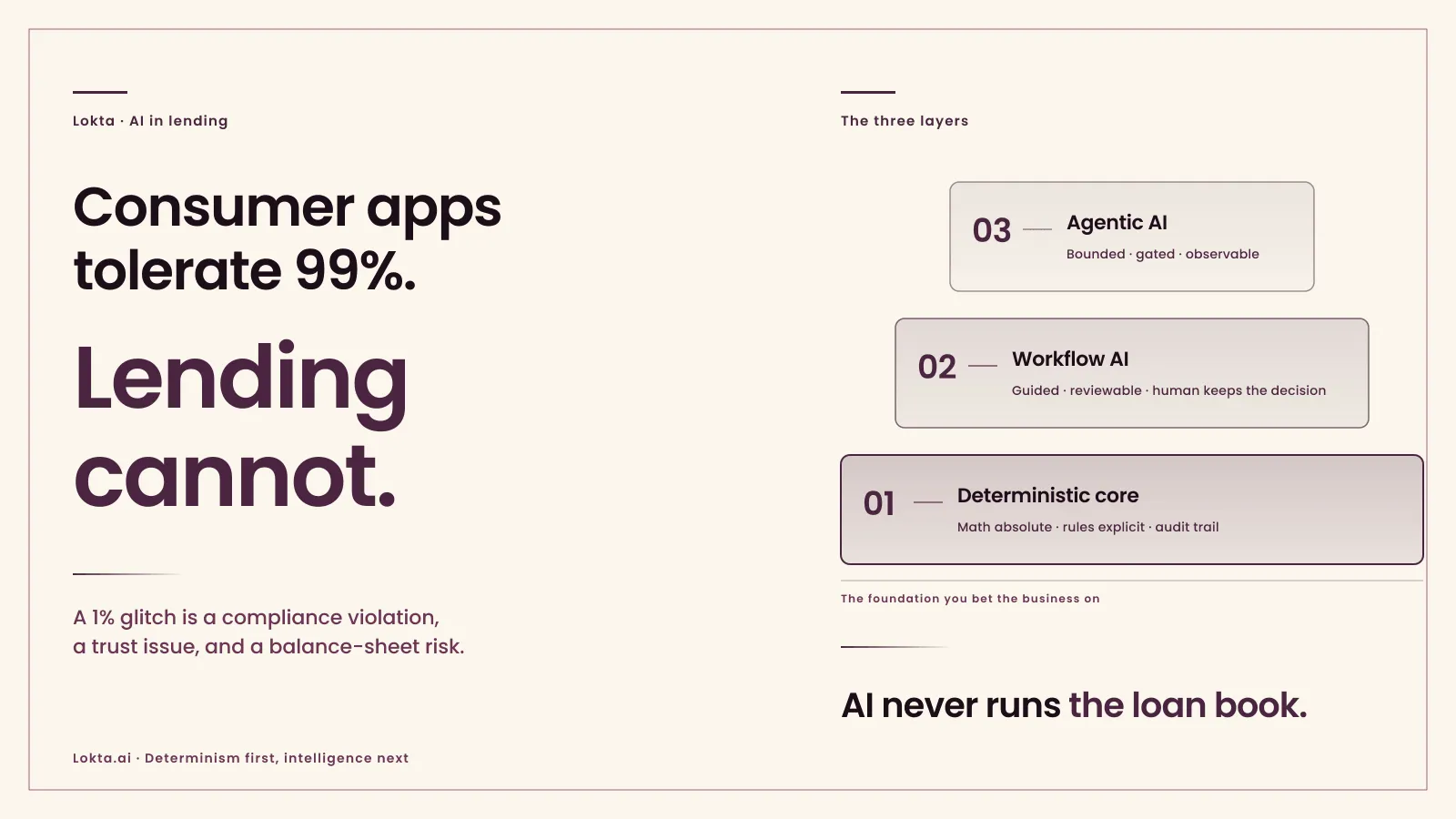
Consumer apps can tolerate a 99% accuracy rate. Lending platforms cannot. In lending, a minor glitch is not a bug: it is a compliance violation, a customer trust issue, and a balance-sheet risk. Misallocate a repayment, miscalculate interest, or lose an audit trail, and the consequences land somewhere expensive.
That is why at Lokta we do not take an “AI-first” approach to core financial operations. We build the platform in three deliberate, risk-aware layers: a deterministic core, workflow AI around it, and agentic AI on top.
Here is how we deploy AI without breaking trust.
Layer 1: The deterministic core (the source of truth)
Pure AI is probabilistic: it does not guarantee the same output every time. In a lending ledger, probabilistic data is a hidden time-bomb.
The heart of the Lokta platform is 100% deterministic. It functions like a reliable engine where:
- Math is absolute. Balances, interest, and fee allocations are precise and reproducible.
- Rules are explicit. State transitions (disbursed, delinquent, closed) are strictly controlled.
- Everything is auditable. Every action is logged with a what, when, and why.
AI is brilliant at language and classification. It cannot be your ledger. The core is the foundation you bet the business on.
Layer 2: Workflow AI (intelligence inside guardrails)
Once the core is locked down, intelligence goes around it. We do not ask AI to be the system. We ask it to assist the system.
Workflow AI at Lokta is guided, bounded, and reviewable. It accelerates operations without compromising correctness:
- Smart document intake. AI extracts KYC, income, and bank data, flagging inconsistencies. It does not become “truth” until validated by deterministic rules.
- Policy-guided credit memos. AI drafts risk summaries and highlights policy checks, leaving the final, rules-based decision to the underwriter.
- Collections guidance. AI suggests the next-best action and drafts borrower communications, while actual rescheduling stays gated by workflow approvals.
- Audit console. AI surfaces compliance trails and flags missing evidence, saving teams hours of manual digging.
Layer 3: Agentic AI (end-to-end agents, safely boxed in)
The third layer scales productivity through agentic AI: autonomous agents that execute multi-step outcomes, such as moving an application to “decision-ready” or resolving a reconciliation mismatch.
In lending, agents do not get to run wild. Lokta’s agents are strictly:
- Action-bounded. They can only pull specific, approved levers.
- Workflow-gated. Critical actions require human-in-the-loop approval.
- Fully observable. Every attempt, action, and rollback is logged.
Agents operate on top of the core, using deterministic workflows as their guardrails.
The Lokta principle: determinism first, intelligence next
The winners in the next era of lending will not be the ones who slap AI onto every feature. They will be the ones who keep the core bulletproof, use AI to remove human bottlenecks, and scale agents with built-in governance.
That is how Lokta lowers operational cost without giving up compliance posture or customer trust. Correct every single time, moving faster than ever.
Frequently asked questions
Why does Lokta build on a deterministic core for AI in lending?
Consumer apps can tolerate 99% accuracy. Lending platforms cannot: a minor glitch is a compliance violation, a customer trust issue, and a balance-sheet risk. Lokta deploys AI in three layers above a deterministic core: workflow AI (assistive, bounded, reviewable) and agentic AI (action-bounded, workflow-gated, fully observable). The core itself (money movement, schedules, regulatory records, state transitions) stays 100% deterministic and replayable. AI never runs the loan book.
What is the difference between workflow AI and agentic AI?
Workflow AI is guided, bounded intelligence that accelerates specific tasks (smart document intake, policy-guided credit memos, collections guidance, audit-console flagging) while keeping the final, rules-based decision with a human. Agentic AI is autonomous: multi-step agents that execute end-to-end outcomes like moving an application to 'decision-ready' or resolving a reconciliation mismatch. Both operate above the deterministic core; the difference is the scope of the action and whether a human is in the immediate decision loop.
Can AI run the loan ledger at Lokta?
No. The Lokta core is 100% deterministic: math is absolute, rules are explicit, every state transition is auditable. Pure AI is probabilistic; it does not guarantee the same output every time, which in a lending ledger is a hidden time-bomb. AI is brilliant at language and classification, and at Lokta it acts as an intelligence layer above the ledger, never as the ledger itself.
What constraints do Lokta's agents operate under?
Three explicit constraints. Action-bounded: agents can only pull specific, approved levers. Workflow-gated: critical actions require human-in-the-loop approval, with maker-checker on any policy-crossing action. Fully observable: every attempt, action, and rollback is logged. Agents operate on top of the deterministic core, using deterministic workflows as their guardrails, not as autonomous principals with general authority over the loan book.
Read next:
- Agentic AI is the next operating system for lending: why the next productivity unlock in credit is a workforce of agents rather than a better model.
- Where AI value lands in lending over the next 3-5 years: a practitioner’s read on underwriting, operations and collections, and where the industry is over-investing.