Connected Lending: Fixing Loan Lifecycle Chaos
Why fragmented lending stacks compound costs, NPAs, and compliance risk, and what a truly connected, single-source-of-truth lending platform looks like.
Imagine a concert where the drummer, the guitarist, and the singer are each playing a different song. Chaotic, fragmented, unbearable for the audience.
This is exactly how most lending teams operate.
Sales (DSAs), underwriters, operations, servicing, and collections sit in silos. They work off different systems, look at different data, and only catch up with each other through emails, spreadsheets, and meetings. The result is a disjointed loan lifecycle: costly to run, frustrating to borrow from, hard to audit.
At Lokta, we are building a different model. We call it Connected Lending.
The hidden cost of disconnected lending
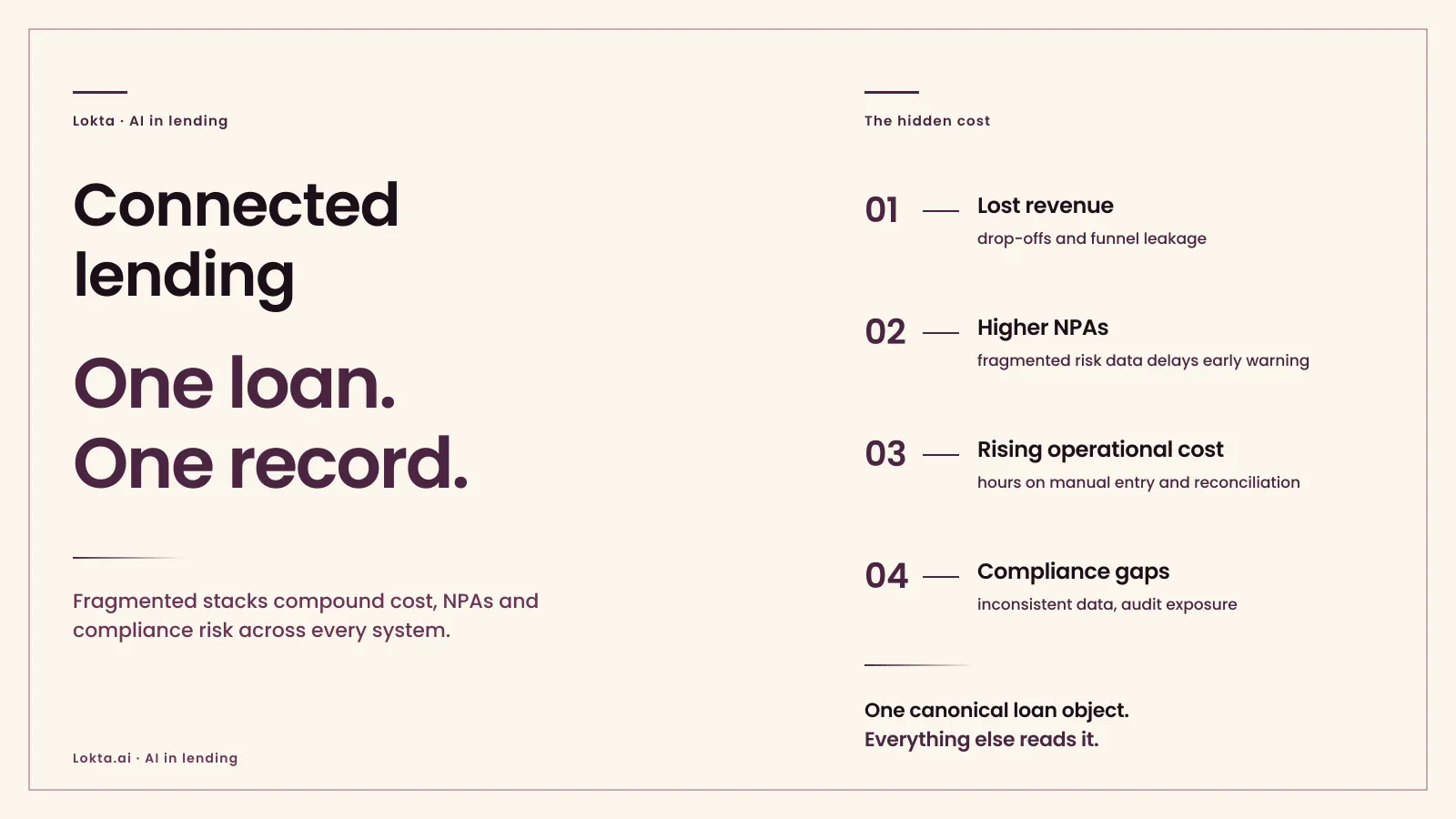
When the systems don’t talk to each other, the costs compound at every stage of the funnel. A fragmented stack creates five recurring risks:
- Lost revenue. Slow onboarding, application drop-offs, leakage in the origination funnel.
- Higher NPAs. Fragmented risk data delays the early warning signals. By the time the risk is visible, it’s often too late.
- Rising operational cost. Teams burn thousands of hours on manual entry, reconciliation, and rework between disparate systems.
- Compliance gaps. Inconsistent customer data across platforms creates audit gaps and regulatory exposure.
- Borrower experience. Customers get conflicting updates and fall through the cracks between teams.
Connected Lending: one flow, one rhythm
Connected Lending is a unified operating model where every stakeholder in the loan lifecycle works off the same sheet of music.
From the first inquiry and underwriting through disbursement, servicing, collections, and recovery, every team operates from the same context. Whether a borrower is talking to a loan agent or receiving a collections reminder, the picture they get is consistent across the platform.
Same data. Same insights. Same context. Same truth.
What makes a platform truly “connected”?
A connected lending stack is not the sum of its API integrations. It is a different architectural commitment.
- Shared data ontology. Customer, loan, risk, and collections data are modelled once and used everywhere, not re-modelled per system and reconciled later.
- Real-time synchronization. Data flows between Loan Origination System (LOS), Loan Management System (LMS), and Collections modules without batch lag.
- AI grounded in the same state. Workflow AI and agents read from canonical state and write back through governed APIs: same source of truth, same audit trail.
- End-to-end visibility. Every team has 360-degree visibility into the customer and the loan, in real time.
- No more patchwork. Manual workarounds and spreadsheet reconciliations are designed out of the operating model, not papered over with another tool.
What this delivers
When the systems stop fighting each other, the operating outcomes follow. A connected operating model is engineered to deliver:
- Faster, more accurate credit decisions, because the underwriter, the policy engine, and the agent are reading the same applicant 360.
- Lower cost-to-serve, because repetitive lookups and reconciliations stop showing up in the OPEX line.
- Earlier, more empathetic collections, because risk signals surface days earlier and the collections team sees the same context the borrower has.
- Audit readiness, by default. Every state transition is captured with actor, evidence, and rationale. No assembly required.
Lending should not be a fragmented mess of disparate software. The teams running the loan book deserve the same picture.
Lokta is building the connected lending stack. Read the rest of the dossier to see how the rails are coming together.
Frequently asked questions
What is connected lending?
Connected lending is a unified operating model where every stakeholder in the loan lifecycle (sales, underwriting, operations, servicing, collections, recovery) works off the same data, the same insights, the same context, and the same truth. From the first inquiry through disbursement, servicing, collections, and recovery, every team operates from a shared canonical state, not from per-team copies stitched together by emails and spreadsheets.
How is connected lending different from API-integrated lending systems?
A connected lending stack is not the sum of its API integrations. It is a different architectural commitment: customer, loan, risk, and collections data are modelled once and used everywhere, not re-modelled per system and reconciled later. Workflow AI and agents read from canonical state and write back through governed APIs, against the same audit trail. Manual workarounds and spreadsheet reconciliations are designed out of the operating model, not papered over with another integration.
What are the hidden costs of a fragmented lending stack?
Five recurring risks. Lost revenue from slow onboarding, drop-offs, and origination-funnel leakage. Higher NPAs because fragmented risk data delays early warning signals. Rising operational cost as teams burn thousands of hours on manual entry, reconciliation, and rework. Compliance gaps from inconsistent customer data across platforms. Broken borrower experience as customers receive conflicting updates and fall through the cracks between teams.
What architectural properties make a lending platform 'connected'?
Five properties. (1) A shared data ontology: customer, loan, risk, and collections data modelled once, used everywhere. (2) Real-time synchronization between LOS, LMS, and Collections, with no batch lag. (3) AI grounded in the same canonical state via governed APIs. (4) End-to-end 360-degree visibility into the customer and the loan for every team, in real time. (5) Manual workarounds designed out, with no patchwork spreadsheets papering over data gaps.