Build, buy, or compose: the credit-decisioning call a lender gets one shot at
Custom credit-decisioning builds fail in three predictable ways. For fast-growing lenders in India, APAC, MEA and Africa, this is how to fund one that lasts.
Across India, APAC, the Middle East, and Africa, lenders are standing up new credit-decisioning platforms faster than almost anyone else in the world. Books are doubling, new segments open every quarter, regulators are tightening disclosure, and margins are thin enough that the cost of the platform itself matters. The decision to build, buy, or compose that platform is one a lender effectively gets one shot at — and custom builds fail in ways predictable enough to name in advance.
This piece is about the failure modes, not any one company. They are the same whether the lender is an NBFC in Mumbai, a digital bank in Jakarta, a microfinance institution in Nairobi, or a bank in Riyadh — and they are testable before a rupee, rupiah, shilling, or riyal is committed.
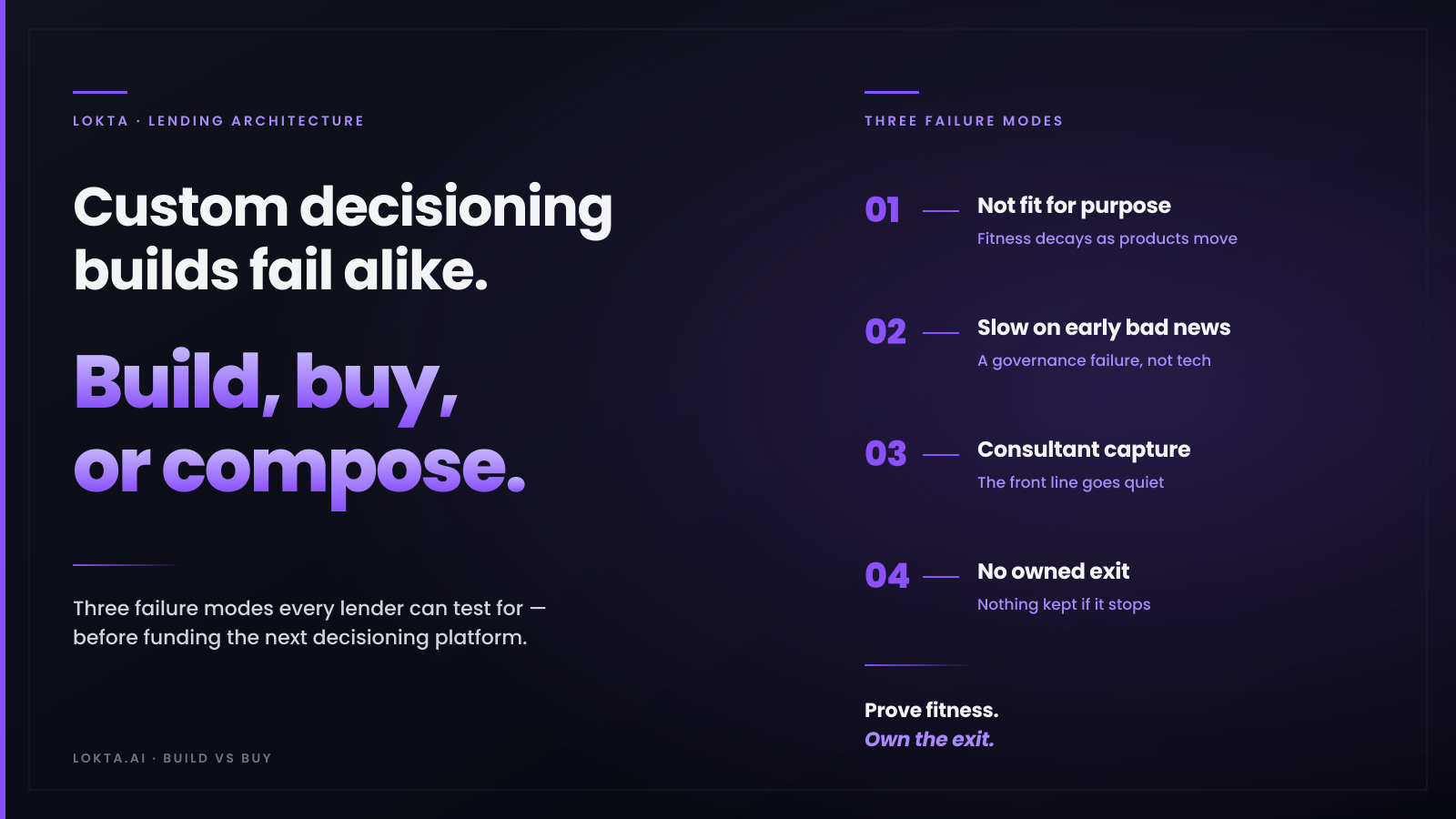
- A custom decisioning build is scoped against today’s products and policies. In fast-growing markets lending changes faster, not slower — “fit for purpose” is earned every quarter, not certified once.
- The most valuable signal in a build is early bad news. Programs fail in slow motion when the governance layer treats it as something to manage rather than act on.
- Consultant capture is the quiet killer. When staff perceive the sponsor and the advisor are aligned, the organisation loses its earliest and cheapest line of defence.
- The modern choice is not build versus buy — it is compose. A configurable platform the lender controls keeps earning fitness without re-opening a multi-year build.
- Five questions expose all three failure modes before any money is committed. Demonstrated fitness, rule ownership, independent evaluation, an owned audit trail, and exit rights.
What is a real-time credit-decisioning platform?
A credit-decisioning platform is the lending system that decides whether to lend, how much, and on what terms — ideally in seconds, at the point of need. It sits downstream of origination intake and upstream of disbursement and servicing. It ingests application data, bureau and alternative data, and policy rules; it runs the business rules engine and scorecards; and it returns an approve, decline, or refer decision with the reasoning attached. When a borrower applies for a card, a personal loan, or a point-of-sale instalment and gets an answer before they finish their coffee, a decisioning platform produced that answer.
This is not back-office plumbing. It is the part of the lending stack most directly tied to conversion, pull-through, risk-adjusted yield, and regulatory defensibility. A decisioning engine that is wrong is expensive; one that cannot explain itself is a fair-lending finding waiting to happen. That is why a failed decisioning build is more instructive than a failed ledger migration: the stakes sit in the one system where lending economics and compliance meet.
The three failure modes — and one example that shows all of them
The failure modes are easiest to see together. One widely-reported case makes the point: Westpac wrote off more than US$70 million on a custom real-time decisioning platform, and its own internal review — as reported by Mi3 — attributed the collapse to three causes at once: a platform that was not fit for purpose, senior executives slow to act on early internal criticism, and project staff who did not feel able to challenge the program. Westpac sits in a developed market; the failure modes are not bounded by geography. The three below are what a lender anywhere should test for.
| Failure mode | What it really is | What a lender should demand |
|---|---|---|
| Not fit for purpose | Fitness has a short shelf life; a bespoke build decays as products and policy move. | A complete decision on real data, under peak concurrency, with measured latency. |
| Slow to act on early criticism | A governance failure — early bad news treated as something to manage, not act on. | Objective gates a steering-committee vote cannot pass. |
| Staff unwilling to challenge | Consultant capture — perceived sponsor/advisor alignment silences the front line. | Independent evaluation, separated from delivery and vendor ties. |
Mode one: a platform that is not fit for purpose
The first mode is the easiest to under-weight because it is discoverable late. Custom decisioning platforms are commissioned against a snapshot of today’s products and today’s policies. Lending does not hold still — and in high-growth markets it moves faster. New products, new segments, new regulatory disclosure requirements, and new data sources arrive on a cadence that a bespoke build, scoped at kickoff, struggles to absorb. “Fit for purpose” is not a property you certify once; it is a property the platform either keeps earning every quarter or quietly loses.
The build-versus-buy economics make this worse, not better. One widely-cited industry analysis of loan-origination and decisioning software puts the three-year cost of a custom build at three to five times that of a configured platform, before the compliance treadmill is priced in.
“Over a 3-year period, custom LOS can cost 3–5x a SaaS platform.” — LendFoundry (https://lendfoundry.com/blog/loan-origination-software-build-vs-buy-cost-analysis-2026/)
A platform that is not fit for purpose at month thirty-six has consumed three-to-five-times spend and produced an asset the lender then has to impair. The lesson is not “never build.” It is that the burden of proof for fitness sits on the build, and that proof has a short shelf life.
Mode two: a governance layer slow to act on early criticism
The second mode names a governance failure, not a technology failure. The most valuable information in any lending-platform program is the early bad news — the integration that does not behave, the latency that will not come down, the rule that cannot be expressed. Programs fail in slow motion when the governance layer treats that signal as something to manage rather than something to act on.
This is why mature lenders separate the program’s reporting line from the program’s sponsor, and why they instrument decisioning builds with objective gates: a working decision returned end-to-end on real data, an auditable reason code on every decision, a measured latency under peak concurrency. Gates that can be passed by a steering-committee vote rather than a demonstration are not gates.
Mode three: a front line that will not challenge — consultant capture
The third mode is the one with a name worth keeping: consultant capture. The people closest to the work stop challenging the program because they perceive that the project’s sponsor and its external advisor are aligned. When raising a problem reads as a career risk, the organisation has lost its cheapest and earliest line of defence.
Consultant capture is structurally more dangerous in decisioning builds than almost anywhere else, because the integrator’s incentives frequently run with the platform’s. A systems integrator that is paid to implement, and that also carries a relationship with the underlying platform vendor, has limited incentive to declare that the platform is not fit for purpose. The remedy is not distrust of advisors; it is independence of evaluation. The party that assesses whether the platform works should not be the party paid to make it work, and should not be commercially aligned with the platform being assessed.
Build, buy, or compose?
The decision is read most often as build versus buy. CIOs running large lending-platform programs are routinely reminded that they get limited room for error.
“Core banking system modernization is accelerating, but bank CIOs typically only get one shot to get it right.” — Don Free, Gartner, cited in IBM Institute for Business Value research (https://www.ibm.com/thought-leadership/institute-business-value/en-us/report/core-banking-modernization)
But the modern decision is not binary. The third option is to compose: assemble decisioning on a configurable platform the lender controls, where an in-house credit team can change rules and scorecards, integrations are documented rather than bespoke, and the lender owns its decision logs outright — rather than commissioning a monolith or accepting a black box. The composable path is what lets a lender keep earning “fit for purpose” without re-opening a multi-year build every time policy or product moves, and it changes the consultant-capture calculus: a lending team that can change a rule itself is no longer dependent on a party whose incentives it cannot fully see.
What should a lender ask before funding a decisioning build?
An RFP or internal business case for a credit-decisioning platform should force the three failure modes into the open before any money is committed. (The Lokta LMS/LOS RFP toolkit turns these into ready-to-use vendor questions.) A procurement team can ask vendors and internal sponsors to demonstrate, not assert:
- Show a complete decision — application in, approve/decline/refer out, with reason codes — on representative data, under peak concurrency, with measured latency. Fitness is demonstrated, not certified on a slide.
- Show who can change a credit rule or scorecard, and how long it takes. If the answer is “a vendor or integrator change request,” price that as a recurring cost and a roadmap dependency.
- Show the independence of the evaluation. Identify who assesses whether the platform is fit for purpose, and confirm that party is not paid to deliver it and is not commercially aligned with the platform vendor.
- Show the audit trail. Every decision should carry its inputs, the policy version applied, and its reasoning, exportable to a store the lender owns — for fair-lending defence, regulator review, and model governance.
- Show the exit. Identify what the lender keeps if the program is stopped at month eighteen: the rules, the data, the decision history, or nothing.
A program that cannot answer the last question is the one most likely to be written off.
The takeaway
A failed decisioning build is rarely caused by ambition. It is caused by a build whose fitness no one could prove, a governance layer slow to act on its own experts, and a team that did not feel safe saying the platform did not work. Those three modes do not respect borders — but they are testable before signing. For a lender in a fast-growing market, where the book this platform decides will be many times larger in a few years than it is today, the discipline that prevents the write-off — demonstrated fitness, independent evaluation, owned exit rights — is the cheapest insurance available. A platform the lending team can change, evaluate independently, and exit cleanly is the one that keeps earning its fitness.
Why do custom credit-decisioning builds fail?
Custom decisioning builds tend to fail in three predictable ways: the platform is not fit for purpose because it was scoped against today’s products and policies and lending does not hold still; the governance layer is slow to act on early bad news; and consultant capture sets in, where staff stop raising problems because they perceive the sponsor and the advisor are aligned. One widely-reported example — Westpac’s roughly US$70 million write-off of a custom real-time decisioning platform — showed all three at once. The geography is incidental; the failure modes are universal.
Should a lender build or buy a credit-decisioning platform?
The modern decision is not binary. The third option is to compose: assemble decisioning on a configurable platform the lender controls, where an in-house credit team can change rules and scorecards, integrations are documented, and the lender owns its decision logs. One widely-cited industry analysis puts the three-year cost of a custom build at three to five times that of a configured platform. A bespoke build is scoped against today’s products and policies, and “fit for purpose” is a property a platform either keeps earning every quarter or quietly loses.
What is consultant capture in a lending-platform build?
Consultant capture is when the people closest to the work stop raising problems because they perceive that the project’s sponsor and its external advisor or integrator are aligned. It is structurally dangerous in decisioning builds because an integrator paid to implement, and tied to the underlying platform vendor, has limited incentive to declare the platform unfit. The remedy is not distrust of advisors; it is independence of evaluation — the party that assesses whether the platform works should not be the party paid to make it work.
What should a lender ask before funding a custom decisioning build?
Force the three failure modes into the open before committing money. Ask the team to demonstrate, not assert: a complete decision — application in, approve/decline/refer out with reason codes — on real data under peak concurrency; who can change a credit rule and how long it takes; an independent evaluation not paid to deliver the platform; an audit trail of inputs, policy version, and reasoning the lender owns; and what the lender keeps if the program is stopped at month eighteen. A program that cannot answer the last question is the one most likely to be written off.
Read next
- LOS API rate limits and lending velocity — how a vendor’s published ceilings quietly rule out the architectures a lender can ship.
- Why we built Lokta polylithic — the case for a composable lending stack a lender controls, rather than a monolith or a black box.
- The LMS customization trap — why bespoke configuration becomes the dependency you cannot change or exit.
Sources
- https://www.mi-3.com.au/15-03-2024/westpacs-moment-was-70m-decisioning-flop-has-left-it-years-behind-its
- https://lendfoundry.com/blog/loan-origination-software-build-vs-buy-cost-analysis-2026/
- https://www.ibm.com/thought-leadership/institute-business-value/en-us/report/core-banking-modernization
Ashok Auty is the co-founder of Lokta and co-creator of Apache Fineract. Lokta builds an AI-native, connected lending platform on a deterministic core — origination, loan management, and servicing on one governed, audit-ready stack.