The 30-Call Limit: Why Your LOS API Quietly Caps Your Lending Velocity
LOS and LMS rate limits aren't infrastructure constraints. They are commercial controls, and the 30-call ceiling shapes what a lender's roadmap can ship.
Contents 8 sections
“The default limit of 30 concurrent API calls is set for each lender environment… When the lender’s hard stop limit is utilized, a 429 - Too Many Requests status code is returned, and all processes cease to execute until the concurrency remaining rate exceeds 0.”
Source: developer documentation, the dominant US mortgage Loan Origination System
Thirty concurrent calls. Hard stop at 429. Published, enforced, and, for most lenders running on top of the largest US mortgage Loan Origination System, the single most important number governing how fast their lending operation ships.
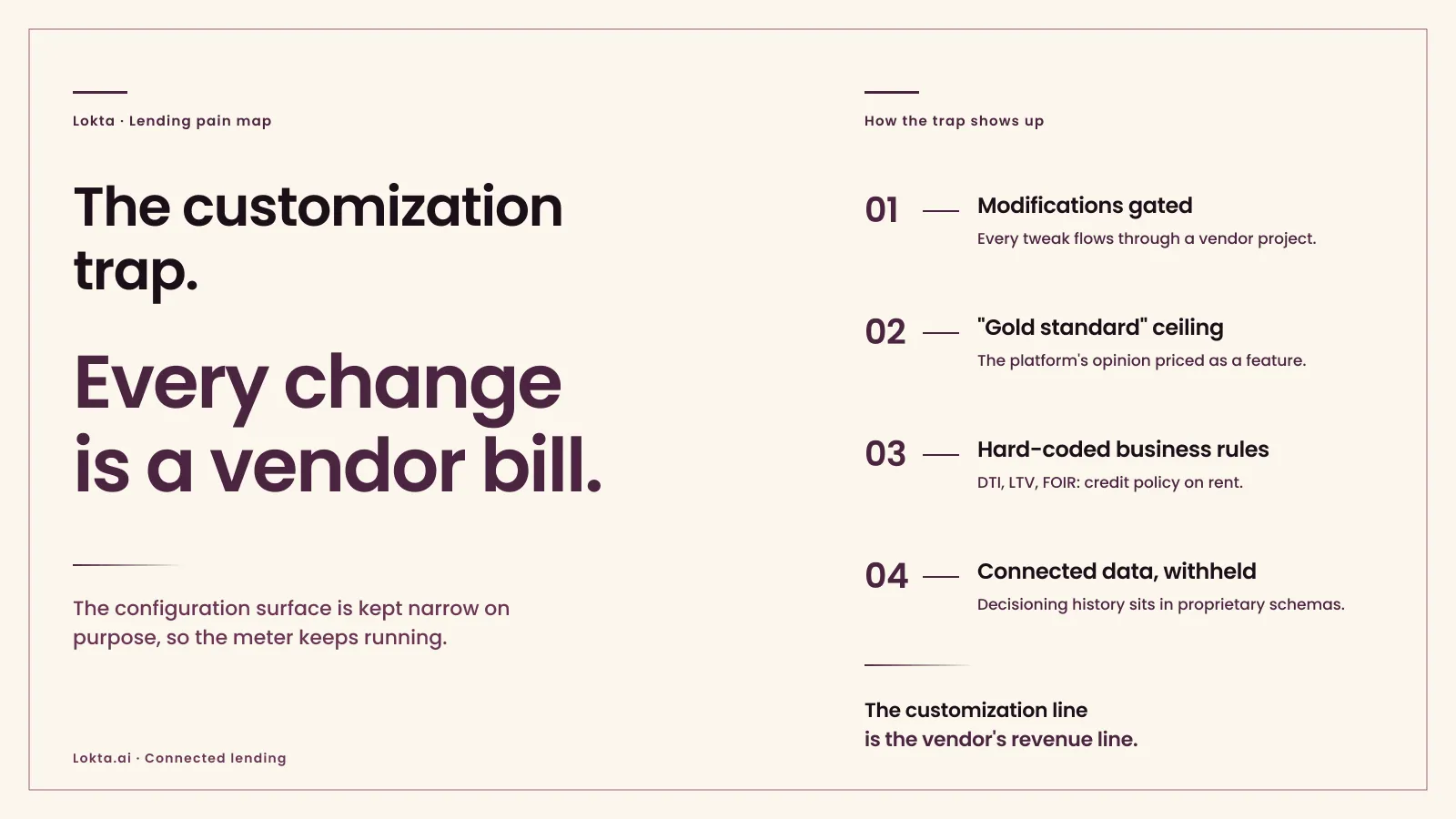
The number is not the story. The story is that LOS rate limits, across every major vendor, are not infrastructure constraints. They are commercial controls. They shape what a lender can automate, how quickly a lender can scale, and which roadmap items a lender can fund without a vendor conversation. The API ceiling is a board-level dependency.
- The published ceiling is the floor, not the cap. The full set of per-tier limits is a support ticket away.
- Rate limits are commercial controls dressed as infrastructure. The 429 falls out of the contract, not the platform’s capacity.
- Roadmap features the vendor hasn’t priced for trigger a tier conversation, not a technical one.
- The lender owns the queueing, the dead-letter handling, and the borrower-facing degradation, not the vendor.
- Migration is the worst case. Bulk reads are exactly the pattern fair-use policies throttle first.
What does the documented 30-call ceiling actually mean in production?
There is no graceful degradation. There is no per-priority queue. Origination, borrower-status webhooks, and decisioning calls all share the same envelope. When the 429 lands mid-loan-creation, the recovery path is undefined, for the lender to design and own.
Worse: the published floor is not the full picture. From an integration analysis on Mortgage Workspace:
“Rate limits are enforced but not publicly documented; developers must contact [the vendor’s] support for the limits applicable to their subscription tier before designing retry logic.”
A retry strategy you cannot write down is not a retry strategy. It is a relationship dependency.
Is this a mortgage-LOS problem, or an LOS/LMS problem?
The pattern is consistent across mortgage LOS, cloud LMS, and credit-union core. The vendor names change. The ceiling does not.
Per-environment ceiling published in developer docs. All processes cease to execute on breach. Per-tier limits beyond the published floor sit behind a support ticket.
Throttling reserved as a remedy when “specific API limits have not yet been defined.” Pagination capped at 1,000 per list call with 100-record batches recommended, which is 2,000 round trips for a portfolio-wide reconciliation across 200K loans.
Platform-wide session-token ceiling. At the limit, new logons are refused and the integration’s logon service returns an error. No queue, no warning: the pressure-release valve belongs to the integration partner.
What does this actually cost the lending business?
The 429 doesn’t show up on the LOS contract line. It shows up everywhere else.
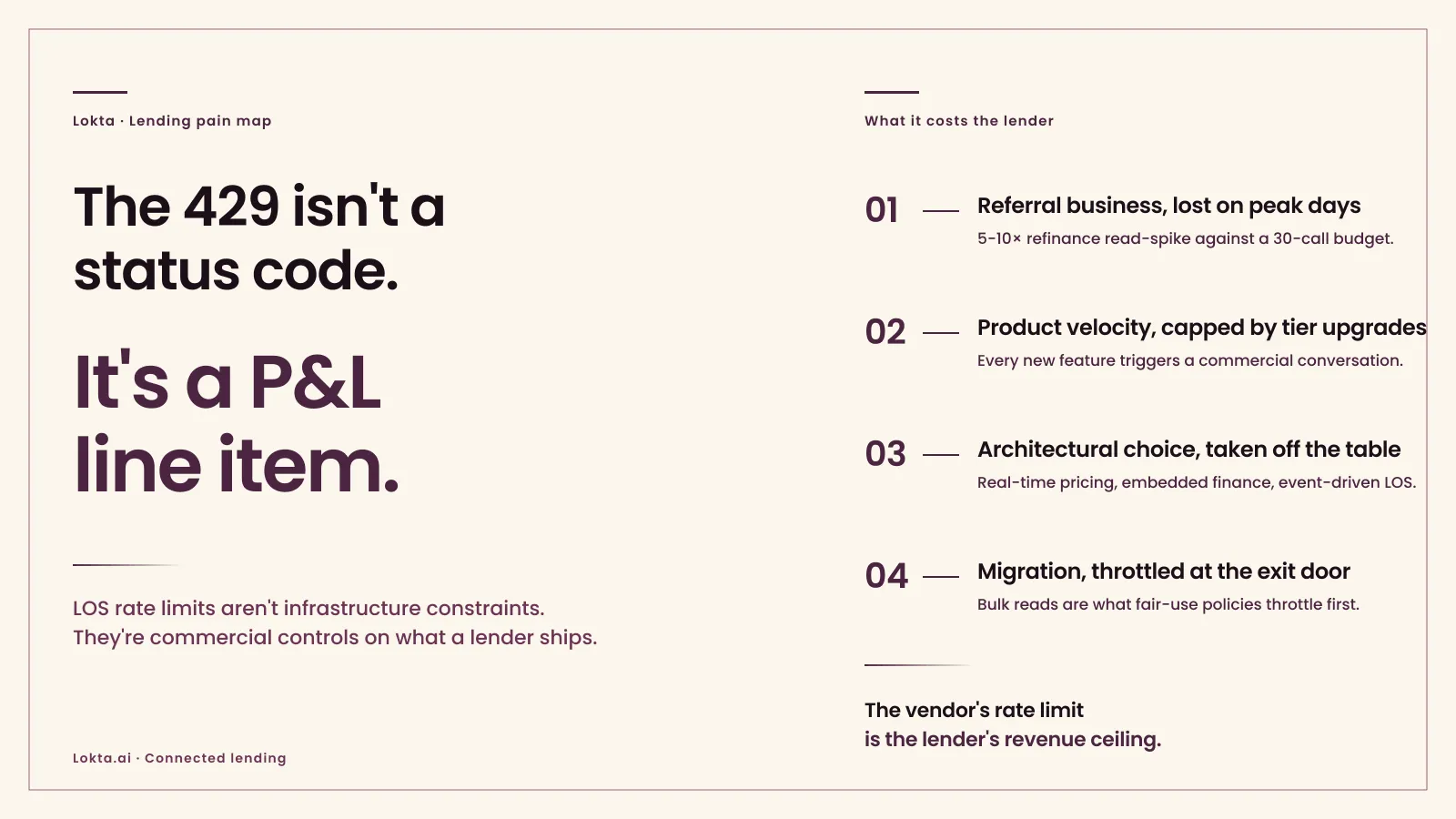
- Lost referral business when peak-day spikes stall pipeline status checks borrowers and brokers are watching.
- Capped product velocity as every new feature triggers a subscription-tier conversation instead of a sprint.
- Foreclosed architectures. Real-time pricing, embedded-finance APIs and event-driven origination, silently ruled out by a 30-call budget.
- Migration friction at the worst possible moment, when the lender’s leverage is supposed to be highest.
| Lending workflow | What trips the ceiling | What it costs the business |
|---|---|---|
| Peak refinance window | 5-10× spike in loan-status reads as servicing, borrowers, and brokers check pipeline state at once. | Lost referral business, delayed lock confirmations, processor capacity halved on the day it matters most. |
| Co-lending bulk reconciliation | Loan-level state sync across thousands of loans hits pagination caps and the fair-use envelope. | Stop-start batches, manual escalation, partner-SLA breaches, eroded trust on the co-lending arrangement. |
| Borrower-facing real-time quote | Synchronous reads across 3-4 LOS endpoints per quote × concurrent users blow the budget. | Forced aggressive caching → stale quotes → conversion drop and competitive losses to faster lenders. |
| Embedded-finance / partner API | Higher per-loan call volume than the original contract was priced for. | Roadmap deferred to the next renewal; partner deals stalled; revenue left on the table. |
| Migration off legacy LOS | Bulk reads of historical loan data, exactly what fair-use policies are written to throttle. | Migration timelines extended by months; vendor leverage maximized at the exit door. |
The licence fee is not the cost. The cost is the loans that did not fund on a peak day, the product that took a quarter longer than the competitor’s, and the migration that ran twice as long as the project plan.
Why is this roadmap control, not infrastructure?
A rate limit looks like a technical constraint. It functions like a commercial one.
Real-time pricing, borrower self-service, embedded-finance APIs: every one generates traffic the vendor has not priced for. A rate-limit conversation becomes a tier conversation.
Event-driven origination, real-time decisioning, and continuous portfolio analytics need denser traffic than a 30-call ceiling allows. An entire class of designs is foreclosed without the vendor ever saying no.
”All processes cease to execute” is a posture, not a recovery plan. The lender’s engineering team owns the queueing, the dead-letter handling, and the borrower-facing degradation.
What should buyers ask vendors before signing?
A Loan Origination System or Loan Management System RFP that does not probe API limits is leaving the most important operational lever undefined. Buyers should require vendors to demonstrate, in writing, in the contract:
The published concurrency limit per environment, with the exact HTTP response and recovery semantics on breach. “All processes cease to execute” is a posture, not a recovery plan. Make the vendor name the recovery plan.
The full set of rate limits applicable to the subscription tier, not “contact support.” A retry strategy you cannot write down is a relationship dependency, not a strategy.
The pagination limits and recommended batch sizes for every list endpoint, with the implication for portfolio-wide operations spelled out. A 100-record batch against a 200,000-loan portfolio is 2,000 round trips.
A change-control commitment that throttling and pagination limits cannot be tightened without a defined notice period. Otherwise the envelope is a fair-use clause the vendor can reshape unilaterally.
The vendor’s published behavior on bulk export of the lender’s own data, for migration scenarios. The exit clause is the rate limit’s evil twin: bulk reads are the first thing a fair-use policy throttles when a lender leaves.
A full peak-day simulation against a representative loan portfolio, with the 429 envelope and recovery path observable in the audit trail. If the answer is “we will tune your tier” rather than a contractual commitment, the lender has its answer about who controls the roadmap.
What does “connected lending” actually require?
The architectural takeaway is not that rate limits are wrong. Every platform needs back-pressure. The takeaway is that the lender, not the vendor, should own where the back-pressure lives. A modern connected lending stack, spanning origination, loan management, servicing, collections, co-lending and governance, should expose its limits explicitly, version them with notice, and give the lender first-class visibility into how its workload is consuming the envelope.
Anything short of that means the LOS or Loan Management System is not a platform. It is a metered tap. The lender pays for the tap and the vendor decides the flow.
Takeaway
The next 429 is the moment your lending pipeline stops, and the documentation on what to do next belongs to the vendor.
Frequently asked questions
Why are LOS and LMS API rate limits commercial controls, not infrastructure constraints?
Because the published ceilings (and the larger envelope behind them) determine which architectures a lender is allowed to consider, from event-driven origination and real-time decisioning to continuous portfolio analytics and embedded-finance APIs, and which require a subscription-tier conversation with the vendor. The 429 doesn't fall out of the platform's capacity. It falls out of the contract the vendor priced the lender on. That is a commercial lever wearing infrastructure clothes.
What should a lender ask about API rate limits in an LMS or LOS RFP?
Five contractual asks. (1) The published concurrency limit per environment, with exact HTTP response and recovery semantics on breach. (2) The full set of rate limits applicable to the subscription tier in writing, not "contact support." (3) Pagination limits and recommended batch sizes for every list endpoint, with the implication for portfolio-wide operations spelled out. (4) A change-control commitment that throttling and pagination limits cannot be tightened without a defined notice period. (5) Published behavior on bulk export of the lender's own data, for migration scenarios. The RFP should require a peak-day simulation against a representative portfolio with the 429 envelope and recovery path observable in the audit trail.
Which lending workflows are most exposed to API throttling?
Four. Peak refinance windows that drive 5-10× spikes in loan-status read traffic and share the same concurrency budget as every other integration. Co-lending bulk reconciliation across thousands of loans, where pagination ceilings and undefined throttling envelopes turn a deterministic batch into a stop-start exercise. Borrower-facing real-time pricing or eligibility quotes, where a modest concurrent-user count blows the budget through synchronous reads across three or four LOS endpoints. And migrations off a legacy LOS, where bulk reads of historical loan data are precisely the pattern fair-use policies are designed to throttle.
What does lender-controlled back-pressure actually mean?
A connected lending stack should expose its limits explicitly, version them with notice, give the lender first-class visibility into how its workload is consuming the envelope, and let the lender decide where back-pressure lives: at the workload level, at the borrower-facing surface, or at the batch boundary. The vendor still needs back-pressure; every platform does. The question is whether the lender or the vendor owns the queueing, the dead-letter handling, the partial-state cleanup, and the degradation policy when the envelope tightens.
Read next:
- The Lending Technology Pain Map: 3 Audiences: how loan officers, in-house tech teams, and executives describe the same platform in three different vocabularies.
- Every Lender Replaces Their LMS Eventually: five symptoms tell you whether you replace your LMS on your terms or the board’s.
- What is Connected Lending?: the architectural alternative when the LOS stops being a platform and starts being a metered tap.
- Why lender portfolio analytics lives in Excel: what the API ceiling costs when the analytical layer migrates out of the platform entirely.
Sources:
- Developer documentation, the dominant US mortgage LOS (concurrency limits)
- Mortgage Workspace: API integration analysis
- Cloud-native LMS: Fair Use Policy
- Cloud-native LMS: API response and error codes
- Major US credit-union core: integration-layer documentation
Ashok Auty is the co-founder and Chief Customer Officer of Lokta and co-creator of Apache Fineract. He has spent two decades building lending infrastructure, and reads every vendor’s published rate-limit page, because the number on the page tells you who controls the lender’s roadmap.