The Customization Trap: When LMS Vendors Bill Every Change
Why every 'small change' in an LMS or LOS funnels through a billable vendor project, and the RFP questions that surface the trap before you ever sign.
Contents 9 sections
“We have gone from implementation where nothing worked to 4 years of tweaks and a full time staff that try to make it work but it does not. It doesn’t work properly. It constantly has issues that will not let you create a loan.” Source: verified four-year customer, public review of the dominant US commercial banking LOS (TrustRadius)
The reviewer is a four-year customer of one of the most widely deployed commercial Loan Management Systems in the United States. Four years live, a full presidential term, and the lender still runs a permanent internal staff trying to keep the platform working, and still cannot reliably create a loan.
That review is not an outlier. It is the most-quoted line in the customer-facing review corpus for large-vendor commercial LMS and Loan Origination System (LOS) deployments. And it is the description of a business model, not the description of a software defect.
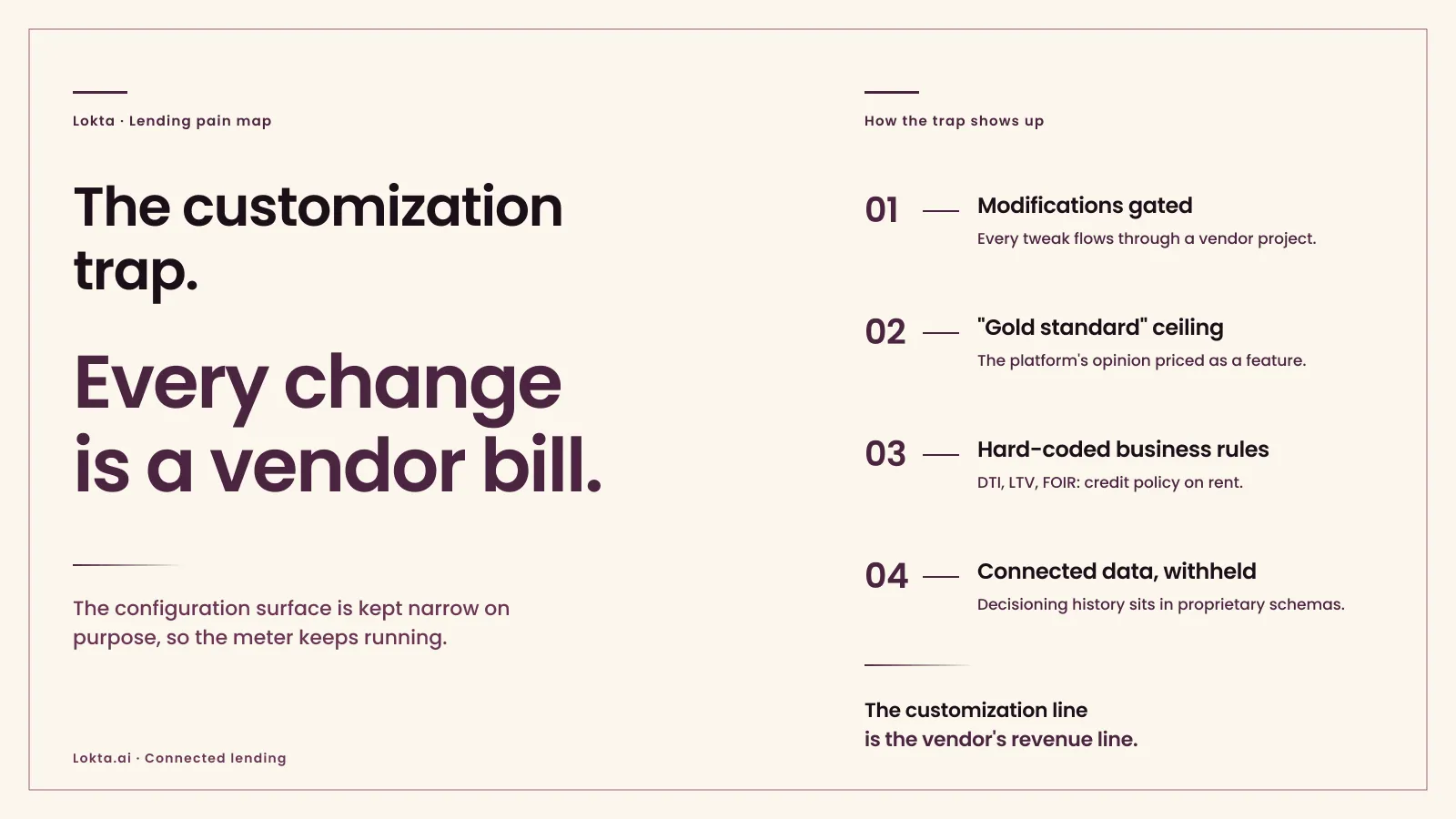
- Customization is the vendor’s revenue line. The configuration surface is kept narrow on purpose, so every product change becomes a billable engagement.
- The trap is structural, not accidental. The vendor owns the configuration model, the scripting language, the certification path, and the meter.
- ”Gold standard” is the vendor’s product opinion priced as a feature. Where the platform and the lender’s credit policy disagree, the lender is expected to change first.
- Hard-coded ratios are externalised credit policy. A platform that won’t let admins change a DTI cap has moved credit policy from the credit committee to the vendor’s release schedule.
- The trap is surfaceable in the RFP. A sandbox, a business rules engine demo, an extract test, and a published rate card decide which side of the meter the lender lives on.
How does the LMS customization trap actually work?
For a generation of LMS, LOS, and loan servicing platform vendors, the configuration model has converged on a single pattern. Keep the configuration surface narrow enough that the lender’s own admins cannot self-serve. Then sell the configuration work back to the lender as a series of billable services engagements.
The pattern is structural, not accidental. The platform owns the configuration model, the data model, the scripting language, and the certification path for the consultants who can change any of it. Every change has to clear the platform’s gates. Every gate is a billing opportunity.
The pattern shows up in three places that an evaluator can verify before signing.
A verified reviewer of the dominant US commercial banking LOS reports “modifications requiring extensive project engagement with the vendor even for minor adjustments” (G2). A separate review of the same product adds the structural framing: “customization often requires specialized developers, making changes difficult and expensive” (Software Advice).
A verified reviewer of the same platform describes the result with unusual precision: “the tool is very standardized and broadly forces the bank to adopt the vendor’s gold standard, which some users view as limiting flexibility” (TrustRadius). “Gold standard” is vendor framing for “the way the product wants the lender to operate.”
A reviewer of a major consumer-lending LOS reports “the ratios and underwriting criteria within the platform were not flexible to institutional needs, with the DTI as the vendor coded it having no real wiggle room and not being changeable by customers and administrators” (G2). A reviewer of a credit-union consumer-lending LOS delivers the clincher: “everything has to be done the way the vendor wants it to be done as opposed to creating a custom experience that fits your organization’s needs” (Capterra).
Why are modifications gated behind billable vendor projects?
The trap is not that the platform cannot be changed. The trap is that every change has to flow through a billable engagement, and the billing meter is set by the vendor. The lender does not get to define which changes are configuration (zero cost, admin-driven) and which are customization (developer-led, vendor-billed). The vendor draws that line, and the line moves with the contract.
A reviewer of the dominant US Home Loan LOS captures the equilibrium state: “In order to take full advantage of the platform, you almost always need a dedicated administrator and a developer, and recent and upcoming changes in their coding model mean that your administrator will need to be able to code more than VB script” (TrustRadius).
The lender, in effect, ends up running a small in-house vendor-services team just to keep the vendor’s product fit for the lender’s own workflows. The platform is sold as a product. The bill arrives as a service.
What does it mean when a platform calls its way of working the “gold standard”?
The phrase deserves attention. Gold standard in vendor literature reads like neutral best-practice language. From the lender’s side, it means: where the vendor’s product opinion and the lender’s underwriting policy disagree, the lender is expected to change first.
A platform with a “gold standard” for how a loan should be created is a platform that has an opinion about how the lender’s business should run. That is fine, because every platform has opinions, but the opinion stops being neutral the moment it is bolted to the lender’s credit policy. The lender’s policy team should set policy. The platform should render it.
When the lender is told to align to the gold standard, what they are being told is that the gap between the lender’s policy and the vendor’s opinion is the lender’s problem. The cost of closing it shows up on the next quarterly invoice.
Why are some LMS business rules hard-coded and not configurable at all?
Debt-to-income is the spine of a consumer credit decision. Loan-to-value is the spine of a mortgage. Foreclosure-of-income (FOIR), in regions where it applies, is the spine of unsecured personal lending. A platform that hard-codes any of them to a single shape, and refuses to let the lender’s own credit policy override it, is not configurable software. It is opinionated infrastructure that has externalised the lender’s credit policy to the vendor.
The justification, when pressed, is usually some version of regulatory safety: the platform is “protecting” the lender from a bad rule. That is not how lending regulation works. The regulator holds the lender’s board accountable for the credit policy. The vendor is accountable for the platform. When the platform refuses to let the credit committee change a ratio, the regulator has not been protected. The vendor’s release schedule has.
How does the customization trap transfer margin from the lender to the vendor?
Every “small change” billed as a project is a transfer of margin from the lender’s P&L to the vendor’s services line. The lender pays twice: once for the license, and again for the change the lender’s product team needs to ship a new loan product, run a credit-committee decision, or meet a new disclosure rule. Over a four-to-seven-year contract, the meter compounds.
- Every product launch carries a vendor SOW. A new loan product, a regional variant, a co-lending split: each one a billable engagement before it sees a borrower.
- Every credit-policy change waits for vendor capacity. The risk team ships at the pace of the vendor’s services bench, not at the pace of the credit committee.
- Every disclosure rule becomes a change order. Regulatory cadence accelerates; the platform’s gate widens; the bill grows.
- Every “small” UI label, required field, or stipulation tweak rolls into the same meter. The trap is the cumulative effect, not the unit cost.
What does good lending platform architecture look like?
The alternative is not “no customization.” Lending is heterogeneous by product, by geography, by regulator, and by underwriting policy. A platform that refuses to bend is not a lending platform. The question is whether the bend lives inside the lender’s control or inside the vendor’s invoice.
Three architectural primitives separate the two.
Field labels, required-vs-optional flags, stipulation lists, disbursement templates, document checklists by product type. These are routine product decisions inside any lender. A platform that requires a “specialized developer” to rename a field has misclassified configuration as code.
DTI ceilings, FOIR caps, age cutoffs, LTV bands, regional product variants, co-borrower treatment. These are credit-committee decisions, not vendor-product decisions. The lender’s policy team should author them, version them, and audit them. The vendor’s role is to render the rule, not to write it.
When customisation data, decisioning rationale, and stipulation history live in proprietary schemas, or in archive tables that overwrite history mid-loan, the lender’s analytics team is forced to rebuild the data layer in Excel, and the lender’s AI ambitions never leave the slide deck. Industry analysis on LOS lock-in names it directly: “legacy LOS lock-in often means data is stored in proprietary formats or tightly bound schemas, and access requires custom reports or vendor involvement” (Citeables).
The flip side of letting the lender’s admins self-serve is that every change has to be governed. Maker-checker, version control, effective-date switches, evidence-backed audit. The point is not to slow the lender down. The point is to make sure that when the regulator asks, the lender, not the vendor, can answer.
What should an LMS or LOS RFP require to surface the trap before signing?
A procurement team writing an LMS or LOS RFP can surface the customization trap before signing by requiring specific, demonstrable answers. The vendor can show them in a live environment, or it cannot. The functional requirements template gives those answers a place to land, with a Must, Should or Could priority on every row.
| RFP ask | What the vendor has to demonstrate | What the answer reveals |
|---|---|---|
| Live admin sandbox | An admin changing a field label, a stipulation list, and a product-level required-field rule, with no SOW and no redeploy. | Whether the vendor’s “configuration” is admin-grade or developer-grade. |
| Business Rules Engine demo | The lender’s credit-policy team changes a DTI cap (or LTV, FOIR, age limit) with version control, audit log, and effective-date switch. | Whether credit policy lives in the lender’s governance or in the vendor’s release notes. |
| Connected data extract | End-to-end extract of every field that touched a decision (the rule version that fired, the decision rationale, any overrides) into the lender’s data warehouse. | Whether the lender owns its decisioning history or rents it. |
| Written customization rate card | Hourly rates, expected ticket cadence, escalation path, change-control commitment, in writing, during procurement. | The bill the lender will actually pay over the contract term. |
| Audit-trail walkthrough | The vendor walks through who changed what, when, under whose authority, on a live loan, including overrides and rule-version switches. | Whether the lender can answer a regulator without going through the vendor. |
| Reference customer on customization | Two reference customers willing to talk about the cumulative customization bill over the last twenty-four months. | The compounded version of the customization line, the line the contract does not show. |
The point of the asks is not gotcha. The point is that the answers determine which side of the meter the lender will live on for the next four to seven years. If the vendor will not produce a rate card during procurement, the rate card is the contract.
The takeaway
An LMS whose configuration model funnels every product change through the vendor’s services bench is not a platform. It is an annuity priced to the lender’s growth. The cumulative bill is the platform’s real price, and it is paid in margin the lender thought they were keeping. Putting that bill on one five-year cost sheet beside the licence is how it becomes visible before signature.
Frequently asked questions
What is the LMS customization trap, in plain terms?
The trap is structural, not a defect. A platform's configuration surface is kept narrow enough that a lender's own administrators cannot self-serve routine product changes. Every change (a renamed field, a new stipulation, a tweaked underwriting ratio) has to flow through a billable vendor engagement. The vendor controls the configuration model, the scripting language, and the certification path for the consultants who can change any of it. The lender pays once for the license and again for every change the business needs to make. The customization line is the vendor's revenue line.
How can a lender tell during procurement whether a platform's customization is gated behind vendor projects?
Ask the vendor to show, in a sandbox the lender can touch, an admin changing three things without a vendor statement of work and without a redeploy: a field label, a stipulation list, and a product-level required-field rule. Ask the credit-policy team to change a debt-to-income ceiling through a governed business rules engine, with version control and an effective-date switch. Ask for a written rate card for any customization the platform itself cannot perform, covering hourly rates, expected ticket cadence, and escalation path. If the vendor will not produce the rate card during procurement, the rate card is the contract.
Why does an LMS platform's "gold standard" framing hurt the lender's credit policy?
Because "gold standard" is vendor framing for "the way the product wants the lender to operate." From the lender's side it means: where the vendor's product opinion and the lender's underwriting policy disagree, the lender is expected to change first. Lending policy is the lender's job, not the vendor's. A platform that hard-codes ratios, scoring shapes, or document-checklist logic to a single "standard" has externalised credit policy to the vendor. The lender's risk team is then operating inside someone else's assumptions, and every divergence becomes a billable engagement instead of a credit-committee decision.
What is the difference between configuration and customization, and why does the distinction matter contractually?
Configuration is what a trained lending operations admin can change inside the platform without writing code: field labels, required-vs-optional flags, stipulation lists, document checklists, disbursement templates, product-level rule toggles. Customization is what requires a developer, a scripting language, or a vendor consultant: schema extensions, custom calculations, new business rules, integration glue. The distinction matters because vendors quietly classify routine product decisions as customization and bill the lender accordingly. The contract should name which changes are configuration (zero cost, lender-controlled) and which are customization (rate card, change-control, audit log). If the platform cannot draw the line, it has already drawn it on the invoice.
Read next:
- 100 LMS Reviews: The Same Six Complaints Recur: the broader review corpus from which the verbatims in this post are drawn.
- LMS Requirements 2026 Checklist: the full RFP-grade requirements list a lender should bring into any LMS or LOS evaluation.
- The 30-Call Limit: How LOS API Rate Limits Cap Lending Velocity: the same “commercial controls dressed as infrastructure” thesis, applied to API rate limits instead of customization.
- The LMS RFP toolkit: the vendor-neutral kit for surfacing the customization trap before you sign, with a functional-requirements template that asks who can change what, plus a checklist, scorecard, and vendor questions.
Sources:
- TrustRadius: verified reviews of the dominant US commercial banking LOS
- G2: reviews of the dominant US commercial banking LOS
- Software Advice: reviews of the dominant US commercial banking LOS
- G2: reviews of a major consumer-lending LOS
- Capterra: reviews of a credit-union consumer-lending LOS
- TrustRadius: reviews of the dominant US Home Loan LOS
- Industry analysis: vendor lock-in in legacy LOS platforms
Ashok Auty is the co-founder and Chief Customer Officer of Lokta and co-creator of Apache Fineract. He has spent two decades building lending infrastructure, and reads every vendor’s customer reviews before procurement, because the line a reviewer keeps repeating is the line the contract will quietly bill for.