Agentic AI Is the Next Operating System for Lending
Why the next 10× productivity unlock in credit comes from a workforce of AI agents, not a better underwriting model. A lending-lens view of the shift.
Contents 7 sections
Lending has spent the last decade chasing efficiency in roughly the same way: better risk models, better workflow software, more outsourcing, more automation around the edges. The results have been real but incremental. Most credit organizations still allocate a large share of their workforce to document review, verification, exception handling, and quality control. Customers still wait days for decisions that, in theory, should take minutes. Compliance overhead keeps growing.
A different kind of AI is finally changing the shape of that problem.
The shift is not another scoring model. It is a workforce of AI agents that can carry an application end to end: pulling documents, verifying income, performing checks, building a credit narrative, and handing off only the genuinely complex cases to a human. When that workforce is set up well, the productivity gain is not 15 or 20 percent. It is several multiples of human throughput.
This is the change worth paying attention to.
- Agentic AI doesn’t make underwriters faster. It changes who runs the process. A single experienced credit professional supervises a workforce of agents handling dozens of files simultaneously.
- The productivity gap is not marginal. Analytical AI and generative AI copilots deliver 15-20% gains. Agentic AI, when it re-architects the full journey, delivers several multiples.
- The audit trail is produced by default. Every data point, every step, every QA observation is logged. Under ECOA and fair-lending requirements, this is an architectural requirement, not a feature.
- The technology is the easier half. Data fragmentation and organizational change management are the gating constraints, not the models.
- 90 days, not two years. The right starting point is a narrow pilot with a single agent squad deployed to production in 90 days, not “agentic AI for underwriting” as a whole.
This article is inspired by McKinsey’s recent work on agentic AI in banking. We have taken the same shift and looked at it through a lending lens: what it means for origination, underwriting, servicing, and the operating model that surrounds them.
Three generations of AI, and why only the third is transformative
It is tempting to lump every AI capability together. In lending, it helps to keep three distinct generations in mind.
The first two generations make a process faster. The third changes who runs it.
What an agentic lending factory looks like
Picture an unsecured personal loan or a small-business working-capital application moving through your shop today. Now picture the same application moving through a chain of AI agents, each with a specific role and a clear handoff to the next.
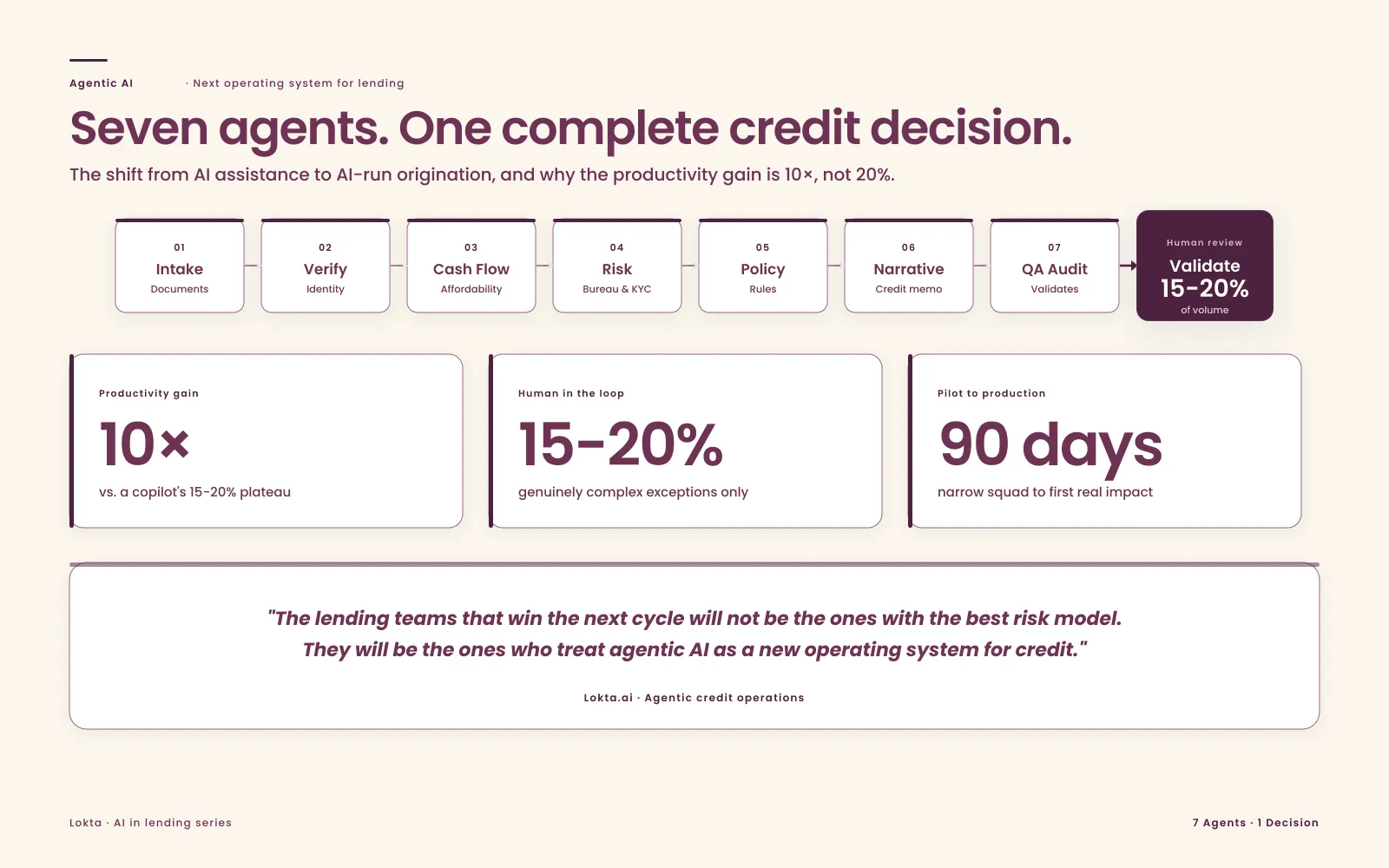
The seven-agent chain:
-
An intake agent receives the application and structures it. It pulls documents the customer uploaded (paystubs, bank statements, tax returns, articles of incorporation) and extracts every field it can.
-
A verification agent confirms identity, employment, and bank account ownership through APIs and source documents. It flags any mismatch.
-
A cash-flow agent parses bank statements, builds an income and expense view, computes debt service ratios, and stress-tests affordability.
-
A risk-and-screening agent pulls bureau data, runs fraud signals, executes KYC and sanctions checks, and reconciles them against the customer’s stated profile.
-
A policy agent applies the lender’s underwriting rules, the deterministic ones, and flags exceptions where human judgment is required.
-
A narrative agent assembles the credit memo: a summary, a recommendation, a risk rationale, and the supporting evidence trail.
-
A QA agent sits inside the chain and audits every step. Did the income calculation reconcile? Was the policy exception documented? Does the recommendation match the data?
The human reviewer sees a complete file with a recommendation and an audit trail. Their job is to validate the chain, handle the genuinely complex exceptions, and coach the agents when something needs to be done differently next time.
Two things to notice. First, every agent in this chain has a defined role: not one giant model trying to do everything, but a team of specialists with clear handoffs, much like the human teams credit organizations have always run. Second, the agentic chain produces a full audit trail by default. Every data point used, every step taken, every decision made, every QA observation, all of it is logged. For a regulated lender operating under ECOA, fair-lending testing, and adverse-action requirements, that audit trail is what makes the architecture defensible.
The principles that make it work
Building an agentic lending capability is not a matter of dropping in a single tool. It is a redesign of how credit work gets done. Five principles separate the lenders who get this right from the ones who stall.
A copilot for memo drafting alone will not change unit economics. Re-architecting the full path (application, verification, decision, documentation, funding, servicing handoff) will. Pick a journey and own it end to end.
Agentic AI does not replace analytical AI or rules-based automation. It orchestrates them. The strongest lending stacks combine deterministic policy rules, scored risk models, document AI, and agent orchestration in a single coordinated flow.
Lending has been doing role-based workflow for decades: processor, underwriter, QC, funder. Map agents to those roles. It makes the system easier to design, easier to monitor, and dramatically easier to roll out to the team that has to live with it.
Self-checking is not optional. A QA agent that verifies whether the income calculation reconciles, whether the exception was documented, and whether the recommendation matches the data is the single most effective way to keep an agentic chain trustworthy.
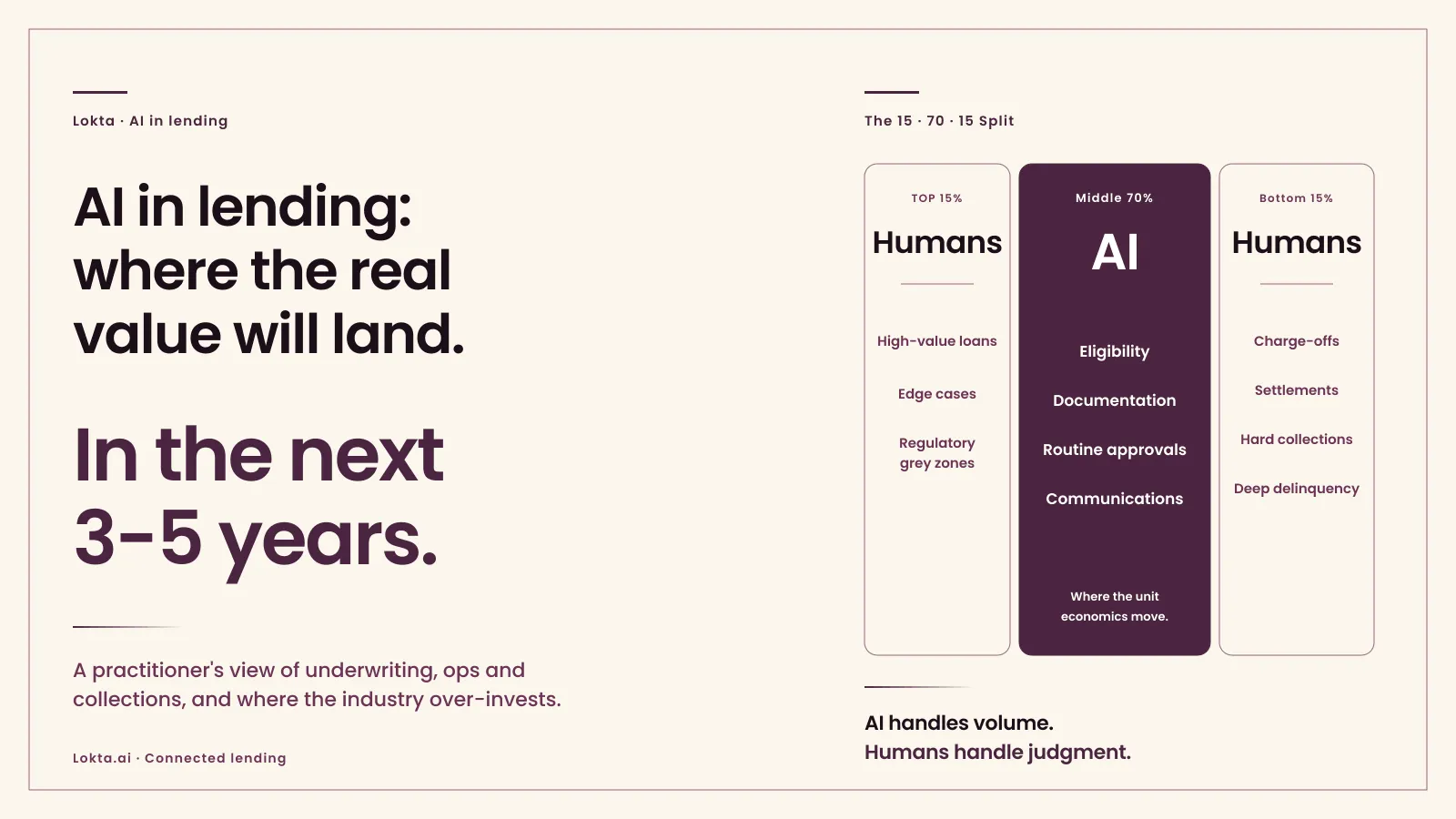
Manual underwriting should be reserved for the genuinely complex exceptions, typically 15-20% of volume, and for coaching the agent workforce. Everything else should flow through.
What it takes to actually get there
The technology is the easier half of this. The harder half is the foundation underneath it and the change management around it.
Data is the gating constraint. Lending data is fragmented by design. Origination, servicing, collections, and bureau data sit in different systems, in different formats, with different identifiers. Before an agent squad can do meaningful work, you need an entity-resolved, modular data layer that any agent can call cleanly. Investing in this foundation is not glamorous. It is the difference between an agentic prototype and an agentic factory.
Change management takes longer than the build. Building the agentic capability is a six-to-nine-month engineering effort. Getting underwriters, QC, compliance, and risk to operate in the new model, coaching agents, evaluating against new metrics, restructuring teams around exception handling, takes twelve to eighteen months and almost always requires changes to job descriptions, performance metrics, and reporting lines. Start that conversation early.
Beyond those two, the usual ingredients apply: the right talent (a mix of credit expertise, risk data science, and applied AI engineering), a clear and granular process map, a modular technology stack with API access to the data and models that matter, and a dedicated risk-management framework for agentic deployments.
- Origination, servicing, collections, and bureau data sit in different systems with different identifiers
- Requires an entity-resolved, modular data layer before agents can do meaningful work
- This is the difference between an agentic prototype and an agentic factory
- 6-9 months to build the agentic capability
- 12-18 months to get credit teams operating in the new model
- Requires changes to job descriptions, performance metrics, and reporting lines
- Start this conversation before the engineering is done
Where to start
The pattern that works is contained: pick a narrow pilot perimeter, build the squad, prove the impact, then scale.
The wrong starting point is “agentic AI for underwriting” as a whole. That framing leads to two-year roadmaps, vendor bake-offs, and no measurable impact. The right starting point is a single agent squad with a clear handoff to the existing workflow, deployed to production in 90 days.
The bigger picture
The lending teams that win the next cycle will not be the ones with the best risk model or the slickest applicant UX. They will be the ones who treat agentic AI as a new operating system for credit, one that re-allocates human judgment to where it actually matters and lets a workforce of agents do the rest.
The technology is here. The architectural patterns are clear. The remaining work is operational, organizational, and cultural, and that is where the real edge will be built.
That is the bet we are making at Lokta.
Frequently asked questions
What is agentic AI in lending and how is it different from a better risk model?
A better risk model makes individual credit decisions sharper. Agentic AI changes who runs the credit process. Instead of underwriters opening files, reading documents, and writing memos, with AI assisting on individual tasks, a chain of AI agents carries the application end to end: pulling documents, verifying income, running policy checks, building a credit narrative, and auditing its own work. The human's role shifts from operator to supervisor. The productivity gain is not 15-20 percent, as with generative AI copilots. It is several multiples of human throughput.
What does an agentic lending squad actually look like?
Seven specialized agents, each with a defined role and a clear handoff to the next: an intake agent that structures the application; a verification agent that confirms identity, employment, and bank account ownership; a cash-flow agent that parses bank statements and stress-tests affordability; a risk-and-screening agent that runs bureau, fraud, KYC, and sanctions checks; a policy agent that applies deterministic underwriting rules and flags exceptions; a narrative agent that assembles the credit memo; and a QA agent that audits every step in the chain. The human reviewer sees a complete file with a recommendation and an audit trail, and handles the genuinely complex exceptions, typically 15-20% of volume.
Why is a QA agent necessary inside every agent chain?
The chain cannot self-monitor from the outside. A QA agent embedded in the workflow checks whether the income calculation reconciled with the bank statement data, whether the policy exception was documented, and whether the recommendation matches the data the other agents produced. Without it, errors compound silently across steps and surface only at the human review stage, defeating the purpose of the chain. Self-checking is not optional; it is the single most effective way to keep an agentic chain trustworthy.
What is the hardest enabler to get right when standing up an agentic lending capability?
Two enablers are harder than the technology itself. First, data: lending data is fragmented across origination, servicing, collections, and bureau systems, in different formats, with different identifiers. Before an agent squad can do meaningful work, you need an entity-resolved, modular data layer that any agent can call cleanly. Second, change management: building the agentic capability is a six-to-nine-month engineering effort. Getting underwriters, QC, compliance, and risk to operate in a model where they coach agents rather than run the process takes twelve to eighteen months, and almost always requires changes to job descriptions, performance metrics, and reporting lines.
Where should a lender start with agentic AI, and what is the wrong starting point?
The right starting point is one of three narrow perimeters: a single product segment with high enough volume to learn from and manageable exception rates; a single sub-process (typically document extraction and income analysis, where data is most structured and unit economics are clearest); or a single decision type such as pre-approvals, line increases, or hardship review where the human-in-the-loop is well-defined. The wrong starting point is 'agentic AI for underwriting' as a whole, because that framing produces two-year roadmaps and no measurable production impact. The right target is a single agent squad deployed to production in 90 days.
Does an agentic lending chain produce an audit trail that satisfies ECOA and fair-lending requirements?
By design, yes, if the chain is built correctly. Because agents cannot work off-platform or rely on implicit context the way human underwriters can, every data point used, every step taken, every decision made, and every QA observation is logged by default. Under ECOA, fair-lending testing, and adverse-action requirements, that audit trail is an architectural requirement, not a nice-to-have. A chain that does not produce an auditable log for every decision is not a governed lending chain.
Source and inspiration: This piece draws on the framing and findings from McKinsey & Company, How agentic AI can change the way banks fight financial crime (August 7, 2025), which examined the agentic shift in a KYC and AML context. We have looked at the same shift through a lending lens.
Views expressed are those of Lokta.ai and do not constitute legal, compliance, or investment advice.