The thinking behind the platform.
Product updates and essays on lending infrastructure, AI governance, and agentic loan servicing. Guides, the glossary and the RFP toolkit live in the resources library.
84 articles
No articles match these filters. Try a shorter search or clear the filters.
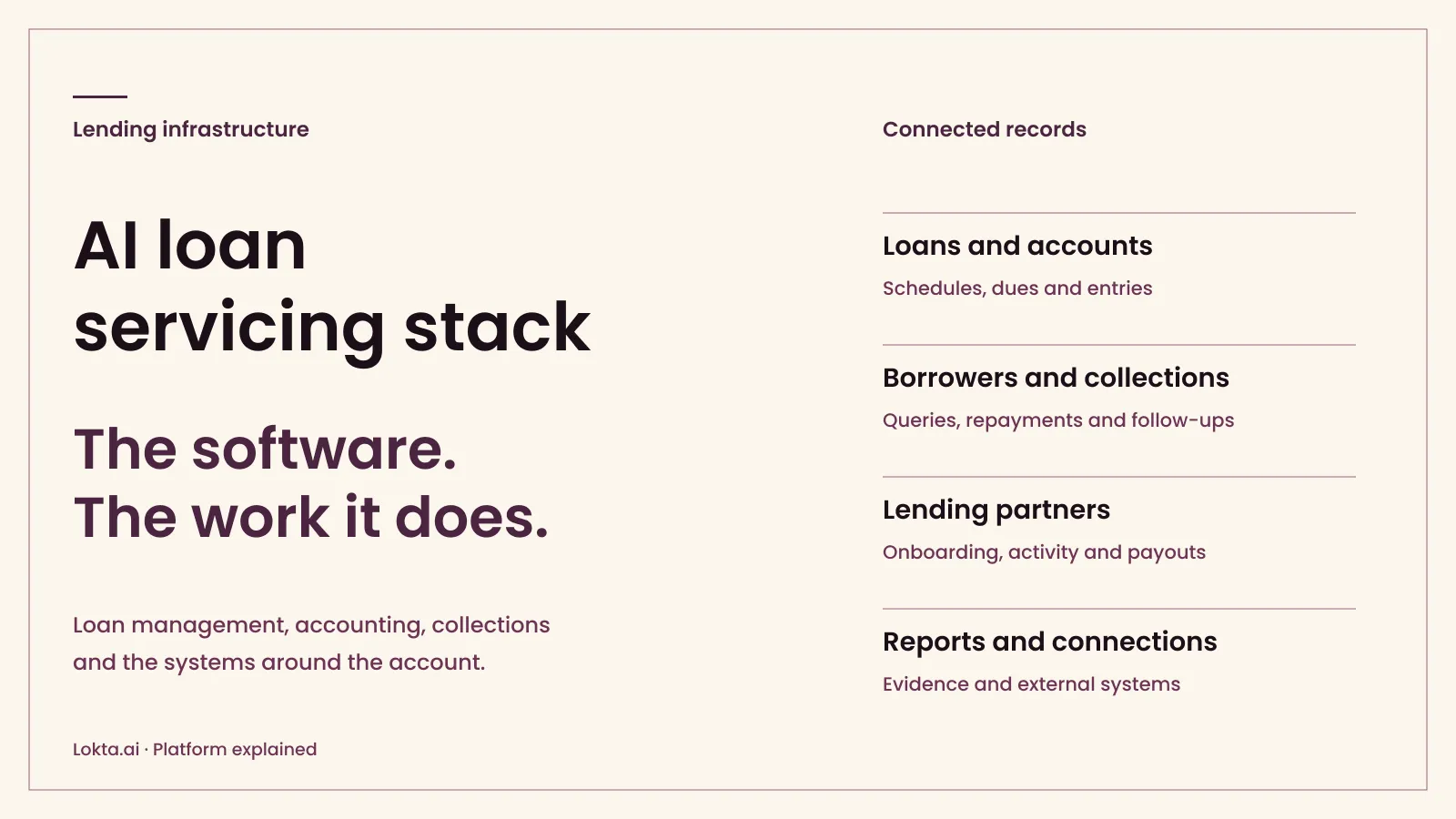
Notes from the people building the lending core
Payment allocation, deterministic money paths, modular architecture, and the lessons carried forward from Apache Fineract.
Payment appropriation is a configuration science
A partial loan payment can clear different dues under different allocation rules. Compare ranking, traversal and eligibility with worked examples.
Modular monolith vs microservices for a lending core: why Lokta is polylithic
Why a loan platform needs one transaction per disbursement: Lokta's modular monolith, Gradle modules shipped as one Spring Boot binary, versus microservices.
AI in Lending: Why a Deterministic Core
How Lokta deploys AI in three layers (deterministic core, workflow AI, and agentic AI) without breaking trust, compliance, or balance-sheet correctness.
What We Learned Building Apache Fineract
Three architectural lessons from a decade building Apache Fineract, and why incremental upgrades couldn't meet what modern lending now demands.
More from Lokta
79 articles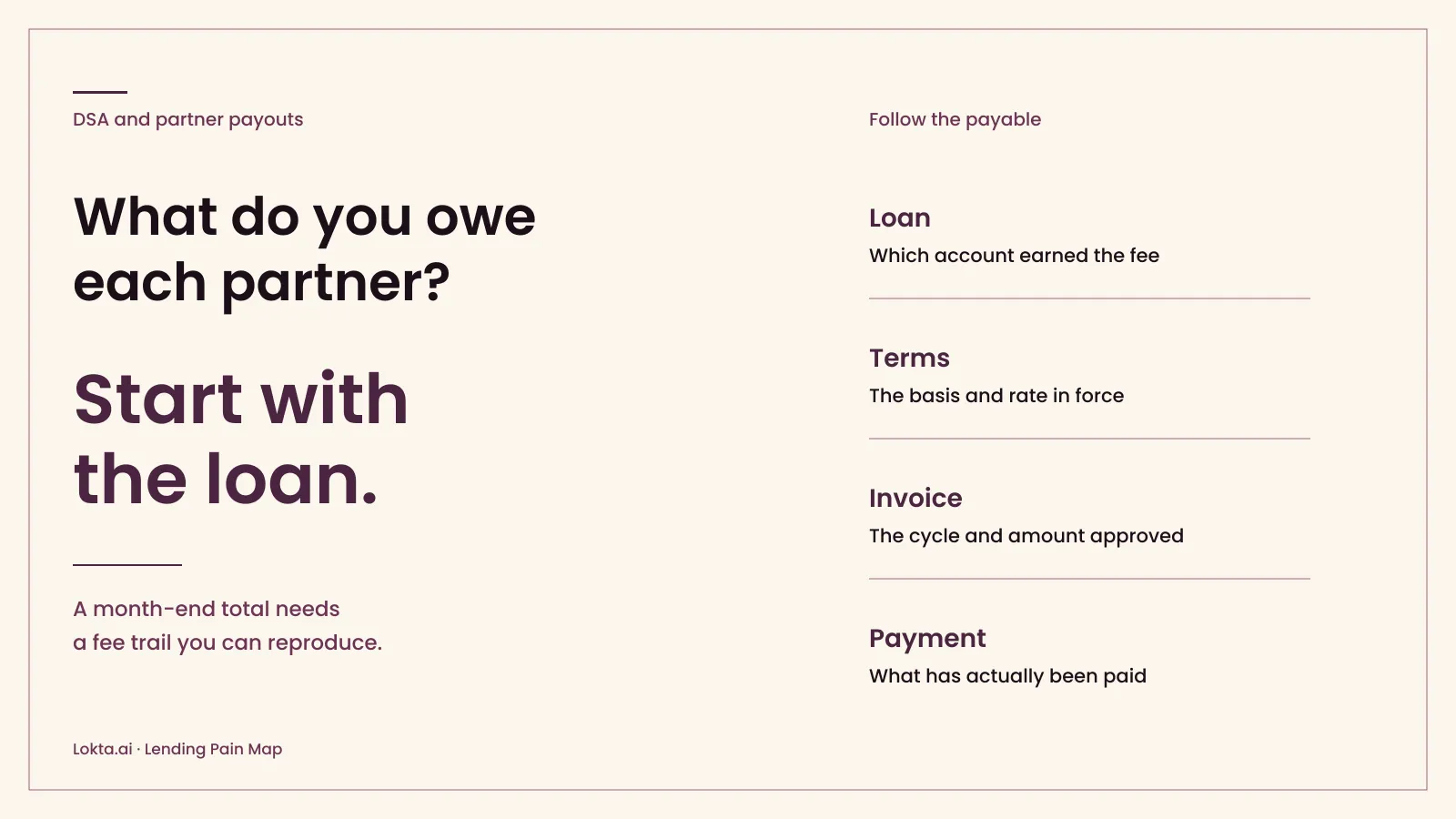
DSA and partner payouts: how much do you owe each partner this month?
Trace each DSA payout to its loan, fee basis and rate. Reconcile partner invoices, distinguish approval from payment, and keep borrower charges separate.
5 min readRead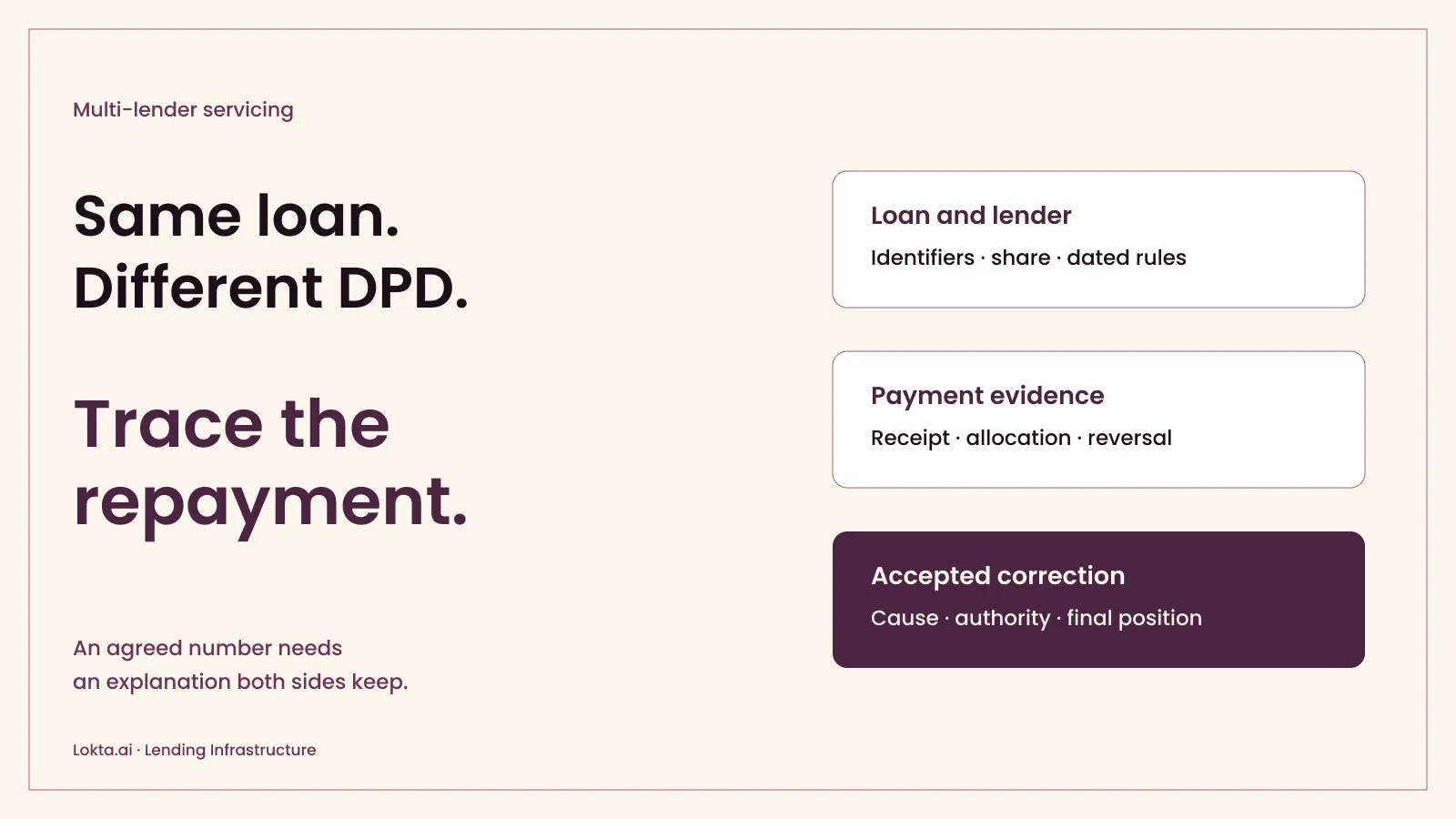
Multi-lender servicing: trace the repayment before fixing the DPD gap
When your repayment record and a partner lender's DPD disagree, start with the loan, dated rules and payment evidence. Keep borrower dues and partner obligations distinct.
5 min readRead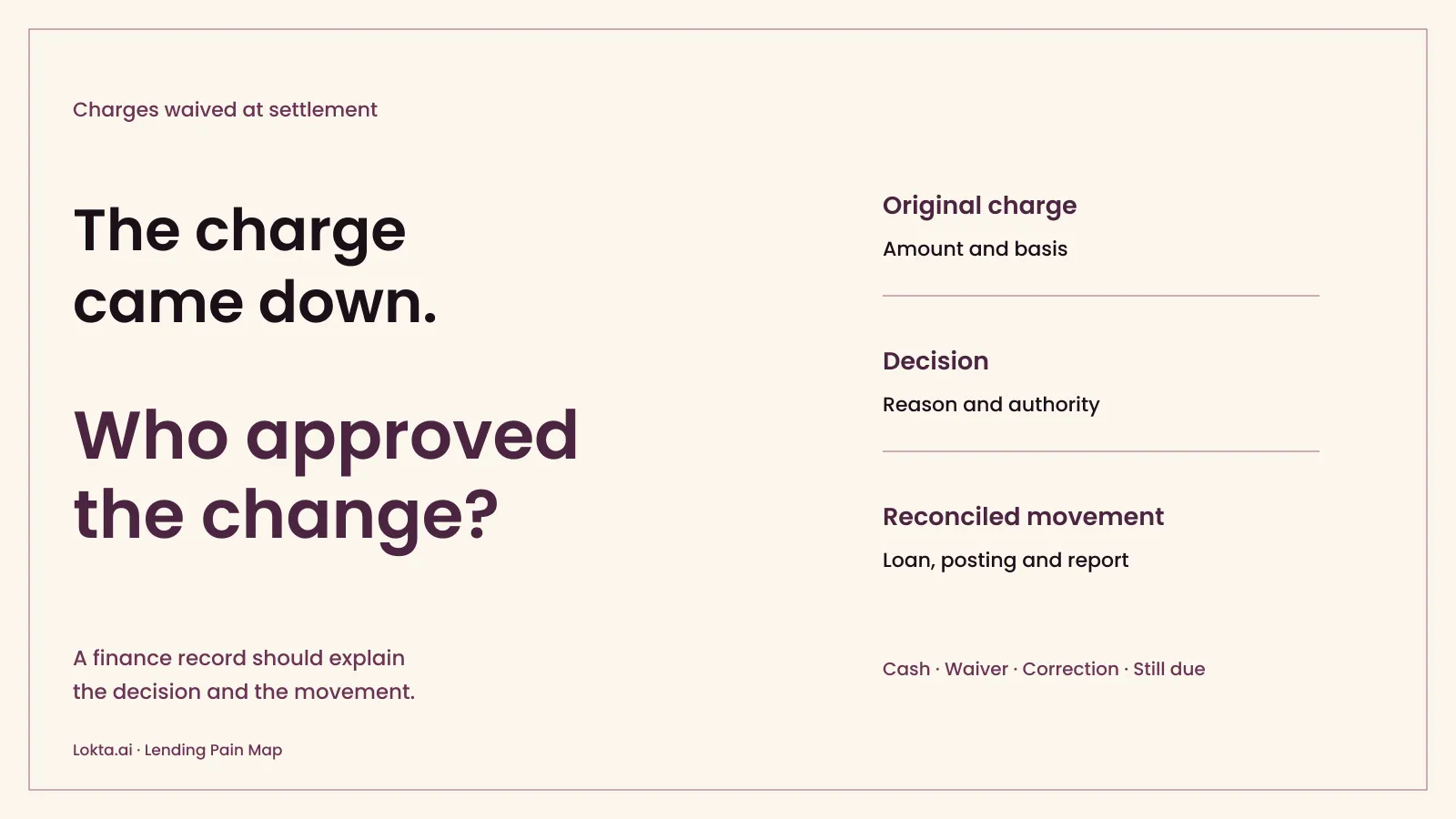
Charges waived at settlement: what changed, and who approved it?
A charge waiver belongs in a decision record finance can reconcile. Separate concessions, corrections and unpaid dues before judging a branch's collections.
5 min readRead
Running an NBFC loan book on Excel and Tally: when to move
The test is whether someone else can explain a loan when the person who keeps the workbook is away. Follow one repayment from the bank entry to the accounts.
5 min readRead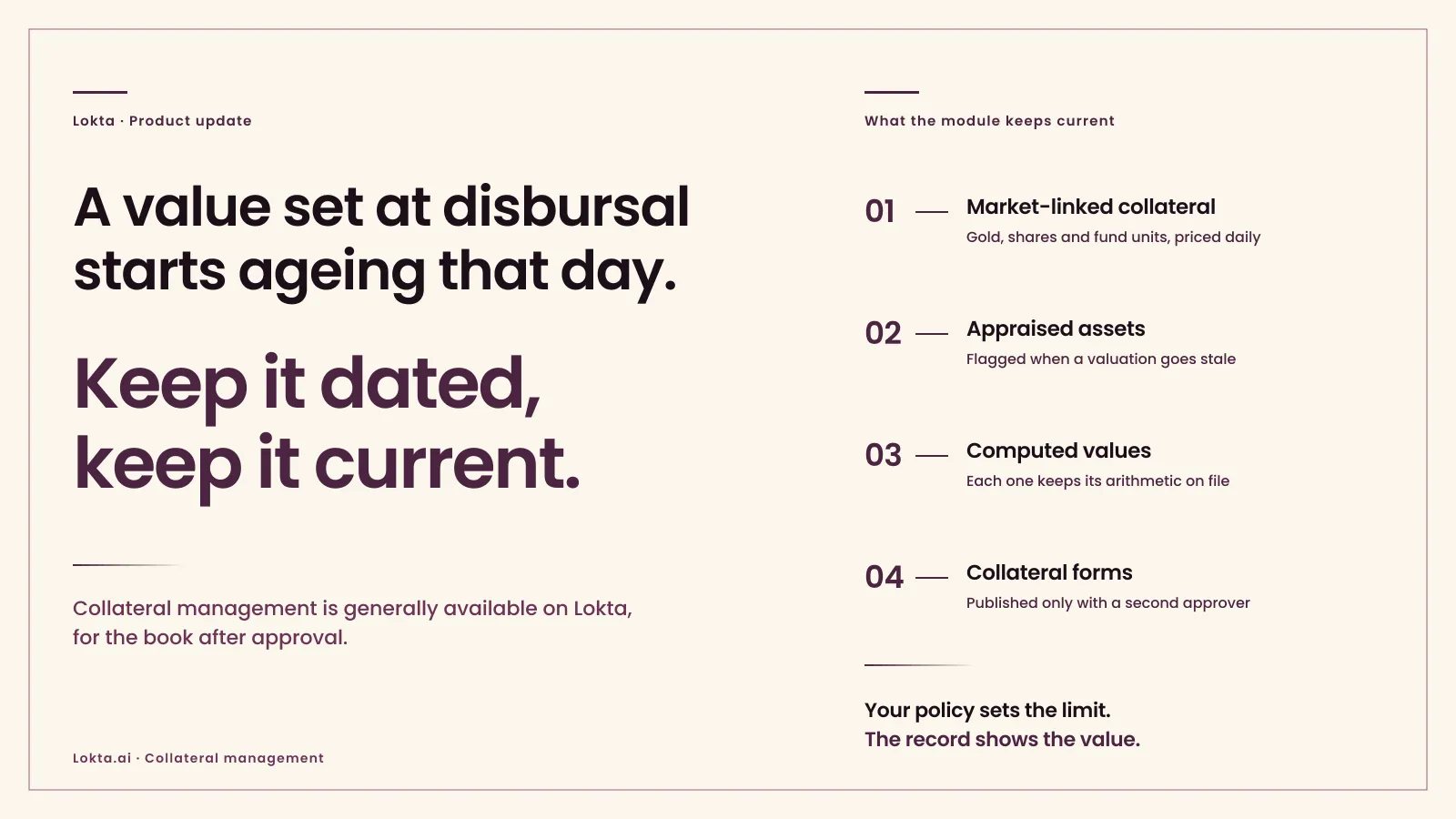
Lokta launches collateral management that prices the security daily, and names Vamshi Krishna Putta Head of Engineering
A collateral value set at disbursal starts ageing that day. Lokta's module gives gold, shares and fund units dated daily prices and flags stale appraisals.
9 min readRead
Account Aggregator data in loan servicing: turn signals into reviewed action
Use Account Aggregator data to inform loan servicing: cash-flow monitoring, borrower conversations and repayment-support reviews, with lender-owned controls.
6 min readRead
A borrower’s details change: what must loan management and servicing update?
A borrower detail change can leave loan systems out of step. See how an LMS should track verification, effective dates, downstream updates and open exceptions.
6 min readRead
Build Vs. Buy Loan Management Software (LMS)
Compare building, buying and composing an LMS by who owns loan servicing exceptions, policy changes and releases. Use a decision matrix before choosing a stack.
6 min readRead
A borrower disputes an EMI: can your LMS reconstruct the account?
Investigate an EMI dispute using loan terms, payment history and approved changes. A worked LMS case shows the evidence needed before correcting an account.
6 min readRead
Which loan management and servicing workflow should an NBFC automate first?
Choose an LMS and loan servicing automation pilot using eligible volume, retained human work, exception cost and consequence. Includes a worked comparison.
6 min readRead
Before your first repayment cycle: rehearse loan management and servicing
Test loan management and servicing before the repayment cycle. Use a four-account rehearsal to expose gaps in reconciliation, ownership and borrower replies.
5 min readRead
Loan pricing and RAROC: servicing costs change the return
See how servicing costs change risk-adjusted loan returns. Work through a RAROC example and trace the operating evidence an NBFC needs after loan approval.
6 min readRead
LOS-to-LMS handoff: an accepted API request does not prove a serviceable loan
Define what an LOS-to-LMS handoff must prove: approved terms, account identifiers, usable schedules and clear recovery when requests conflict or responses fail.
6 min readRead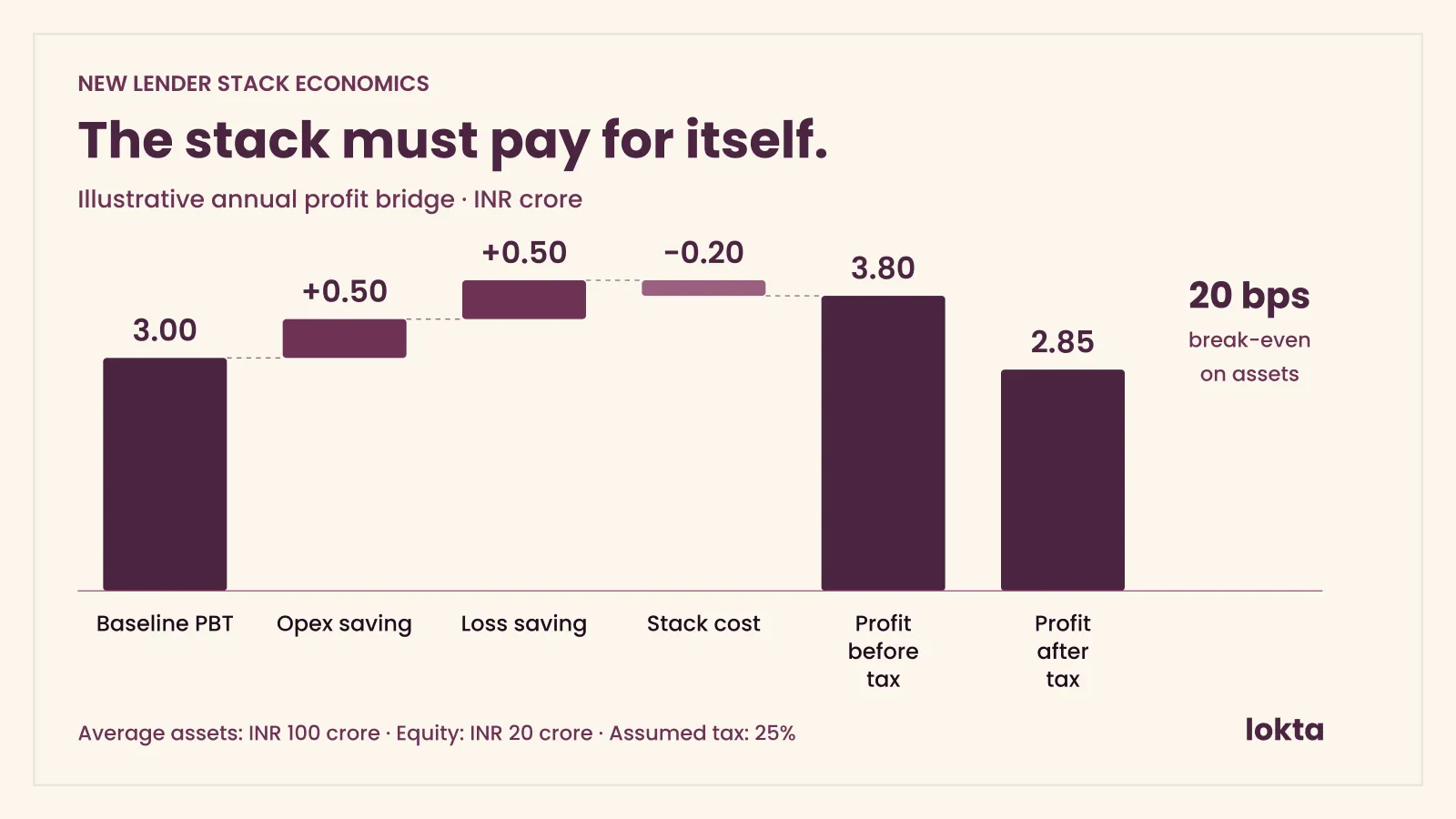
Got your lending licence? Choose a loan management stack built for profitable operations
Choose a new lender’s loan management stack through ROA, ROE, credit losses and opex. Map collections, partners, reporting and compliance to operating tests.
8 min readRead
The borrower has paid: why is the collections queue still calling?
A posted payment may leave stale collection tasks behind. See how loan management and servicing should refresh assignments, queued messages and agent actions.
5 min readRead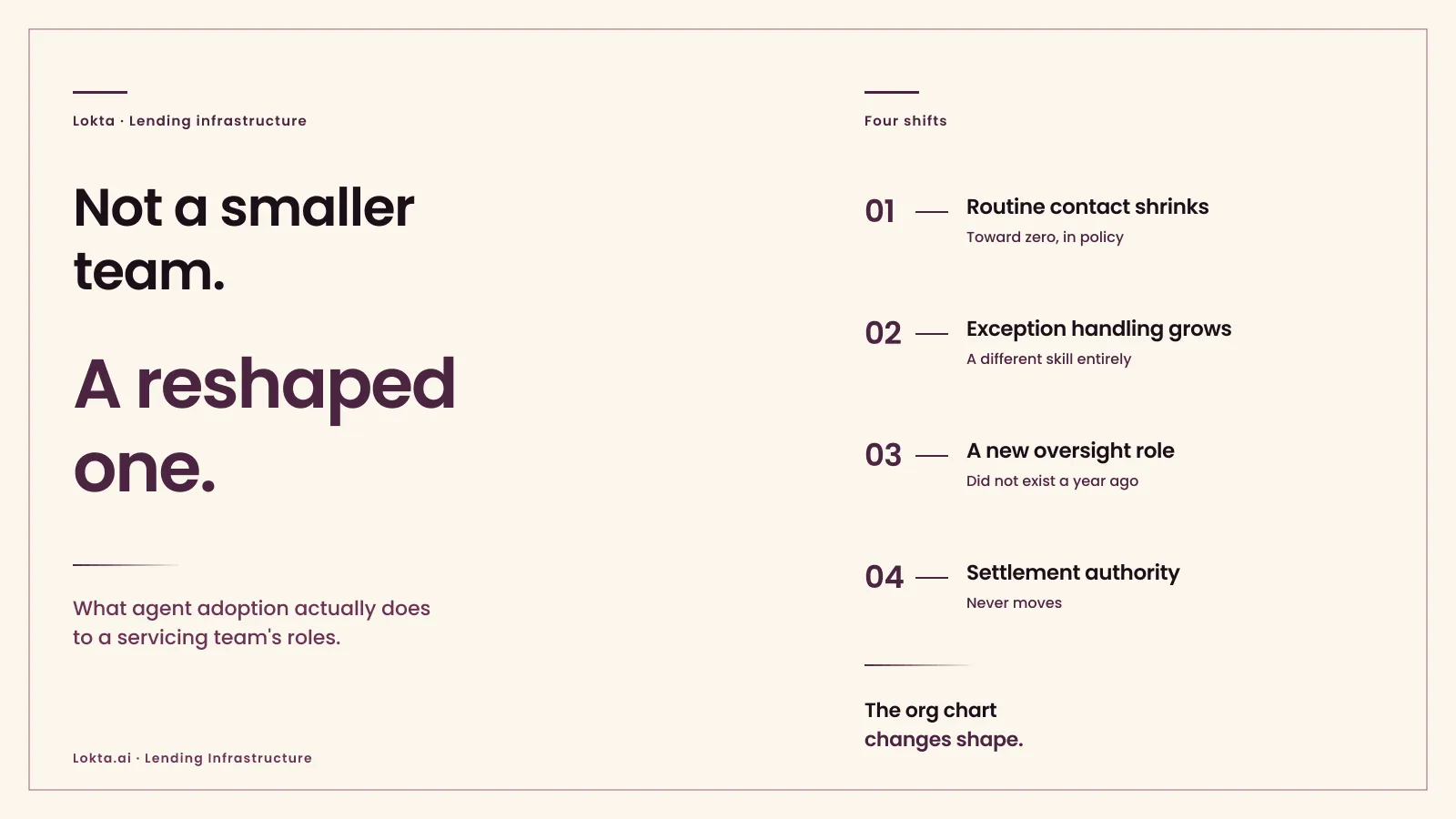
Agent Adoption Does Not Shrink a Servicing Team. It Reshapes It.
The staffing plan behind most agent rollouts assumes a smaller team doing the same jobs at a lower headcount. What actually happens is stranger: some roles shrink toward zero, a role that never existed becomes necessary, and one kind of authority never moves at all.
4 min readRead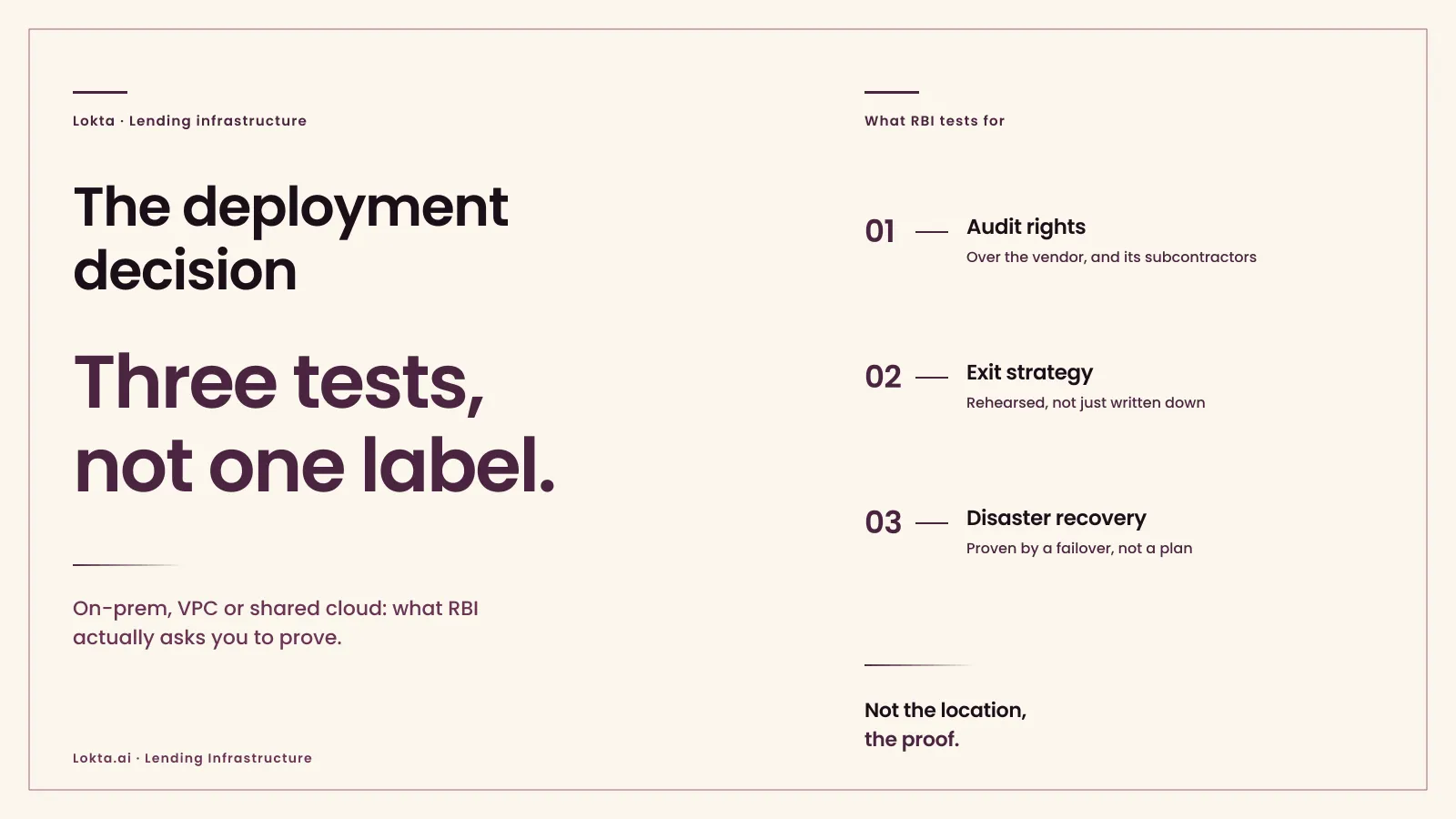
On-Prem, VPC or Shared Cloud: What RBI Actually Requires You to Prove
NBFCs argue about where the LMS should run. RBI's outsourcing rules do not name a hosting model. They ask whether you can audit the vendor, exit it, and prove disaster recovery works.
7 min readRead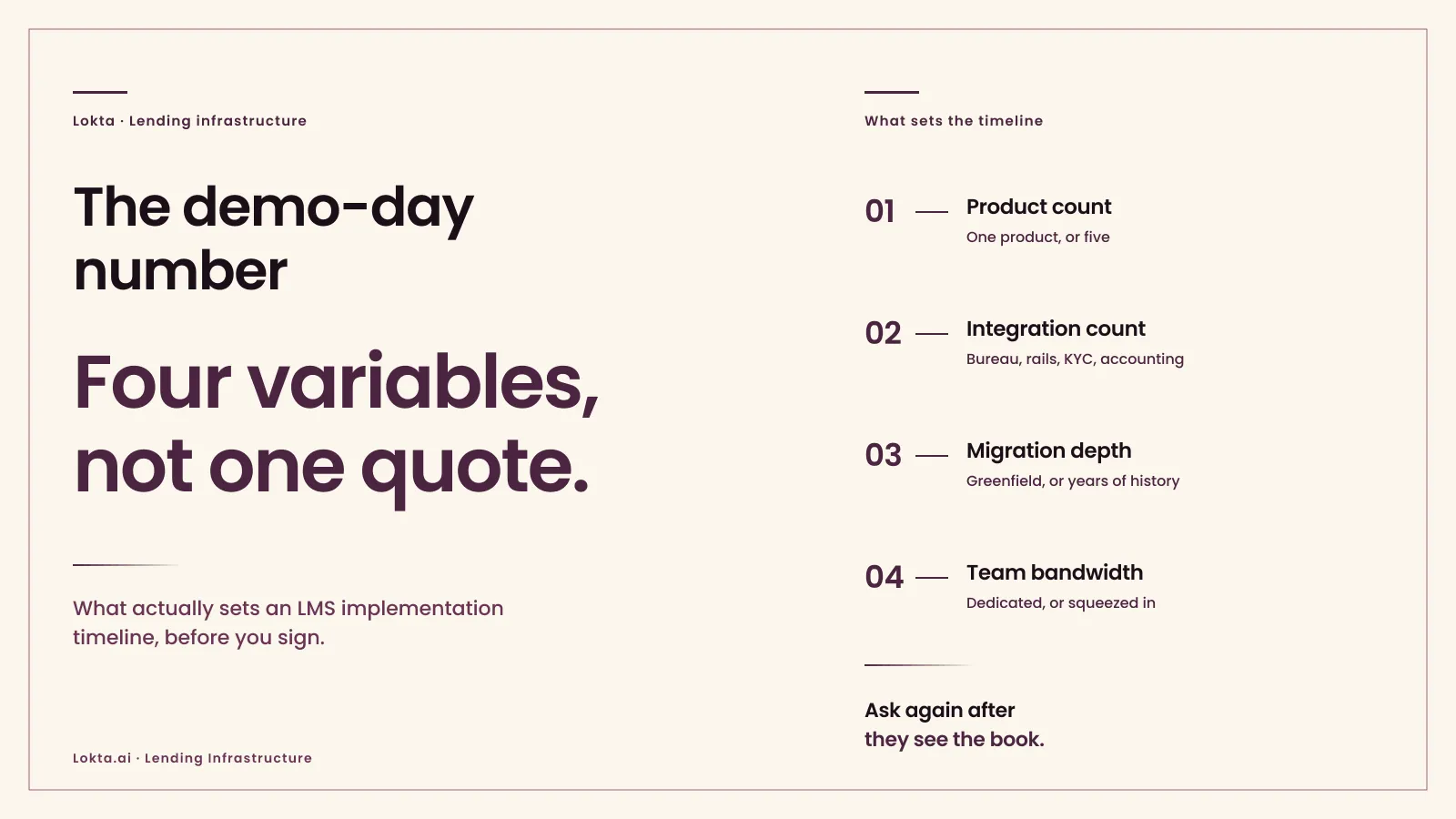
How Long an LMS Implementation Actually Takes
Vendors give a demo-day number before they have seen your book. The real timeline is set by four variables: product count, integrations, migration depth and team bandwidth.
6 min readRead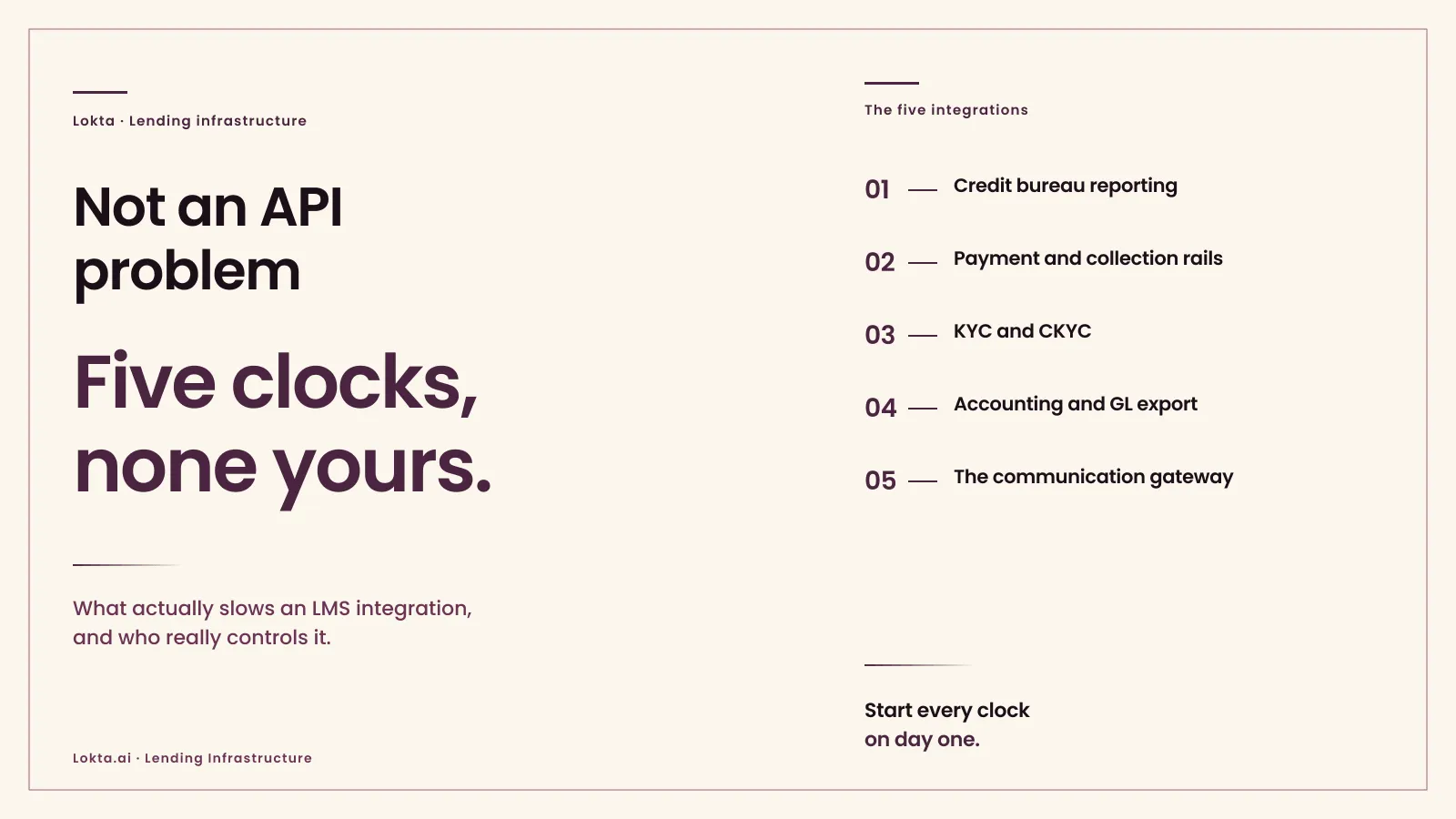
The Five Integrations Every LMS Needs, and What Slows Them Down
The API is rarely the hard part of an LMS integration. Bureau certification, mandate registration, CKYC onboarding and DLT approval all run on someone else's clock, not the vendor's.
5 min readRead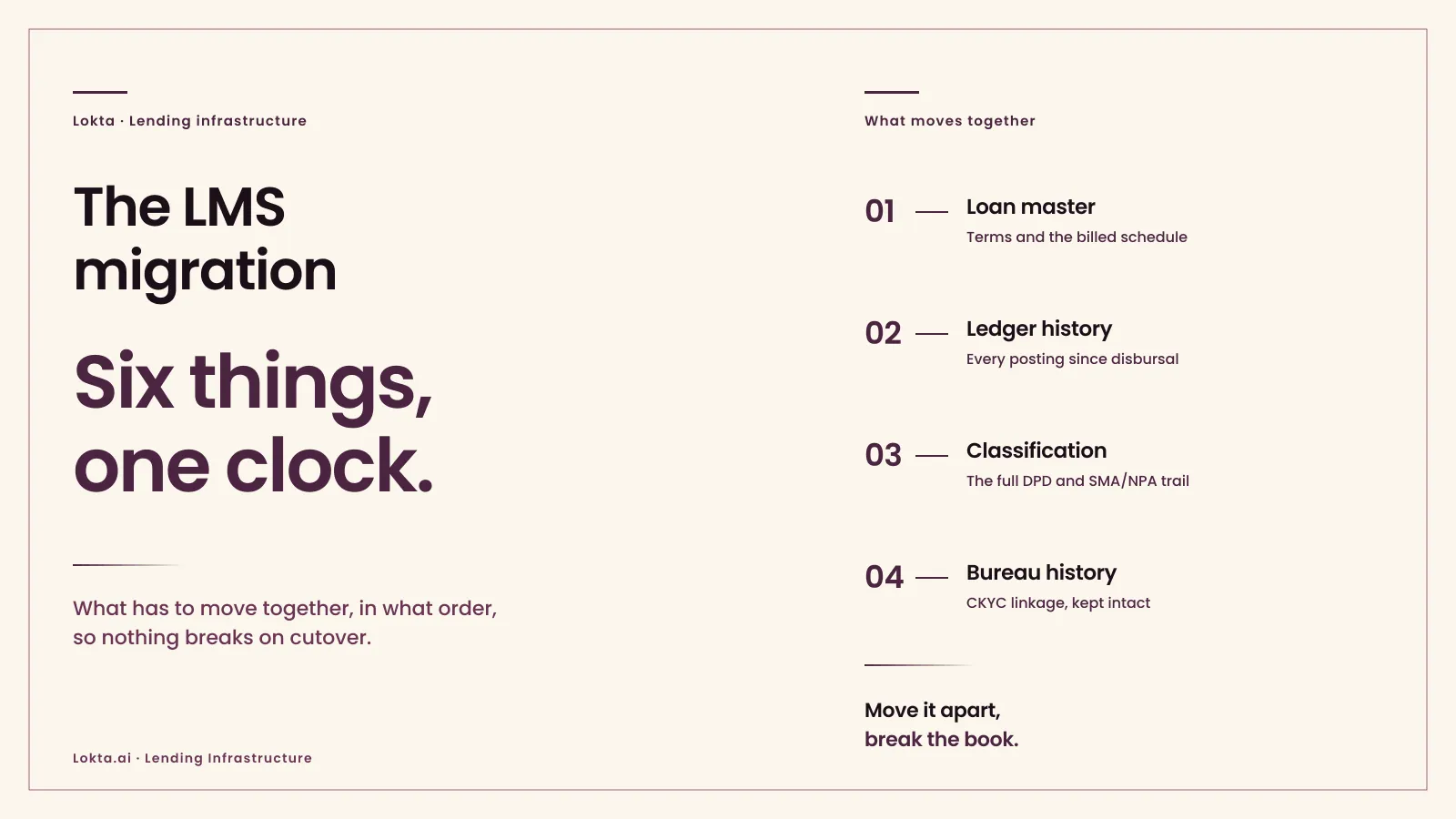
What Has to Move Together When Your LMS Migrates
A loan book migration breaks when systems move on different clocks. What has to move together, in what order, so classification, the ledger and bureau reporting stay correct through cutover.
9 min readRead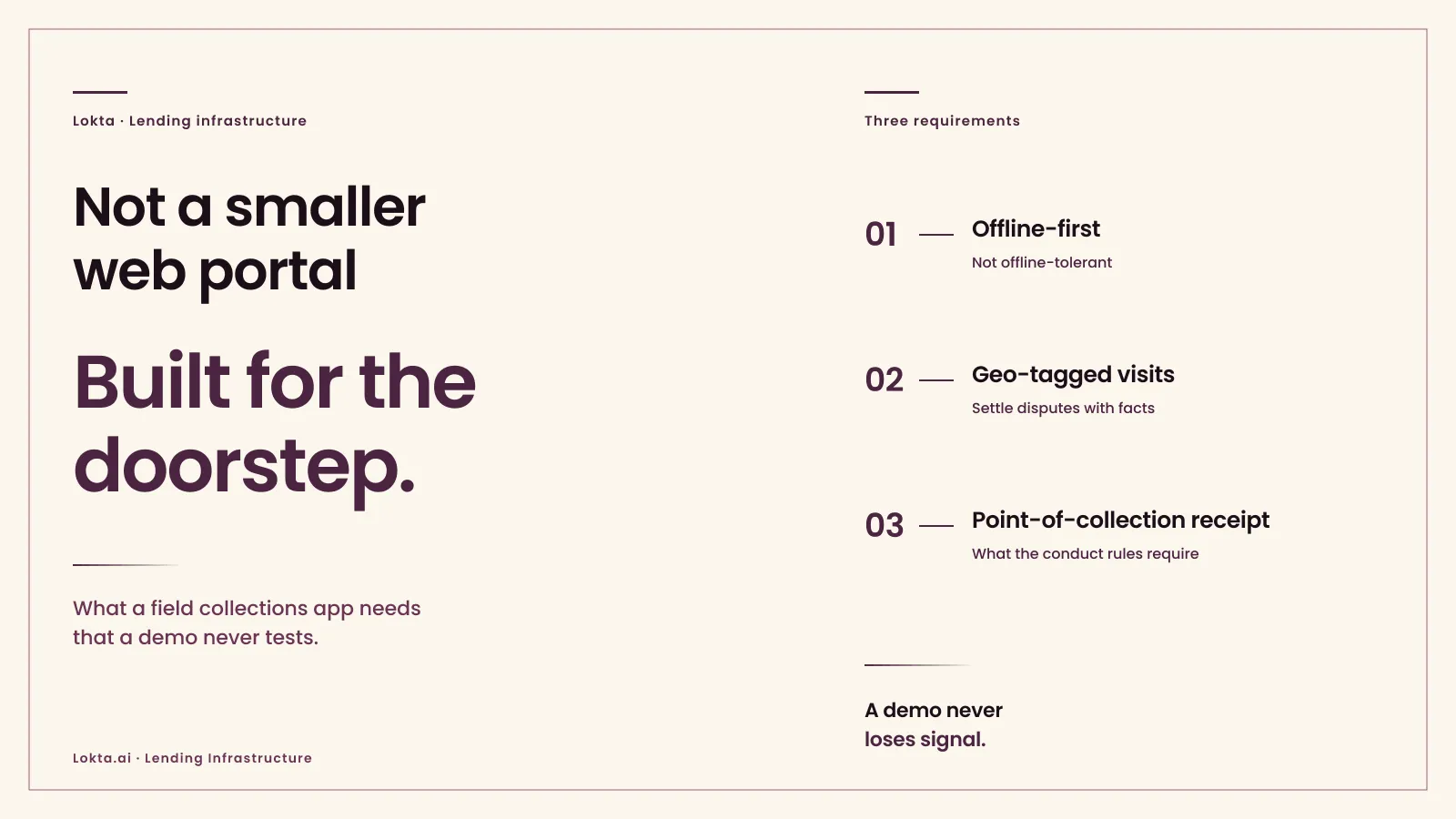
A Field Agent's App Is Not a Smaller Version of the Web Portal
A responsive web view looks like a mobile app in a demo with full signal. A field agent finds out otherwise on the first doorstep visit with no connectivity, and by then it is the lender's problem, not the vendor's.
5 min readRead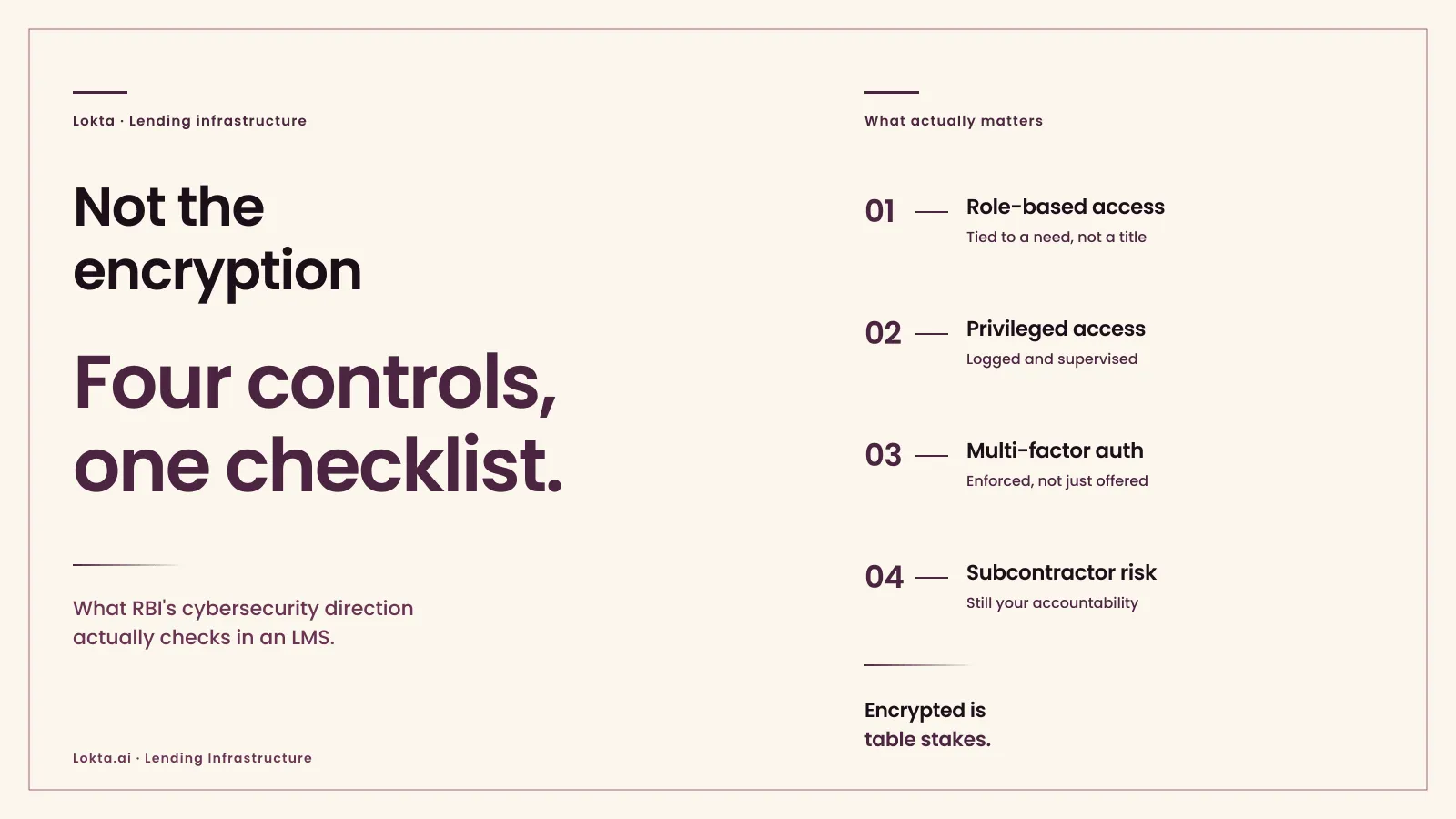
Encryption Is Not the LMS Security Question That Matters
Every LMS vendor says the data is encrypted. RBI's cybersecurity direction asks a harder question: who can access it, whether that access is logged, and whether a subcontractor can too.
5 min readRead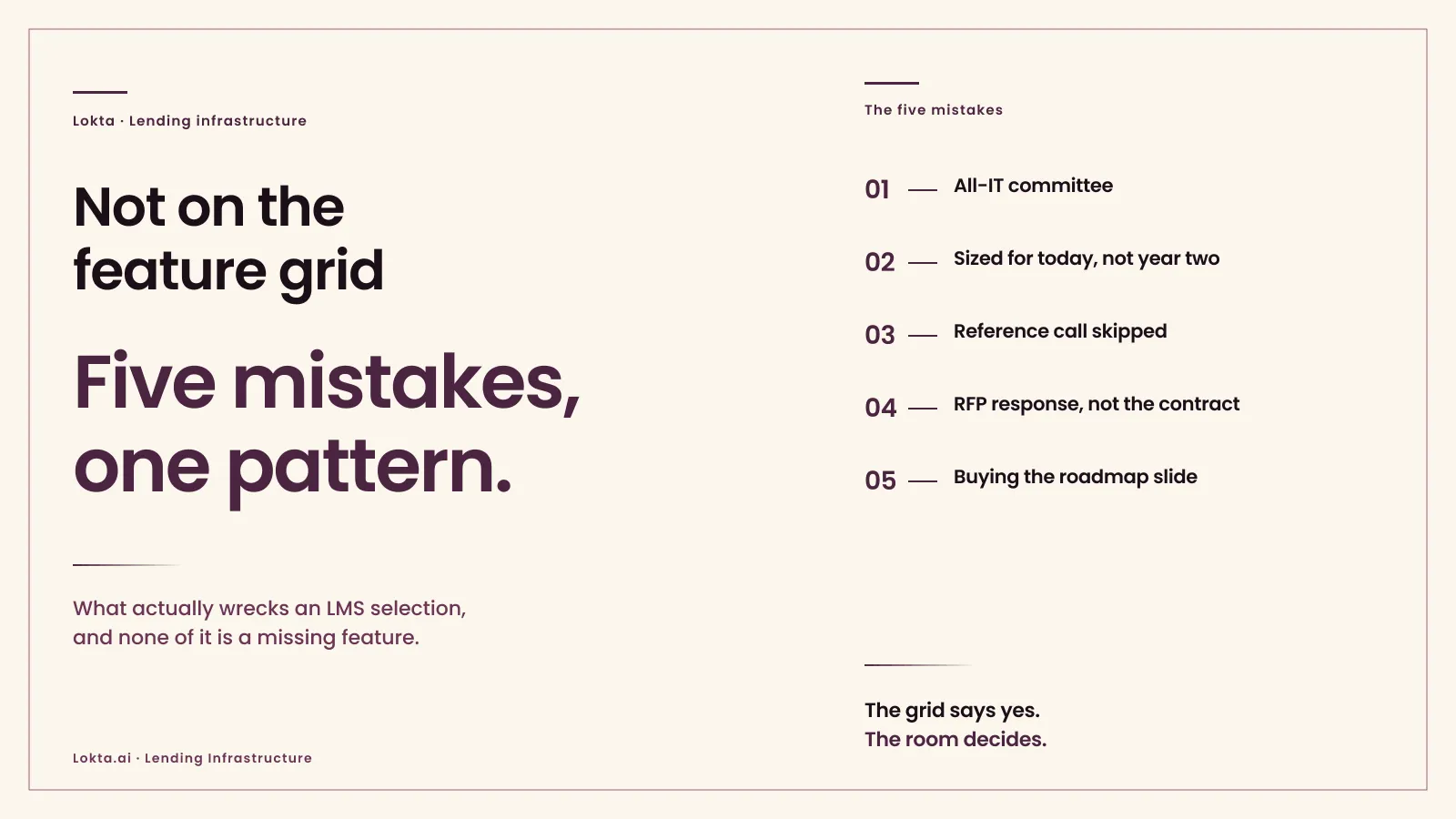
The LMS selection mistakes that have nothing to do with features
The feature grid is rarely why an LMS selection goes wrong. It is who ran the evaluation, what the reference call would have shown, and what the signed contract actually says.
8 min readRead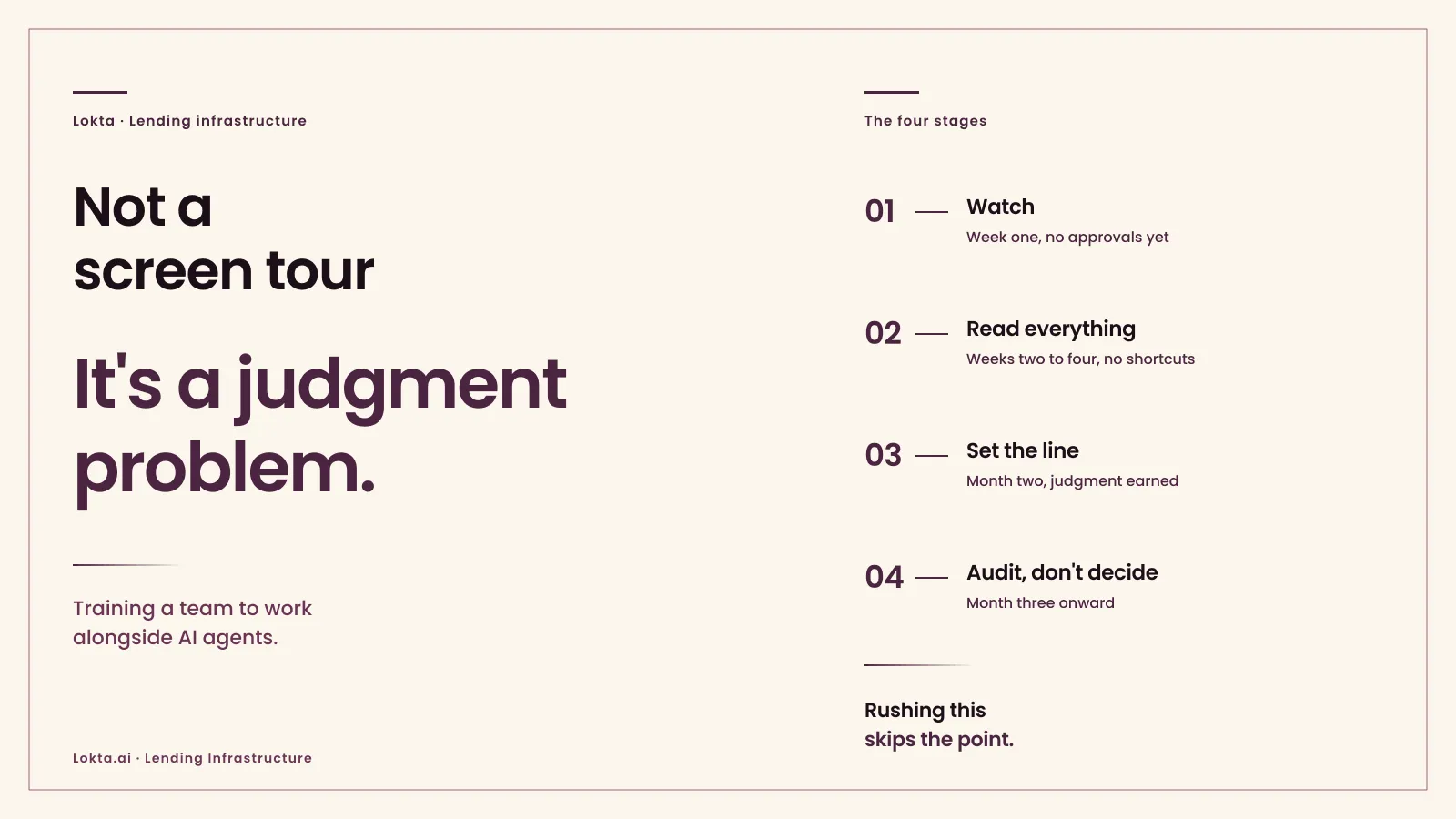
Training a Servicing Team on AI Agents Is Not a Screen Tour
The training that decides whether an agent rollout works is not which button approves a proposal. It is whether the team builds the judgment to know when to trust one, question one, or escalate one.
5 min readRead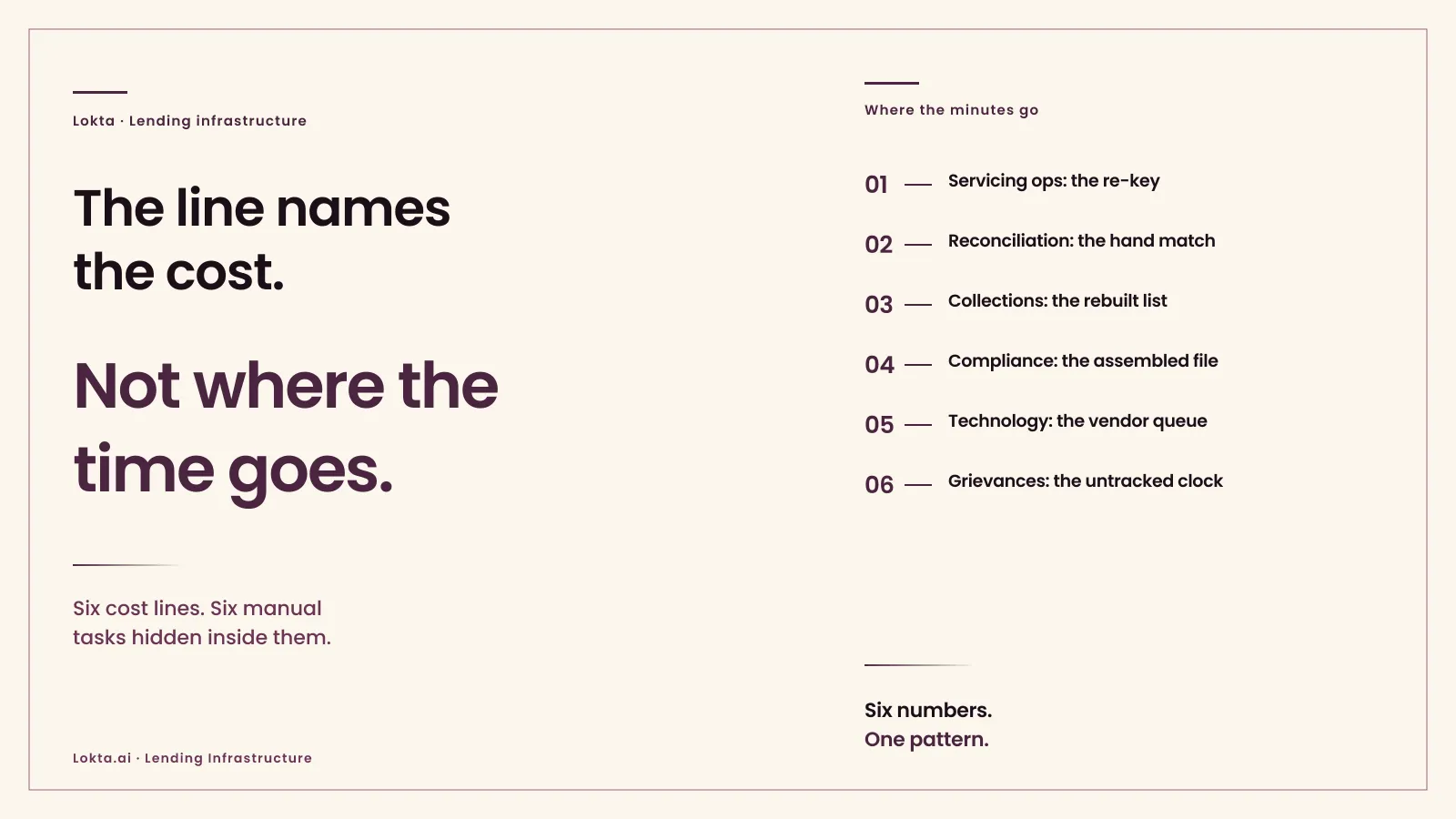
A Cost-to-Service Line Item Names the Cost. Not Where the Time Goes.
Six cost lines make up what an NBFC spends servicing a loan. Inside each one sits a specific manual task nobody put a name to: a re-key, a hand match, a spreadsheet a person rebuilds every morning.
5 min readRead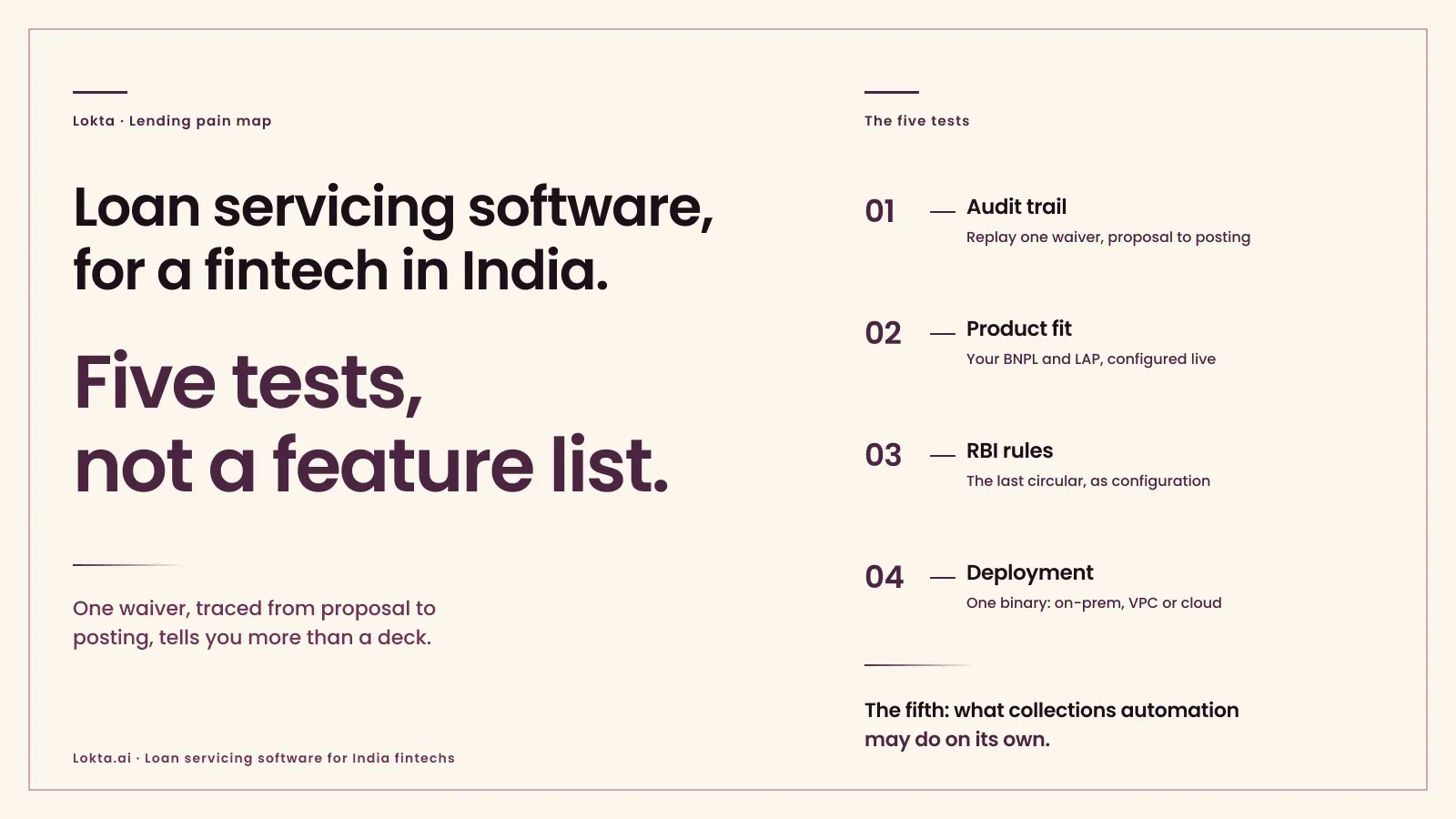
Best loan servicing software for fintechs in India: five tests to run on every vendor
Five tests a fintech lender in India should run on every loan servicing software vendor, including a replayable audit trail and RBI rules as configuration.
10 min readRead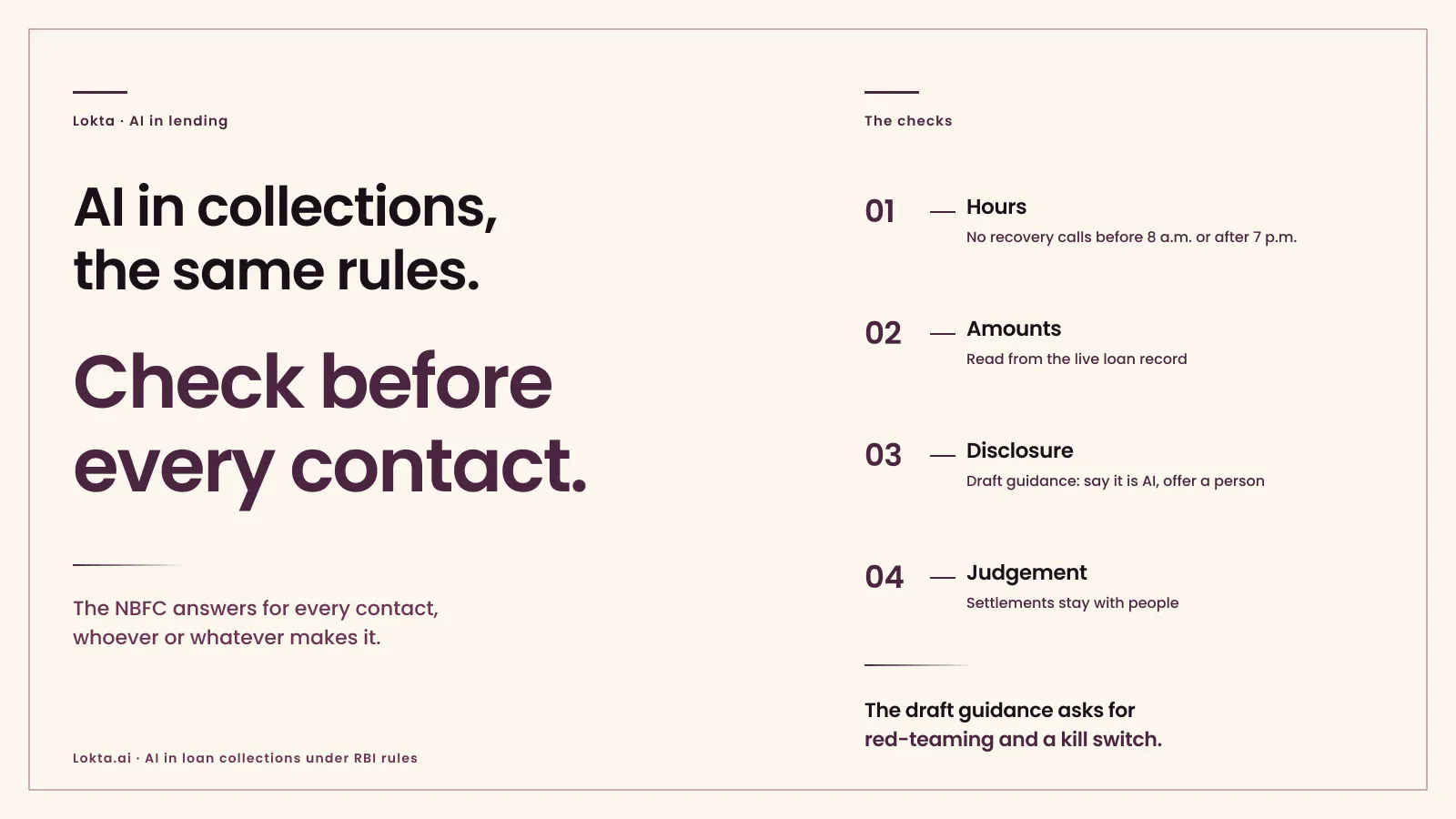
AI in loan collections under RBI's rules: what an agent may do, and what stays with people
What an AI agent may do in NBFC collections under RBI's conduct rules and draft model risk guidance, what stays with people, and what each contact should log.
9 min readRead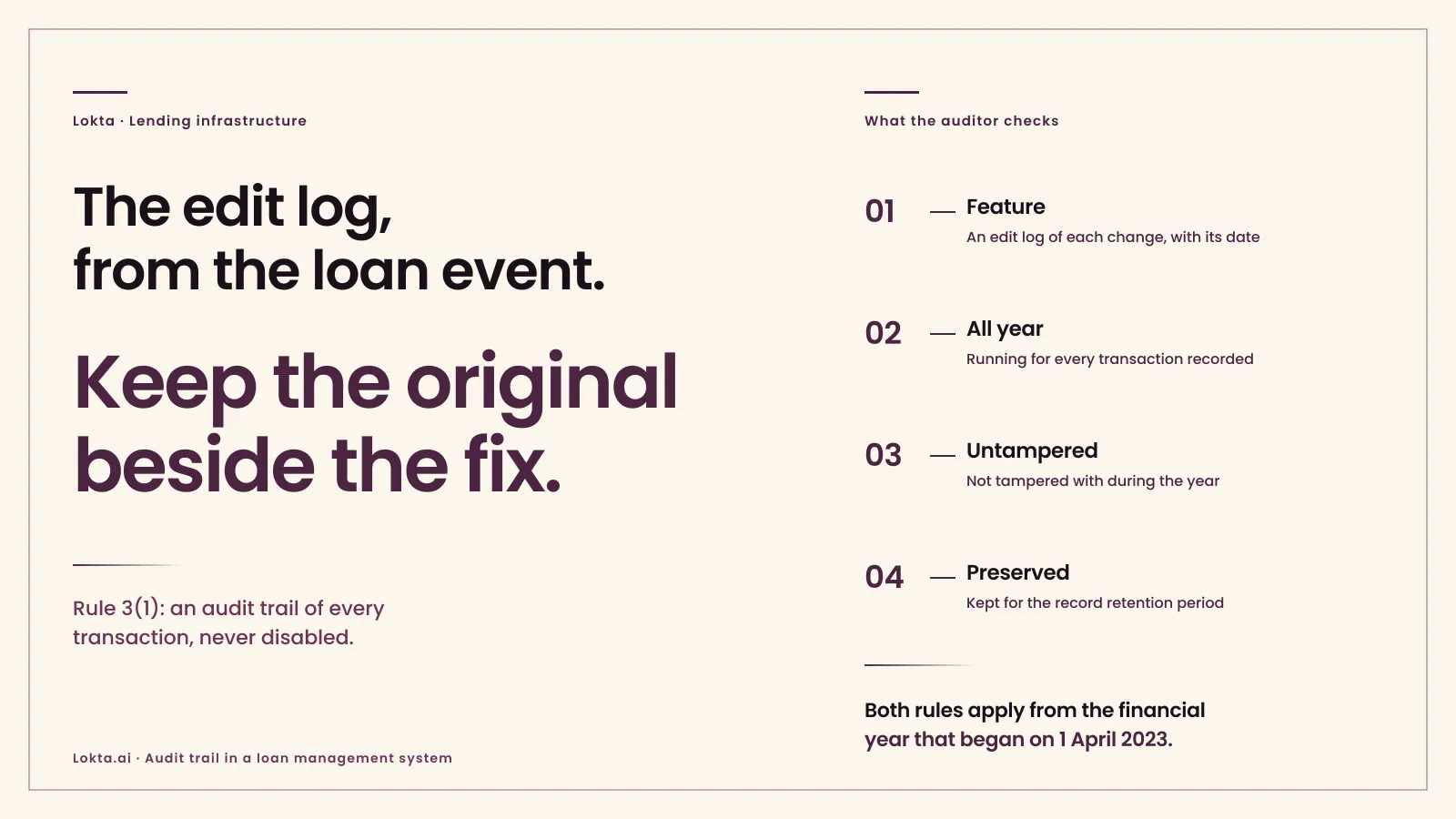
Audit trail in a loan management system: what Rule 3(1), RBI's technology directions and your auditor check
What a loan system's audit trail has to show under the Companies Act edit log rule, the auditor's Rule 11(g) report and RBI's 2026 NBFC technology directions.
10 min readRead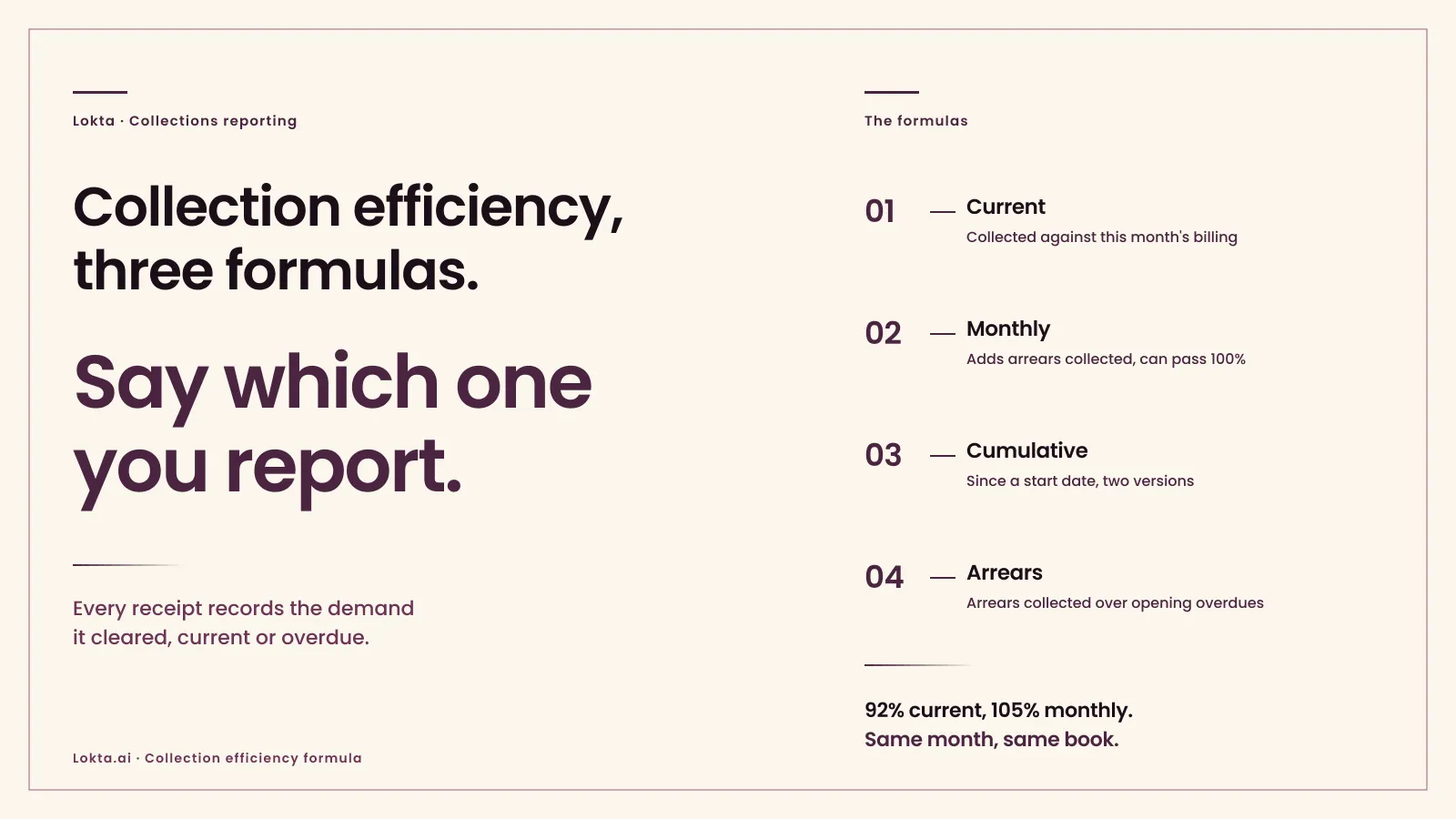
Collection efficiency for NBFCs: three formulas, and why 105% can be a bug
Current, monthly and cumulative collection efficiency divide different things. How each is calculated, why one can pass 100%, and which figures to report.
8 min readRead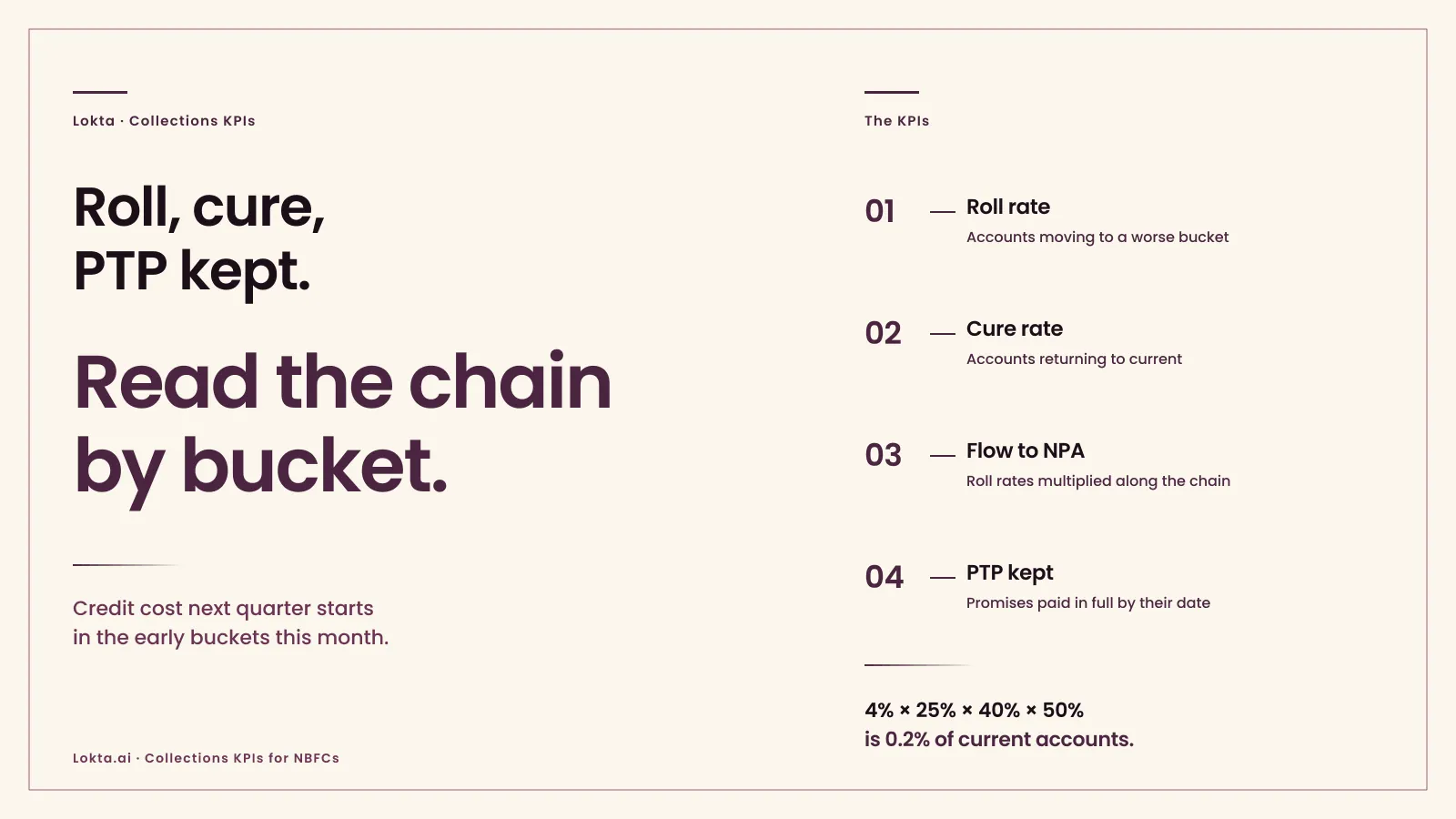
Roll rate, cure rate, PTP kept: the collections KPIs that show where credit cost is heading
Collections KPIs to track by bucket: roll rate, cure rate, flow to NPA, promise-to-pay kept and right-party contact, with formulas and a worked NBFC example.
10 min readRead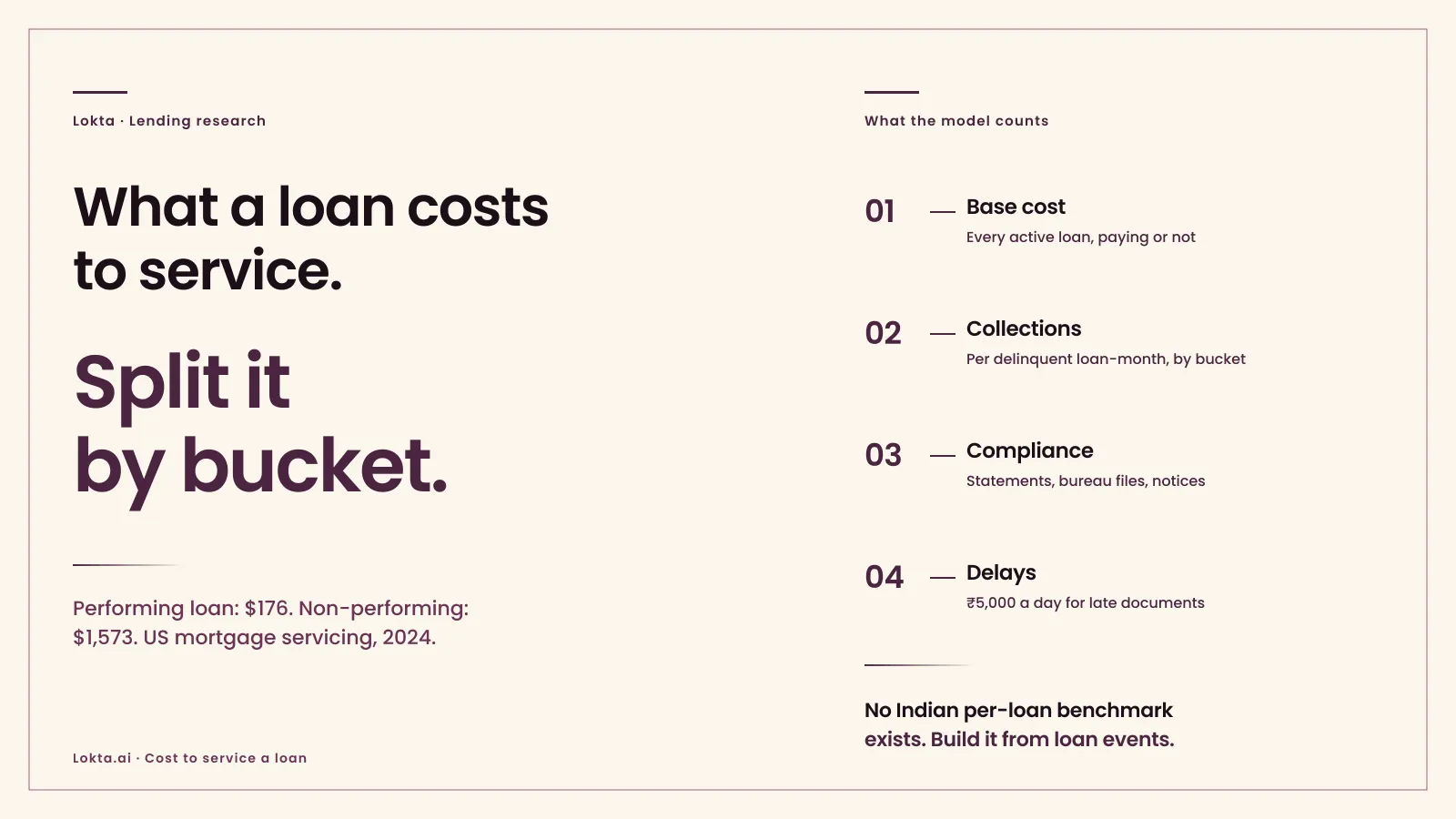
What it costs to service a loan: a cost-per-loan model for an NBFC book
How to work out what it costs an NBFC to service a loan: what RBI's ratios show, why delinquent loans cost more, and a cost-per-loan model from your books.
8 min readRead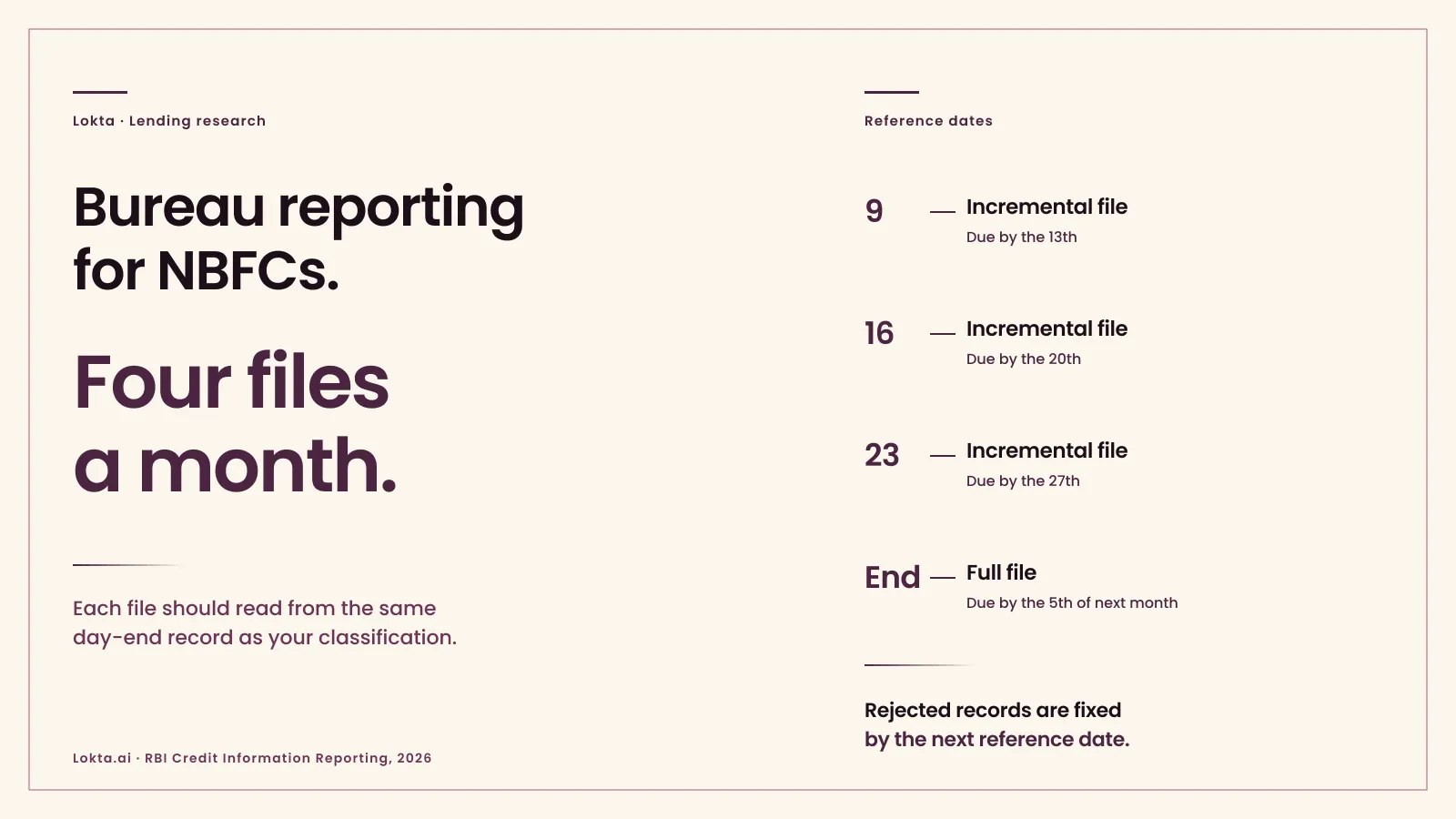
Credit bureau reporting for NBFCs: four reference dates a month from July 2026
Since 1 July 2026, NBFCs report to credit bureaus as on the 9th, 16th, 23rd and month end. Deadlines, rejections, corrections, and what your LMS must produce.
10 min readRead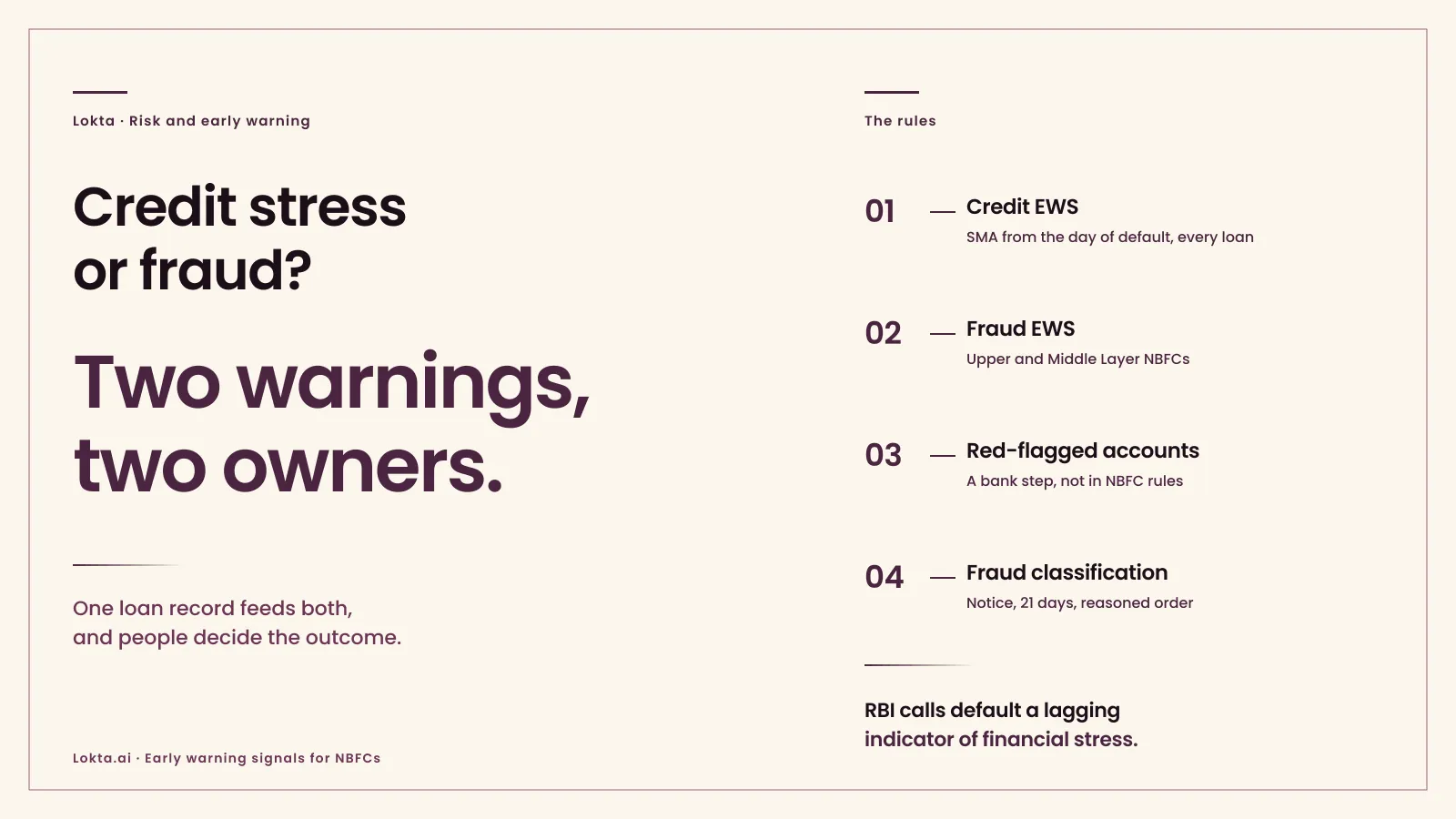
Early warning signals for NBFCs: credit EWS and fraud EWS are different things
RBI asks NBFCs to catch credit stress and fraud early under two separate sets of rules. What each requires, who it covers, and how one loan record feeds both.
8 min readRead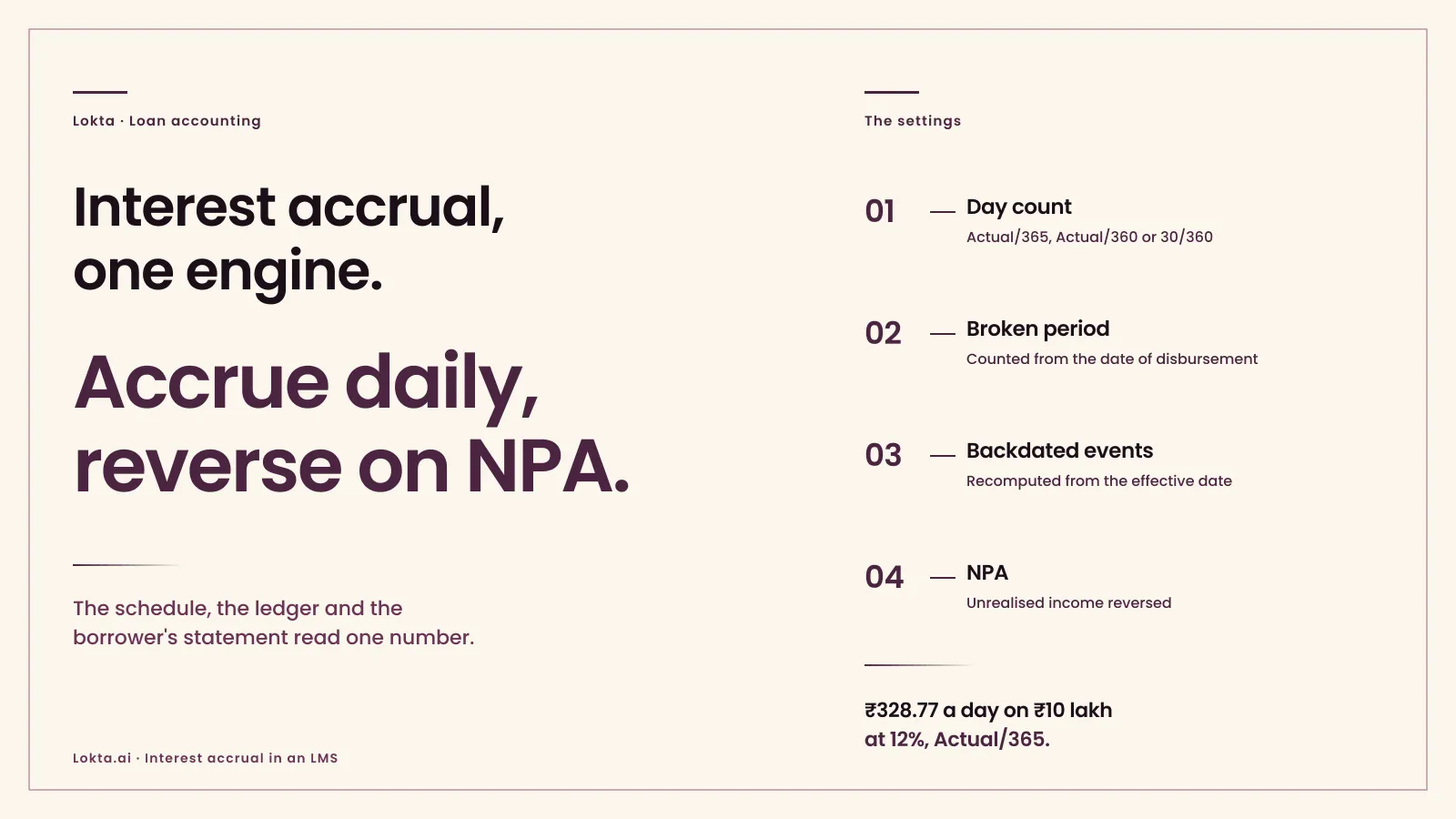
Interest accrual in a loan management system: daily accrual, day count and reversal
How a loan system should accrue interest daily, which day-count convention to set, how to handle broken periods and backdated events, and when to reverse it.
8 min readRead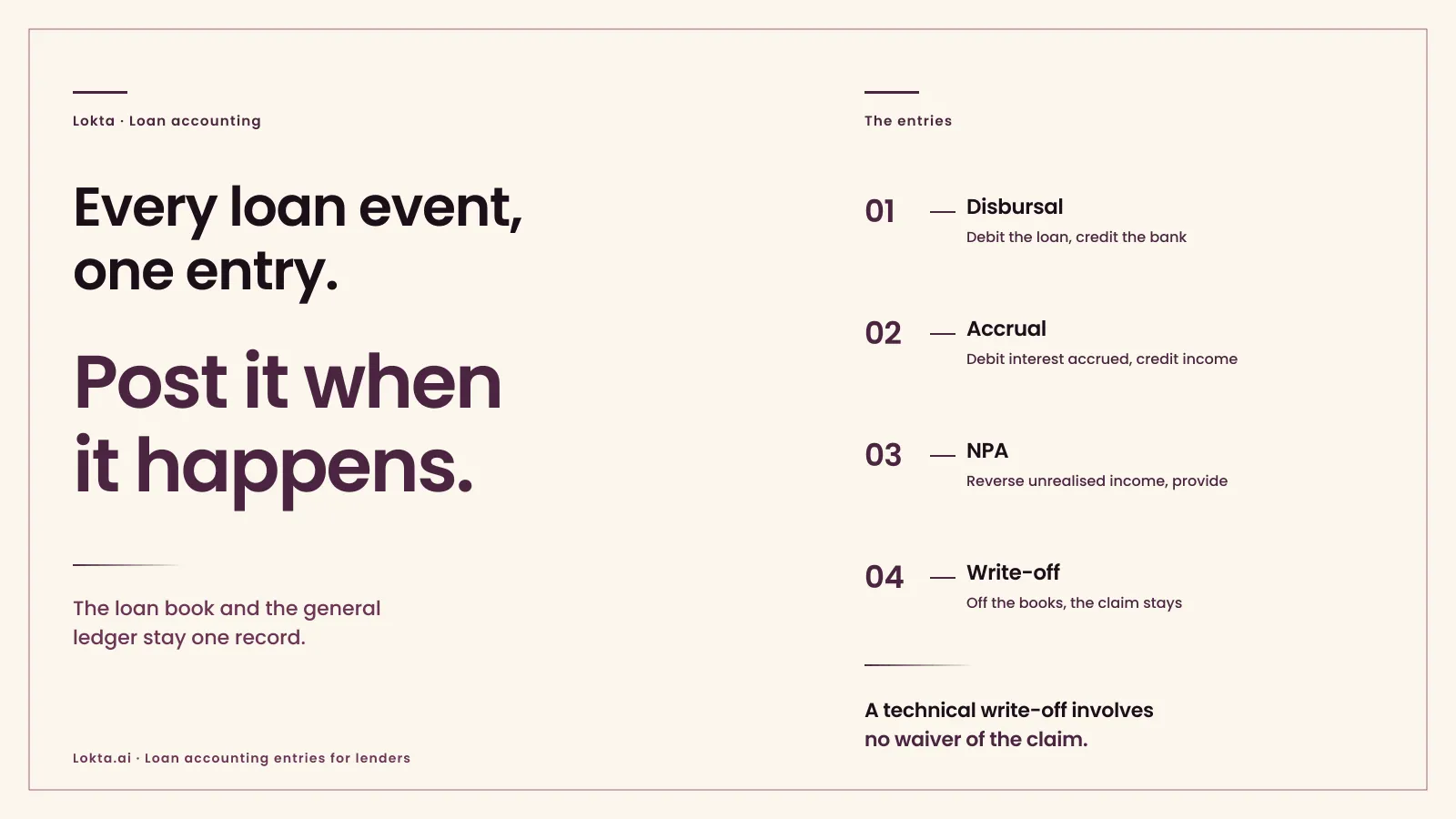
Loan accounting entries for lenders: GL postings from disbursal to recovery after write-off
The journal entries a loan system should post for each loan event, from disbursal, accrual and repayment to NPA reversal, provisioning, write-off and recovery.
8 min readRead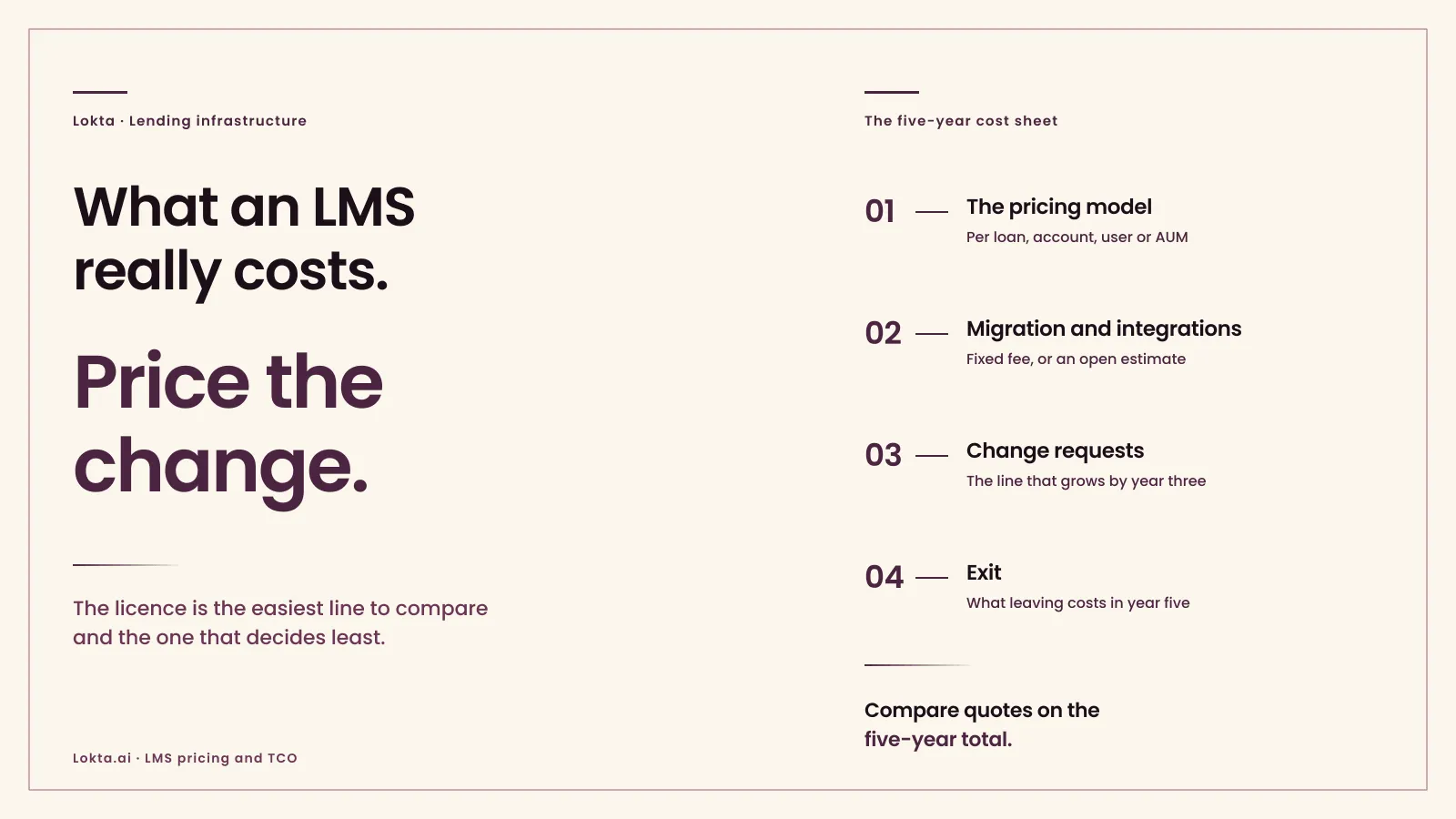
Loan management system cost: pricing models and TCO
What a loan management system costs: the pricing models vendors use, the fees buried in implementation and change requests, and a published price to anchor on.
12 min readRead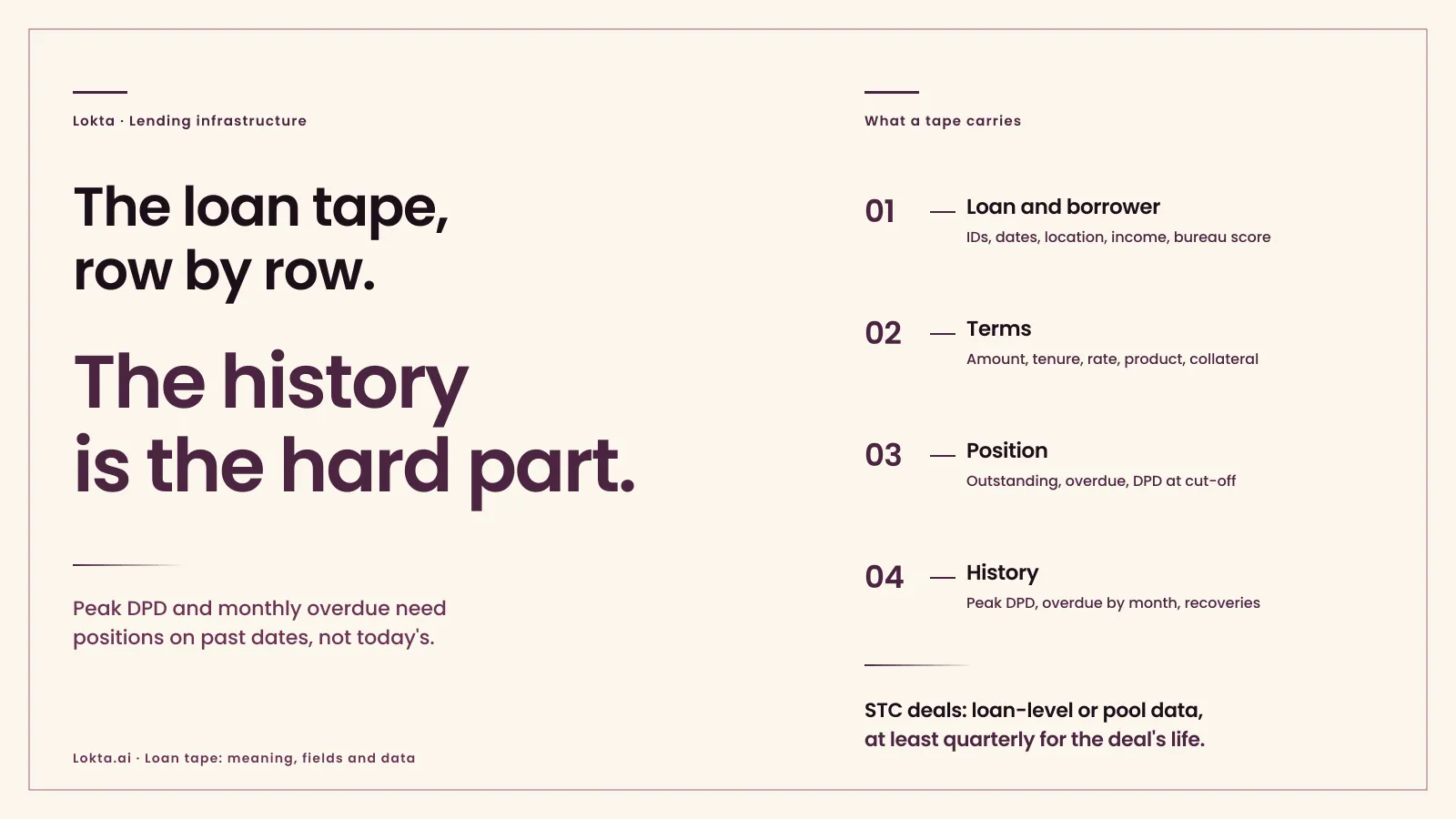
Loan tape: what a buyer, investor or rating agency asks for, and the loan history behind it
What a loan tape is, who asks an Indian NBFC for one, the fields RBI's rules and rating agencies look at, and the loan history a loan system has to keep.
9 min readRead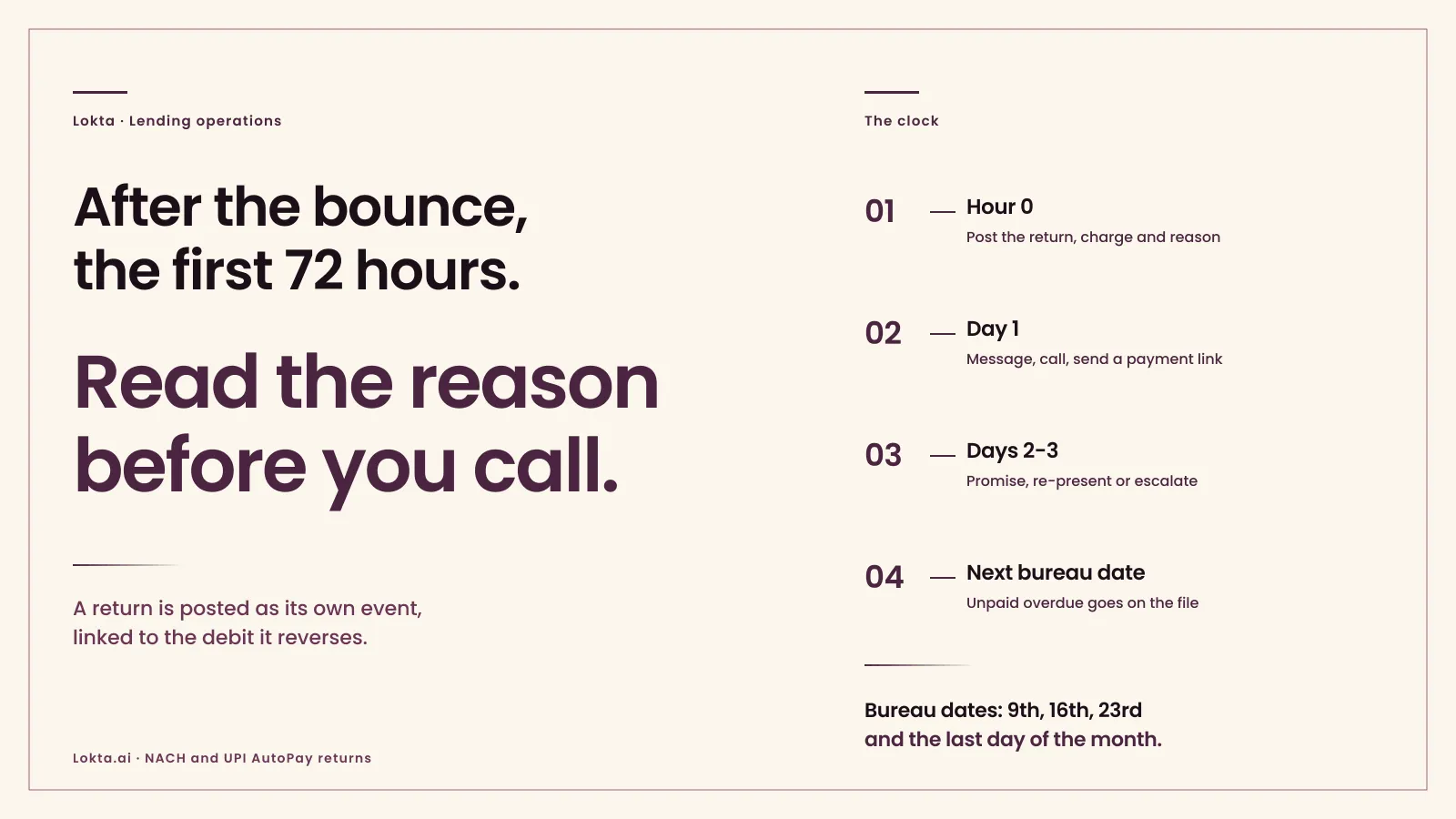
NACH or UPI AutoPay bounce: the lender's first 72 hours
What an NBFC should do in the 72 hours after a NACH or UPI AutoPay debit bounces: post the return, read the reason, reach the borrower and beat the bureau date.
12 min readRead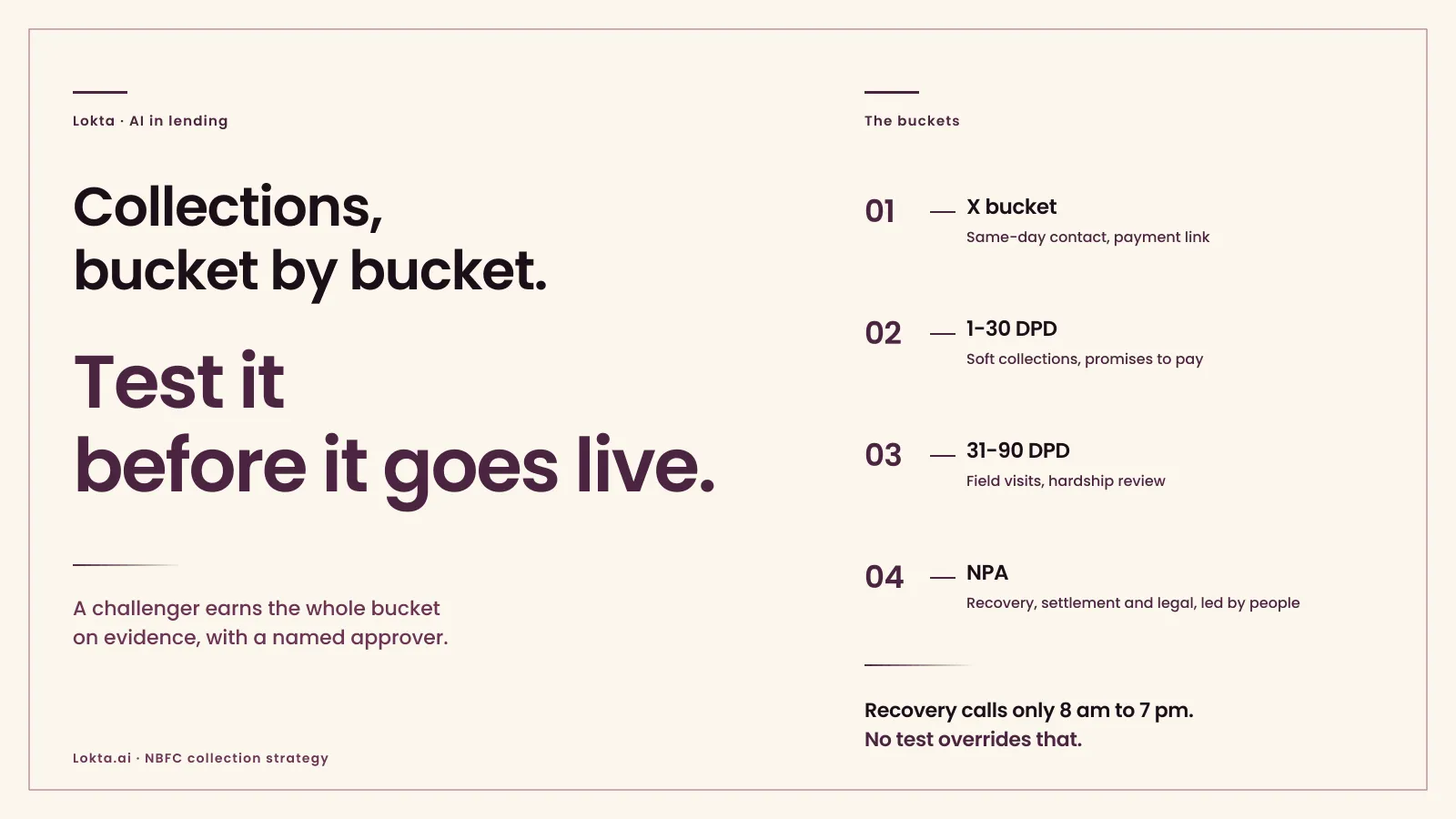
NBFC collection strategy, bucket by bucket
Design an NBFC collection strategy by DPD bucket. Review demand and receipts by due date, refresh work lists and test treatment changes inside lender policy.
11 min readRead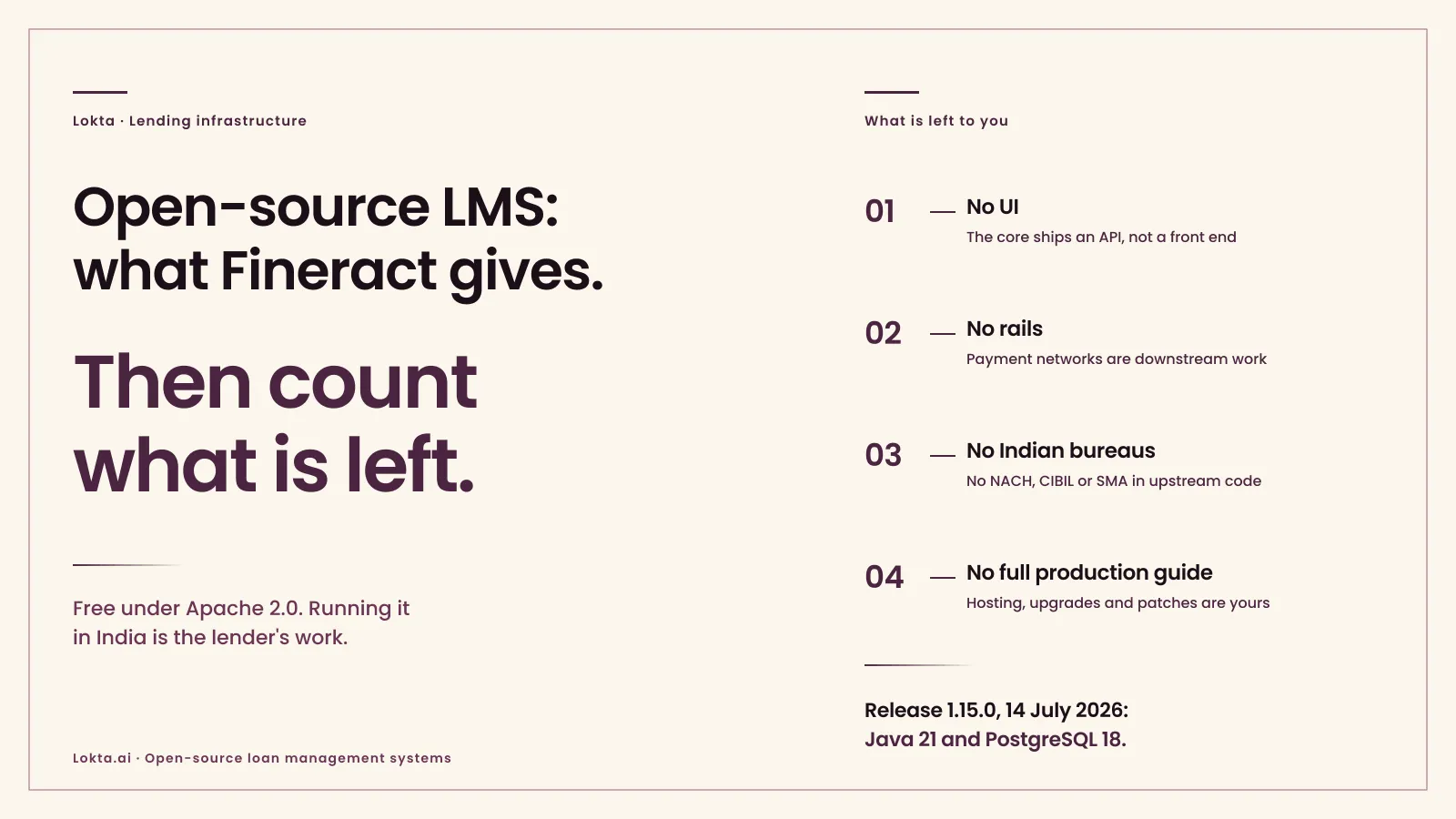
Open-source loan management systems: what Apache Fineract gives you and what you still build
Is Apache Fineract free, what does it do, and how is it installed? What an open-source loan management system gives an Indian lender, and what you still build.
8 min readRead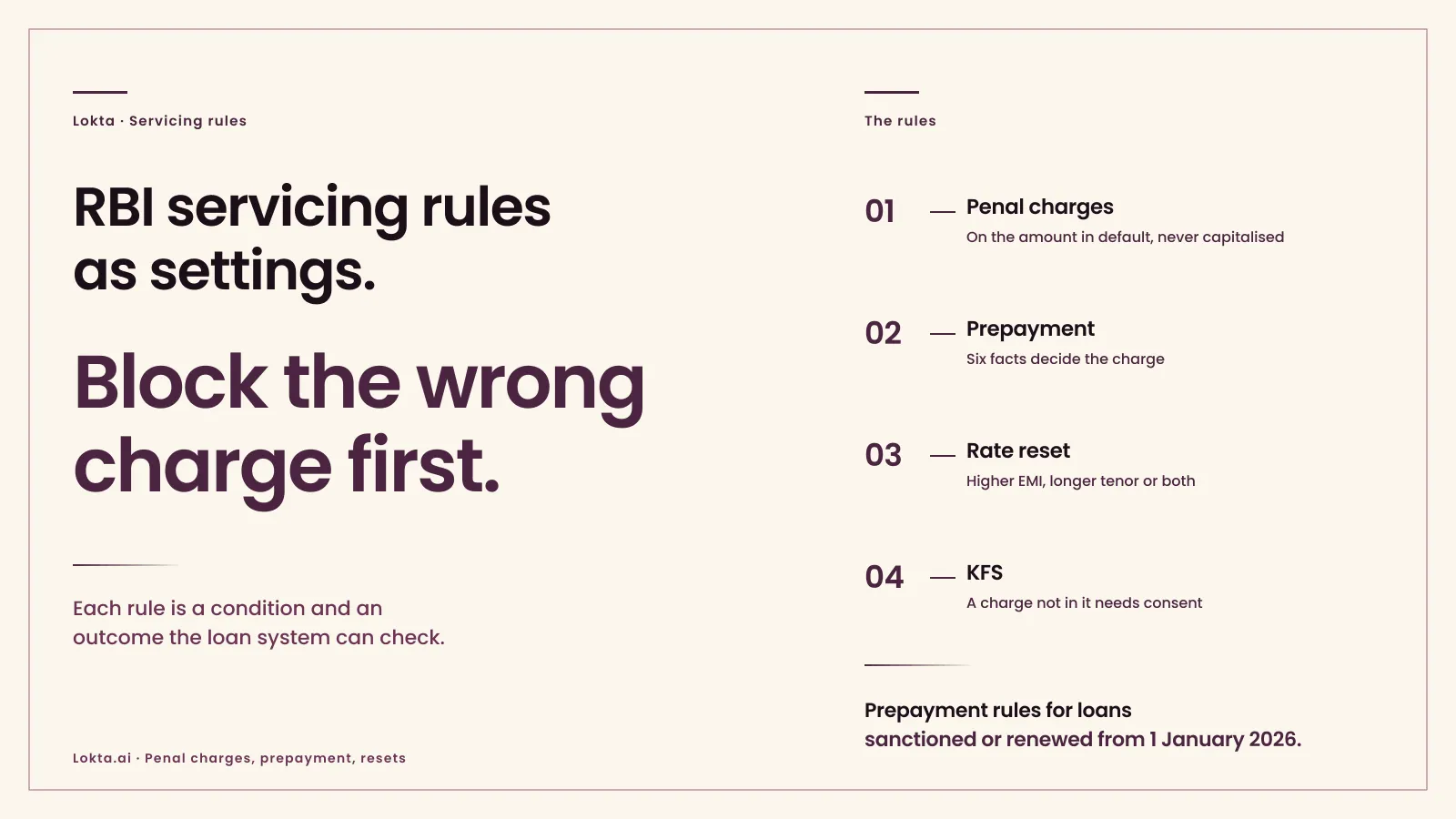
Penal charges, prepayment and rate resets: RBI's servicing rules as LMS configuration
RBI's rules for NBFCs on penal charges, prepayment charges and floating rate resets, set out as the conditions and settings a loan system has to enforce.
10 min readRead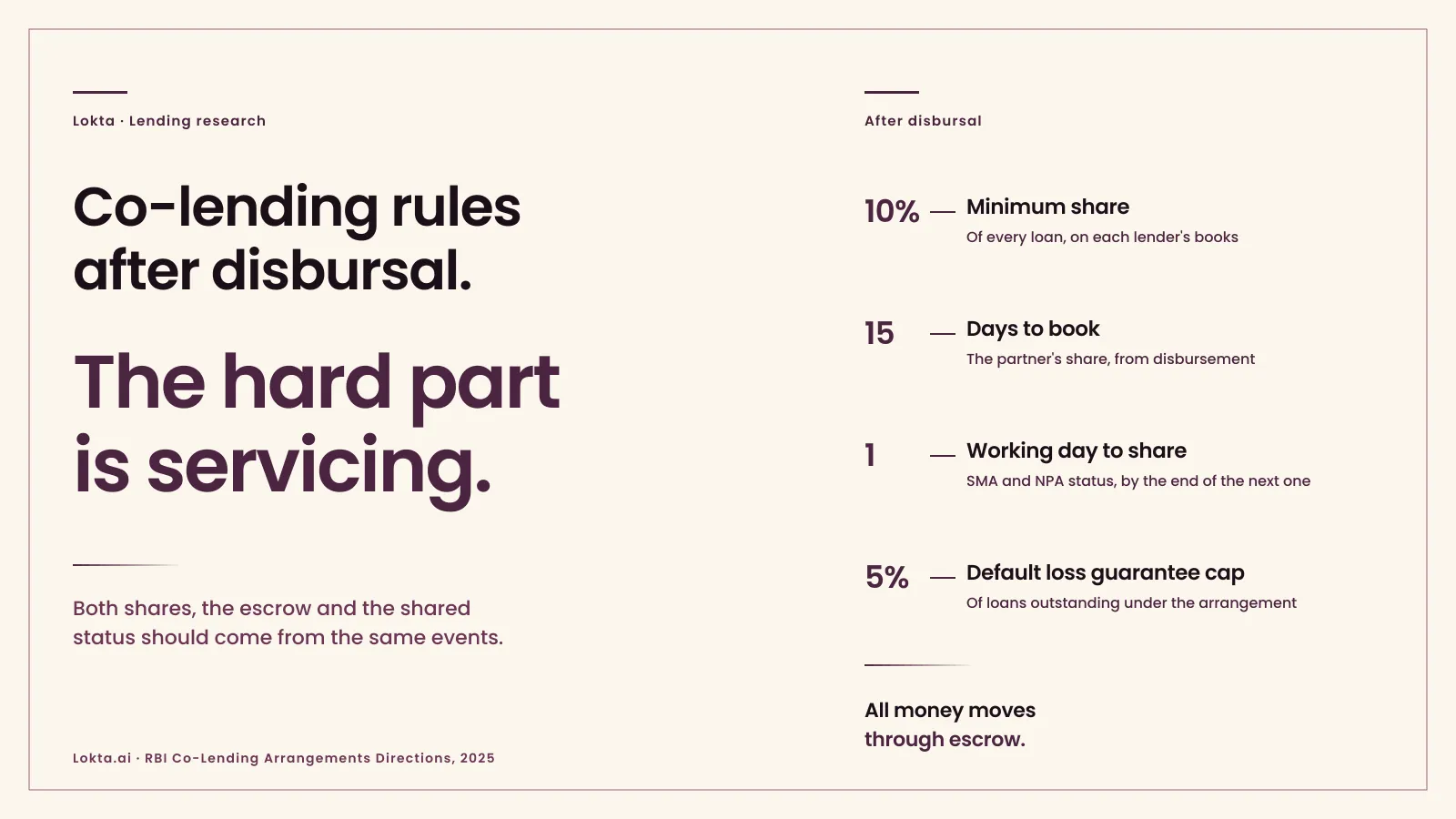
RBI Co-Lending Directions 2025: what changes after disbursal
What RBI's Co-Lending Arrangements Directions, 2025 require once a loan is live: the 10% share, escrow, 15-day booking and next-day SMA and NPA sharing.
10 min readRead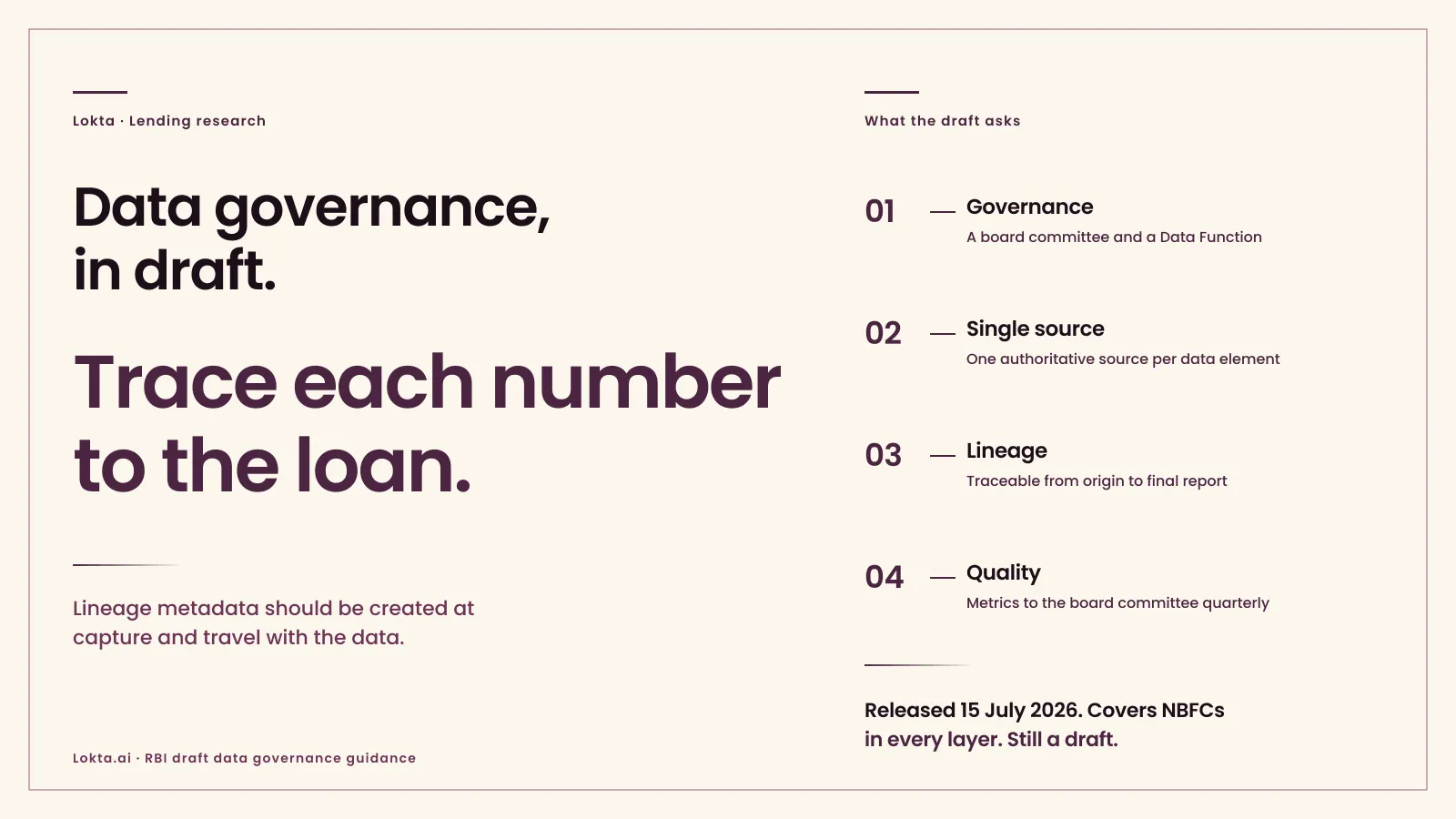
RBI's draft data governance guidance: tracing a reported number back to the loan behind it
What RBI's July 2026 draft data governance guidance would ask of NBFCs: a single source of truth, lineage from capture to return, metadata and quality metrics.
8 min readRead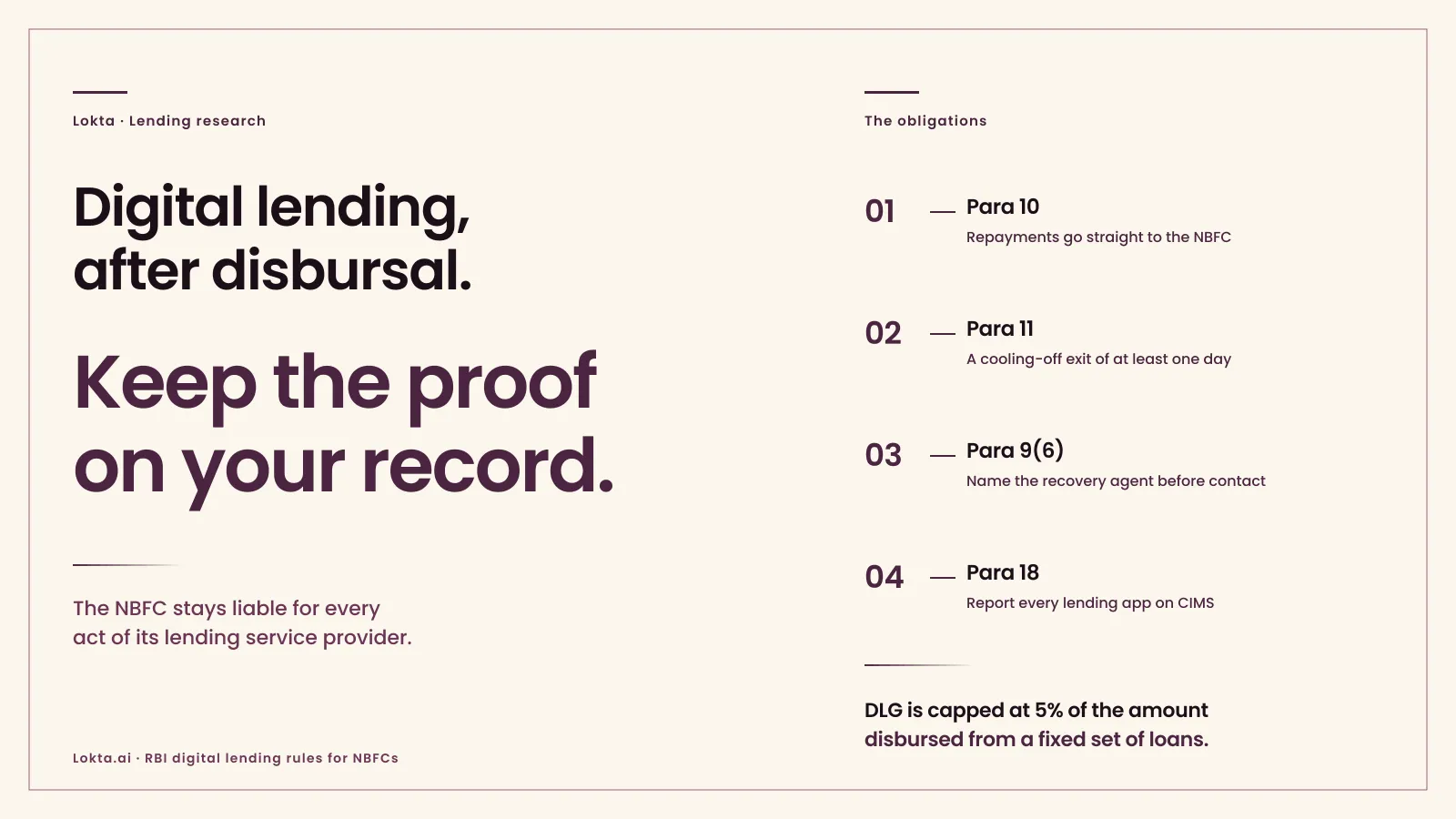
RBI digital lending rules for NBFCs: what you have to evidence after disbursal
Where RBI's digital lending rules for NBFCs sit now, and what they ask after disbursal: fund flow, cooling-off, recovery notices, data, DLA reporting and DLG.
12 min readRead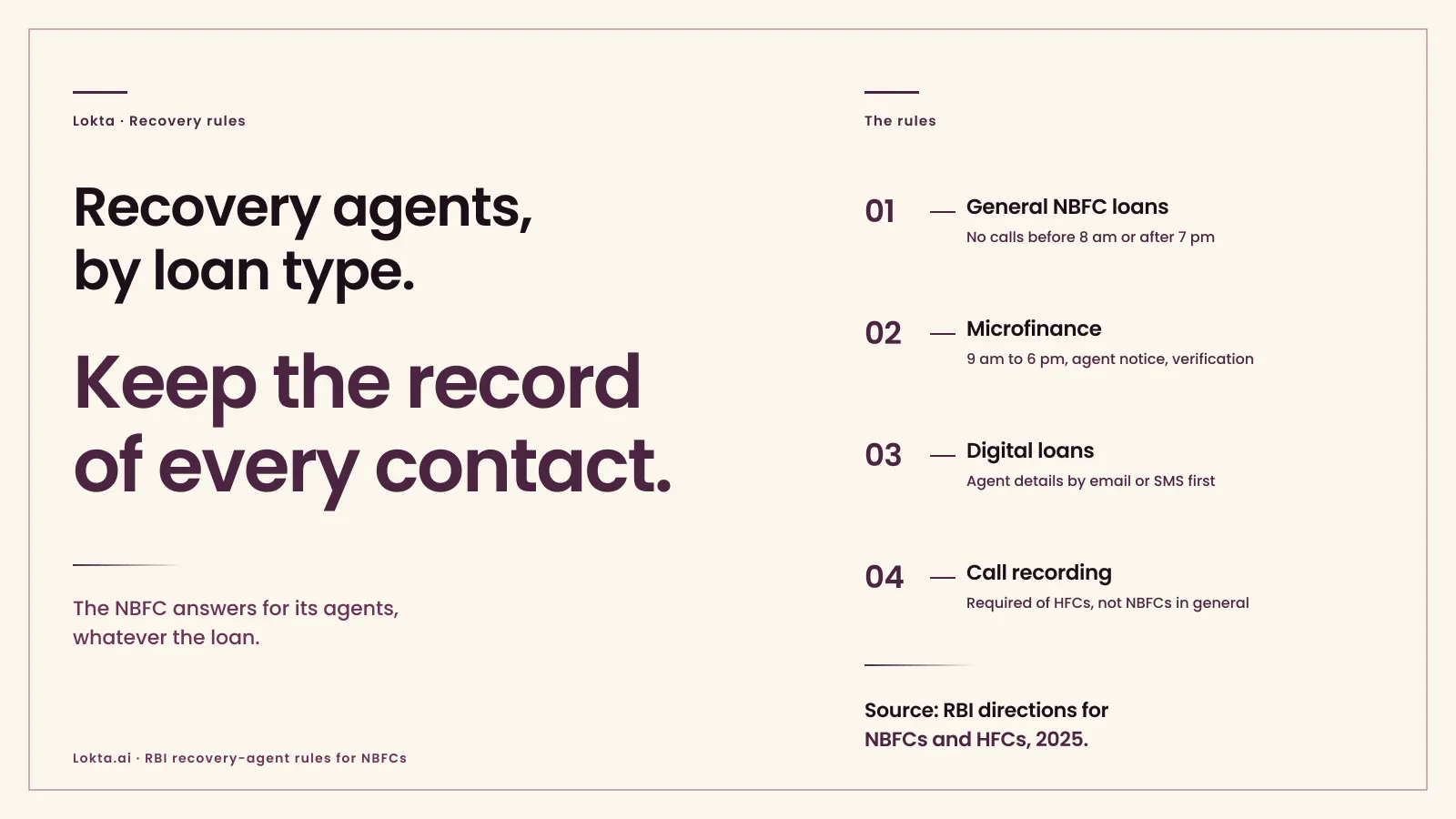
RBI recovery-agent rules for NBFCs: the evidence every collection contact should leave
Which RBI recovery-agent rules apply to which NBFC loans, from calling hours to agent notices, and the record that shows each collection contact was lawful.
8 min readRead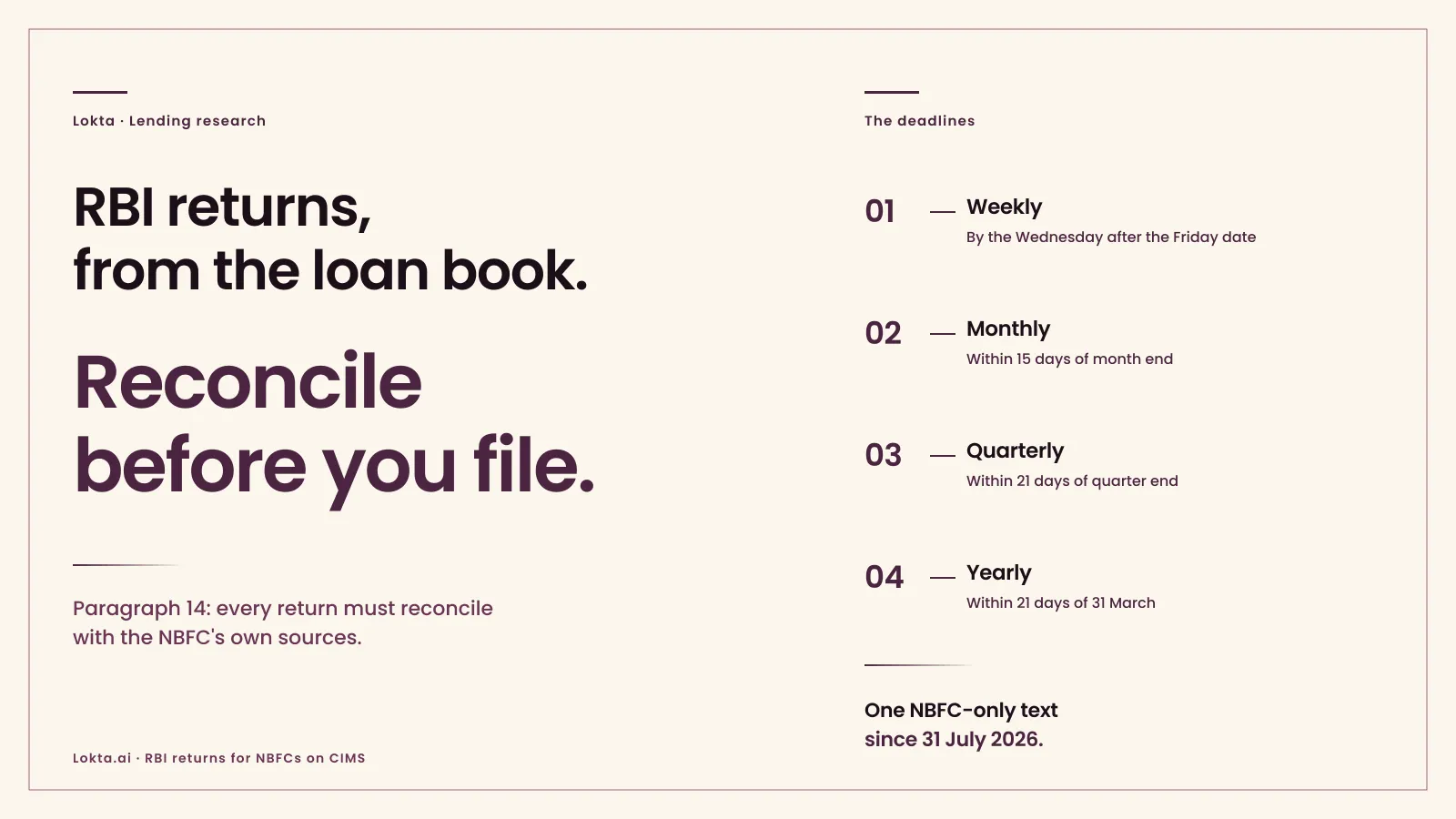
RBI returns for NBFCs on CIMS: which ones you file, when, and which numbers come from the loan book
Which RBI returns an NBFC files on CIMS by layer, the due dates, the data-quality rules behind them since July 2026, and which figures start in the loan book.
9 min readRead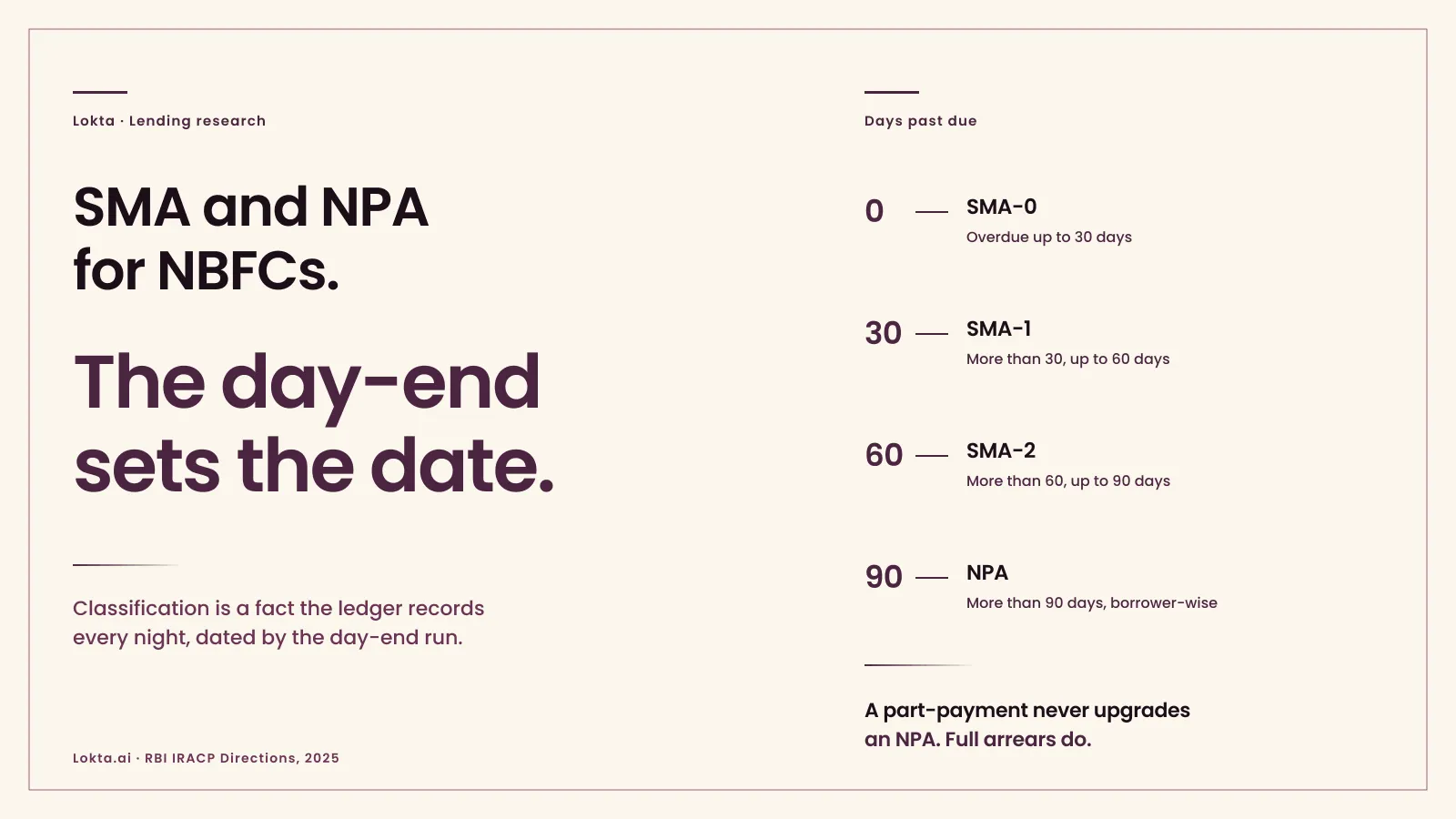
SMA and NPA classification for NBFCs: the day-end rules
When an NBFC loan turns SMA-0, SMA-1, SMA-2 or NPA under RBI rules, why the day-end run sets the date, and what your loan system has to prove every night.
12 min readRead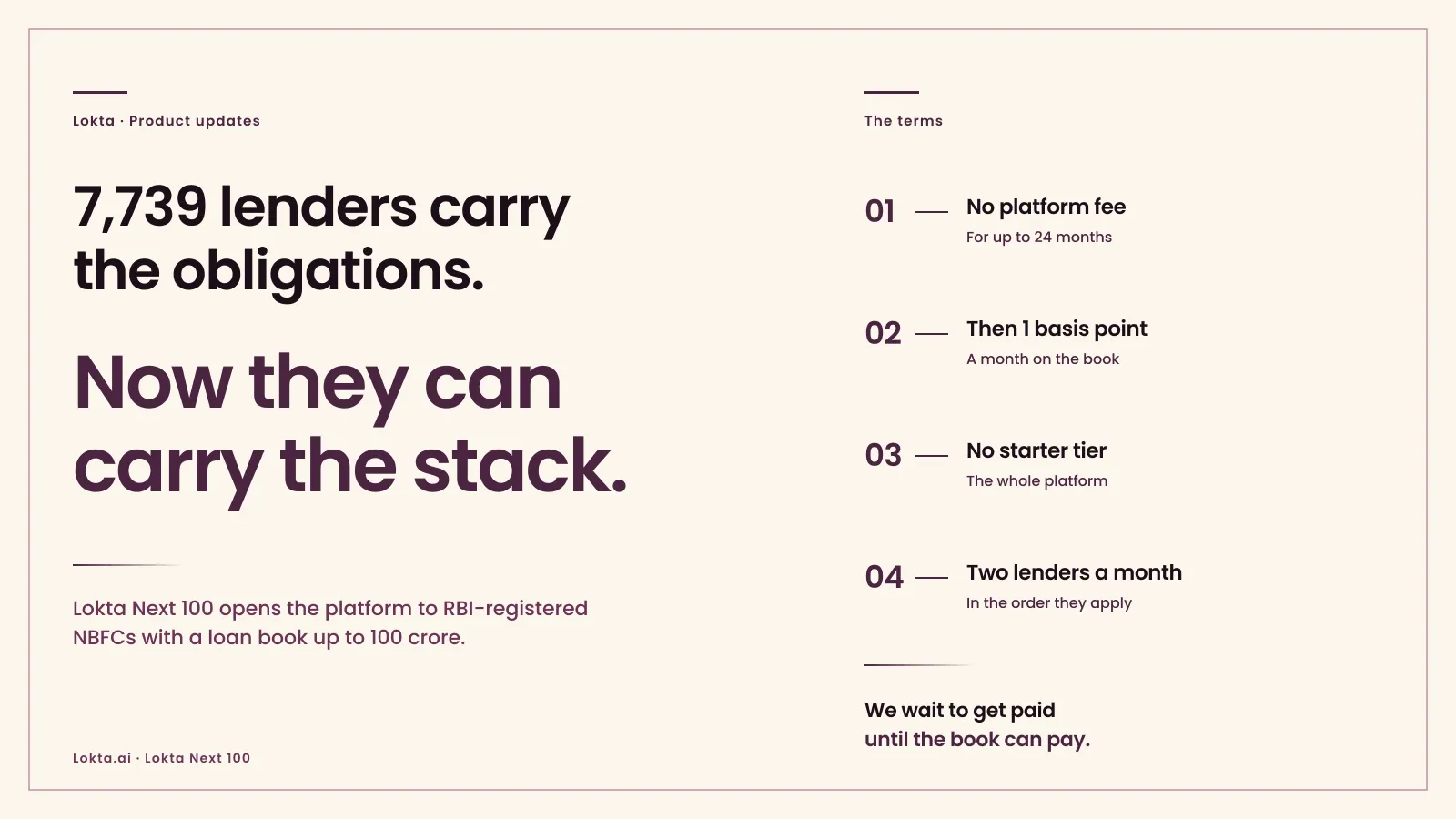
Lokta opens its platform to NBFCs up to ₹100 crore, with no platform fee for up to two years
The programme is aimed at lenders whose credit judgment can build an institution before the book is large enough to pay for one.
6 min readRead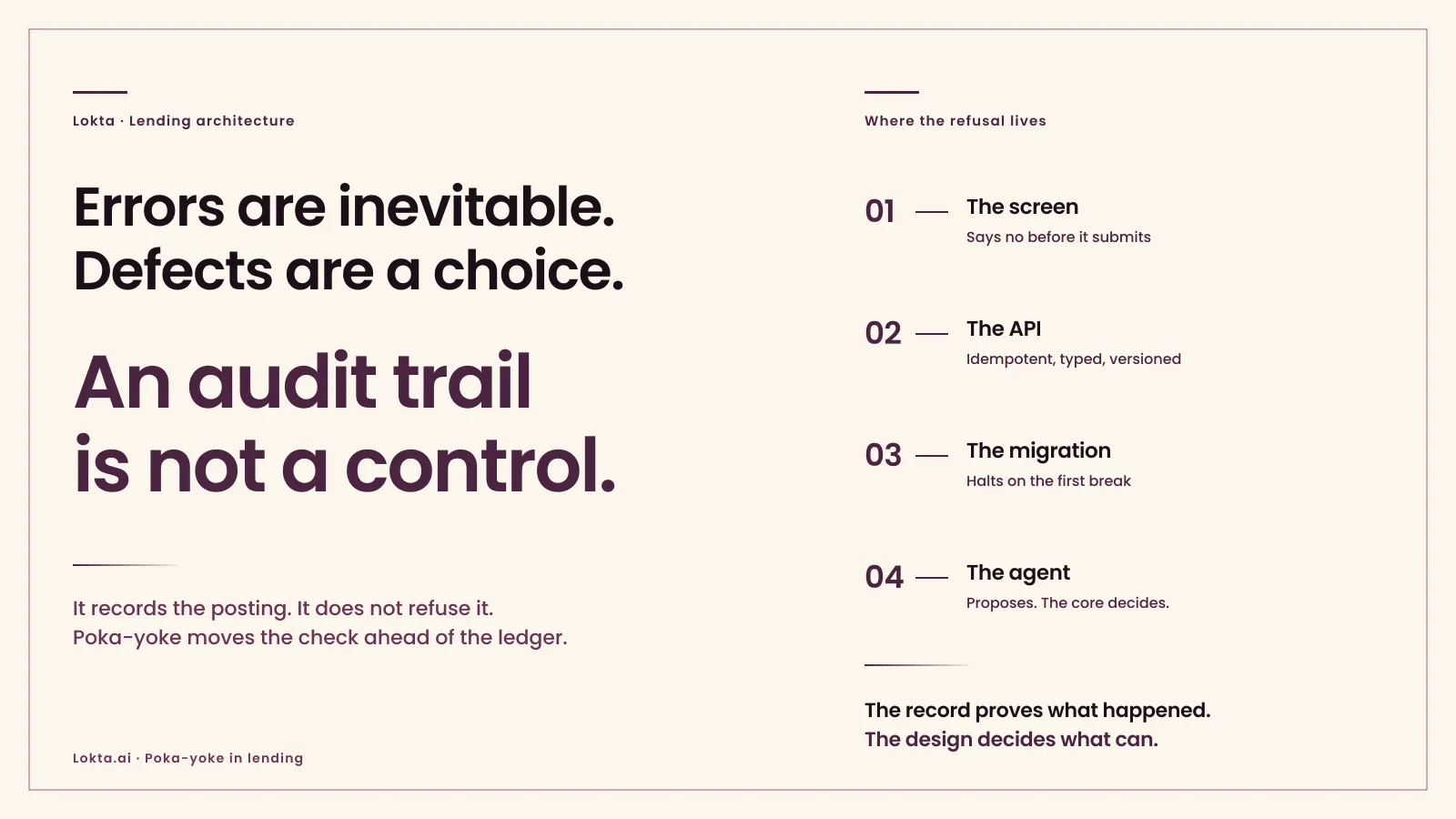
Poka-yoke in lending: an audit trail is not a control
Toyota drew a line between a mistake and a defect. Lending software mostly ignores it. Here is what the other kind of system looks like, one layer at a time.
17 min readRead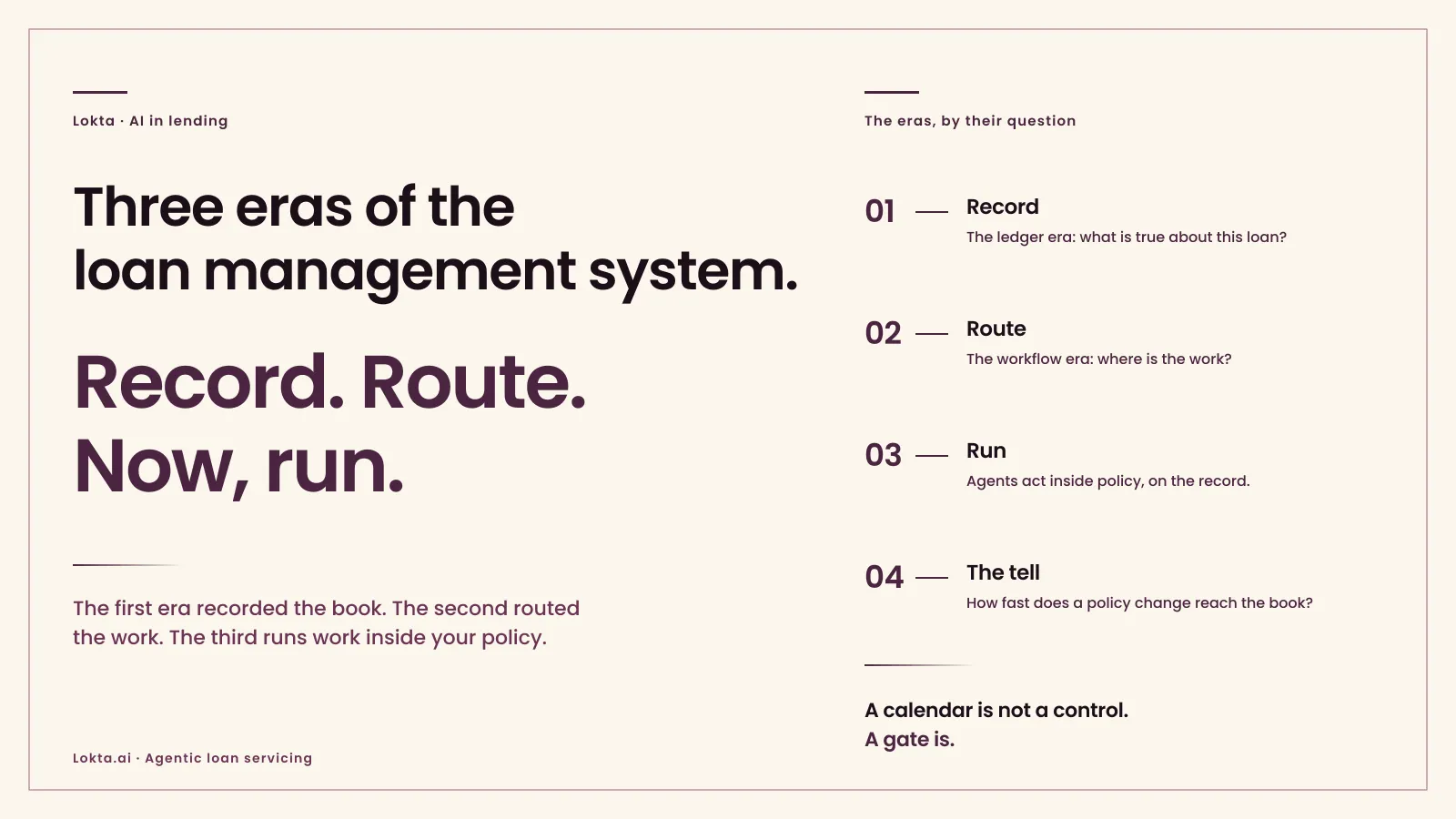
Record, route, run: the three eras of the loan management system
Every era of the loan management system changed what it did with your policy. The first recorded the book. The second routed the work. The third runs work on the book inside the policy, and AI features alone do not get a system there.
11 min readRead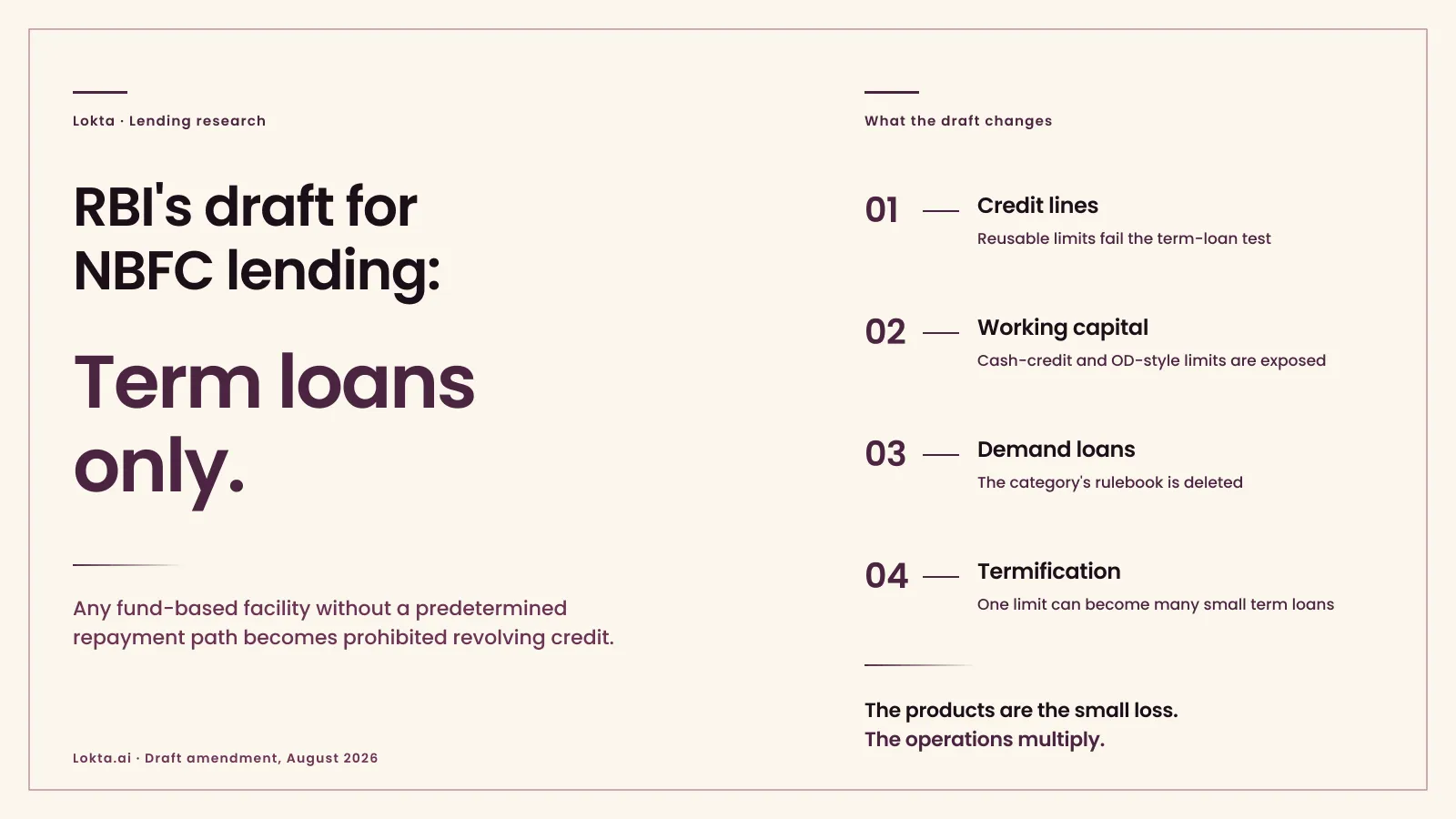
RBI's proposed revolving-credit restriction: what it means for NBFC lenders
The draft goes beyond reusable credit limits. It could change how NBFCs design, book and service consumer and business credit across the live book.
14 min readRead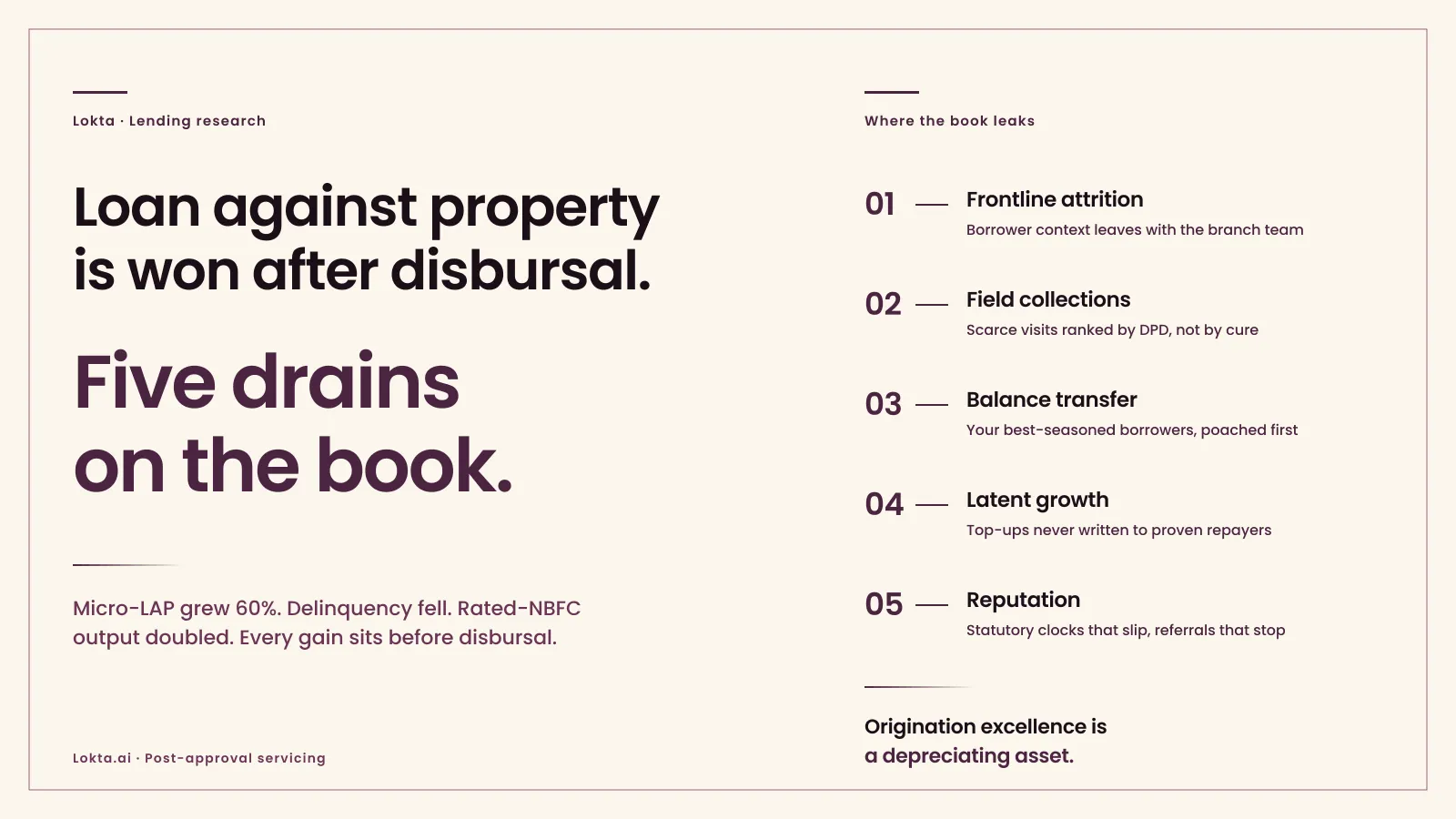
Loan Against Property (LAP) lenders in India: the five challenges that start after disbursal
Five things drain a loan against property book after the money goes out: frontline attrition, field collections, balance transfer, the top-ups nobody writes, and the statutory clocks that cost referrals when they slip. With a published signal behind each one.
14 min readRead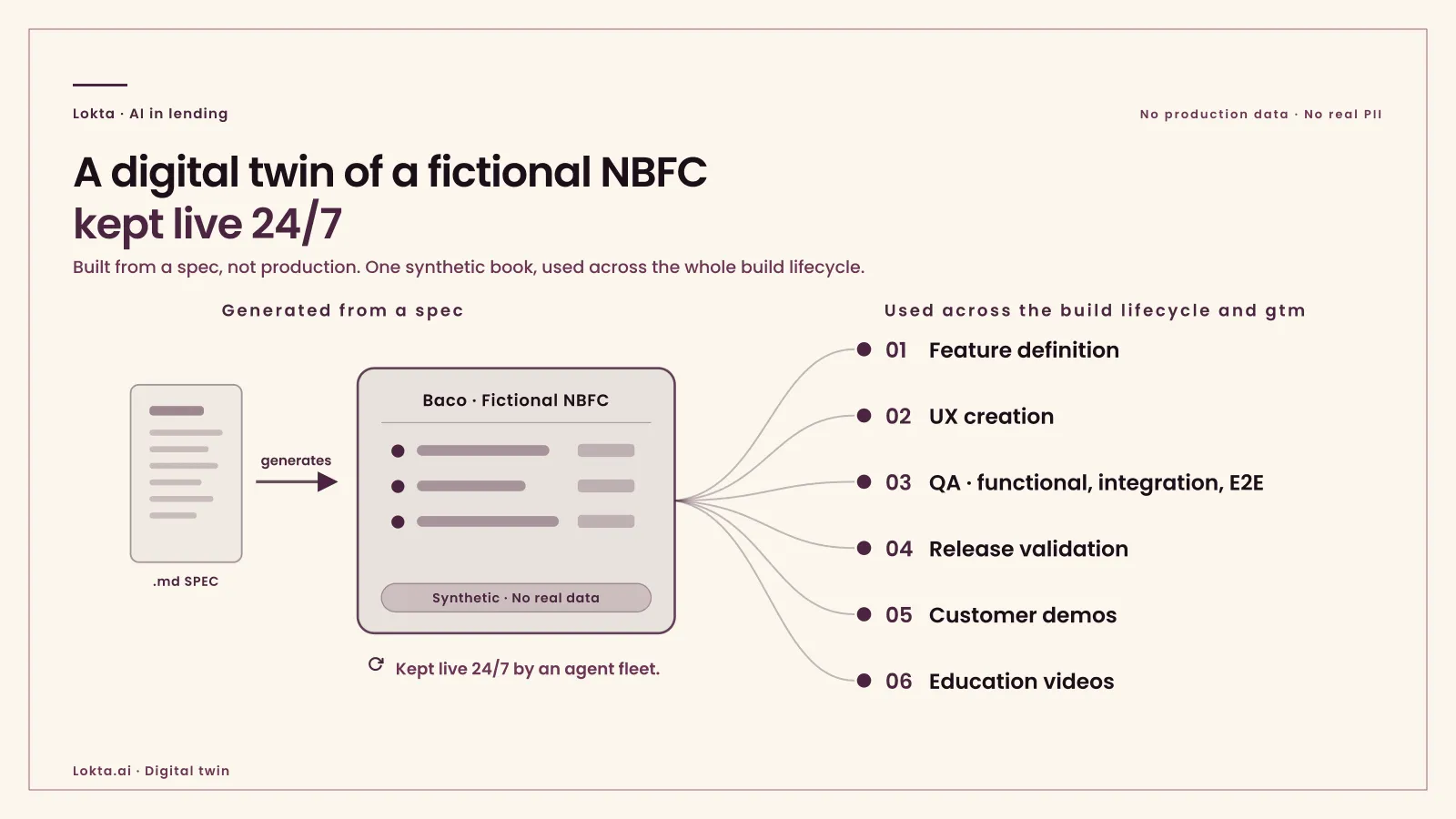
Why we test lending software on a digital twin NBFC
Most lending software is tested on stale, made-up data. That fake data, not the feature, is often the real bug. So we built a living NBFC we can test on.
17 min readRead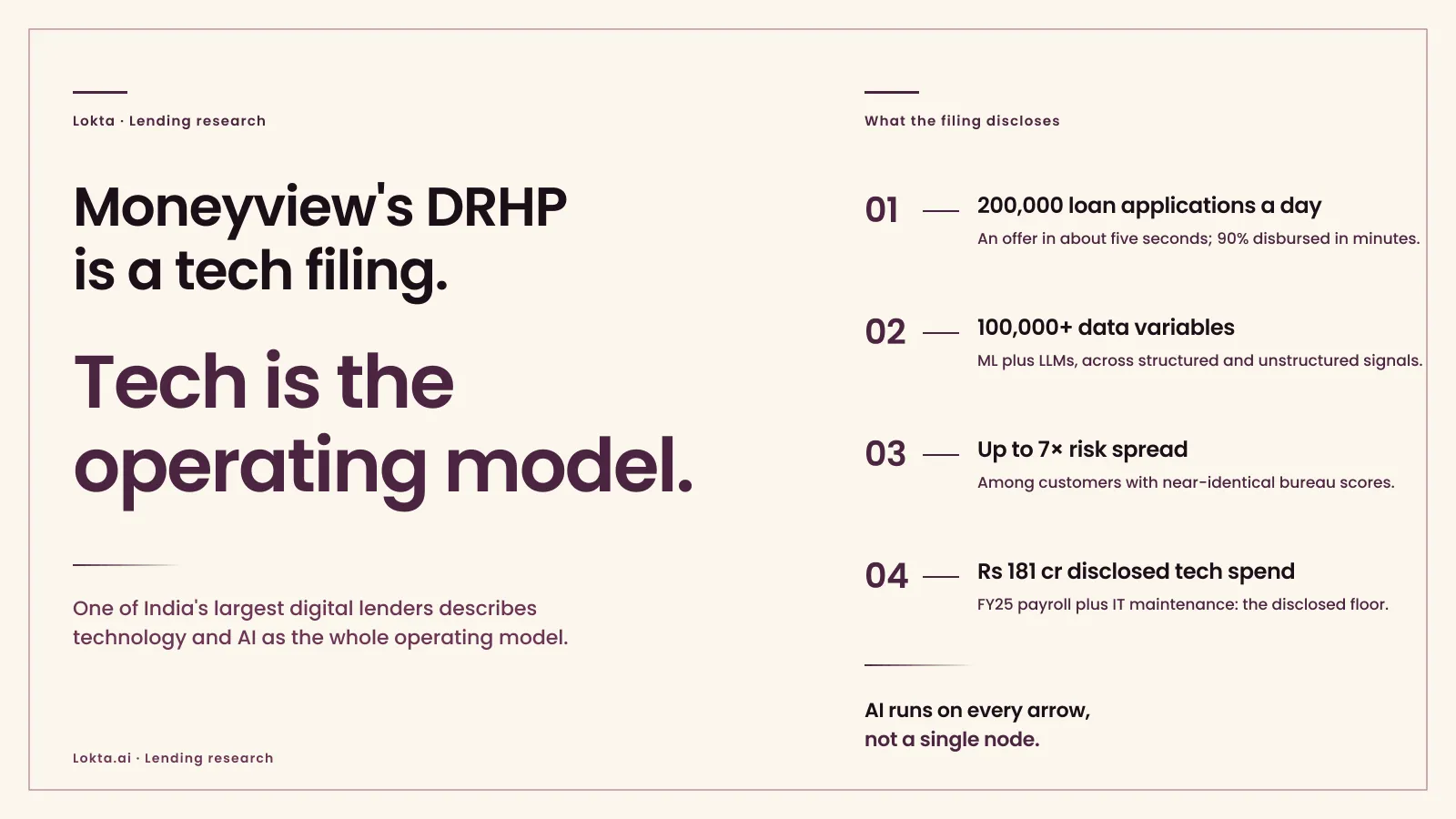
Inside Moneyview's technology and AI strategy
Moneyview's DRHP reads like a technology company's filing: AI across underwriting, collections and servicing, a hybrid LSP-plus-NBFC book, and a widening product line.
11 min readRead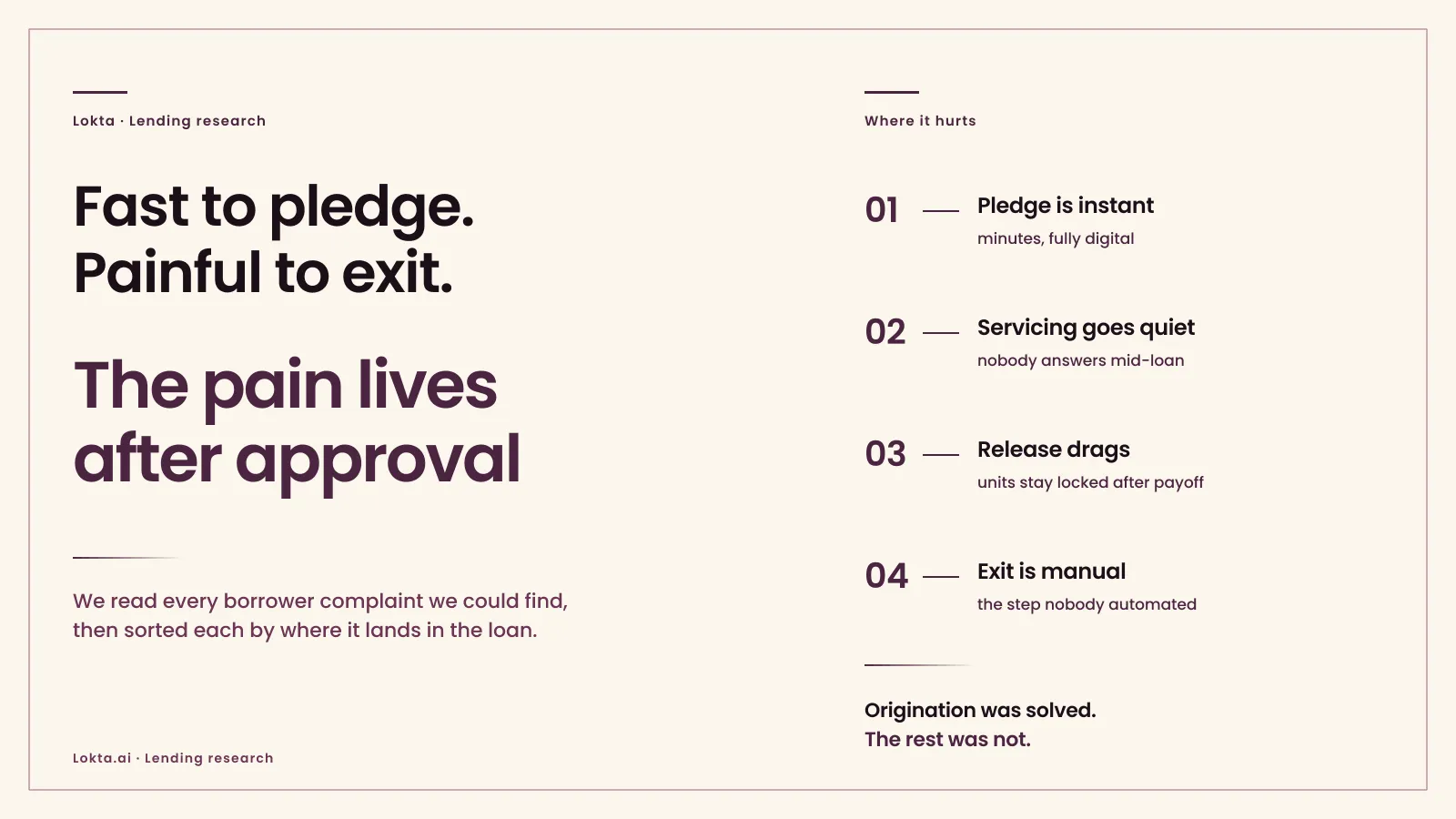
Loans against mutual funds: fast to pledge, painful to exit
We read every borrower complaint we could find on loans against mutual funds and shares, then sorted each by where it lands in the life of the loan. The pain clusters after approval.
9 min readRead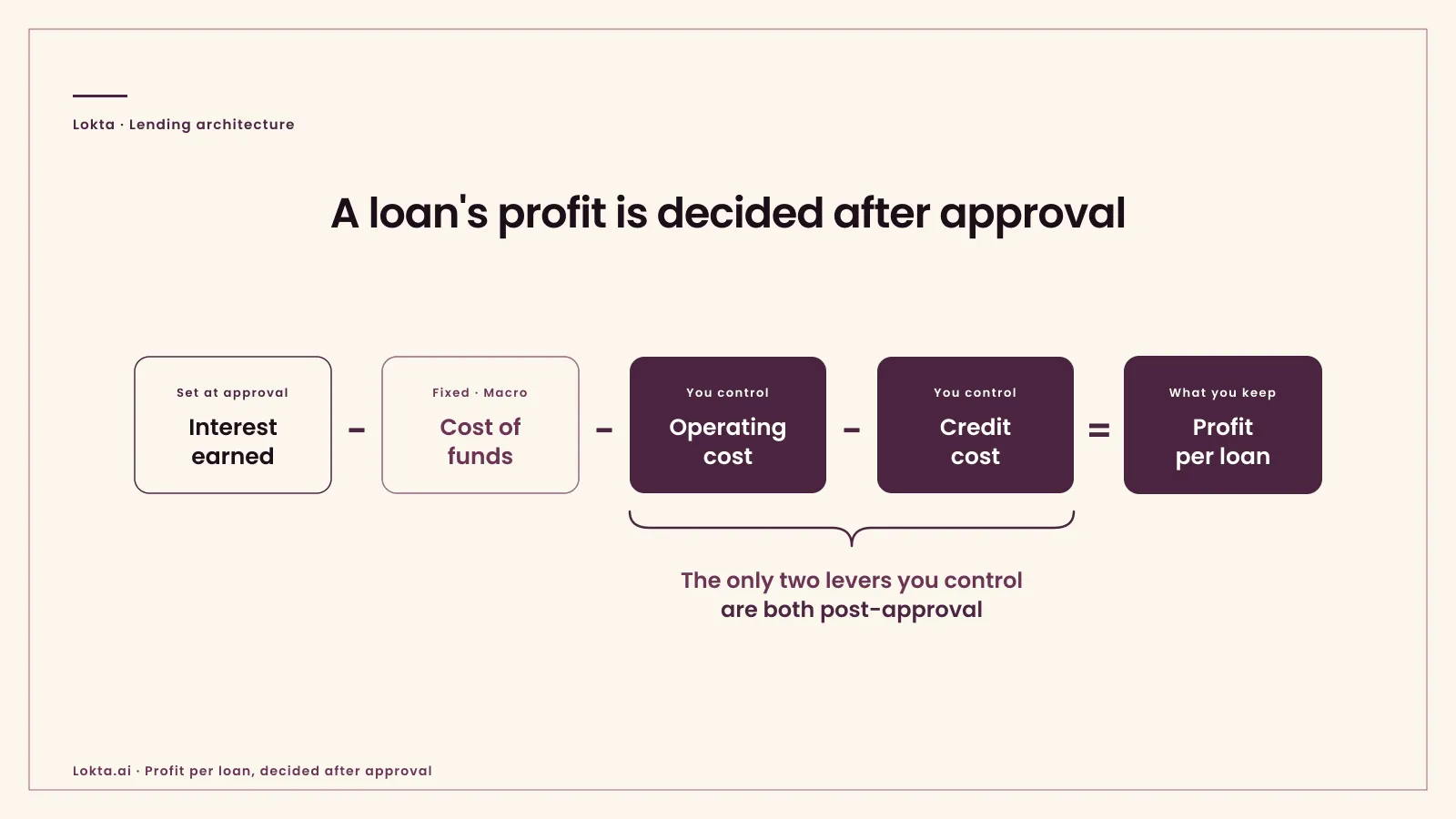
A loan's profit is decided after approval, not at underwriting
The credit decision is the least important call a lender makes. A loan's profit is won or lost after approval: in servicing, monitoring, and collections.
8 min readRead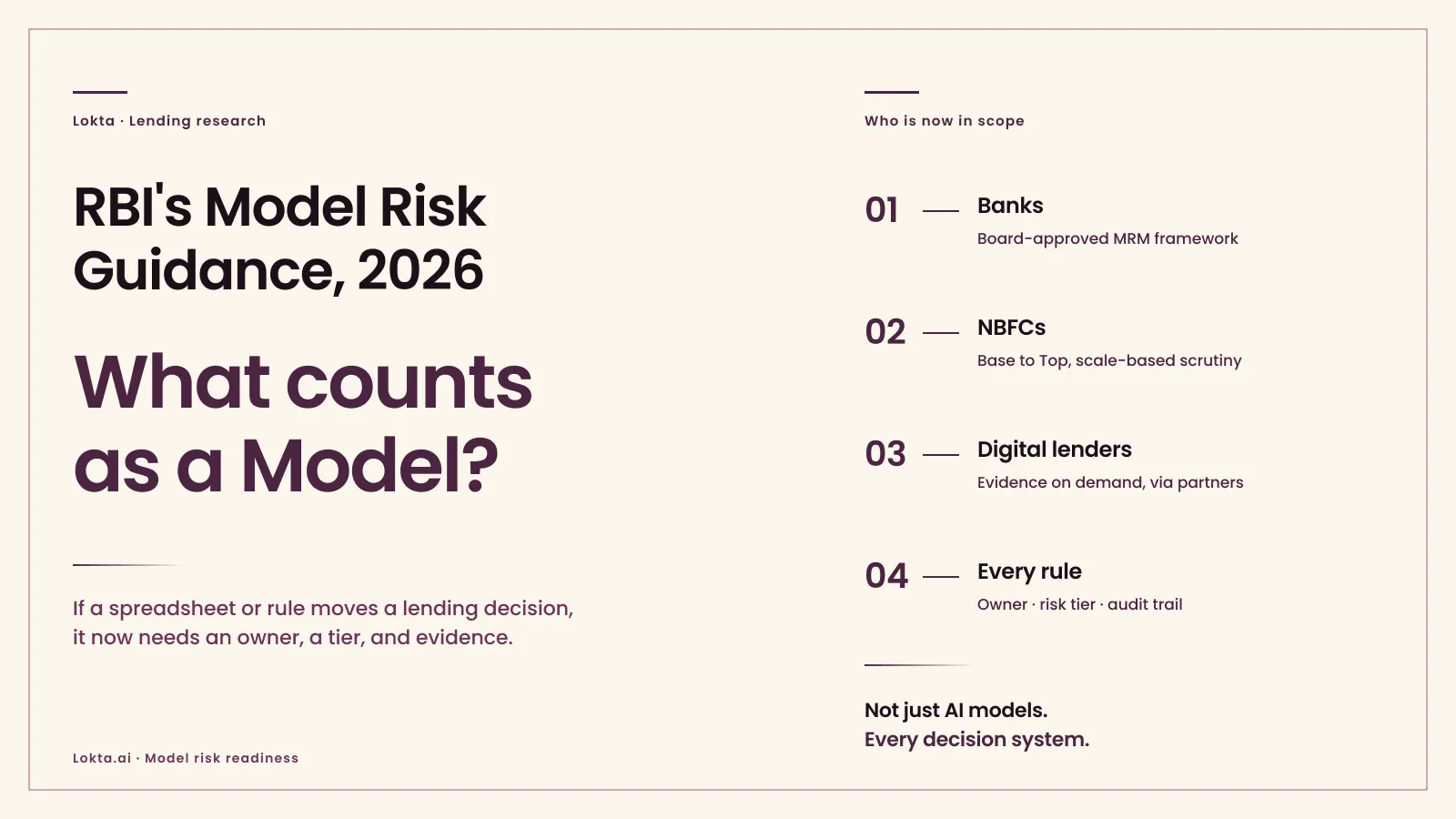
RBI Just Redefined What Counts as a 'Model'
I spent the last few days reading RBI's draft model risk guidance. The headline is not AI. It is that RBI just redefined what counts as a 'model,' and a pricing spreadsheet now qualifies.
14 min readRead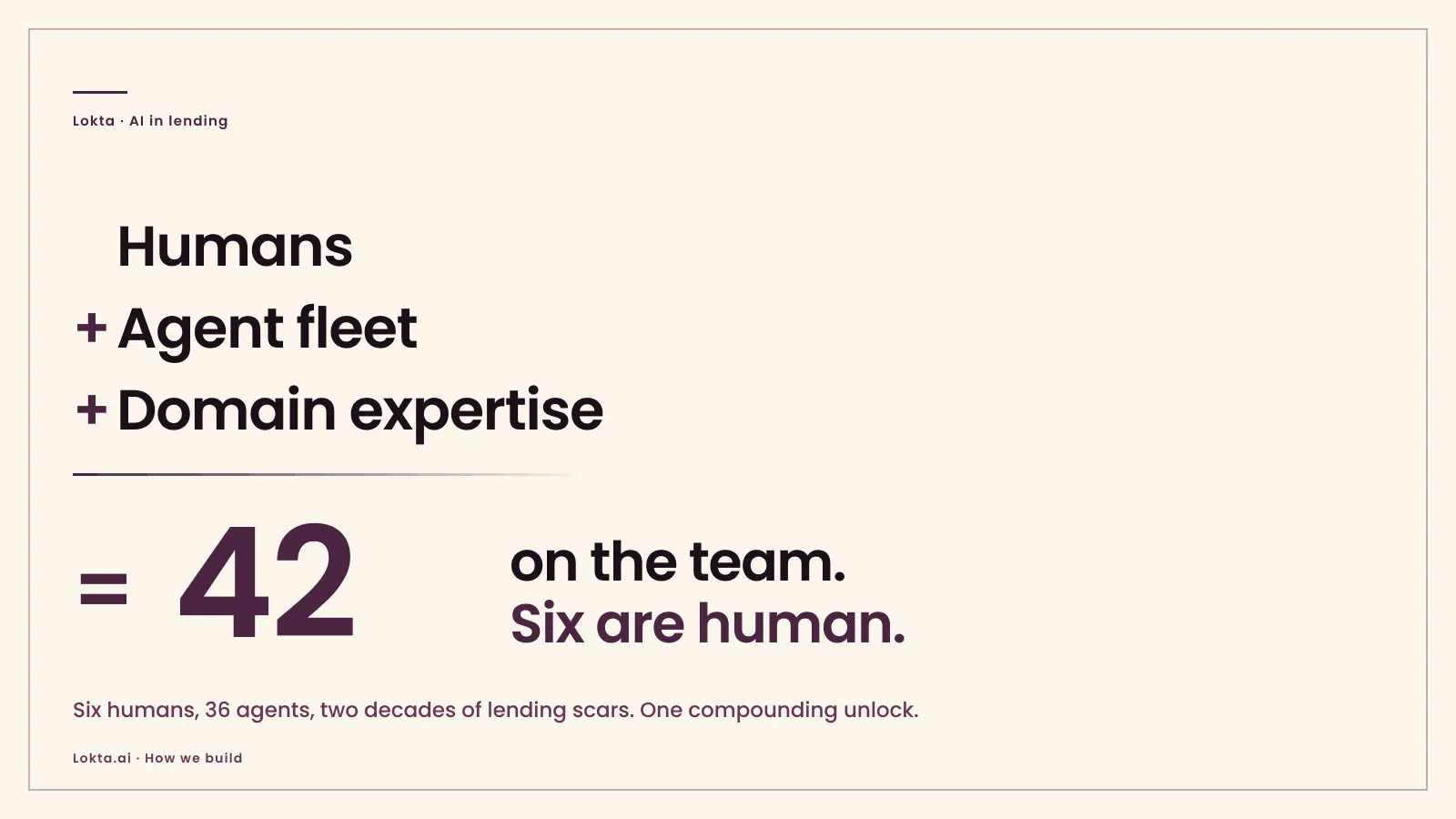
Our team is 42. Six of us are human.
Lenders keep asking how a six-person team ships this fast. The honest answer: everyone codes, and a role-specific agent fleet, pointed at four product principles and two decades of lending scars, runs the book of work alongside us.
11 min readRead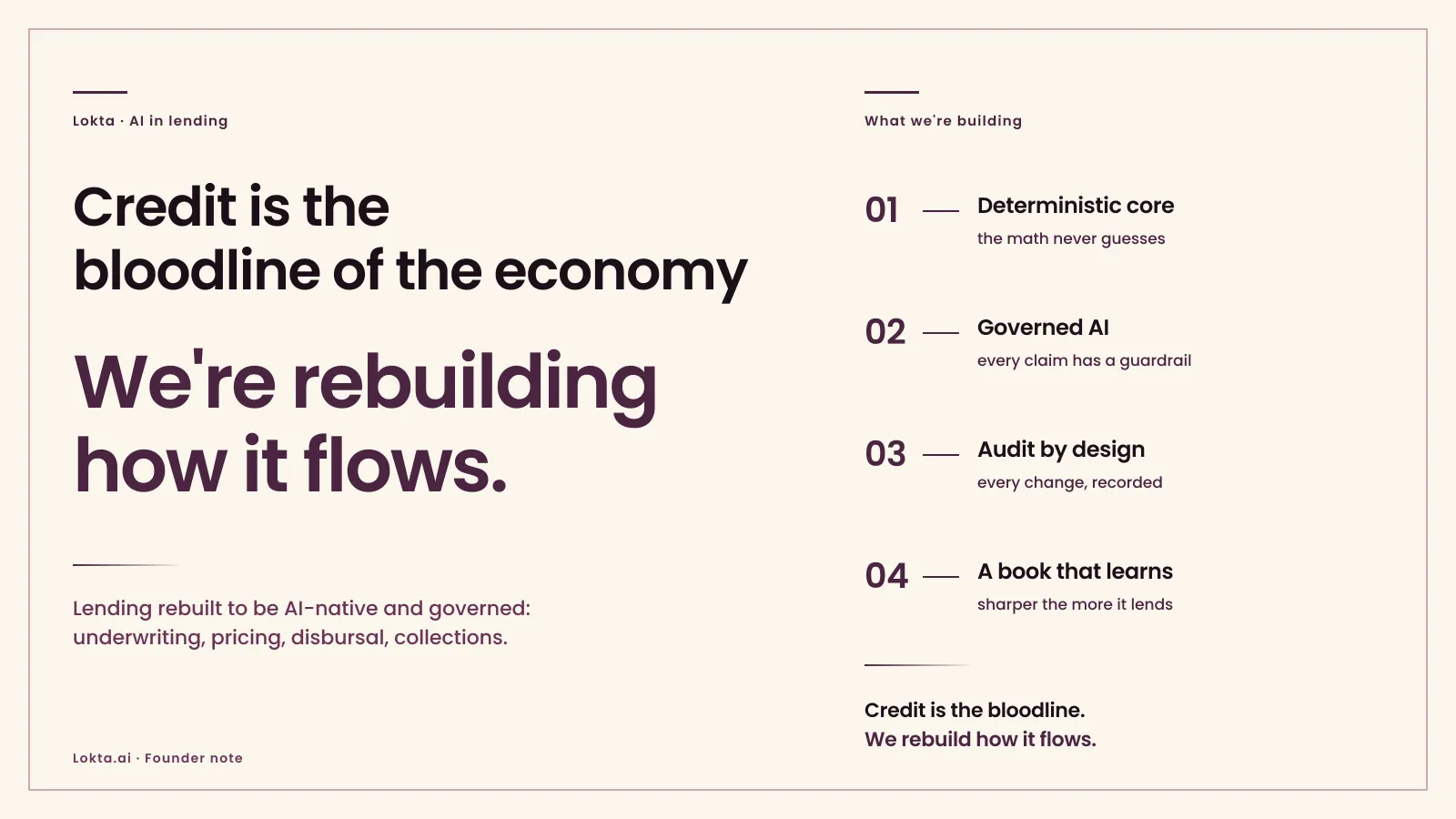
Credit is the bloodline of the economy
I'm co-founding Lokta, the agentic loan servicing platform lenders, fintechs and LSPs use to run the live book: servicing, monitoring, collections, recovery.
7 min readRead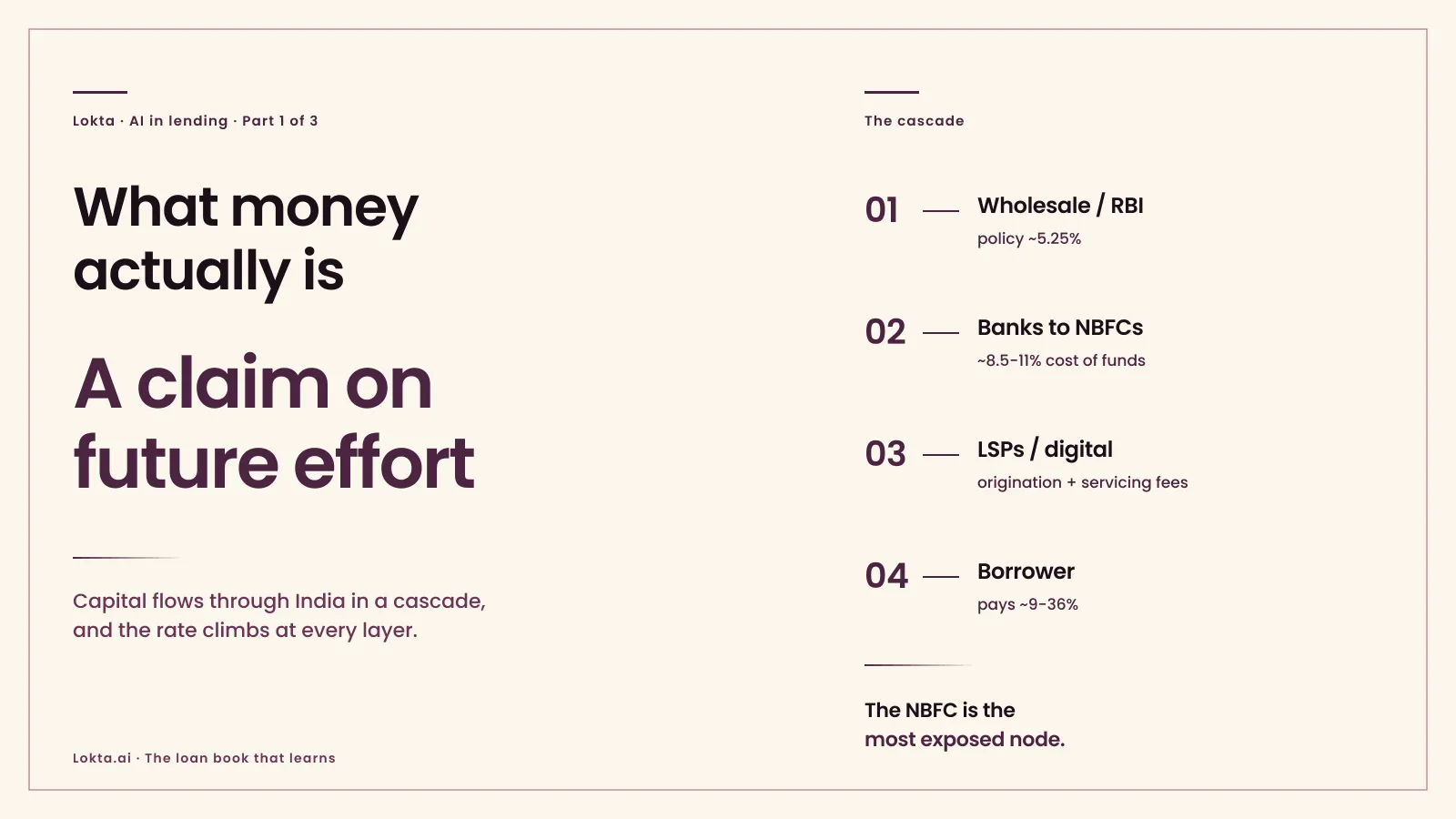
What money actually is
Money is a claim on future productivity, and lending is the oldest way of allocating it. This is how capital really flows through India today, and why the NBFC sits at the most exposed node of the whole cascade.
11 min readRead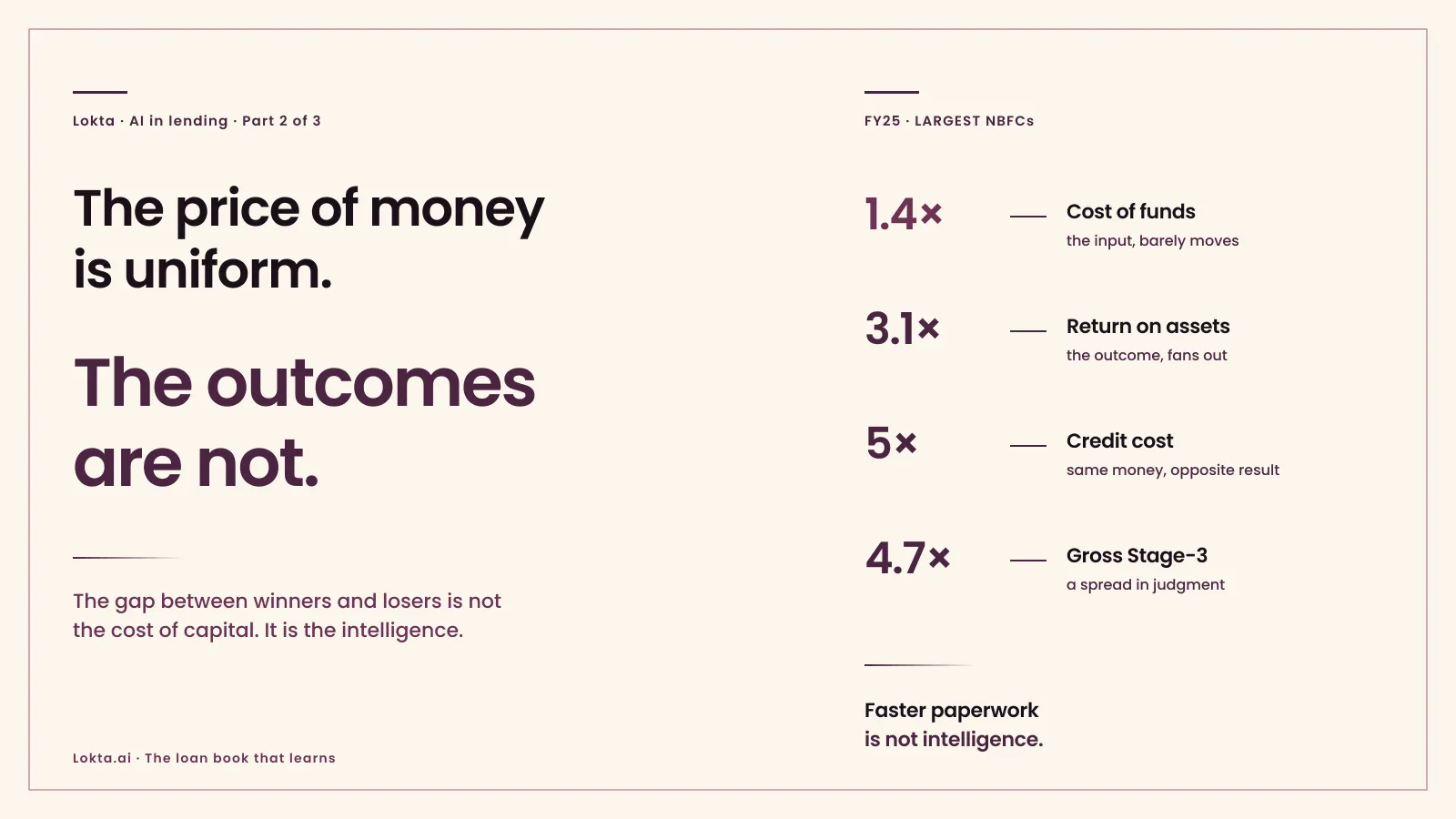
The price of money is uniform. The outcomes are not.
Same input price, opposite results. The cross-section and the cycle both say the separation between lenders is not the cost of capital. It is the intelligence applied to risk. And digitisation, for all it did, never touched the judgment.
11 min readRead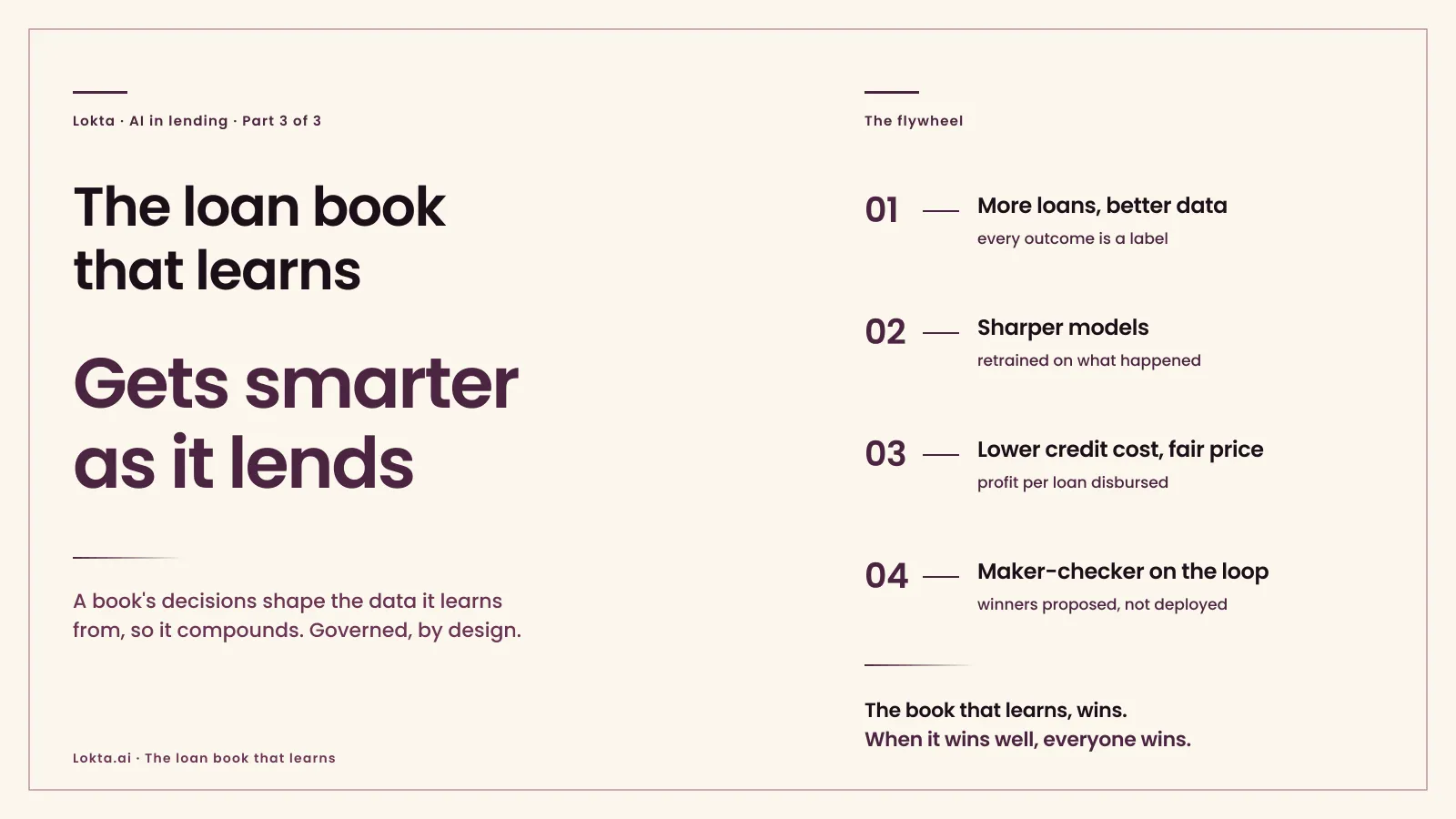
The loan book that learns
Why a loan book can finally learn, and why it is different from anything that learned before it: its own decisions shape the data it learns from. The flywheel, the borrower it includes, the brakes it needs, and the infrastructure Lokta is building to run it.
23 min readRead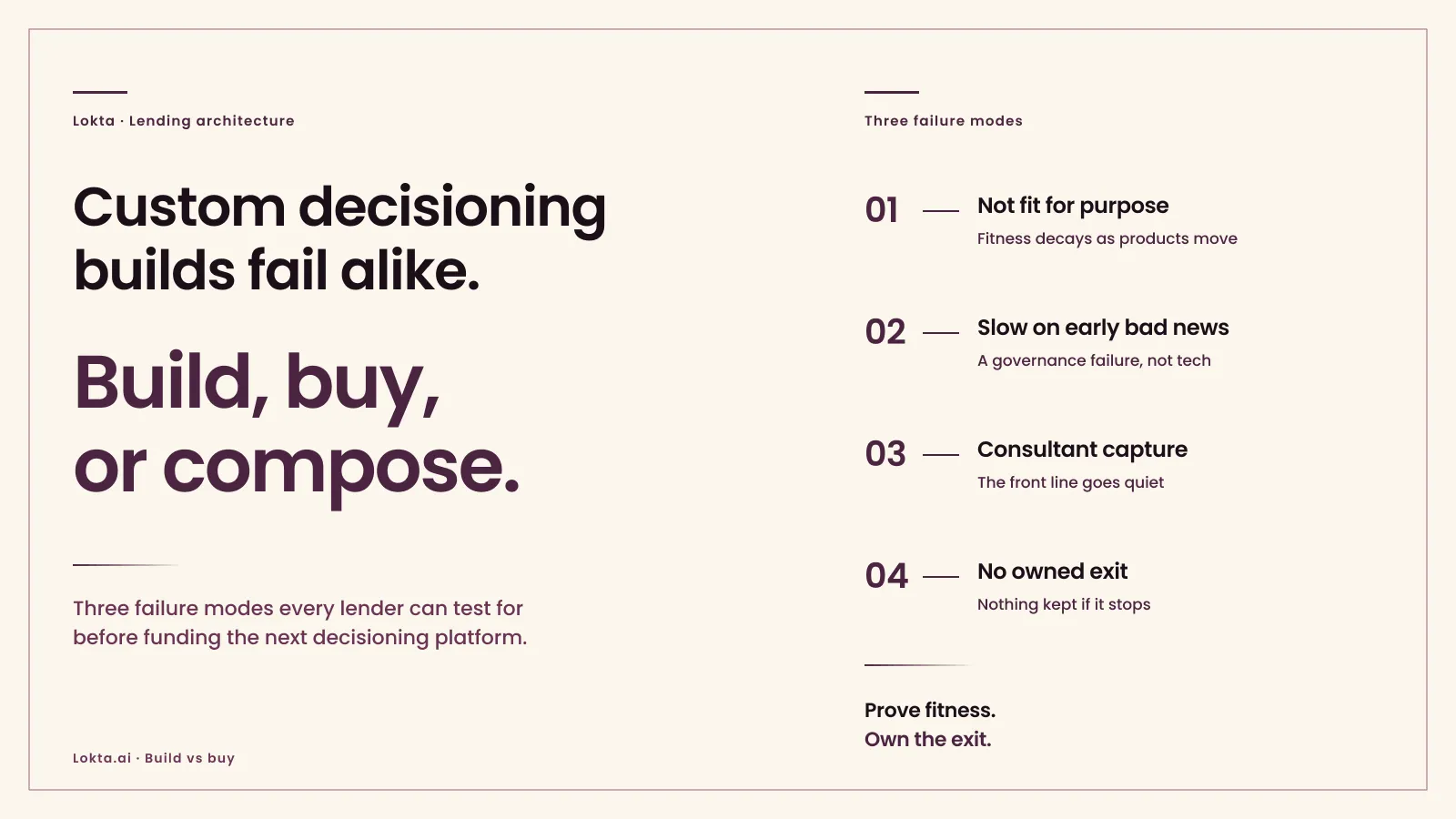
Build, buy, or compose: the credit-decisioning call a lender gets one shot at
Custom credit-decisioning builds fail in three predictable ways. For fast-growing lenders in India, APAC, MEA and Africa, this is how to fund one that lasts.
9 min readRead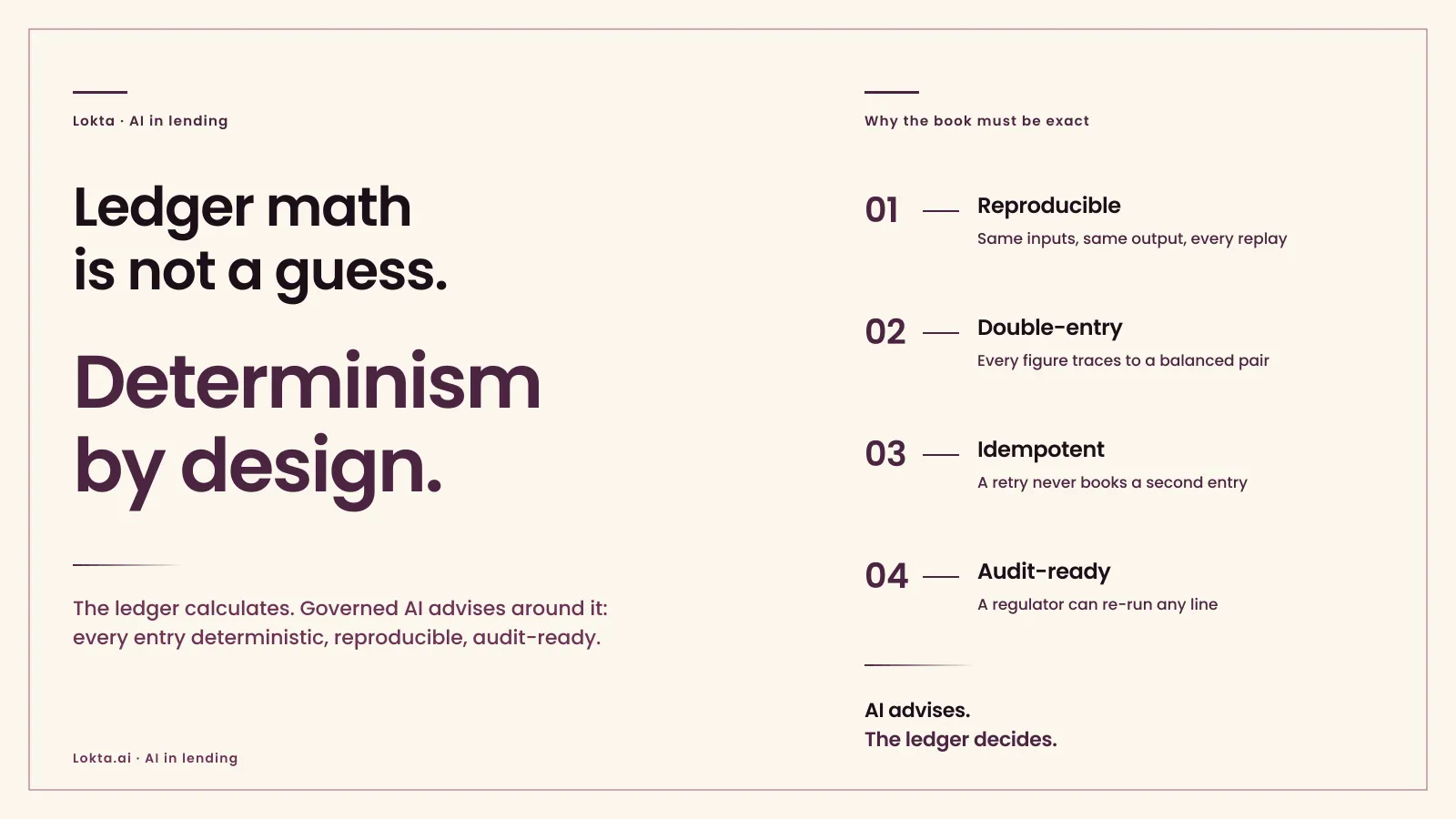
Why your LMS ledger should never be model-guessed
LLMs predict; they do not calculate. Loan ledger math must be deterministic and reproducible. Here is what that means for your LMS and your next RBI audit.
9 min readRead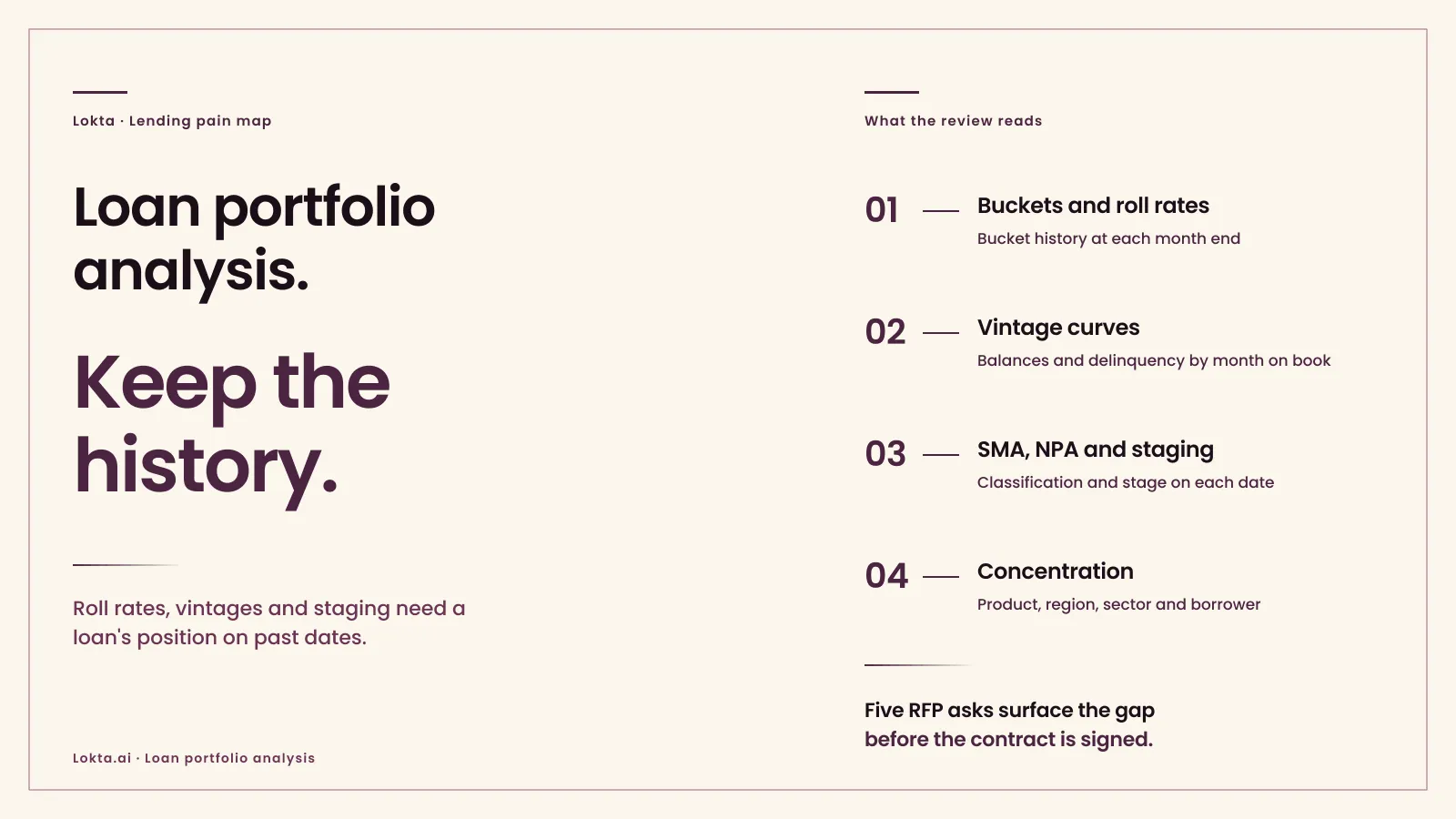
Loan portfolio analysis: the measures a lender needs, and why they end up in Excel
If your loan portfolio analysis runs in Excel, look at what the loan system keeps. The measures a CRO needs, the history each one depends on, and five RFP asks.
8 min readRead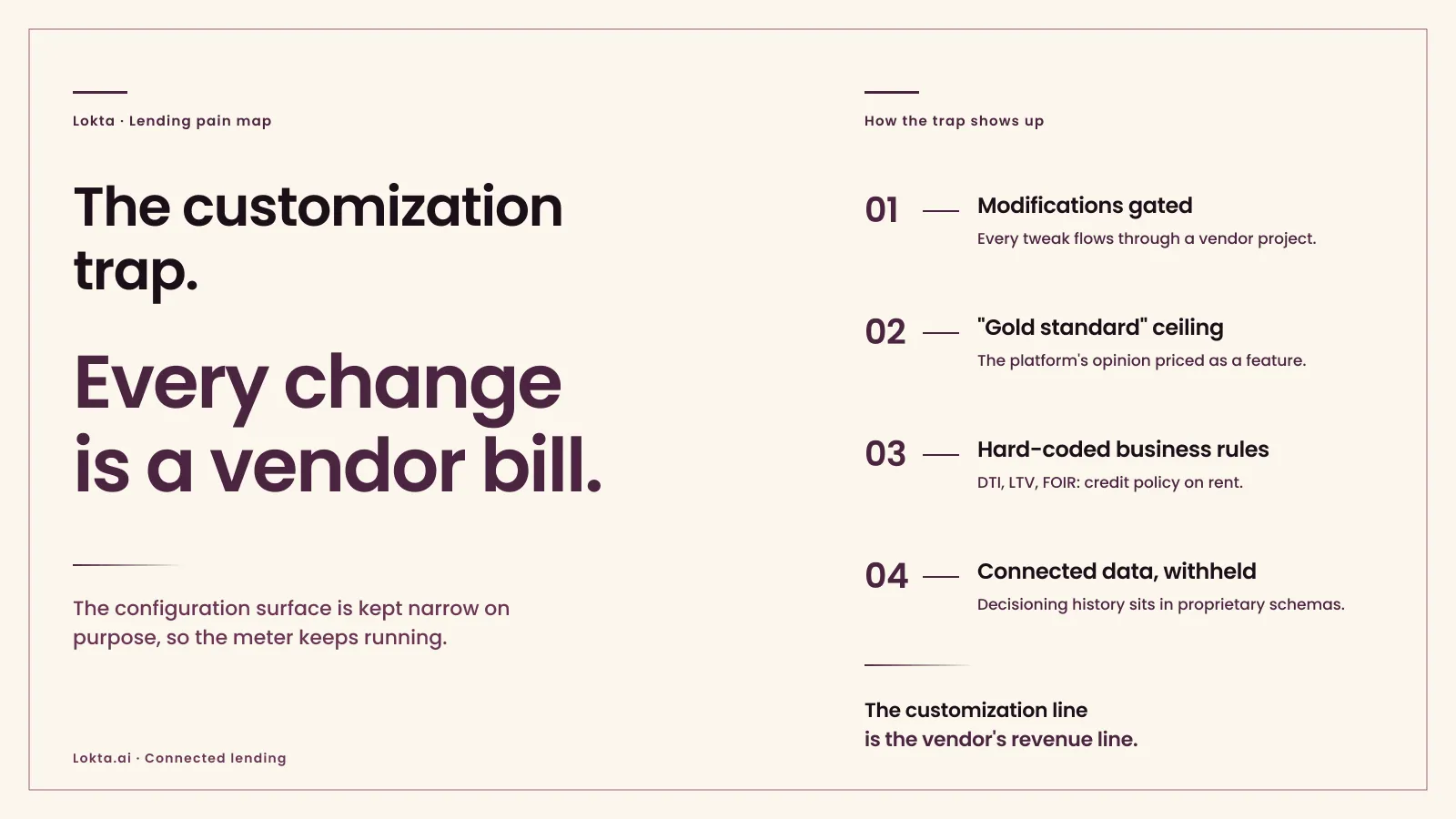
The Customization Trap: When LMS Vendors Bill Every Change
Why every 'small change' in an LMS or LOS funnels through a billable vendor project, and the RFP questions that surface the trap before you ever sign.
10 min readRead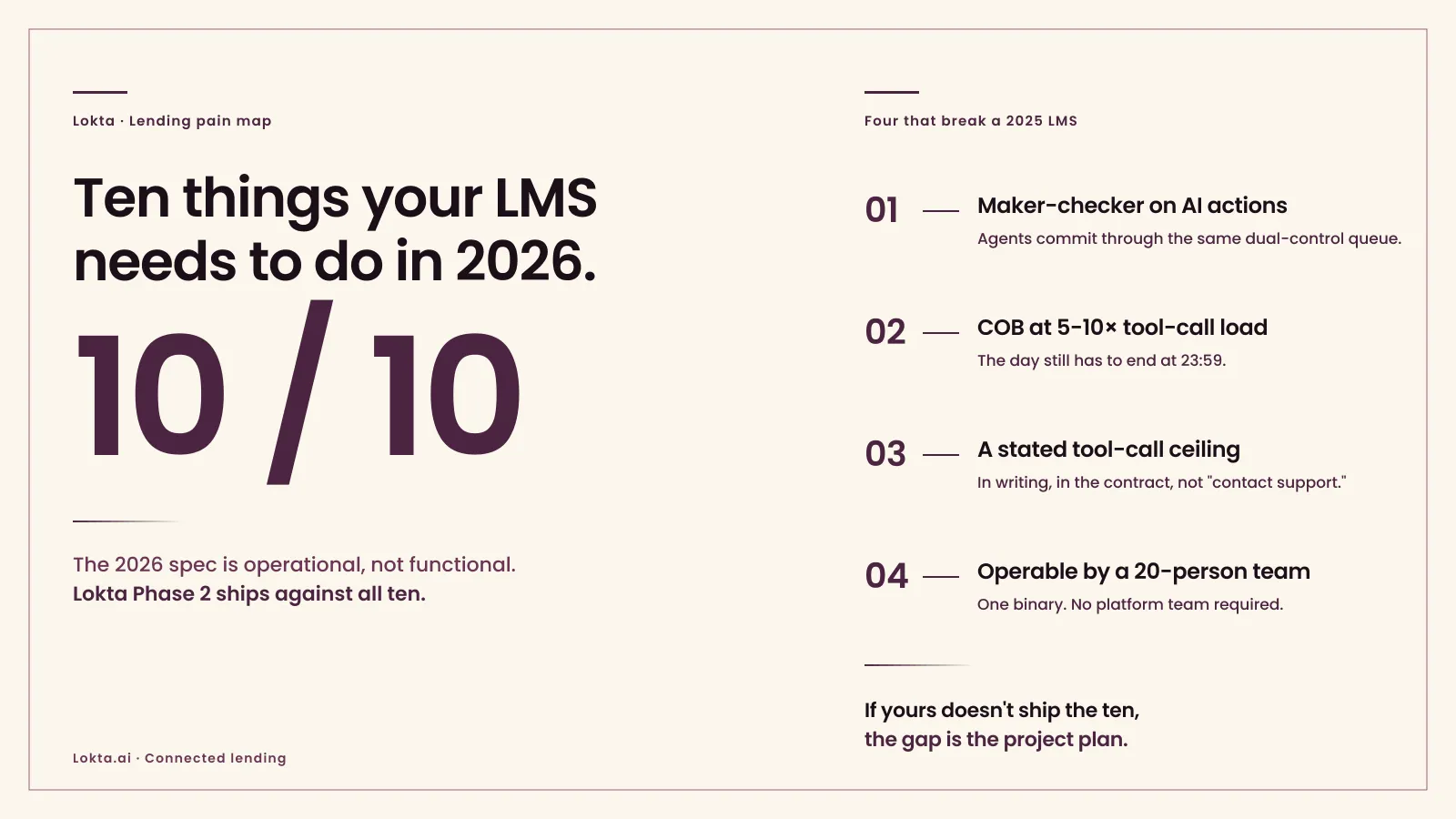
Ten Things Your LMS Needs to Do in 2026
The 2026 LMS requirements list: AI maker-checker trails, 5-10× tool-call EOD throughput, event-sourced accounting, policy-bounded agents, single-binary deployment, and operability for a 20-person team. Lokta Phase 2 ships against all ten.
11 min readRead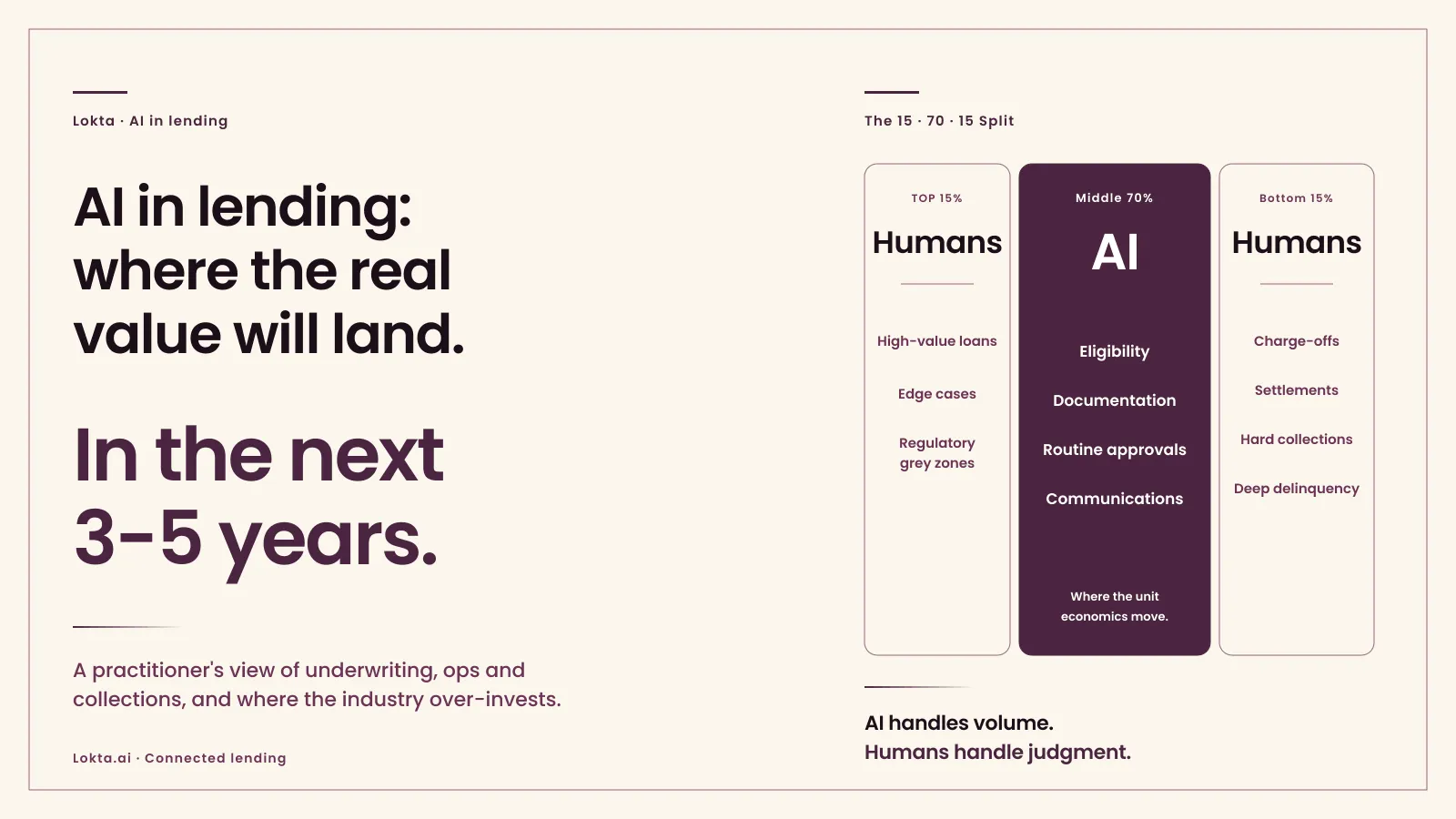
AI in Lending: Where the Real Value Will Land in the Next 3-5 Years
A practitioner's view on AI's real role across underwriting, operations, and collections, and where the lending industry is quietly over-investing today.
7 min readRead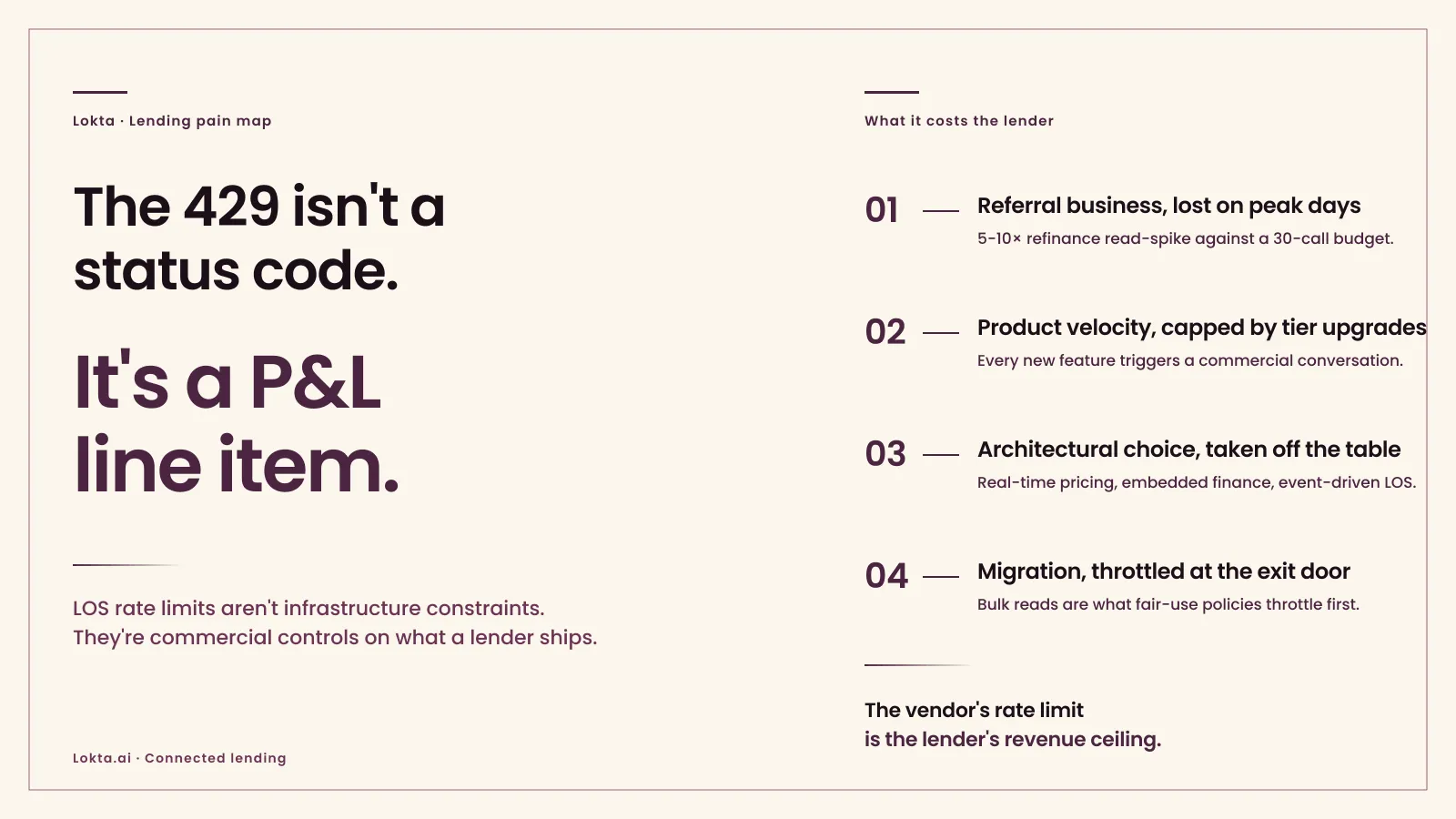
The 30-Call Limit: Why Your LOS API Quietly Caps Your Lending Velocity
LOS and LMS rate limits aren't infrastructure constraints. They are commercial controls, and the 30-call ceiling shapes what a lender's roadmap can ship.
7 min readRead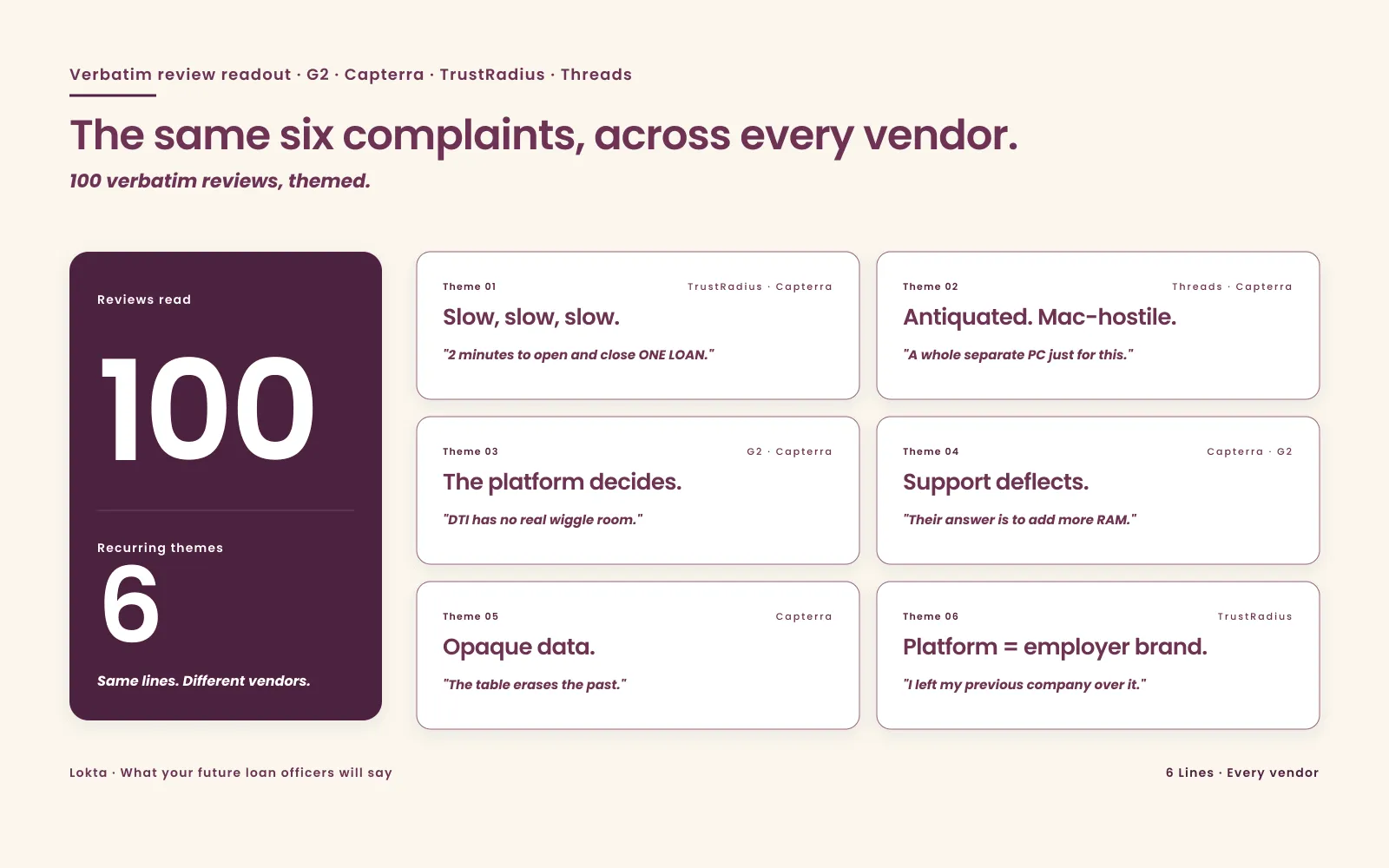
100 LMS Reviews: The Same Six Complaints Recur
We read 100+ public LMS and LOS reviews from loan officers and servicers. The same six complaints recur across every vendor: here is the theme-by-theme map.
10 min readRead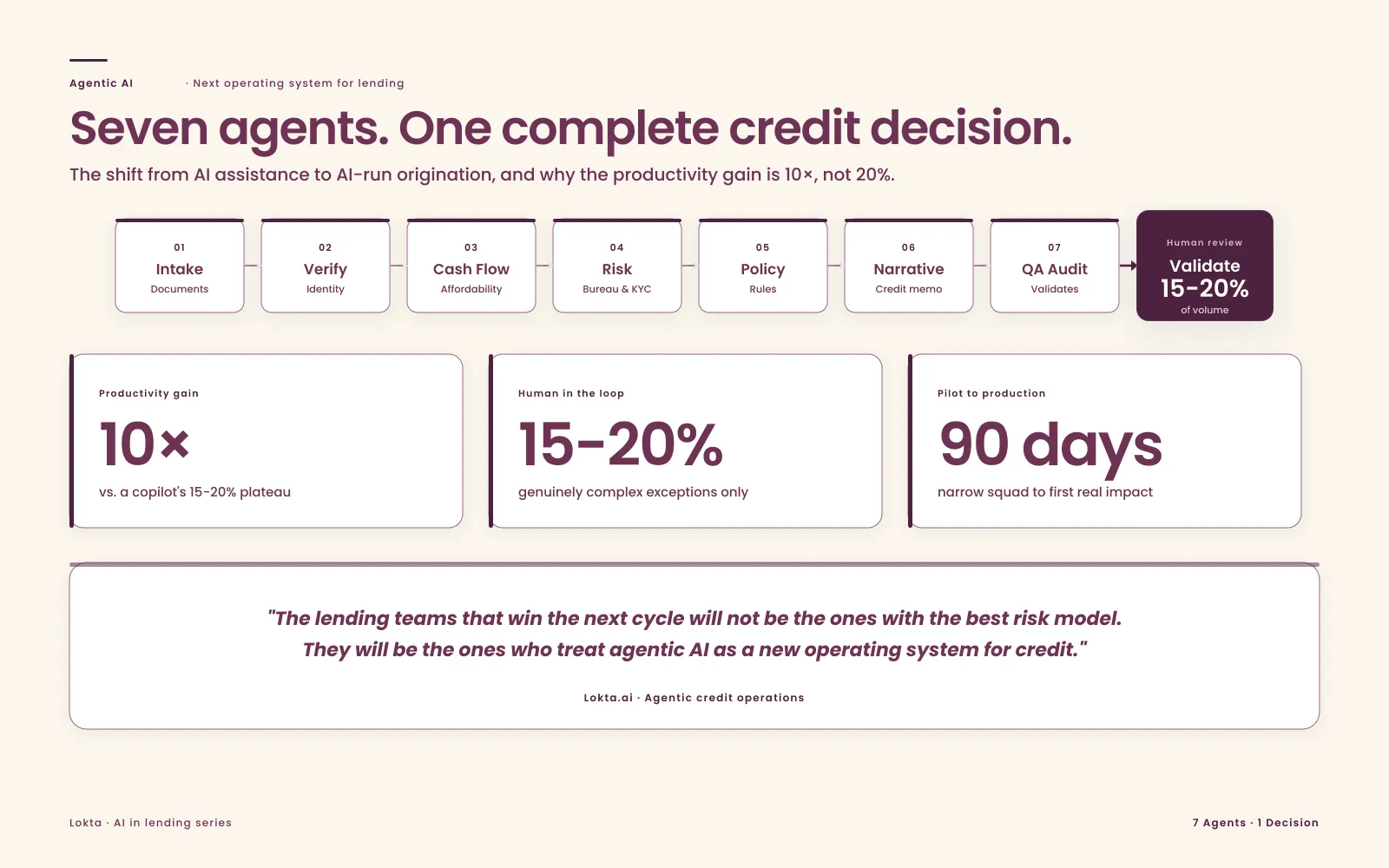
Agentic AI Is the Next Operating System for Lending
Why the next 10× productivity unlock in credit comes from a workforce of AI agents, not a better underwriting model. A lending-lens view of the shift.
8 min readRead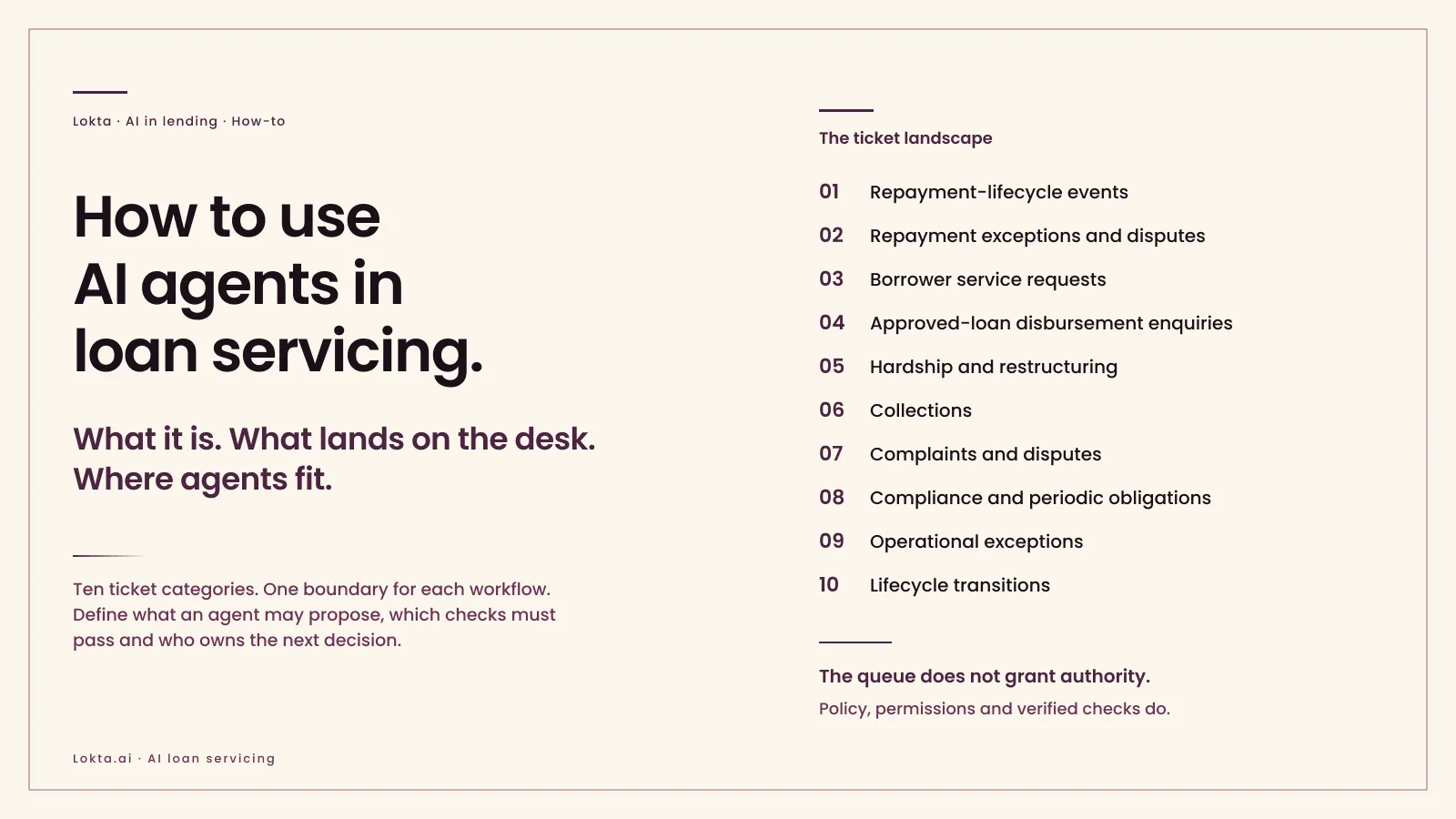
How to Use AI Agents in Loan Servicing
A practical guide to loan servicing workflows, where AI agents can act, where people must approve, and how to design the control boundary.
14 min readRead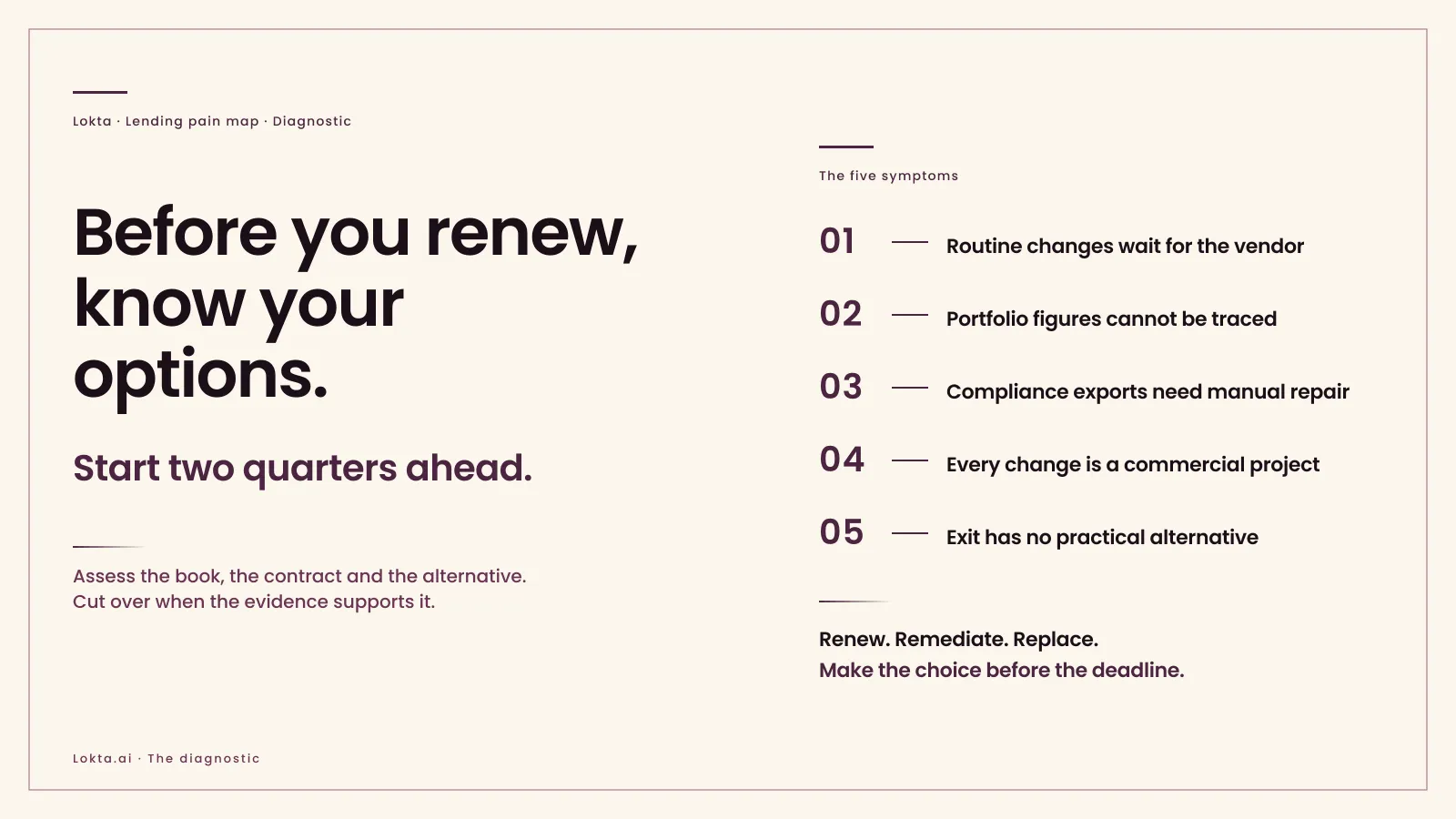
Before you renew your LMS, assess these five symptoms
Start an LMS renewal assessment two quarters ahead. Review five operating symptoms, contract notice dates and parallel-run evidence before choosing to stay or move.
5 min readRead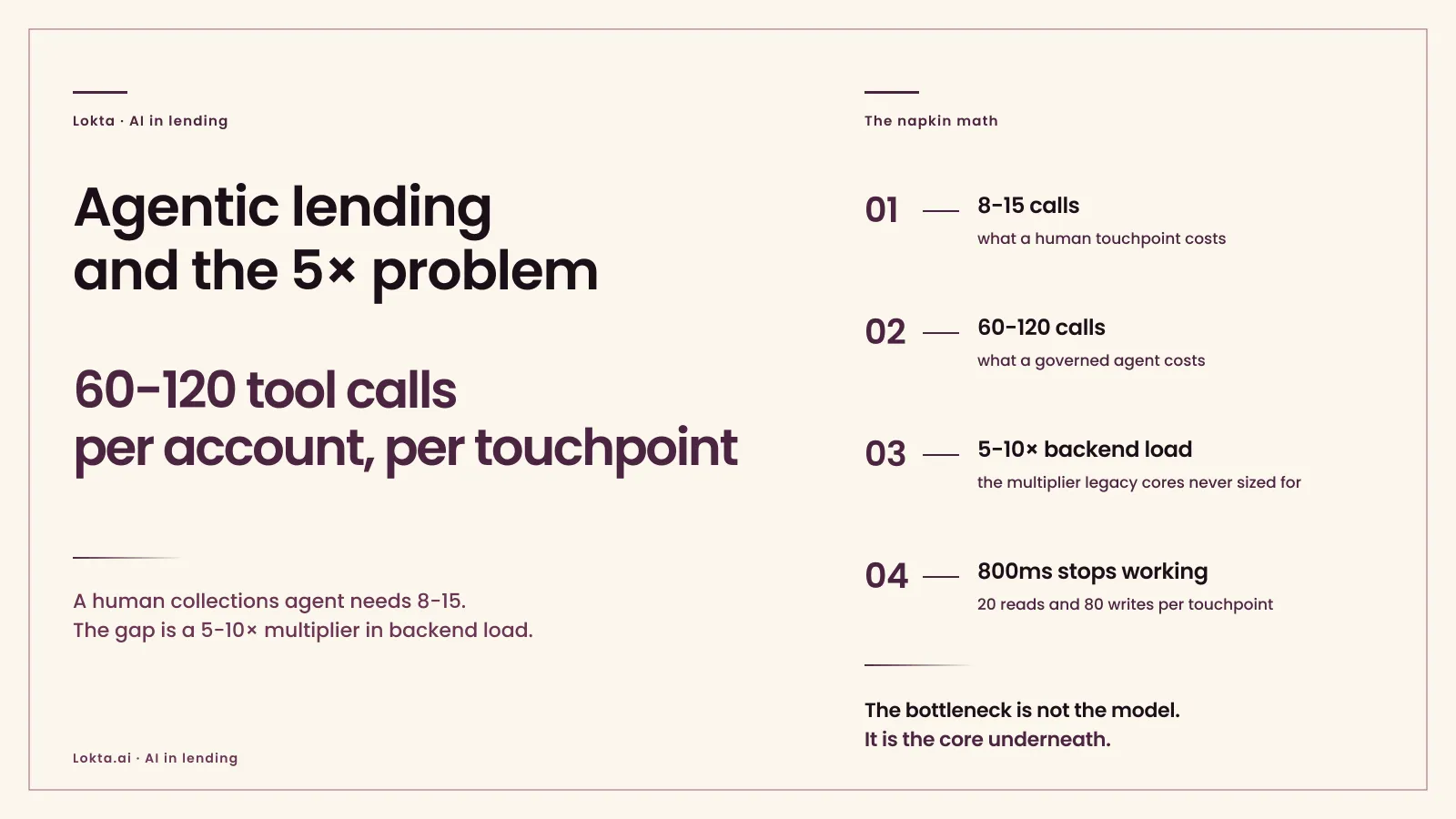
Agentic Lending and the 5× Problem
The napkin math no one has done: agentic collections needs 60-120 governed tool calls per account, the 5-10× multiplier no legacy LMS is built for.
7 min readRead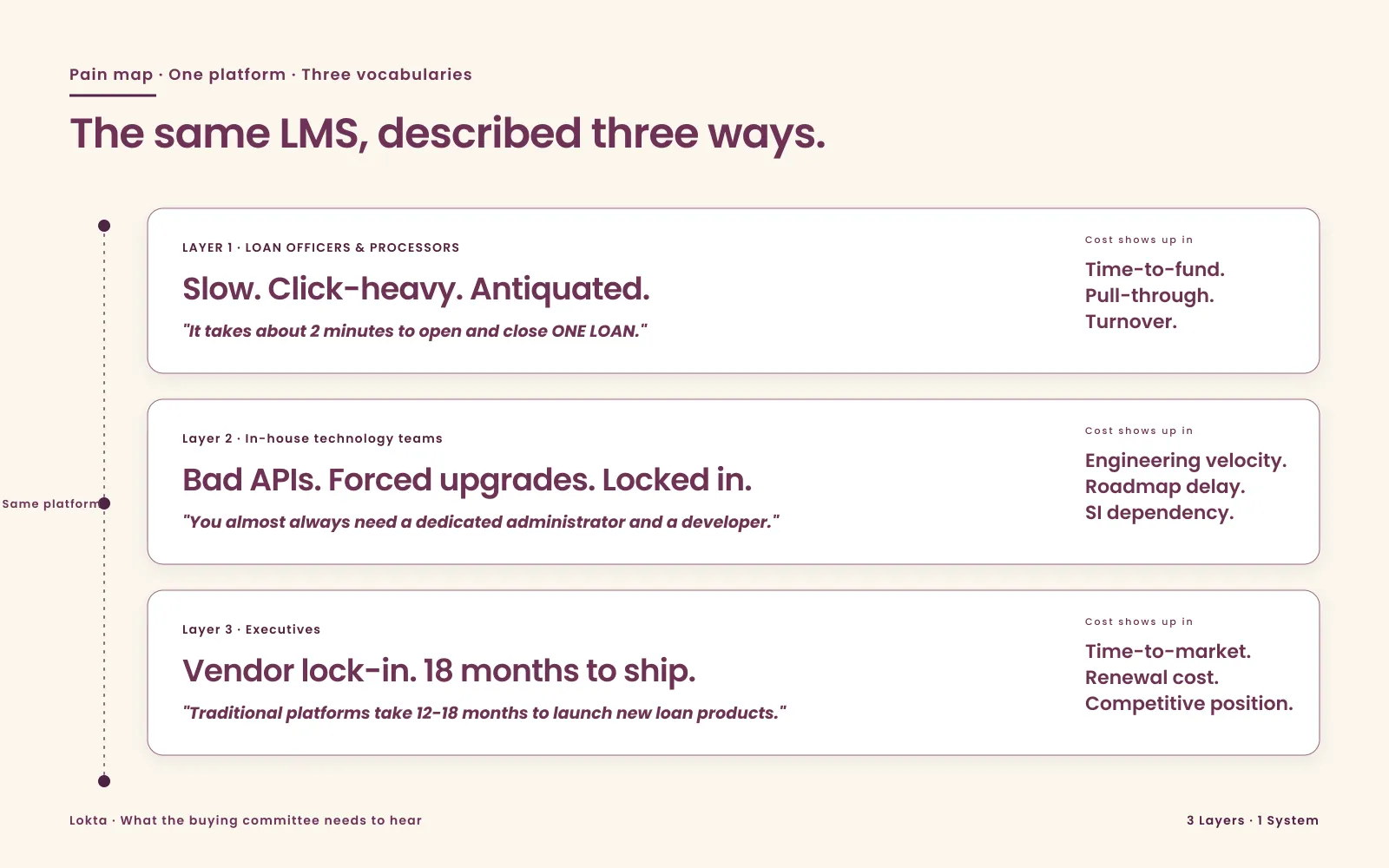
The Lending Technology Pain Map: 3 Audiences
Loan officers, in-house tech teams, and executives describe the same LMS in three different vocabularies. The pain map every buying committee needs to read.
8 min readRead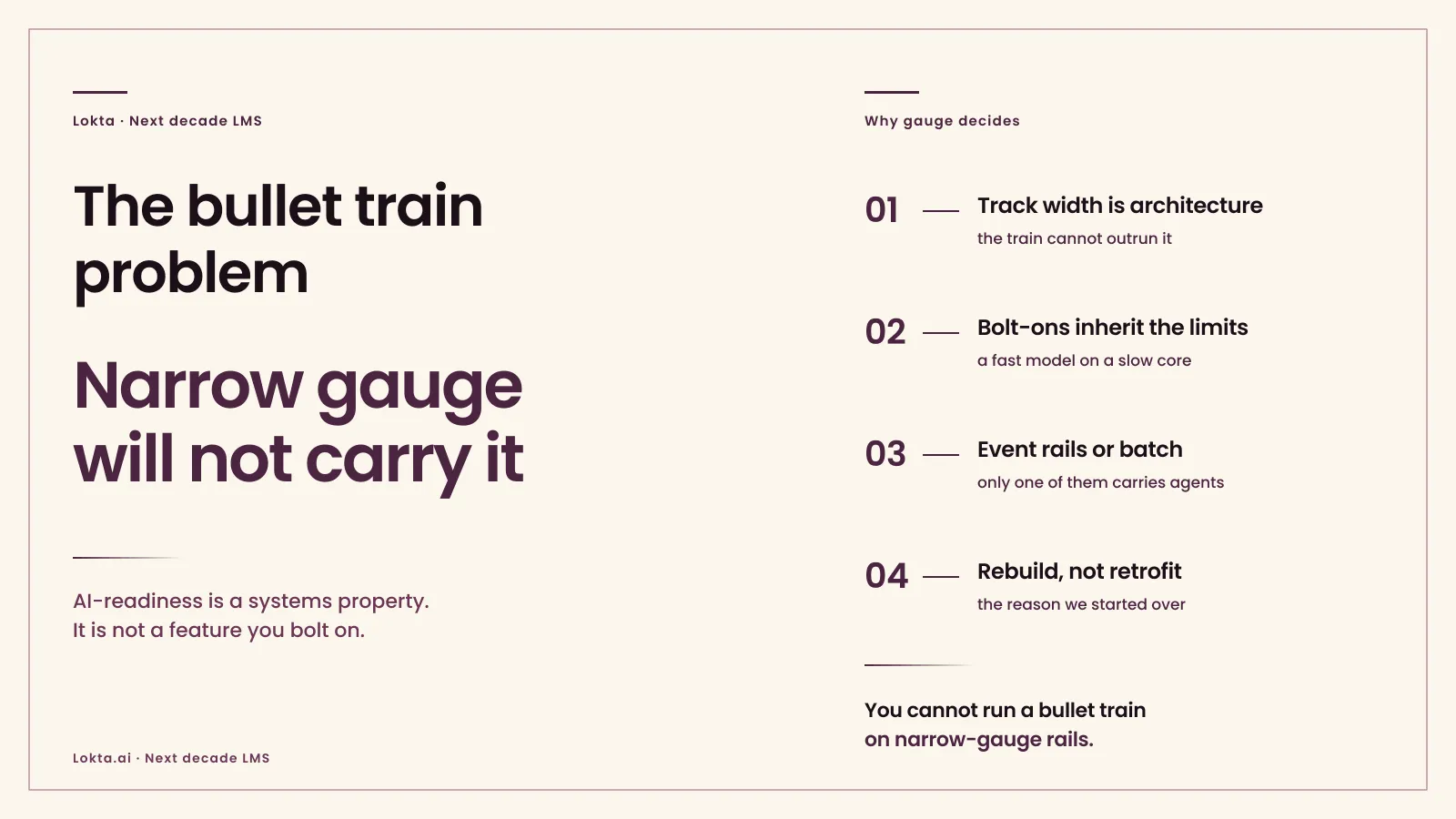
The Bullet Train Problem: Legacy LMS vs. AI Lending
Agentic AI is the bullet train. Legacy LMS is narrow gauge. Here's why AI-readiness is a systems property, not a feature you can bolt on.
6 min readRead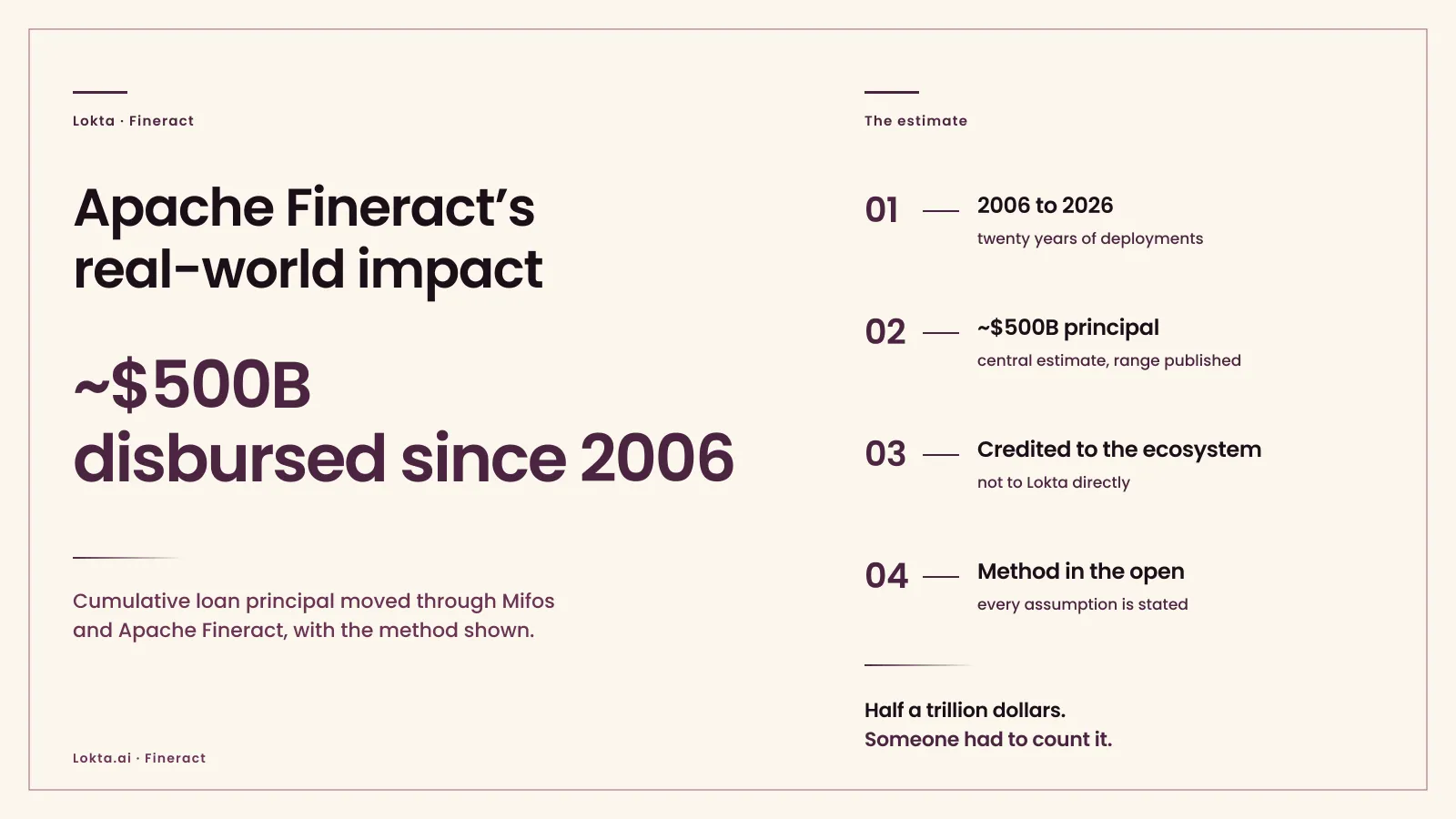
Cumulative Impact of Apache Fineract on Global Lending
~$500B, half a trillion dollars, in cumulative loan principal disbursed via Mifos → Apache Fineract (2006-2026). Our central estimate, with full methodology.
7 min readRead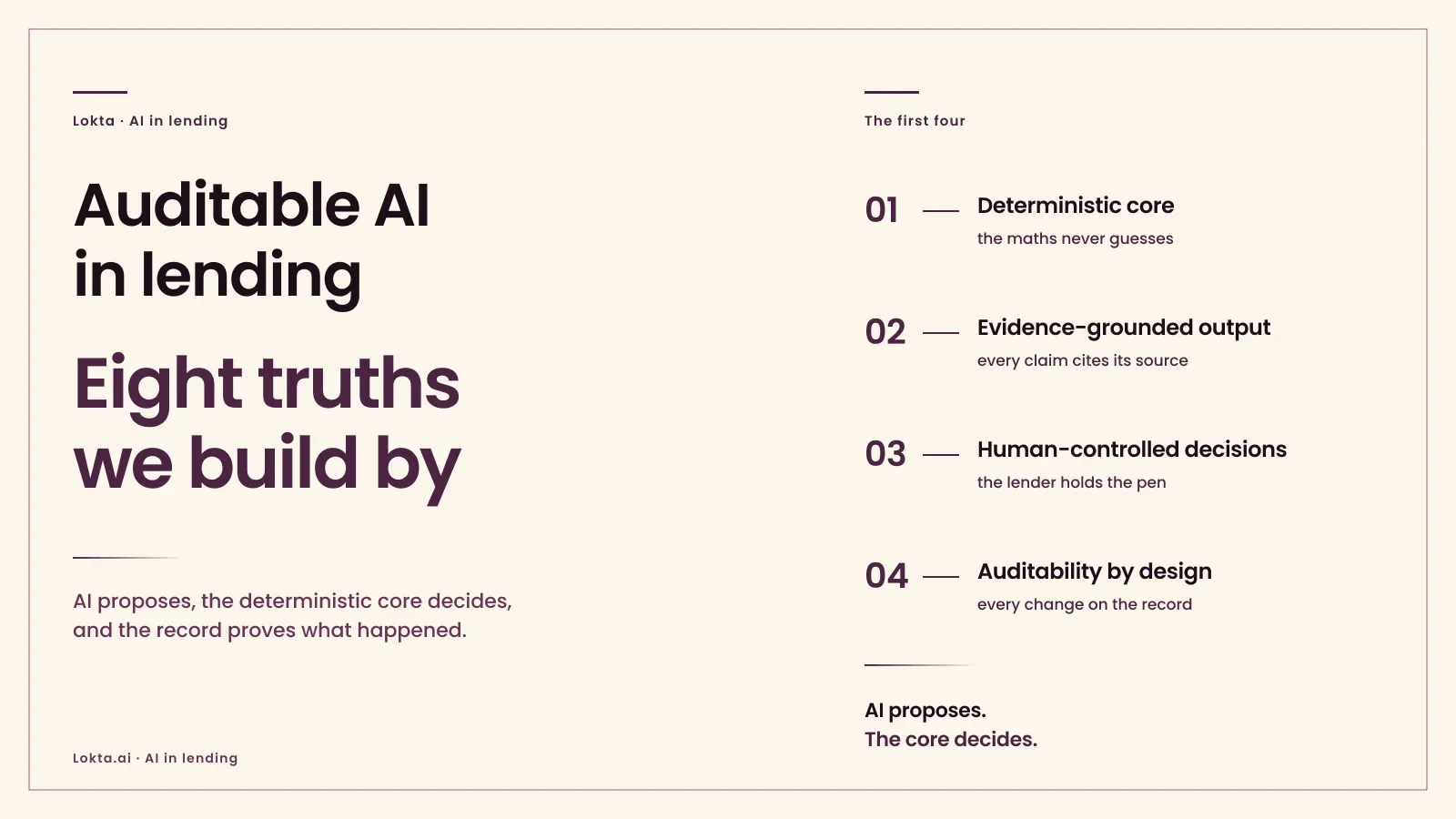
Lokta's Philosophy for Auditable AI in Lending
Eight truths that define how Lokta uses AI in lending: deterministic core, evidence-grounded outputs, human-controlled decisions, built-in auditability.
3 min readRead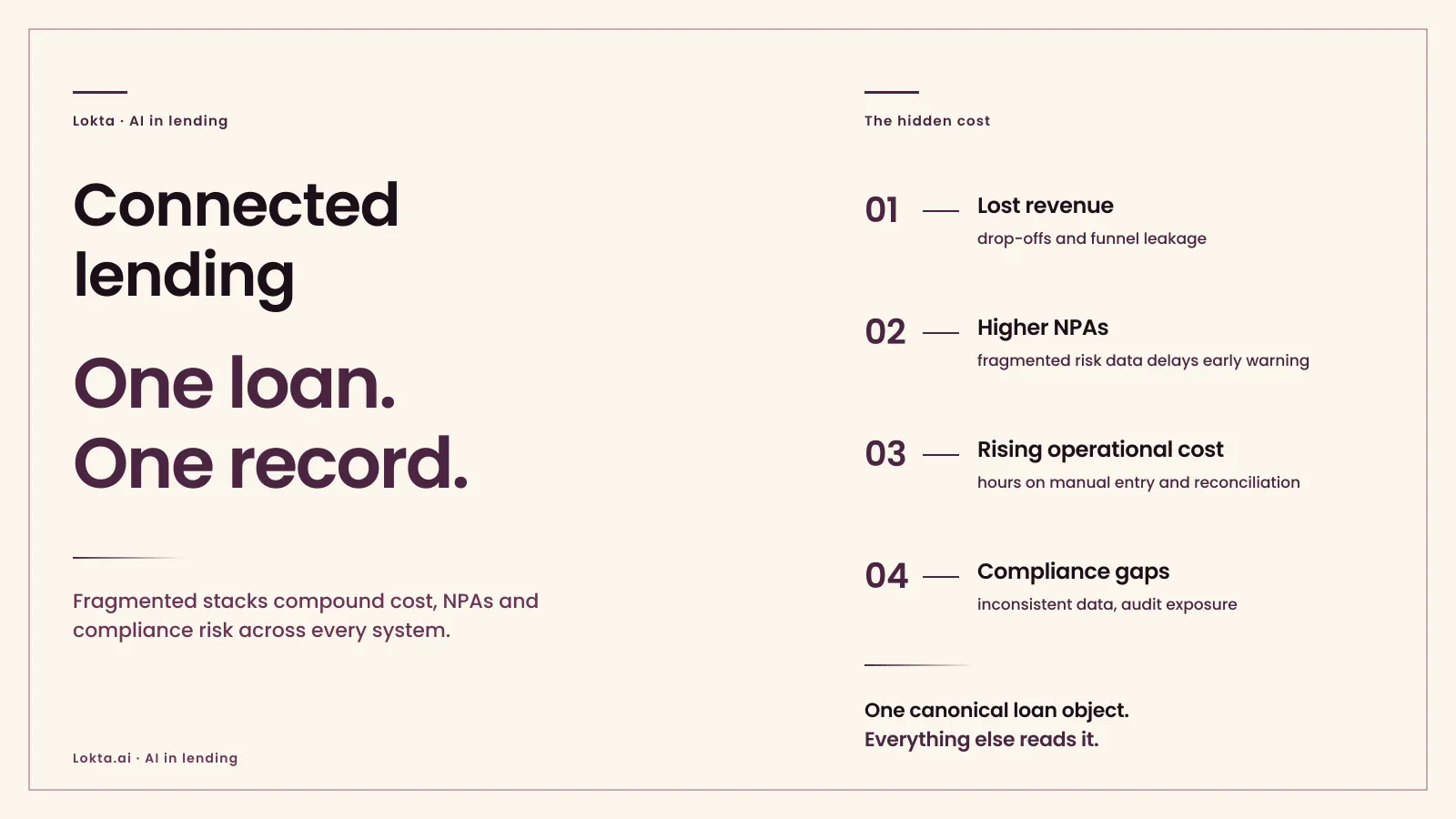
Connected Lending: Fixing Loan Lifecycle Chaos
Why fragmented lending stacks compound costs, NPAs, and compliance risk, and what a truly connected, single-source-of-truth lending platform looks like.
3 min readRead