AI Loan Servicing
AI loan servicing software for the live loan book
You run servicing and collections on a live loan book. Every borrower message lands beside the loan, your policy, and the next action, with nothing lost between systems.
Scope: The servicing agent covers borrower queries and complaints, collections prioritisation and recovery follow-up, and the policy, approval, and audit trail behind material actions.
The product
Loan context first. AI second.
The model works inside a lending workflow, with the account and the control boundary visible to the operator.
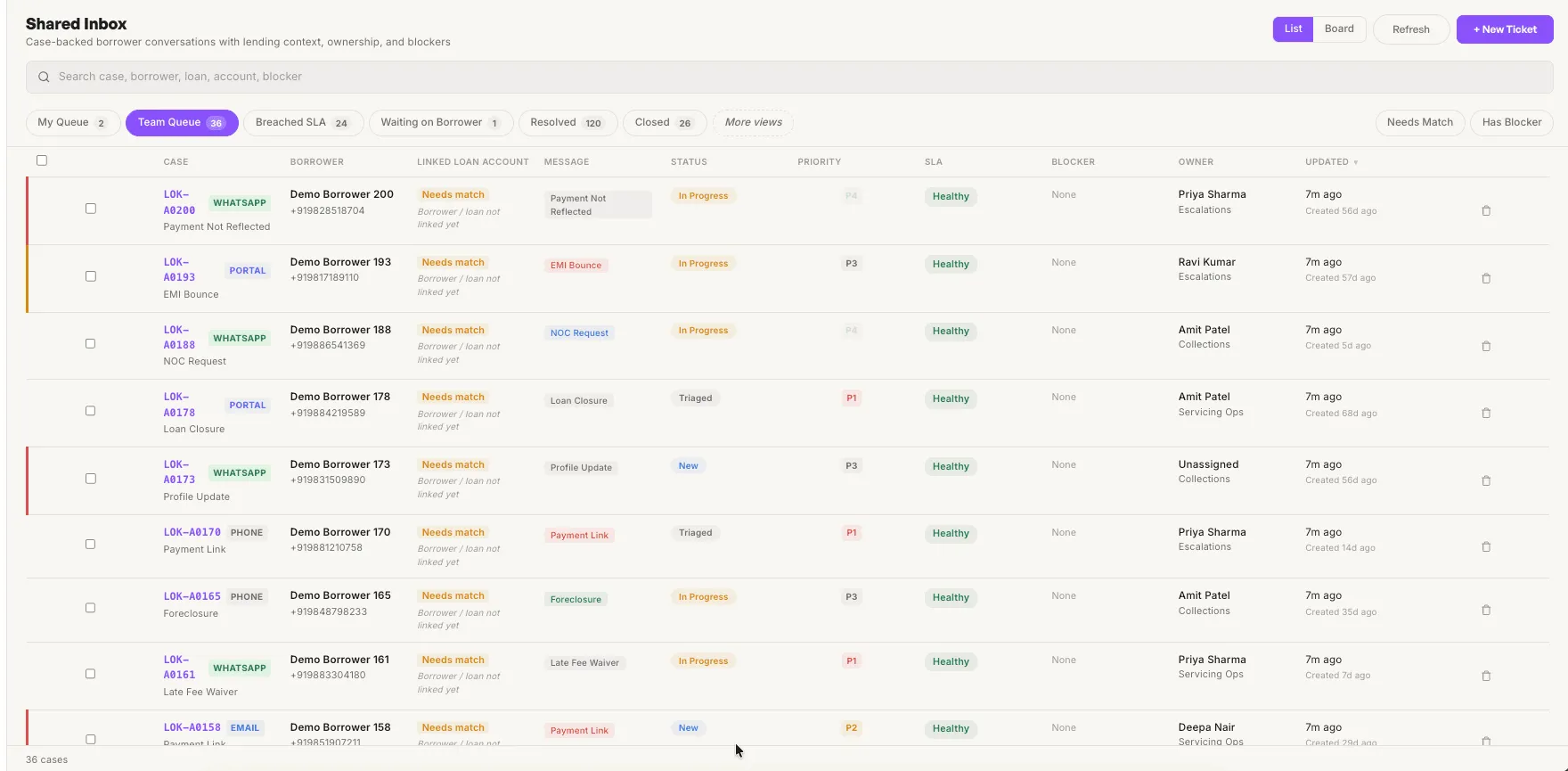
One inbox with the loan behind it
The agent sees the borrower conversation beside the account, schedule, mandate, overdue history, and complaint trail. It does not answer from the message alone.
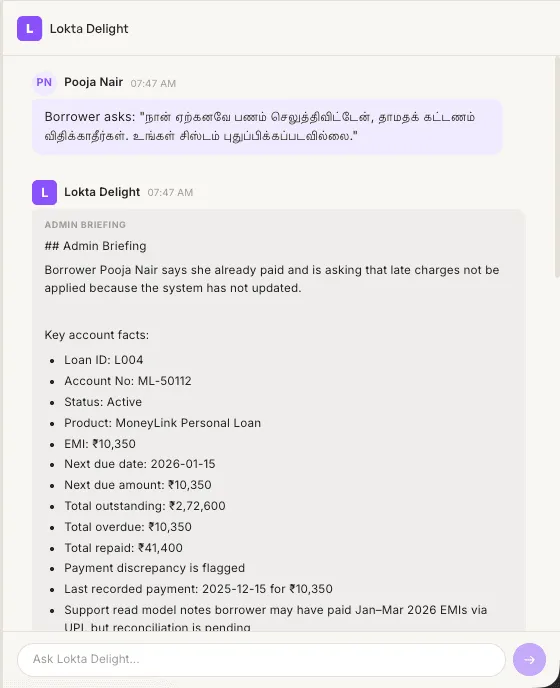
A grounded answer, ready for review
The servicing agent drafts the response from loan data and approved knowledge. The operator reviews the evidence, edits the reply, and sends from the same screen.
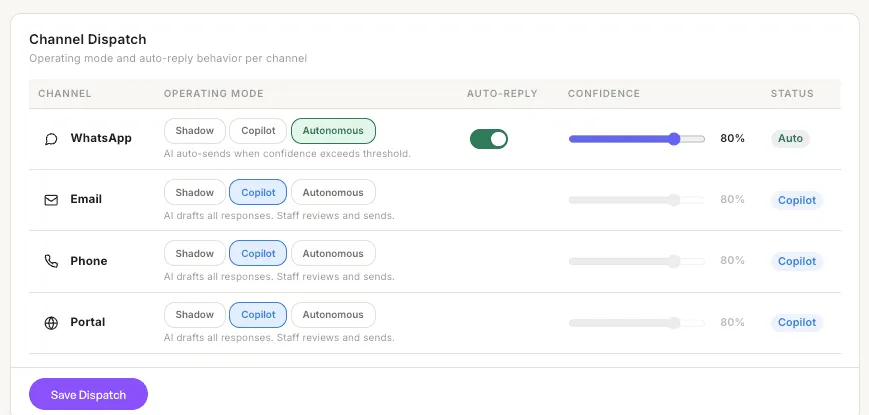
Automation with a clear boundary
Each workflow defines what can be answered automatically, what needs a person, and what must be refused or escalated. The boundary is configuration, not a model guess.
What it covers
Loan servicing automation with the live loan in view
Built for the teams that run a book after approval at NBFCs and fintech lenders in India, and at non-bank lenders in any market. The live loan, the borrower conversation, and the next action stay together. If you are a lending service provider running more than one lender partner from one desk, start with AI Loan Servicing for LSPs.
Borrower service
Bring messages, repayment schedules, mandates, payment history, and prior complaints into one lending-specific workspace.
Payment queries
Answer bounce, mandate, statement, part-payment, foreclosure, charge, and closure questions from the account record.
Collections and recovery
Prioritise accounts on overdue and early-warning signals, propose treatment, track promises to pay, follow recovery through, and carry the outcome back to the live loan.
Complaints and exceptions
Detect urgency, preserve the full trail, and route sensitive or out-of-policy cases to the right person.
The operating loop
AI proposes, the core decides, the record proves it
The servicing agent proposes the reply or the next action. The deterministic core applies your policy, confidence thresholds, and approval requirements, and decides whether it runs. Automation expands only after the workflow, evidence, and failure path are clear.
- The agent proposes. It does not post to the ledger. Your core does.
- A named person approves every financial and loan-state action the workflow marks for review.
- The lender runs the book. Lokta provides the technology.
- 01
Understand
The servicing agent reads the borrower message together with loan state, payment events, policy, and conversation history.
- 02
Propose
It prepares the reply or the next action with the source data and the reason attached.
- 03
Decide
The deterministic core applies workflow rules, confidence thresholds, policy controls, and approval requirements. The agent does not decide.
- 04
Record and verify
The approved result reaches the system of record through the core, never through the agent, and the account audit trail keeps the proposal, the approval, and the outcome.
Illustrative evaluation scenario
A borrower says: “I paid, but my account still shows overdue.”
Use demonstration data and agree the source records and approval policy before testing it.
Read the evidence
Inspect the receipt, payment status, loan ledger and complaint history. A payment screenshot alone is not confirmation of settlement.
Propose the next step
Draft an explanation grounded in verified records. If the receipt is unmatched, propose reconciliation and assign the exception.
Apply the approval boundary
Do not let the model mark the loan paid or waive a charge. Any proposed correction must pass the configured rules and approvals.
Preserve the result
Inspect the source evidence, proposed response, approver and resulting system event. Test missing data, a duplicate receipt and a failed downstream action too.
Agree pilot measures before enabling automation
Establish a baseline for the same workflow and case mix. Measure resolution time, operator touches, evidence accuracy, reopened cases, escalation rate and unauthorised actions. Record sample size, exclusions and the review period; these are evaluation measures, not promised improvements.
Use the pilot scorecard to agree success, pause and rollback criteria.
Connected to the stack around the book
Runs with Lokta Loan Management as the system of record
AI Loan Servicing works on the book held in Lokta Loan Management; an existing book moves across through a reconciled migration. The direction, frequency, and approval boundary for every important field are configured during implementation.
- Lokta Loan Management, the system of record
- Core banking and escrow accounts
- Payment rails and mandate providers
- Data warehouse and portfolio signals
- WhatsApp, email, phone, and borrower portals
- Knowledge bases, SOPs, and policy documents
- Document generation and storage
Not included today
The agent does not originate or underwrite; Loan Origination is on the roadmap with no published date. There is no leasing module, and no voice bot is claimed on this page. Pricing for the servicing agent sits with the platform tiers on the pricing page; what the agent may and may not post to the ledger is answered plainly on the FAQ page.
What lenders said
Lenders on the servicing and collections views.
On seeing bucket roll-back and roll-forward at account level
“My team takes half a day today just to get this data out manually.”
On why Lokta starts after sanction
“The post-sanction area is the one which still today remains a grey area.”
After the portfolio dashboards
“This kind of concise and clear dashboard I never saw.”
On hearing the rate, ₹1,000 per crore of book a month
“It's a reasonable price.”
On the partner and payout view
“Traditional systems never had something like this.”
Asked when he wanted servicing automated
“At this point, I can start within a month.”
At the end of the demo
“You have covered all the pain points of the smaller NBFC.”
AI loan servicing questions
Clear answers about the servicing agent, scope, controls, integrations, and collections.
What is AI loan servicing software?
AI loan servicing software uses loan data, policy, and borrower history to assist or automate post-disbursal work such as borrower queries, payment follow-up, collections, complaints, statements, and closure. A production system also needs controls over what the AI may propose, approve, execute, and record.
What is Lokta's servicing agent?
The servicing agent is the part of Lokta that reads a borrower message with the loan behind it, proposes the reply or the next action, and hands that proposal to the deterministic core for the policy and approval check. It runs agentic loan servicing: multistep servicing, collections, and recovery work inside explicit guardrails, with every action logged on the account.
What can Lokta automate?
The boundary is set workflow by workflow. Routine, low-risk queries can be automated after validation. Sensitive, financial, out-of-policy, or low-confidence cases can require a named reviewer. Lokta records the path taken and the evidence used.
Does Lokta replace our loan management system?
Yes. Lokta AI Loan Servicing works on the book held in Lokta Loan Management, which becomes the system of record. An existing book moves across through a migration that maps accounts, reconciles balances and plans the cutover. Field direction and approval boundaries are configured during implementation.
Does AI Loan Servicing include collections?
Yes. The same account context supports servicing, collections automation, and recovery, including prioritisation, borrower contact, promises to pay, payment follow-up, treatment proposals, escalation, and outcome tracking.
What should collections software do for an NBFC?
Work from the live loan record rather than an export, so the balance and days past due are right that morning. Check contact hours and consent before any message goes out. Record every contact and promise to pay on the account. Post recoveries back to the ledger, so classification and the borrower statement stay correct without a month-end reconciliation.
Can AI run loan collections within RBI's recovery rules?
Yes, when the platform enforces the rules instead of trusting the model to remember them. RBI’s recovery-agent circular of 12 August 2022, now carried into its Responsible Business Conduct Directions for NBFCs, bars recovery calls before 8 am or after 7 pm and any intimidation or harassment. Lokta checks the contact window before a message goes out, logs every contact, and leaves legal escalation with people.
Is Lokta a scalable loan servicing platform for NBFCs in India?
It is built for that book. Lokta covers servicing, collections and recovery for NBFCs and fintech lenders, with RBI rules such as IRAC and SMA classification held as configuration. Each lender gets its own single-tenant deployment, sized for the extra calls agents make on every account. How far servicing cost flattens as the book grows is measured in a pilot, not promised up front.
How does Lokta support regulated servicing operations?
Lokta supports access controls, maker-checker workflows, policy checks, source-grounded responses, escalation, and an account-level audit trail of material actions. The lender remains responsible for its policies, regulatory interpretation, approvals, and oversight.
Does Lokta also offer loan origination?
Loan Origination is on the roadmap and is not available now. No release date is published. AI Loan Servicing, the product on this page, is available now and works with the lender's existing origination system or with Lokta Loan Management, which is also available now.
Go deeper
Read next, or compare
Read next
- AI Loan Servicing for LSPs
- The platform: control plane and deterministic core
- Loan Management, the system of record
- Glossary: agentic loan servicing
- AI loan servicing pilot scorecard
- NBFC collection strategy, bucket by bucket
- Early warning signals for NBFCs
- AI in loan collections under RBI rules
- RBI recovery-agent rules for NBFCs
- Collections KPIs: roll rate, cure rate, PTP kept
What AI loan servicing covers
AI loan servicing software uses loan data, policy, and borrower history to assist or automate post-disbursal work such as borrower queries, payment follow-up, collections, complaints, statements, and closure. A production system also needs controls over what the AI may propose, approve, execute, and record.
Lokta is the agentic loan servicing platform for that work. Its servicing agent handles borrower conversations, collections, and recovery on the live loan, and the deterministic core keeps every financial and loan-state action inside policy, approval, and audit controls.
Planning an evaluation? Use the AI loan servicing pilot scorecard, read the implementation guide to AI agents in loan servicing, or see how a servicing agent differs from a chatbot.
Three ways to run servicing
Start with one servicing workflow.
- Keep the manual operating model. Headcount and cost keep pace with the book, and the evidence behind each decision stays spread across inboxes and spreadsheets.
- Bolt a chatbot onto the LMS. Common questions get a faster answer, but the reply comes from a knowledge base rather than the account, and any action on the loan still needs a person and a second system.
- Run the servicing agent inside the deterministic core, ours or the one you have.Every proposal passes your policy and approval check before it runs, every action lands on the audit trail, and your team keeps the approval.
A grounded draft in review from the first workflow, but the first weeks go on mapping data, controls, and the approval boundary, and nothing is automated until that boundary is signed off.
Lokta is built by the team that helped create Apache Fineract*, the open-source lending core.
Talk to usMambu, LoanPro, Lentra, Nucleus FinnOne Neo, TurnKey Lender, Musoni and OpenCBS are trademarks of their respective owners, shown here for identification only. Apache, Apache Fineract and Fineract are trademarks of the Apache Software Foundation. Lokta is not affiliated with, sponsored by or endorsed by the Apache Software Foundation, the Mifos Initiative, or any other company named here.