AI in Lending: Where the Real Value Will Land in the Next 3-5 Years
A practitioner's view on AI's real role across underwriting, operations, and collections — and where the lending industry is quietly over-investing today.
Every lender we speak to has an “AI strategy.” Almost none of them have AI in the critical path yet.
That gap — between the noise on stage and the reality in production — is where the next 3–5 years of lending will be decided. Most of what is shipping today is productivity work: document reading, summarization, agent assist, QA, copilots. The money decisions are still being made by humans, on legacy systems, with AI sitting next to the workflow instead of inside it.
This is our honest read on where lending is actually headed, based on what we watch lenders, vendors, and regulators do — not what they say from a podium.
- AI in lending today is mostly an efficiency play, not core infrastructure. That changes in 3–5 years.
- The biggest value lands in underwriting, early warning, and portfolio risk — not collections.
- Most lenders will fund AI from manpower budgets, not IT line items.
- Operational capability — not model quality — will separate the winners.
- The 15-70-15 rule: AI handles the middle 70% of decisions; humans take the top and bottom 15%.
Is AI infrastructure yet, or still an efficiency layer wearing the AI label?
For now, it is mostly an efficiency play. Lenders are building most of these capabilities on the Loan Origination System side themselves, and technology vendors are selling AI agents as productivity add-ons. The work is real — but it sits next to the system, not inside it.
In 3–5 years that flips. AI becomes the orchestration and action layer running across the lending lifecycle — origination, servicing, recovery. The value, though, will not be captured at the infrastructure layer. It lands at the application and services layer, where outcomes actually meet the borrower.
Where will the real value in lending get created?
Underwriting, early warning, and portfolio risk management. These are the decisions where a single good signal moves real money — on the loss line and the approval line. Lenders that get better at these earn a structural advantage that compounds book by book.
One good signal moves the loss line and the approval line. Compounds book by book. Hardest to copy because the advantage lives in data, policy, and operating model — not in the model card.
Faster files, fewer manual reviews, lower cost per disbursement. Shows up cleanly in unit economics — but every competent vendor will arrive at parity in 18–24 months.
Gets the most stage time, delivers the least uplift. The bottleneck is process, regulation, and borrower contactability — not the model. Better dashboards do not collect more.
Operations efficiency is the next layer of value — real, but more easily copied. Collections gets a disproportionate share of the AI conversation, but it is mostly an operations play wearing intelligence costume. The lift exists; the bottleneck is process.
Can vendors charge separately for AI, or will lenders expect it bundled?
AI-enabled services are the future shape. Service providers will use AI to deliver out-of-the-box workflows at comparable cost but higher quality — and lenders will AI-enable their own teams in parallel.
What most people miss: lending software is already priced on AUM, usage, or loans processed. You cannot simply stack an “AI fee” on top of that. The lender will not pay twice. Vendors that try to sell intelligence as a separate line item will struggle. Vendors that bundle it into outcome-based services or per-loan economics will win.
Which budget actually funds AI in lending — IT or labour?
Manpower and productivity budgets, in most lenders. IT budgets are finite, and the base budget is already consumed running the existing infrastructure — cloud, hardware, new applications, security. There is very little room left there for net-new AI investment.
The real budget comes from labour costs. The pitch that lands with a CFO or COO is simple: do more with fewer people, on the same loans-per-FTE budget. Vendors who frame themselves as productivity multipliers get traction faster than vendors who frame themselves as new IT tools.
What earns trust in a lending company that leads with AI?
Operational capability — not model capability. Every lender, large or small, has access to the same models and agents now. The advantage is not in what you can demo. It is in how you embed it.
Credit, ops, risk, and compliance teams have to be comfortable with a new way of working — or the AI sits idle in the demo environment.
The first six weeks decide whether the lender’s team trusts the workflow. Vendors who deliver training cycles, not just credentials, win.
The model is judged on the 5% it gets wrong, not the 95% it gets right. Clear escalation paths and rollback semantics are non-negotiable.
Auditable trails, model versioning, drift detection. The regulator will ask. The board will ask. The vendor needs the answer pre-built.
The AI company that does change management well will beat the company with the cleaner model every time. In lending, boring wins.
Are lending platforms shifting from systems of record to systems of execution?
Yes. Lending platforms have been systems of record for two decades — they stored what happened. The next generation will actually do things: approve, route, restructure, escalate, collect, communicate. The data will still be stored, but the platform moves from passive to active.
Regulated workloads will keep a human in the loop because the regulator demands it. Everything else will run on AI inside the governance and guardrails the lender has defined. The shift is from “humans decide, software records” to “AI decides within policy, humans govern the policy.” This is the connected lending thesis, and it is where the platform conversation actually ends up.
Where do humans stay, and where does AI take over?
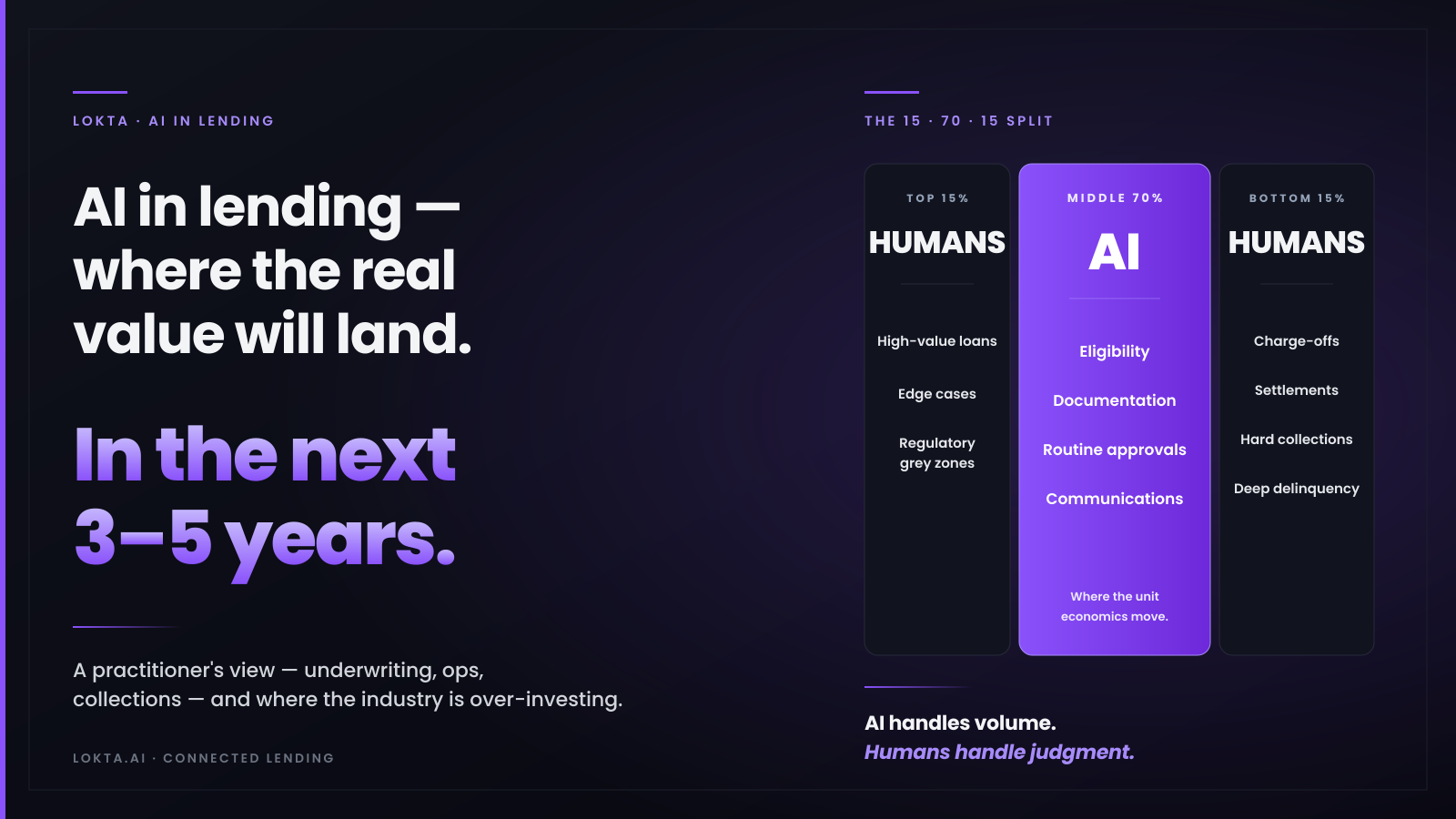
AI handles volume. Humans handle judgment. The cleanest way to think about the split is 15-70-15.
The top 15% stays with humans: high-value loans, edge cases, regulatory grey zones, anything with meaningful reputational or legal exposure. The bottom 15% also stays with humans: charge-offs, deep delinquency, settlements, hard collections — where empathy and discretion matter more than throughput.
The middle 70% moves to AI. Eligibility, documentation, routine approvals, standard servicing, early-stage collections, follow-ups, communications. This is where automation actually pays. Lenders who get this split right see unit economics improve sharply. Lenders who automate the wrong ends create new risks faster than they capture savings.
What are AI-in-lending vendors underestimating?
The single biggest one: AI has still not become the primary reason a lender chooses its core lending software. Buyers continue to pick on coverage, reliability, integrations, and price. AI is a tiebreaker, not a deal-maker.
| What vendors expect | What lenders actually do |
|---|---|
| ”AI capability” lands as the headline buying criterion. | Coverage, reliability, integrations, and price still decide the deal. AI is a tiebreaker between two finalists. |
| Demos shorten the sales cycle. | Sales cycles are longer than vendors model — pilots run into compliance, security, and procurement. |
| Repeatable use cases scale across the customer base. | Asks come back as bespoke workflows the vendor has to absorb deal-by-deal. |
| Intelligence is a separately priced premium. | In Indian lending especially, intelligence is expected inside the price already being paid. |
Vendors who priced and staffed for a fast, clean market will feel this in 2026 and 2027. The market is real. The pace it moves at is not the pace investor decks assumed.
The bet for the next decade
The lending industry does not need another AI demo. It needs AI that survives a regulator’s audit, fits inside an existing cost structure, and quietly takes work off real teams.
The companies that build for that reality will own the next decade. The companies still selling intelligence as a product on a slide will become case studies in why timing is not the same as truth.
Frequently asked questions
Are AI agents replacing underwriters at lenders?
Not for the decisions that actually matter. AI will run the middle 70% of underwriting — eligibility checks, documentation parsing, routine approvals, standard servicing. The top 15% (high-value loans, edge cases, regulatory grey zones) and the bottom 15% (charge-offs, settlements, hard collections) stay with humans, because that is where judgment, empathy, and regulatory exposure compound.
Which AI use cases in lending are creating real value today?
Mostly efficiency work — document intake, agent assist, QA, customer support, and internal copilots. The larger value pools — underwriting intelligence, early warning, portfolio risk — are still emerging and will scale across the next 3–5 years. Collections gets the most stage time and the least real lift, because the bottleneck there is process, not models.
Will lenders pay separately for AI in lending?
In most markets, no. Lending software is already priced on assets under management, usage, or loans processed. AI will get bundled into those economics or sold as outcome-based services. Standalone “intelligence” as a separate paid line will struggle — especially in India, where lenders expect AI to sit inside the price they are already paying.
Which budget actually funds AI in lending — IT or manpower?
Manpower and productivity budgets, in most lenders. IT budgets are already consumed by the existing stack — cloud, hardware, security, new applications — and have little room left for net-new AI spend. The pitch that gets traction with a CFO or COO is cost-per-loan and cost-per-employee, not “new IT tools.”
What separates winning AI lending platforms from the losers?
Not the model. Everyone has access to the same frontier. The winners will have stronger operational capability — change management, integration, exception handling, governance, monitoring, and the patience to navigate long enterprise sales cycles. In lending, boring wins.
Are lending platforms moving from systems of record to systems of execution?
Yes. Lending platforms have been systems of record for two decades — they stored what happened. The next generation will actually do things: approve, route, restructure, escalate, communicate, collect — inside policy and within explicit guardrails. Regulated workloads keep a human in the loop because the regulator demands it; the rest runs on AI.
Read next:
- AI in Lending: Why a Deterministic Core — how Lokta deploys AI in three layers without breaking trust, compliance, or balance-sheet correctness.
- How to Use AI Agents in Loan Servicing — which servicing workflows are agent-ready today, and which still need a human at the wheel.
- What is Connected Lending? — the architectural alternative when AI moves from sidecar to system.
Ashok Auty is the co-founder of Lokta and co-creator of Apache Fineract. He has spent two decades building lending infrastructure across 15 countries — and is more interested in what survives a regulator’s audit than what wins a demo.