How to Use AI Agents in Loan Servicing
A practical guide to loan servicing workflows, where AI agents can act, where people must approve, and how to design the control boundary.
Contents 9 sections
To use AI agents in loan servicing, give them the exception work around a live loan: the bounced mandate, the borrower query, the hardship request, the promise to pay. The agent reads the account and proposes the next step. Postings, classification and anything that moves money stay with the deterministic core and the approvers your policy names.
- Start with exception work. Agents assemble account evidence and propose the next step for borrower requests, disputed payments and operational exceptions.
- Keep authority explicit. The lender’s policy defines permitted actions and human approvals. The deterministic core owns calculations and postings.
- Test the failure path. A proposal can be rejected. Uncertain execution needs reconciliation, and closing a case needs a verified result.
What is loan servicing?
Loan servicing is the operational work on an approved loan through repayment, closure, settlement, write-off and any continuing recovery. It is where interest accrues, principal returns, defaults emerge, and operating cost accumulates. A write-off can leave recovery work outstanding.
The Loan Origination System and Loan Management System need an explicit handoff of approved loan data, with ownership and reconciliation defined. That design requirement does not establish a prebuilt integration. Lokta Loan Origination is on the roadmap and is not available now. Servicing includes schedule maintenance, repayment processing, interest calculation, charges, borrower communication, hardship handling, collections, classification, reporting, complaints and closure. New credit and top-up approval belong to the lender’s separate origination process.
Servicing is mostly silent and slow when nothing is going wrong, and intense when something is. The job of a servicing operation is to handle both modes well: at scale, on time, inside policy, with an audit trail. AI helps in the same place a good operations team would help, not by inventing new categories of work, but by absorbing the volume in the categories that already exist.
What lands on a servicing team’s desk
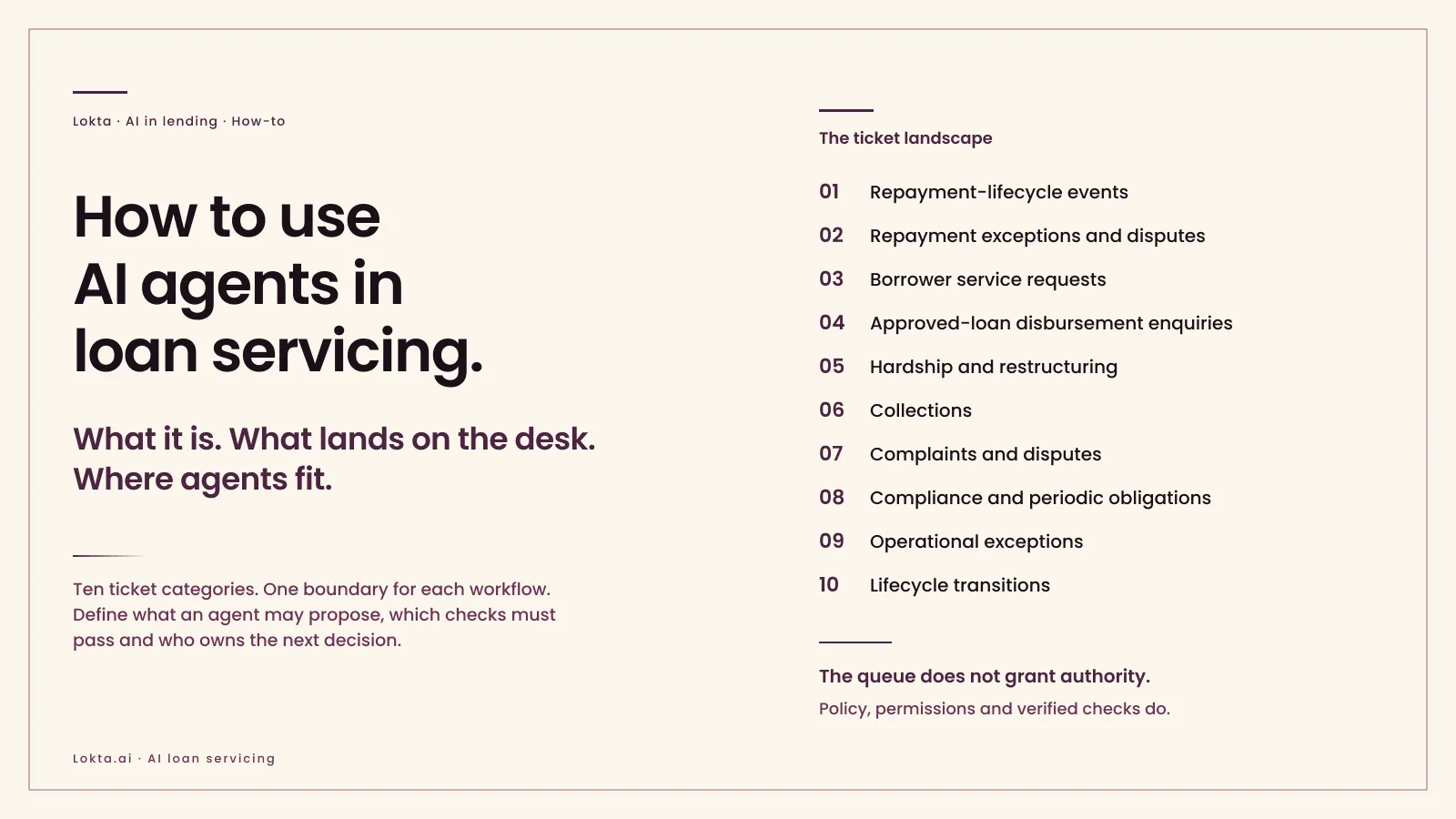
This guide groups servicing work into ten categories. The volumes vary by lender, and a microfinance NBFC’s mix differs from a prime-mortgage book or a BNPL lender’s queue. A vehicle loan book adds repossession and hypothecation-release work. Collection stages and DPD ranges are illustrative queue groupings, not thresholds that grant an agent authority.
1. Repayment-lifecycle events
Successful EMI, partial EMI, failed EMI, mandate bounce (NACH return / direct-debit reject), prepayment, scheduled foreclosure, interest accrual, charge posting. High volume, mostly automated by the LMS. The deterministic-core territory.
2. Repayment exceptions and disputes
Where the LMS and the borrower disagree about what happened.
- “I paid via UPI three days ago. Your system still shows me as overdue.” (Payment-not-reflecting; investigate receipt, settlement, account mapping and posting state before assigning a cause.)
- “I paid extra this month, please adjust against next EMI.” (Overpayment / excess-payment routing.)
- “Why was I charged a late fee? My EMI was on time.” (Disputed charges: late fees, bounce fees, prepayment charges, foreclosure charges.)
- “The interest rate revision wasn’t applied to my schedule.” (Interest disputes: rate, computation, floating-rate revisions.)
- “This transaction isn’t on my statement.” (Statement discrepancies.)
3. Borrower service requests
Statements, interest certificates, applicable tax documents, EMI-date changes, repayment-mode changes, profile updates, channel preferences, foreclosure / prepayment quotes, NOC requests after closure, and co-borrower / guarantor updates. Each request still needs identity, permission and account-state checks.
4. Disbursement queries
Status enquiries about a loan that has already been approved. The servicing workflow can explain verified records or hand the case to the responsible team. It does not approve credit, change a beneficiary, release a tranche or issue a disbursement instruction.
- “The amount hasn’t hit my account yet” (disbursement delay, holding-bank lag).
- “I expected the full sanction but only part disbursed” (partial / tranche disbursement, eligibility-condition gates).
- “It went to the wrong account” (account-detail mismatch, beneficiary-update failure).
- “What were these processing charges?” (disbursement-charge clarification).
5. Hardship and restructuring requests
“I lost my job, can I delay this month’s EMI?” “Medical emergency, can we restructure?” “Can I take a moratorium?” “Can the late fee be waived this once?” Mid-volume, high-judgment, policy-driven. The lender’s hardship policy defines the offer set; the question on each ticket is which offer applies, or whether to seek a non-standard exception.
6. Collections workflow
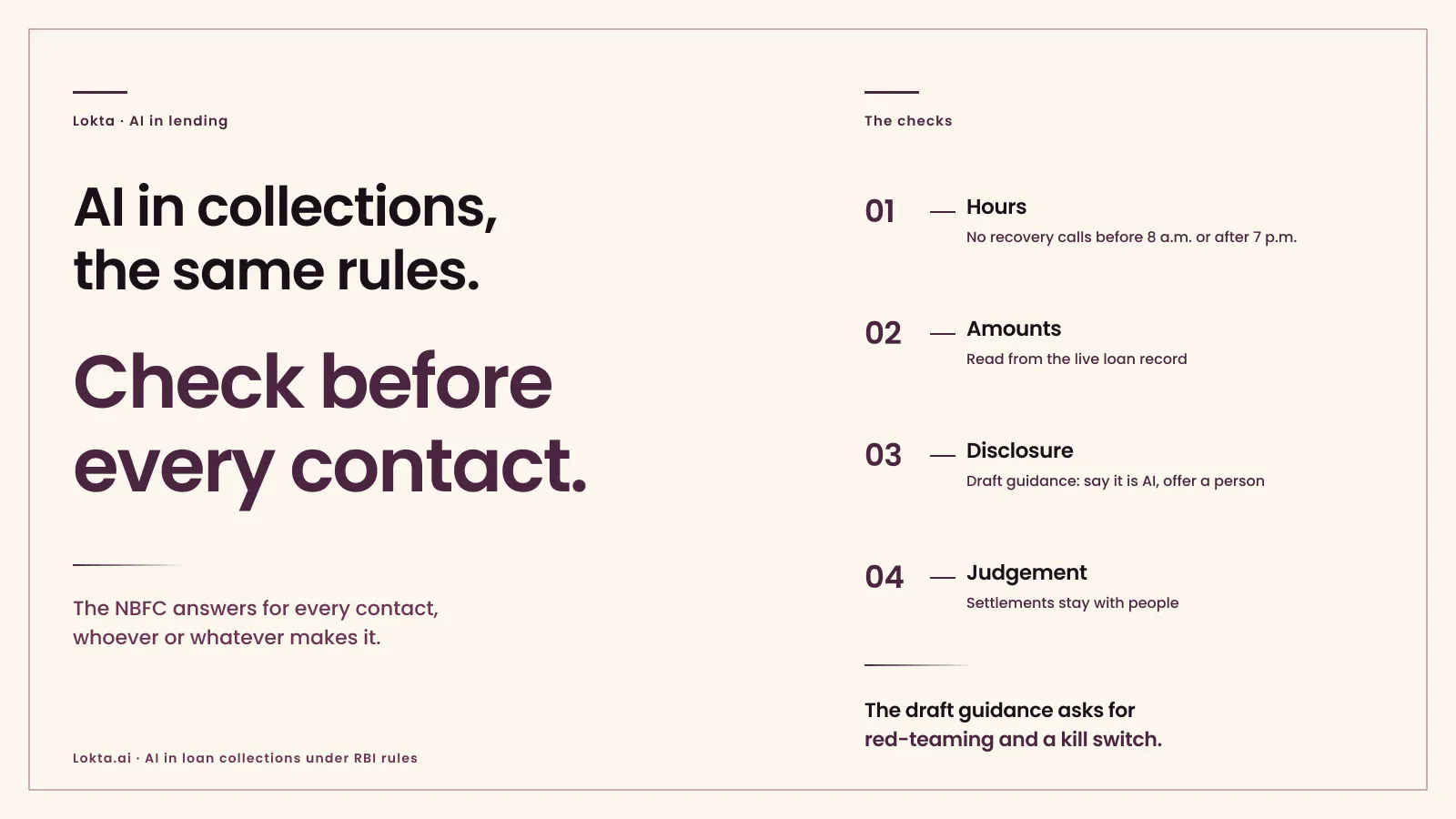
Pre-due reminders, overdue follow-up, hardship referral, recovery and legal escalation. Days past due help organise the queue, but the lender’s policy, borrower circumstances, consent, channel restrictions and applicable rules determine the allowed contact and escalation. No fixed DPD band makes an agent safe to act without those checks. A bucket-by-bucket collection strategy sets out the treatments for each band and how to test a change. For Indian NBFCs, AI in loan collections under RBI’s rules maps the conduct rules and the draft model risk guidance onto what an agent may do.
7. Complaints and disputes
Service complaints, fraud claims, unauthorised-debit claims, regulatory escalations, NOC disputes and fee challenges. Record when the complaint arrived, the responsible owner, the applicable response and escalation deadlines, and each response. The complaint type and jurisdiction determine the clock; do not encode one universal deadline for every case.
8. Compliance and periodic obligations
KYC re-verification cycles, AML / sanctions re-screening, document expiry (insurance, identity, employer letters), interest-rate revision notices, periodic disclosures, regulator-mandated borrower communications, co-borrower / guarantor verification refreshes. Calendar-driven, policy-bounded, audit-watched.
9. Operational exceptions
Settlement mismatches, integration timeouts, partner reconciliation failures, data discrepancies, pending approval queues, manual-intervention backlogs. The endless tail every LMS produces. Categories shift faster than rule-based automation can keep up with.
10. Lifecycle transitions
Loan closure, foreclosure booking, NOC issuance, NPA classification, restructured-asset accounting, write-off processing and recoveries against written-off accounts. A top-up request can arrive in this queue, but new credit approval is routed to origination. Account changes need verified inputs, the relevant checks and approval, and a confirmed posting result.
That is the surface area. Ten categories, varying volumes, varying decision complexity, varying regulatory exposure. Any AI strategy for servicing has to live somewhere on this map.
What “agent” means in this context
Before mapping where agents help, three quick distinctions:
- Not a chatbot. A chatbot answers a borrower’s question; an agent runs the workflow the question implied. A borrower asking “can I delay this month’s payment?” doesn’t want an FAQ. They want a hardship offer routed through policy.
- A proposal still needs checks. An agent can choose a proposed next step from the available context. Controls outside the model must check whether that step is permitted and whether the inputs are sufficient.
- Execution is a separate permission. A workflow may allow an agent to send an approved message, while requiring a human to review a hardship offer. Calling it an agent does not authorise either action.
The architectural anchor: agents sit above a deterministic core. They do not replace it. The core owns the truth: schedules, balances, NPA buckets, the audit log. The agent reads from the core, drafts decisions inside policy, writes back through governed APIs. (More on the layering →)
Where AI agents can actually help
The following patterns describe workflow design. For a particular deployment, demonstrate the data access, permission boundary, rejection path and execution evidence before enabling each action.
Where an agent can lead inside policy
(2) Repayment exceptions and disputes. For a payment-not-reflecting case, the agent can assemble the receipt reference, bank acknowledgement, account mapping and posting history available from approved records. It flags missing or conflicting evidence and drafts the operations handover. Absence from one account view does not prove that a debit or posting failed. Re-presentation or a financial correction requires the lender’s approved checks and authority; reconcile an uncertain execution result before another attempt. Overpayments, disputed charges and waiver requests follow their own checks and approval paths.
(3) Borrower service requests. An agent can retrieve statements and draft responses from approved records. Quotes come from the core’s calculation. EMI-date, repayment-mode and closure requests pass through their configured validation and approval paths. A request or draft does not prove that the account changed or a document was issued.
(4) Disbursement status enquiries. For an approved loan, the agent can compare the status records and bank acknowledgement it is permitted to read, explain a confirmed status, or hand conflicting evidence to operations. This is status support, with no underwriting, credit approval or disbursement execution in scope.
(5) Hardship and restructuring: triage and offer routing. The agent classifies the hardship category against policy (job loss, medical, natural-event, structural income change, fraud claim), retrieves the offer set the policy authorises, drafts the offer, and either sends it (if inside the agent’s authorisation envelope) or routes it to a human approver (if not). Non-standard or out-of-envelope offers stay human; everything that leads up to them is agent work.
(6) Collections: bounded reminders and routing. The lender defines the eligible population, cadence, channels, message content and stop conditions. The workflow should route hardship, disputes and uncertain payment status to the responsible owner before continuing contact. Test those handovers rather than assuming a DPD threshold makes reminders appropriate.
(7) Complaints: intake, classification, routing, draft response. SLA clocks running, regulator-watching. The agent reads the complaint, classifies it (service / product / regulatory / fraud), pulls the relevant ledger and audit history, routes it to the right queue with a draft response and the deadline visible. A human approves and sends.
(8) Compliance: document collection and anomaly escalation. An agent can organise permitted document requests, identify missing fields and prepare a review packet. Identity renewal, sanctions decisions and other compliance determinations remain subject to the lender’s applicable procedures, controls and authorised review. A collected document is not a completed compliance decision.
(9) Operational exceptions: triage and draft resolution. The agent can assemble the exception history, identify missing evidence and propose the next permitted step. Closing the case requires a verified result, not just a plausible explanation. Measure handling effort and errors in the pilot before claiming a saving.
Mixed: agent-assisted, human-led
(6) Collections needing negotiation or sensitive handling. The agent prepares the permitted account history, prior contacts, available offers and restrictions for the responsible human. Hardship or a payment dispute can require this handover at any DPD.
(6) Recovery and legal escalation. Use a human-led workflow for consequential negotiations and legal decisions, with agent-prepared context and evidence. Verify the borrower, amount, authority and notice before any action. This is a recommended control boundary, not a universal legal threshold at a particular DPD.
(10) Lifecycle transitions. The agent prepares the case and borrower communication. Closure, classification, write-off and any resulting posting run through the system of record’s checks and required approvals. A top-up request is handed to the separate credit-approval process.
Belongs on the deterministic core, not the agent
(1) Repayment-lifecycle event posting itself. Use deterministic controls for interest accrual, repayment allocation and schedule revision. Payment instructions also require mandate, authorisation and execution-state checks. A model’s proposal cannot establish that a debit is permitted or that a posting succeeded.
(10) NPA classification, restructured-asset accounting, write-off processing. These calculations and postings belong in deterministic, policy-versioned controls. Their inputs may include approved risk judgments, but the resulting classification and accounting must be reproducible. The core performs that work and preserves the evidence.
That is an architecture recommendation. The lender remains accountable for applying the relevant rules and exercising the judgments they require; this guide does not claim that regulation prescribes a particular software implementation.
A rejected proposal is part of the workflow
Synthetic design example: WF-001. A borrower reports a ₹10,000 payment. A bank acknowledgement exists, but the earlier posting attempt’s final state is unresolved. The proposed action is to retry that posting. This example describes a workflow to test, not a live product demonstration, integration or customer case.
| Step | Expected record in WF-001 |
|---|---|
| Trigger | Payment reported; the account view does not establish the final posting state |
| Source records | Receipt reference, ₹10,000 amount, bank acknowledgement, account mapping and available posting history, with retrieval times |
| Proposed action | Retry the receipt posting |
| Deterministic check | Reject execution because the prior attempt’s final state is unresolved and a retry could duplicate the posting |
| Human handover | Operations reconciles the receipt and transaction history; finance supports the ledger check |
| Execution verification | No new posting or debit instruction is issued by this rejected proposal |
| Retained evidence | Proposal ID, policy version, failed check, rejection reason, source references, timestamp and next owner |
Human approval cannot bypass the unresolved check. Operations first establishes the earlier attempt’s result. If the receipt already posted, verify the allocation and explain it. If a correction is needed after factual resolution, create a new linked proposal and apply its required checks and approvals. The original proposal stays rejected in the case history. A later correction has its own execution result.
Use the AI servicing workflow worksheet to record the source facts, permitted proposal, checks, authority, rejection path and final evidence for one servicing case.
This task boundary is what the platform enforces. The judgment a reviewer brings to a case like WF-001 is a separate, human skill built over the rollout’s first quarter, and what happens to a servicing team’s own role mix once that judgment is in place is a separate question again.
The map at a glance
The map splits collections into two workflows, so the ten categories above appear in eleven rows. Labels show a possible division of work after permissions and controls are established; they do not grant an agent execution authority.
How to deploy this without breaking trust
Knowing where agents help is half the answer. The other half is the platform underneath. Four properties make the control boundary testable by risk, operations, and audit teams. Treat them as deployment requirements.
Step 1: Put a deterministic core under everything
The agent does not own the truth. The system of record remains a deterministic ledger that the agent reads from and writes through. Schedules, balances, NPA classification, and the audit log do not live in agent memory. The deployment test is simple: an agent response must resolve back to the current account state and the evidence used.
Step 2: Treat policy as code, not policy as prompts
The hardship-offer envelope, the dunning cadence, the escalation thresholds, the channel rules, the fee-waiver authorisation table: these are policy. Policy goes in a versioned policy engine the agent calls into, not into the agent’s prompt template where it is invisible to compliance and gets overwritten on the next iteration. Every agent decision links by reference to the policy version it evaluated against. When policy changes, agent behaviour changes, without a re-deployment, and with the change recorded as a policy event.
Step 3: Enforce the authorisation envelope at the API boundary
Inside the agent’s authorisation envelope, the agent acts. Outside it, the agent stops and escalates. The platform enforces that envelope at the API boundary, so model output cannot grant the agent a permission the lender has not configured.
Step 4: Make the audit log identical in shape to a human’s
Every action an agent takes (message sent, offer drafted, ledger change proposed, exception routed) produces an audit record indistinguishable in structure from the equivalent human action, attributed to the agent identity. When a regulator asks for the methodology trail behind a specific decision, the lender produces it without explaining “but the agent did this so we have a different format.” There is no different format.
If a platform cannot demonstrate all four, keep the affected execution disabled until the control gap is closed. A human can investigate through the authorised manual process; approval is not a substitute for missing source facts or a failed check.
Evaluate these controls with Lokta
Lokta AI Loan Servicing and Loan Management are available now for the post-approval book. Lokta’s architecture puts AI proposals above a deterministic core and retains the evidence. Evaluate the particular workflow against four concrete checks:
-
Account state. Demonstrate where the borrower and account facts come from, their freshness, and how a reviewer traces the output back to the system of record.
-
Policy version. Show the approved rule, its effective date, the version used by the proposal and the result of each check.
-
Authority and rejection. Test a permitted proposal and a prohibited one. Confirm that model output or human approval cannot bypass an unresolved execution-state check.
-
Reconstruction. Have an independent reviewer follow the source records, proposal, rejection or approval, execution result and human handover. Availability alone does not prove that a particular integration or operating control has been demonstrated.
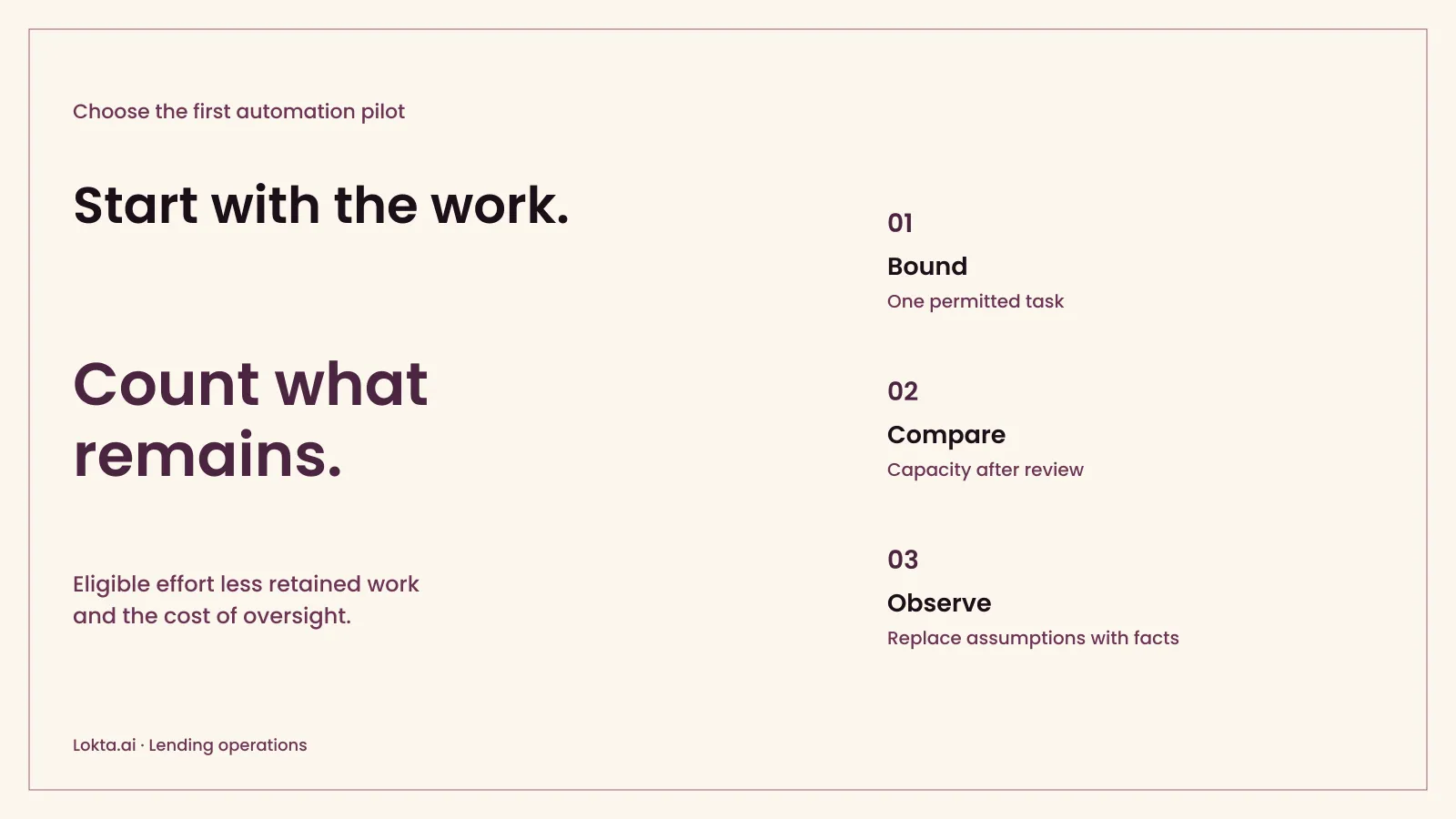
A practical rollout starts with one bounded workflow, such as evidence gathering for a payment exception. Expand only after testing normal cases, missing facts, rejected proposals and the handover. Underwriting, origination-time pricing and disbursement execution are outside the available servicing scope described here.
Before choosing a pilot, compare eligible effort, dependencies and cost across candidate queues. Once the task is selected, use the AI loan servicing pilot scorecard to define the workflow, allowed actions, human approvals, evidence, exception set, and stop criteria before the pilot begins.
Read next:
- AI in lending: the deterministic core: why an agent layer is only as trustworthy as the core under it.
- AI loan servicing pilot scorecard: define the workflow, controls, evidence, and acceptance criteria for a bounded pilot.
- Agentic Lending and the 5× Problem: the throughput and observability math no one is doing on agentic operations.
- Lending glossary: the twelve terms that recur across this post defined in 100 words each.
- Payment appropriation is a configuration science: compare allocation priority, traversal and eligibility with worked examples.
- Inside Moneyview’s technology and AI strategy: what a hybrid LSP-and-NBFC lender told the market about AI across underwriting, collections and servicing.
Frequently asked questions
How do you use AI agents in loan servicing?
To use AI agents in loan servicing, give them the exception work around a live loan: the bounced mandate, the borrower query, the hardship request, the promise to pay. The agent reads the account and proposes the next step. Postings, classification and anything that moves money stay with the deterministic core and the approvers your policy names.
What is loan servicing?
Loan servicing is the operational work on an approved loan through repayment, closure, settlement, write-off and any continuing recovery. It covers schedules, repayments, interest, charges, borrower communication, hardship handling, collections, classification, reporting and complaints. A request for new credit or a top-up goes through the lender's separate origination and approval process.
What types of tickets arrive in a loan servicing operation?
This guide groups the work into ten categories: repayment events; payment exceptions and disputes; borrower service requests; status enquiries about an approved loan's disbursement; hardship and restructuring; collections; complaints; compliance and periodic obligations; operational exceptions; and lifecycle transitions. The categories organise the discussion, not permissions. Disbursement execution and new credit approval remain outside this servicing workflow.
Which loan servicing tickets can AI agents handle today?
A bounded agent can retrieve approved records, draft explanations, route cases and propose actions where those permissions and data access have been configured and tested. The lender defines execution, approval and escalation rules for each workflow. DPD alone does not grant authority. Loan Management and AI Loan Servicing are available now from Lokta; a particular integration or execution path still needs evidence.
Which loan servicing tickets should NOT be handed to AI agents?
Do not give an agent unchecked authority over payment instructions, ledger postings, classification, settlements, write-offs or legal escalation. This guide recommends deterministic, policy-versioned controls for calculations and state changes, with the lender's required human decisions and approvals. It does not claim that regulation mandates a particular software architecture. An unresolved earlier posting must be reconciled before another attempt; human approval cannot bypass that check.
What happens when a proposed posting retry is rejected?
In the synthetic WF-001 example, a borrower reports INR 10,000 and a bank acknowledgement exists, but the earlier posting attempt's final state is unresolved. The proposed retry is rejected and no new posting or debit instruction is issued. Operations reconciles with finance support. The original proposal stays rejected; any later correction is a new linked proposal after the facts are resolved and the required checks and approvals pass.