Built on deterministic ledgers.
Designed for the live book.
Lokta brings an LMS, loan accounting, collections, lending partner management and reporting together for the live loan book.

Loan Ledger
Deterministic record of the loan
- Schedule
- Update the repayment schedule.
- Outstanding balance
- Recalculate loan balances.
- Repayment allocation
- Allocate to principal, interest and charges.
Accounting Ledger
Deterministic record of finance
- Debit / credit
- Post double-entry entries.
- Mapped GL accounts
- Apply product-to-ledger mappings.
- Balanced postings
- Keep the books in balance.
Same inputs. Same outputs. Replayable history.
Loan rules applied to schedules, balances and repayment allocation.
Product GL mappings applied to balanced, double-entry postings.
The software in the stack
A connected stack for loans after approval.
A loan servicing stack is the connected software a lender uses to manage approved loans. These are the capabilities in Lokta, explained by the work each one supports.
Manage loans, accounts and partners
- Loan Management System (LMS)
- Track repayment schedules, amounts due, payments received and outstanding balances for each loan.
- Loan accounting
- Record the accounting entries behind interest, fees and repayments, with a trail back to the loan transaction.
- Lending Partner Management
- Onboard partners, analyse their activity and manage monthly payouts through fee calculation, invoice approval and payment records.
- Loan Product Studio
- Configure loan terms, repayment rules, charges and accounting mappings. Test the configuration before activating the product.
Service borrowers and collect repayments
- AI Loan Servicing
- Help resolve borrower queries and propose follow-ups or actions within lender policy and required approvals.
- Collections and recovery
- Organise overdue-account follow-ups, record promises to pay and track recovery work against the account.
Monitor, report and govern
- Reporting and analytics
- Review portfolio balances, repayments, overdue accounts and partner activity using the underlying loan records.
- Compliance workflows
- Apply access controls and required approvals, and preserve records for audit and compliance review. Accountability stays with the lender.
- Bureau reporting
- Prepare loan and repayment data for credit bureau reporting. Confirm formats, validation and submission responsibilities for the deployment.
- Collateral management
- Maintain records of the assets securing loans, their valuations, documents and changes over the life of the account.
- RBI Model Risk Management
- Organise model validation, monitoring and supporting evidence for the risk team to review.
Connect your systems
- Payment gateway integrations
- Connect payment providers to repayment workflows and payment records. Provider scope and acceptance tests are agreed for each deployment.
- Integration hub
- Exchange data with the lender’s LOS, finance systems, bureaus and communication services through agreed and tested interfaces.
Loan Management, AI Loan Servicing and RBI Model Risk Management are available now. External connections are configured and tested for your deployment; a listed category does not mean every provider is preconnected.
Loan Origination is on the roadmap and is not available now. No release date is published. Loan Origination roadmap
Read the AI loan servicing stack explainerDefine the construct.
Launch your product.
Loan Product Studio
Define. Simulate. Launch.
construct
Rules defined together.
Applied consistently.
- Loan terms
- Tenure, interest method and repayment structure.
- Repayment rules
- Allocation, prepayment and foreclosure.
- Charges & penalties
- Fees, penal interest and waivers.
- Accounting mappings
- GL accounts and posting logic.
From definition to
configured product.
Define the loan construct, simulate scenarios, review the configuration, and launch your product.
Define the loan construct.
Set the terms, repayment rules, charges and accounting mappings in one place.
See how the rules behave.
Test repayment scenarios and inspect schedules, balances and accounting outcomes.
Review before you launch.
Inspect the configuration and simulation results with the people responsible for the product.
Launch a configured product.
Activate the loan product for use. The lender’s origination system controls new lending.
Configured loan product
Apps operate the book
on that foundation.
- Loan Management
Operate the live loan book.
- Collateral
Manage the security behind it.
- Collections
Work repayments and exceptions.
- Compliance
Work within lender requirements.
- Reporting
Bring the book into view.
- Analytics
Understand portfolio performance.
- Agents
Assist within lender guardrails.
Same deterministic ledgers
Lender policy and required approvals govern each change.
AI assists. It never decides.
One connected platform.
Built from the ledgers up.
Explore how the foundation, product construct and apps fit together.
Apps & services
- Loan Management
- Collateral
- Collections
- Compliance
- Reporting
- Analytics
- Agents
AI assists at the service layer. It never decides.
Loan Product Studio
Terms · Repayment rules · Charges · Accounting mappings
Define the construct. Simulate. Review. Launch.
Deterministic foundation
The Loan Ledger calculates the loan. The Accounting Ledger records the finance. Configured rules make both repeatable and traceable.
The Studio defines one loan construct: terms, repayment rules, charges and accounting mappings. Simulate and review it before activating the product.
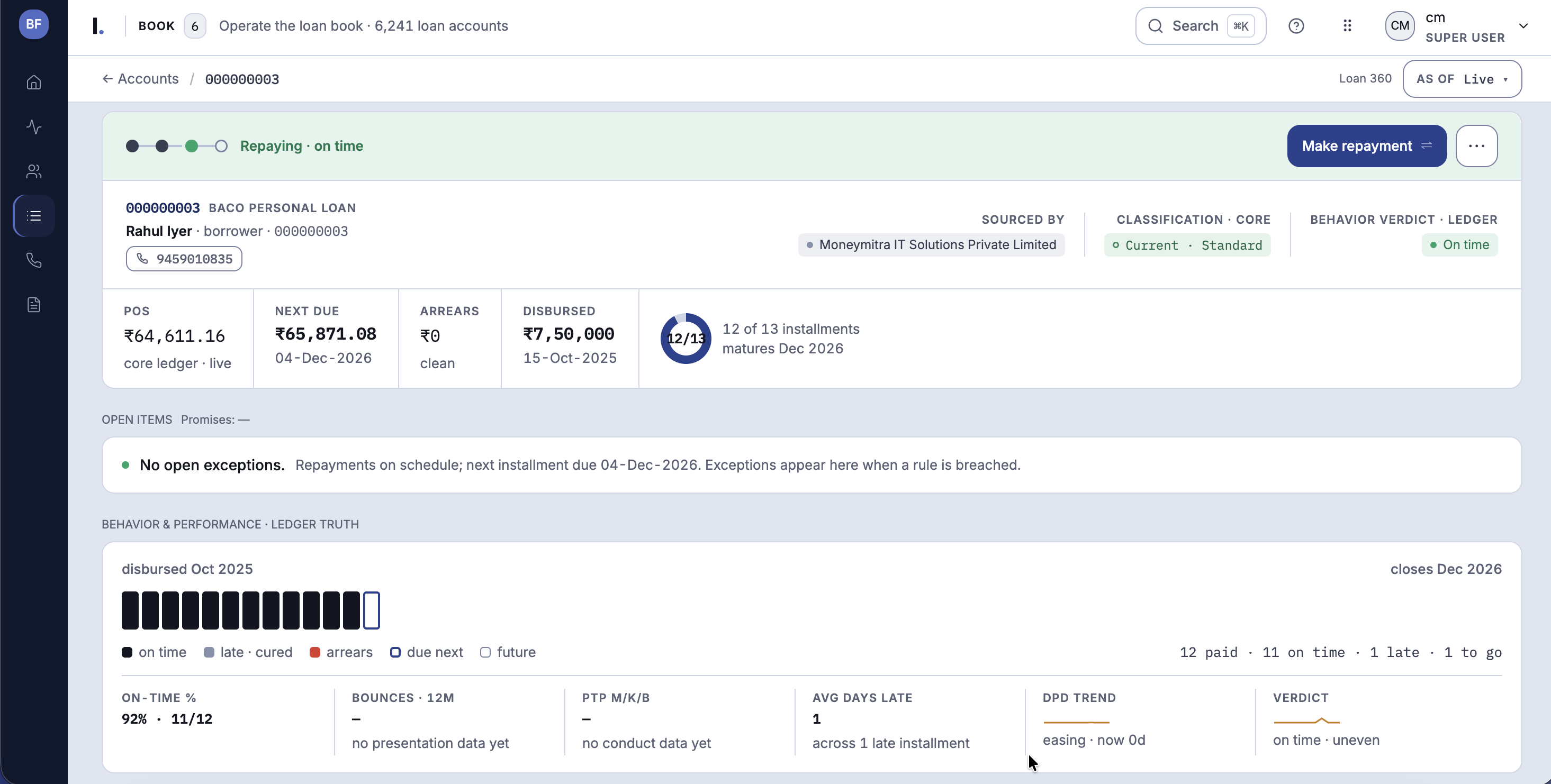
Apps operate and explain the live book on the same foundation. AI assists at this service layer; deterministic rules and required approvals govern changes.
Questions about the platform.
Does Lokta include a Loan Management System?
Yes. Lokta includes an LMS for approved loans, alongside loan accounting, collections, lending partner management, reporting and collateral management. AI Loan Servicing supports borrower service and follow-ups. Loan Origination remains on the roadmap.
What makes the ledgers deterministic?
The same inputs and configured rules produce the same outputs. The Loan Ledger calculates schedules, outstanding balances and repayment allocation. The Accounting Ledger applies GL mappings and records double-entry postings. The event history preserves the basis for replay and review.
What does the Loan Product Studio do?
The Loan Product Studio defines the loan construct: terms, repayment rules, charges and accounting mappings. Teams can simulate scenarios, review the configuration and activate a configured loan product. Launching a product here does not originate or approve a loan.
Where does AI sit in the platform?
AI sits at the service layer. Agents can explain information and propose work. AI never decides: the deterministic core checks changes against lender policy and required approvals. The lender remains accountable for the book.
What is an agentic loan servicing platform?
An agentic loan servicing platform helps a lender operate the live loan book after approval, with software agents assisting routine work inside governed workflows. Lokta combines deterministic loan and accounting ledgers, a Loan Product Studio, and apps for loan management, collateral, collections, compliance, reporting and analytics.
How does an existing book move from our current loan management system?
By migration onto Lokta’s Loan Ledger and Accounting Ledger. The migration maps products and loan accounts from the current system, reconciles balances and plans the cutover. From cutover, Lokta’s ledgers are the system of record for the migrated book. Scope and acceptance checks are agreed with the lender for each engagement.
Is Loan Origination available?
Loan Origination is on the roadmap. Lokta’s current scope is the live loan book after approval. The Loan Product Studio configures the product; the lender’s origination system controls new lending.