The price of money is uniform. The outcomes are not.
Same input price, opposite results. The cross-section and the cycle both say the separation between lenders is not the cost of capital. It is the intelligence applied to risk. And digitisation, for all it did, never touched the judgment.
Contents 5 sections
I ended the first part with a puzzle: lenders at the same layer of the cascade pay roughly the same for their money, yet their outcomes diverge violently. Let me now make that concrete, because the data is more striking than the claim.
- A credit decision is a probability, not a fact. The skill is assigning the right odds: being more right, more often, than the lender across the table.
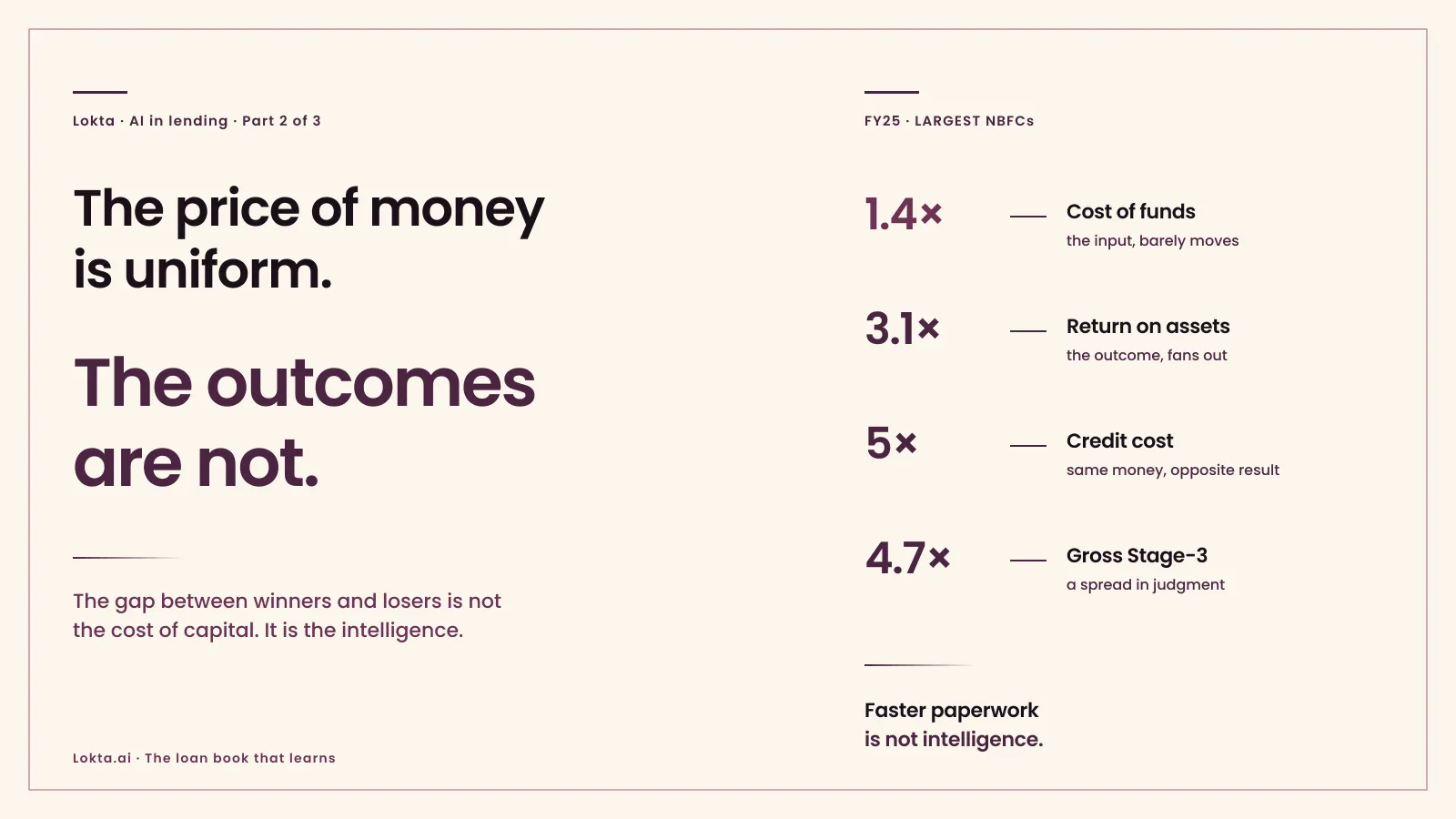
- The input price is uniform. Across India’s largest NBFCs in FY25, cost of funds spans only ~1.4×.
- The outcomes are not. Return on assets spans ~3.1×, credit cost ~5×, gross Stage-3 ~4.7×, cost-to-income ~14pp.
- The cleaner proof: same product, same cycle. Aavas held a ~1% bad-loan ratio while Repco spiked near 7%. Underwriting did the separating, not the cost of capital.
- Digitisation was necessary but not sufficient. It made the process faster and left the judgment static. Faster paperwork is not intelligence.
But before the numbers, one idea that the numbers only make sense against. Because it changes what you think you are looking at.
What is a credit decision, actually?
Strip a loan back to its core and the lender is answering one question: will this money come back? It is tempting to treat that as a fact waiting to be discovered (yes this borrower repays, no that one defaults) and to imagine that good underwriting is the art of sorting the two piles correctly.
That is not what is happening. The answer is never a fact. It is a probability.
Think about how confident you can honestly be about anything in the future. Some statements are as close to certain as the world allows. The sun will rise tomorrow: you would not take the other side of that bet at any odds. Others are a coin-flip, and pretending otherwise is just vanity dressed as conviction. Most things sit somewhere in between. The whole skill, in any business of prediction, is assigning the right odds: being honest about how sure you actually are, and being more right about it, more often, than the person across the table.
A credit decision is exactly that. It is an estimate of the probability that a particular borrower, in particular circumstances, repays a particular loan. A good lender does not magically know who will default. A good lender holds sharper, better-calibrated probabilities than its rivals, and prices, sizes, and structures each loan to match. Lend at a rate that covers the true odds and you make money across the book even though individual loans go bad. Misjudge the odds (believe a seven-in-ten borrower is a nine-in-ten one) and you have underpriced a risk you will meet later, at the worst possible time, in the credit-cost line.
So when I say the separation between lenders is the intelligence applied to risk, here is what I mean precisely. The spread in their outcomes is a spread in the quality of their probability estimates: how accurate those estimates are, and how fresh. The lenders that win are the ones whose odds are sharper than the field’s and stay sharp as the world moves. Hold that. The data is about to show you the spread, and now you know what the spread is made of.
I’ll keep the numbers few and round. The argument carries this piece, not the decimals.
The cross-section
Take India’s largest listed NBFCs in a single recent year, the financial year ending in March 2025. Line them up and look first at their cost of funds. It spans a narrow band: from roughly 6.3% to roughly 8.9% across the set. That is a range of about 1.4 times from the cheapest-funded to the dearest. In a country with one interest-rate environment and one set of wholesale lenders, that is about as uniform as a raw-material price ever gets. Everyone is buying the same thing at almost the same price.
Now look at what they do with it. The outcomes do not span 1.4 times. They span multiples.
Return on assets (how much profit a lender earns for each rupee on its books) ranges across the same set by about 3.1 times, from under two to nearly six. Credit cost (the money lost to loans that default, as a share of the book) spans about five times. Gross Stage-3 (the share of the book that has gone bad, in the accounting language lenders use to mark impaired loans) spans about 4.7 times. And cost-to-income (what it takes to run the operation per rupee it earns) spreads about fourteen percentage points from the leanest to the heaviest.
Sit with the shape of that for a moment. The input price moves by a factor of less than one and a half. The results move by factors of three, five, almost five again. Same raw material, at almost the same price, and the businesses built on it land in completely different places: some among the finest financial businesses in the country, some destroying value year after year. If the cost of capital decided lending, this picture would be impossible. It is the normal picture. What you are looking at is not a spread in luck. It is a spread in the quality of thousands of probability estimates, compounded.
Now the honest part, because skipping it would weaken everything after it. Some of that return-on-assets spread is not skill. It is business mix. A gold lender and an affordable-housing lender are structurally different animals; they earn different margins for sound, permanent reasons that have nothing to do with one being cleverer than the other. So I will not lean the argument on return on assets or headline margin, where mix does real work. I will lean it on the metrics mix explains least: credit cost, asset quality, and cost-to-income. How much of your book goes bad, and how efficiently you run, are far less a function of which product you sell and far more a function of how well you choose, price, and manage borrowers. Those are the disciplined comparisons. That they fan out by roughly five times is the fact that needs explaining.
The cleaner proof: same product, same cycle
The cross-section has a fair objection baked in, and I’ve just conceded part of it. So let me show you the cleaner evidence: lenders doing the same thing, through the same weather, ending up in opposite places.
Take affordable-housing finance: small home loans to lower-income borrowers, a single well-defined product. Now take two lenders in it and watch them across five years, financial 2021 through 2025, a window that includes the COVID shock and a later bout of stress. Both lent to similar borrowers. Both faced the same funding climate. The product is the same. The macro is the same.
Aavas held its bad-loan ratio near one percent in every one of those years (through the pandemic, through the later stress) and earned a steady return on assets around 3.4% the whole way. Repco Home Finance, in the same segment and of similar size, saw its bad-loan ratio spike to nearly seven percent in the COVID year and its return on assets roughly halve before it recovered.1 Same product. Same cost of money. Same storm. One book held its line; the other did not. The difference was not what they sold or what they paid for funds. One of them held better odds on its borrowers, and held them when it mattered, in the weather that tests every estimate at once.
The pattern holds up in the cycle, too. In the very same windows, unsecured microfinance books swung violently: a leading microfinance lender saw its credit cost roughly double into financial 2025, when the sector hit real stress. Same country, same years, same rate cycle. The books that had built genuine discipline into selection and structure held; the books that had not, didn’t.
It is worth pausing on one objection here, because the obvious counter is that some of this is just collateral, not judgment. Muthoot, lending against gold, runs near-zero economic credit loss; it loses almost nothing in real terms, even though its headline bad-loan figure sits around three to four percent. The headline looks worse than the housing lenders’; the actual loss is far smaller. You could say: that’s structure, not intelligence. But that is the wrong way to read it. Designing a product so that a default is not a loss (real collateral, valued conservatively, with an auction process that recovers the money when a borrower stops paying) is intelligence applied to risk. It is the deliberate kind: judgment expressed in how the loan is built rather than in how each borrower is scored. Structure and selection are two forms of the same discipline, and the best lenders use both. Compare it to GIC Housing Finance, a cheaply-funded lender rated AA+, which still could not outgrow a stressed legacy book from years earlier. Its bad-loan ratio peaked near seven percent in FY22, and it worked its way back only by shrinking, lending less, running the legacy book down rather than growing past it.2
Read those two together and the conclusion is unavoidable. Cheap funding did not, on its own, resolve GIC Housing’s legacy stress. And expensive-looking headline numbers did not stop Muthoot from running an almost loss-free book. The cost of capital did not do the separating. Underwriting did. Operating discipline did. The intelligence applied to risk did.
So let me say the thing the whole series turns on, now that it’s earned:
The price of money is roughly uniform. The outcomes are not. The gap between winners and losers in lending is not the cost of capital. It is the intelligence applied to it.
Why was technology necessary but not sufficient?
The natural next thought is: surely technology already fixed this. Every serious lender has digitised. And that’s true: it has. Nearly every NBFC now runs a loan origination system to take applications, pulls credit bureau data in seconds, does KYC digitally, scores applicants with models, disburses to a bank account without a branch visit. A decade ago this was an edge. Today it is the price of entry: if you don’t have it, you’re not in the game.
That phrase is worth slowing down on, because it points at a rule that governs every industry, not just this one. When a capability becomes ubiquitous and close to free, value does not disappear. It migrates. It moves off the thing everyone now has and onto whatever stays scarce. The abundant part commoditises; the scarce part keeps the value.
The same migration has already happened in lending, and most of the industry has not noticed where the value went. Origination systems, bureau pulls, eKYC, instant disbursal: all of it has become abundant and cheap. So the digitisation itself is no longer an edge. It cannot be; everyone has it. What stays scarce is the quality of the judgment (the calibration of those probability estimates) and, more than that, the ability to improve it. The moat did not vanish when the software commoditised. It moved. It moved from the software to the learning.
Which is why the uncomfortable observation that follows is the hinge of this whole essay. Digitisation made the old process faster. It did not make the judgment better.
Look closely at what got automated. The paperwork. The data collection. The hand-offs. The arithmetic. All of it sped up enormously, and that is real value: it lowered cost, cut time-to-decision, widened reach. But the decision rule underneath (the underwriting policy that decides who gets a loan, at what price, on what terms) is still, at most lenders, a static thing. This is the quiet villain of the whole industry: the credit policy a risk team writes once, ships into the system, and leaves running unchanged for a quarter, often longer. When the world moves (a cohort starts behaving differently, a town’s economy turns), the policy doesn’t notice. It keeps applying yesterday’s odds to today’s borrowers until, eventually, a human looks at a report, draws a conclusion, and ships a revision. One change a quarter, if the team is good, while the world moves daily.
That is the gap. We digitised the speed of lending and left the intelligence of it almost exactly where it was. The probability estimate that decides each loan is set once and ages from the moment it ships. We made the grain-store keeper’s ledger electronic. We did not make his judgment any sharper.
Faster paperwork is not intelligence.
Which sets up the only question worth asking next. If the thing that separates the winners is intelligence about risk (not the cost of money, not the speed of the workflow, but the quality and freshness of those probability estimates), then the real question is whether that judgment can be made to improve on its own.
This is the question my co-founders and I built Lokta to answer, so what follows is not idle theory for us.
Can a loan book actually learn? That’s the next part.
Why a loan book can finally learn, and why it is different from anything that learned before it: its own decisions shape the data it learns from. The flywheel, the borrower it includes, the brakes it needs, and the infrastructure Lokta is building to run it.
Frequently asked questions
What actually separates winning lenders from losing ones?
Not the cost of capital. Across India's largest listed NBFCs in FY25, cost of funds spans only about 1.4 times from the cheapest-funded to the dearest, about as uniform as a raw-material price gets. Yet return on assets spans about 3.1 times, credit cost about 5 times, gross Stage-3 about 4.7 times, and cost-to-income about 14 percentage points. The input price barely moves while the outcomes fan out by multiples. The gap between winners and losers is the intelligence applied to risk (the quality and freshness of their probability estimates), not the price they pay for money.
Why is a credit decision a probability rather than a yes-or-no fact?
Because whether a loan comes back is never knowable in advance. It can only be estimated. A credit decision is an estimate of the probability that a particular borrower, in particular circumstances, repays a particular loan. A good lender does not magically know who will default; it holds sharper, better-calibrated probabilities than its rivals, and prices, sizes, and structures each loan to match. Lend at a rate that covers the true odds and you make money across the book even though individual loans go bad. Misjudge the odds and you have underpriced a risk you will meet later, in the credit-cost line.
Did digitisation fix the lending judgment problem?
No. Digitisation made lending faster, not its judgment better. Origination systems, bureau pulls, eKYC, and instant disbursal are now the price of entry: abundant and cheap, so no longer an edge. What got automated was the paperwork, the data collection, the hand-offs, and the arithmetic. The decision rule underneath (the underwriting policy that decides who gets a loan, at what price) is still, at most lenders, a static thing written once and left running for a quarter or longer while the world moves daily. We digitised the speed of lending and left the intelligence of it almost exactly where it was.
If two lenders pay the same for money, why do their outcomes diverge so much?
Because outcomes are a spread in the quality of thousands of probability estimates, compounded. Not a spread in the price of the raw material. Take two affordable-housing lenders across FY21 to FY25, the same product through the same cycle: Aavas held its bad-loan ratio near one percent throughout and earned a steady return on assets around 3.4%, while Repco Home Finance, of similar size in the same segment, saw its bad-loan ratio spike to nearly seven percent in the COVID year before recovering. Same product, same cost of money, same storm. One held better odds on its borrowers and held them when it mattered.
Read next:
- The loan book that learns (Part 3): why a loan book can finally learn, the flywheel it turns, and the infrastructure Lokta is building to run it.
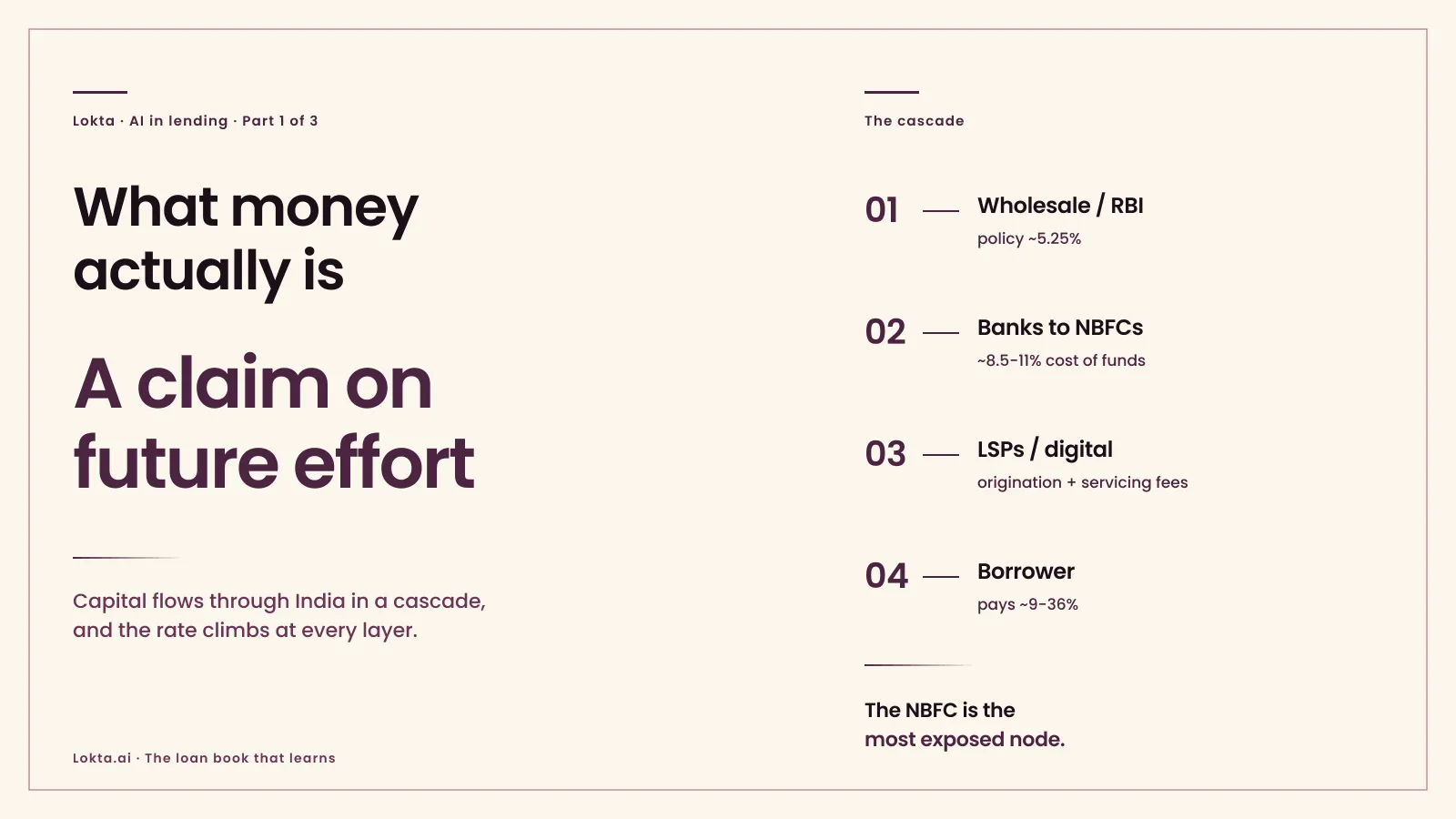
- What money actually is (Part 1): how capital flows through India’s lenders, and why the NBFC is the most exposed node of the whole cascade.
- Why every lender’s portfolio analytics lives in Excel: what it costs when the analytical layer (where judgment is supposed to sharpen) migrates out of the platform entirely.
- ↑ Repco Home Finance: gross NPA peaked at ~6.97% in FY22, recovering to ~3.3% with return on assets ~3.3% by FY25. Sources: CARE Ratings rationale; company investor disclosures.
- ↑ GIC Housing Finance: gross Stage-3 peaked near ~7.3% in FY22, de-stressing to ~3.0% by FY25; rated AA+; loan book broadly flat-to-shrinking over the period. Sources: ICRA / CRISIL rating rationales; company disclosures.
- FY25 cross-section spread (largest listed NBFCs): cost of funds ~6.3%→8.9% (~1.4×); return on assets ~1.83%→5.70% (~3.1×); credit cost ~0.50%→2.50% (~5×); gross Stage-3 ~0.96%→4.55% (~4.7×); cost-to-income ~27.7%→41.7% (~14pp). Sources: company annual reports; Lokta NBFC benchmark (FY25). Figures are rounded.
Chandramouli is co-founder of Lokta. He reads the credit-cost line before the headline margin, because that is where the judgment shows up, and is on LinkedIn for lenders who want to build a book that learns.
Chandramouli · Bengaluru, June 2026