What money actually is
Money is a claim on future productivity, and lending is the oldest way of allocating it. This is how capital really flows through India today, and why the NBFC sits at the most exposed node of the whole cascade.
Contents 4 sections
I want to start a few steps back from where lending conversations usually begin, because the standard starting point (products, rates, channels, scores) hides the thing that actually decides who wins.
So, plainly: what is money?
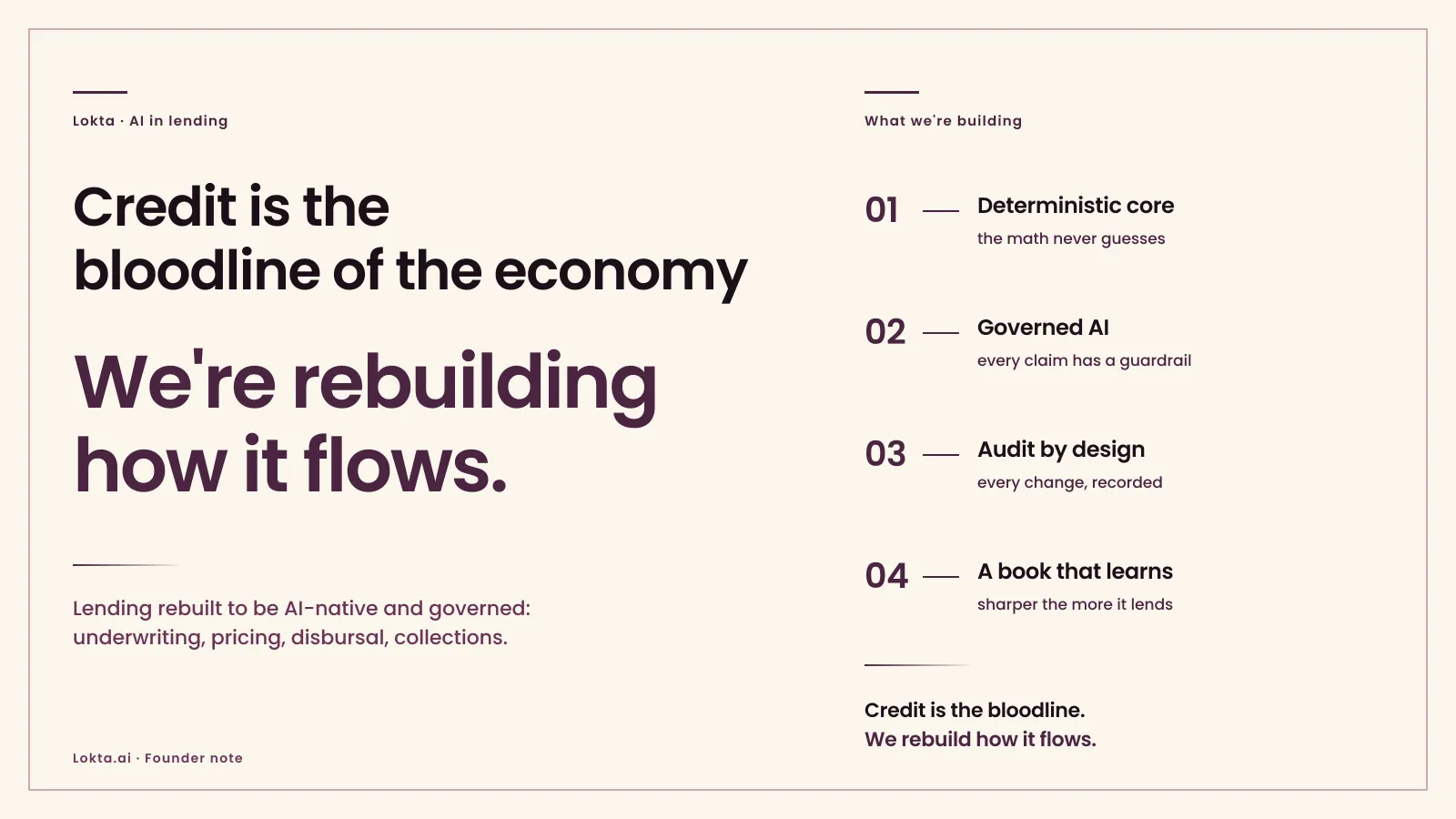
- Money is a claim on future productivity: an information system for allocating human effort. The tokens were never the wealth; the claim on what others can do was.
- Lending is the oldest form of resource allocation: the grain store, then the temple lender, now the NBFC. The clothes change; the substance does not.
- Capital moves in a cascade, not one step: RBI to banks to NBFCs to LSPs to the borrower, and the rate climbs at every layer.
- The NBFC is the most exposed node: closest to the hard-to-read borrower, with the least cushion, and punished fastest for bad judgment.
- The puzzle that powers the series: lenders at the same layer pay roughly the same for money, yet their outcomes diverge violently. Something other than the cost of capital is doing the separating.
Money is a claim on future productivity. A rupee in your hand is not a thing of value in itself. It is a promise that, later, someone will hand you goods, services, or effort in exchange for it. Capital is the same idea held still: stored human effort, parked, waiting to be put back to work. The reason capital exists at all is that effort and need rarely arrive at the same time. The farmer has grain in October and nothing in June. The weaver has cloth but needs thread before the cloth exists. Someone, somewhere, always has more stored effort than they can use right now, and someone else has a use for effort they do not yet have.
There is a sharper way to say the same thing, and it matters for everything that follows. Money is an information system for allocating human effort. Its real work is to carry a signal (that it is worth someone’s while to do something for someone else) and so to coordinate who builds, who grows, who lends, and who waits. Elon Musk put it crisply not long ago: money is really a database for labour allocation. Take away the labour and the numbers mean nothing. Strand a person on a desert island with a trillion rupees and they are no richer for it: there is no one whose effort those rupees can direct. The tokens were never the wealth. The claim they give you on what other people can do, that was always the wealth.
And if money is information, then everything built on top of it is information too. Lending is what closes the gap between stored effort and present need. It is the oldest form of resource allocation we have, older than coins, older than banks, older than interest as we’d recognise it. The first lenders were grain stores. A society that learned to put aside seed could lend that seed to a farmer who had none, on the understanding that more grain would come back after harvest. That is a loan. It carries every feature a modern loan has: a transfer of stored value now, a promise of return later, and a risk (the central one) that the harvest fails and the grain does not come back.
That risk is the whole story. I’ll come back to it more than once.
Trace the line forward and the apparatus gets more elaborate but the substance does not change. Temples in medieval India held stored wealth and lent it; they were among the first institutions trusted to weigh a borrower’s standing and a season’s odds. Today we have the NBFC: the non-banking financial company, a lender that extends credit but does not take deposits the way a bank does. The clothes are different. Underneath, it is still the grain store: stored effort, deployed now, against a promise and a risk.
What changes across these centuries is not the nature of the loan. It is the quality of the judgment about who gets one. The grain-store keeper knew the farmers by name. The temple knew the families. Every advance in lending since has been, at bottom, an advance in how well a lender can tell a good risk from a bad one at a distance, at speed, and at scale. Hold that thought.
How does capital actually flow through India’s lenders?
Now the concrete part, because the philosophy only matters once you see how it plays out in money.
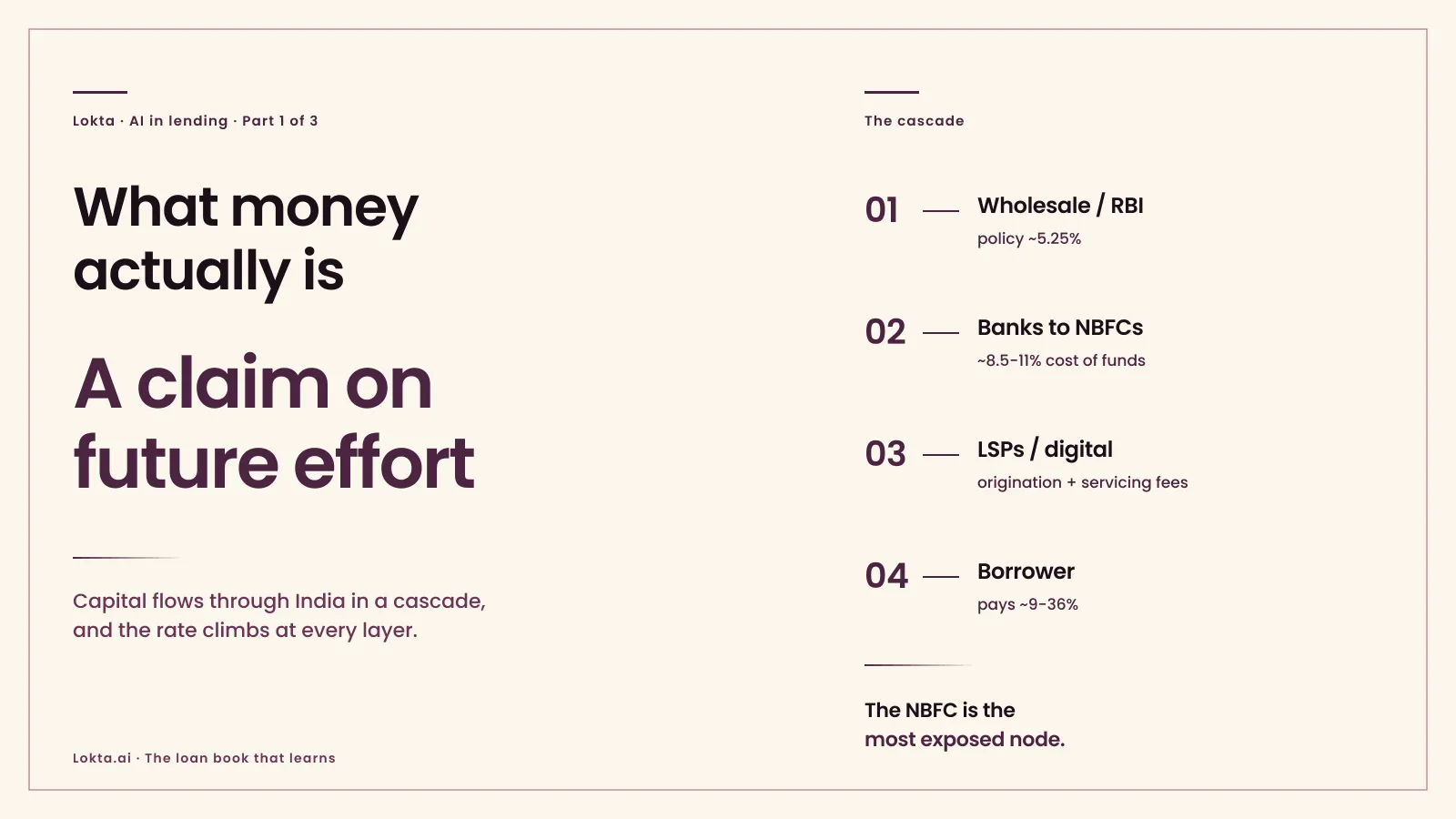
Capital in India does not move from saver to borrower in one step. It moves in a cascade, and at each step it changes hands and picks up a price.
the rate climbs at every layer: the borrower pays a multiple of the policy rate →
Illustrative rates, mid-2026. Money enters near the RBI repo rate (~5.25%); banks fund at ~5-6.5% and lend on to NBFCs at ~8.5-11%; a large NBFC’s own cost of funds runs ~6-9% (smaller, lower-rated lenders pay more). What the borrower finally pays turns on the product: roughly 7.5-10% for a prime home loan, 9-13% affordable housing, 10-24% unsecured personal, 14-36% for app-based digital credit (fees included), 22-26% microfinance. Sources: RBI policy and sectoral lending rates; company disclosures; Lokta FY25 NBFC benchmark.
At the top sit the wholesale and development sources, large pools of capital that do not lend to you and me directly. They lend to banks and to large institutions. Banks, in turn, hold deposits and borrow from these wholesale sources, and they lend onward: to businesses, to households, and (this is the part that matters here) to NBFCs. The NBFC takes that bank money and lends it to the borrower the bank often will not reach directly: the small-shop owner, the first-time home buyer in a tier-three town, the borrower with a thin or non-existent credit file.
And increasingly there is one more layer, closest of all to the borrower: the Lending Service Provider, or LSP, a partner that carries out a lender’s work (finding the customer, helping underwrite, servicing the loan, chasing the recovery) on someone else’s book, for a fee. This is where most of what we loosely call “digital lenders” actually sit. A digital lender is a business model, not a regulatory category. When a fintech sources and services a loan that lives on a partner bank’s or NBFC’s balance sheet (the now-common co-lending arrangement), it is acting as an LSP. Only when it holds its own licence and lends off its own book is it a regulated lender in its own right. So the slick app on the borrower’s phone is usually the front end of an LSP, with a bank or an NBFC carrying the actual risk behind it.
The scale of this is easy to underestimate. More than nine thousand NBFCs are registered with the Reserve Bank of India, but the system is steeply top-heavy: just fifteen are classed as systemically important “Upper Layer” firms, while the rest taper down through a few hundred mid-sized lenders to many thousands of tiny ones. Together the NBFC sector now carries a balance sheet north of ₹60 lakh crore (on the order of fifteen percent of India’s GDP), and it has been growing at close to twenty percent a year. On the digital side, the RBI’s own lending-app directory lists hundreds of Lending Service Providers and some nine hundred distinct lending apps operating on behalf of regulated lenders. This is not a niche. It is a large, fast-growing share of how Indians actually borrow.
India’s lending system, March 2026: 9,086 NBFCs registered with the RBI (15 Upper Layer, 624 Middle Layer, 8,436 Base Layer); sector balance sheet ₹61 lakh crore, about 14.6% of GDP, growing 19.4% year on year. Digital lending: 562 Lending Service Providers behind ~904 lending apps, run on behalf of 347 regulated lenders. Sources: RBI master NBFC registry; RBI Trend & Progress 2024-25; RBI Digital Lending Apps Directory.
Here is the mechanic that governs everything downstream. At each layer, the recipient pays for the money it takes in, and that price is its cost of funds, simply what a lender pays to borrow the money it then lends out. The bank pays a cost of funds to its wholesale sources. The NBFC pays a higher cost of funds to the bank, because it is one step further from the source and carries more risk. The LSP or digital lender, further out again, prices in its own costs on top. Cost of funds compounds down the cascade the way a river loses height: each layer takes its drop. Put rough numbers on it and the climb is plain: money enters near the policy rate of about five percent and reaches the borrower, at the far end, at anywhere from nine to thirty-six percent. The same rupee, at a very different price, depending on where you stand in the cascade.
Margin is created and destroyed along that same cascade. It is created wherever a layer can lend at a rate meaningfully above what it paid, which is to say, wherever it can reach borrowers others cannot, and price them correctly. It is destroyed wherever loans go bad faster than the spread can absorb. A lender that borrows at, say, eight and lends at sixteen looks like it is making eight points of margin. It is not. It is making eight points minus whatever fraction of its book never comes back, minus what the trade calls credit cost, the money a lender loses to loans that default, written as a share of the book it lent. Credit cost is where margin goes to die, quietly, a quarter or two after the loan looked fine.
Why is the NBFC the most exposed node?
Run your eye back up that cascade and one node stands out as both the most interesting and the most exposed: the NBFC.
It is the most interesting because it sits closest to the borrower the system is supposedly there to serve: the underserved one, the one a bank’s credit policy waves away, the one whose risk is genuinely hard to read. That is where the real economic work of credit happens, and where the real spread lives. If you can lend well to the borrower nobody else can price, you have a business almost no one can copy.
It is the most exposed for exactly the same reason. The NBFC pays a higher cost of funds than the bank above it, so it has less cushion to begin with. It lends to harder-to-read borrowers, so its judgments are more likely to be wrong. And it feels the consequences fastest: when an NBFC misjudges risk, the loans sour, the credit cost climbs, the lenders one layer up grow nervous and lend to it more expensively or not at all, and the squeeze arrives from both ends of the book at once. This is the node where judgment matters most and is punished hardest and quickest. The grain-store keeper who misread a farmer lost a season’s seed. The NBFC that misreads a cohort can lose the institution.
Which is why the NBFC is the right place to look if you want to understand what actually separates winners from losers in lending. It is the layer where there is nowhere to hide: not behind cheap funding, not behind safe borrowers, not behind a slow-moving balance sheet. The judgment is the business.
The puzzle
And here is where the cascade leaves us with a question I did not expect to find as sharp as it is.
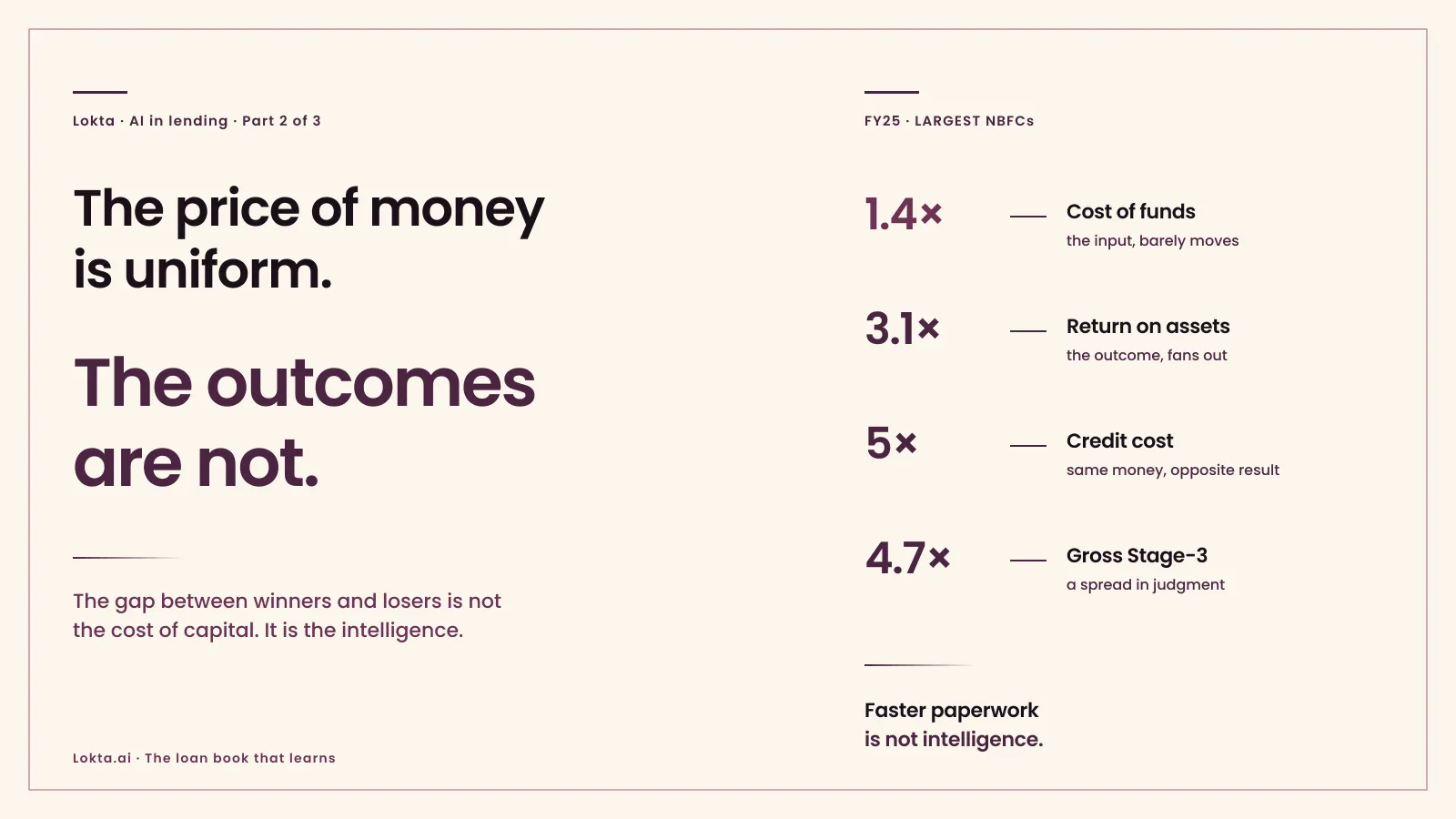
At any given layer of that cascade, lenders pay roughly the same for their money. Two NBFCs of similar standing borrow from the same kinds of banks at broadly similar costs of funds. The input price of their core raw material (capital) is, give or take, the same.
So why do their outcomes diverge so violently?
Because they do. Put two lenders side by side who pay almost the same for money, who often lend into the same towns to the same kinds of people, and you will find one of them quietly compounding wealth while the other quietly bleeds it, not by a little, by a lot, year after year. Same input. Opposite result. If the price of money were what decided lending, this could not happen. It happens constantly.
The raw material costs the same for everyone in the room, and yet the room contains both the best businesses in the country and some of the most value-destroying. Something other than the cost of capital is doing the separating.
That is the puzzle that powers everything that follows. In the next part, I’ll put numbers on exactly how uniform the price is and how wild the outcomes are, and I’ll name the thing in the gap.
Same input price, opposite results. The cross-section and the cycle both say the separation between lenders is not the cost of capital. It is the intelligence applied to risk.
Frequently asked questions
What is money, in first-principles terms?
Money is a claim on future productivity: a promise that, later, someone will hand you goods, services, or effort in exchange for it. A sharper way to say it: money is an information system for allocating human effort. Take away the labour and the numbers mean nothing. Strand a person on a desert island with a trillion rupees and they are no richer for it, because there is no one whose effort those rupees can direct. The claim on what other people can do was always the wealth, not the tokens.
How does capital flow from the RBI to the borrower in India?
Capital moves in a cascade, not one step. Wholesale and RBI sources lend near the policy rate (about 5.25% in mid-2026); banks fund at roughly 5 to 6.5% and lend on to NBFCs at about 8.5 to 11%; NBFCs lend to harder-to-reach borrowers, and Lending Service Providers and digital lenders add origination and servicing on top. What the borrower finally pays (roughly 9 to 36% depending on the product) is a multiple of the policy rate, because each layer prices in its own cost of funds and risk.
Why is the NBFC the most exposed node in the lending cascade?
Because it sits closest to the borrower the system is meant to serve and pays a higher cost of funds than the bank above it, so it begins with less cushion. It lends to harder-to-read borrowers, so its judgments are more often wrong, and it feels the consequences fastest: when an NBFC misjudges risk, loans sour, credit cost climbs, and the lenders one layer up grow nervous and fund it more expensively or not at all. The squeeze arrives from both ends of the book at once. It is the node where judgment matters most and is punished hardest and quickest.
What is a Lending Service Provider (LSP)?
A Lending Service Provider, or LSP, is a partner that carries out a lender's work (finding the customer, helping underwrite, servicing the loan, chasing the recovery) on someone else's book, for a fee. Most of what we loosely call digital lenders sit here: the app on the borrower's phone is usually the front end of an LSP, with a bank or NBFC carrying the actual risk behind it. Only when a fintech holds its own licence and lends off its own book is it a regulated lender in its own right.
Read next:
- The price of money is uniform. The outcomes are not. (Part 2): the cross-section and the cycle both say the gap between lenders is intelligence about risk, not the cost of capital.
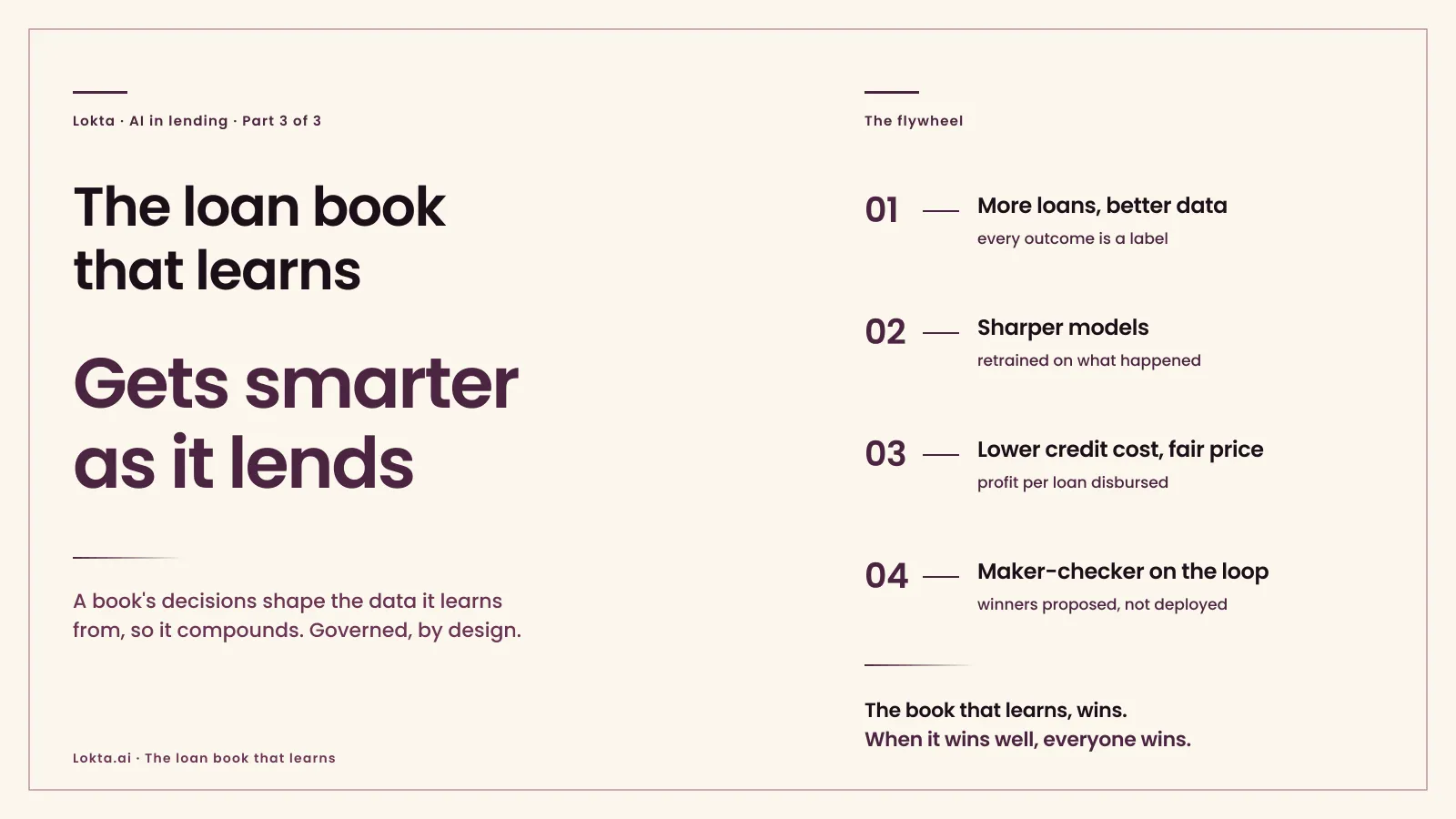
- The loan book that learns (Part 3): why a loan book can finally learn, the flywheel it turns, and the infrastructure Lokta is building to run it.
- Cumulative impact of Apache Fineract on global lending: the rails much of this cascade already runs on, and the team behind them.
- NBFC count (9,086), layer split (15 Upper / 624 Middle / 8,436 Base), sector balance sheet (₹61 lakh crore), credit-to-GDP (~14.6%), and YoY credit growth (~19.4%): RBI master NBFC registry (31 March 2026) and RBI Trend & Progress 2024-25.
- LSP count (~562) and distinct lending-app count (~904) across ~347 regulated entities: RBI Digital Lending Apps Directory.
- Interest-rate cascade (policy ~5.25%, bank ~5-6.5%, NBFC borrowing ~8.5-11%, borrower ~9-36%) and per-product borrower ranges: RBI policy and sectoral lending rates; company disclosures; Lokta FY25 NBFC benchmark. Rates are illustrative for mid-2026.
Chandramouli is co-founder of Lokta. He spends his time on what actually separates winners in lending, and is on LinkedIn for the lenders who want to build a book that learns rather than buy one that doesn’t.
Chandramouli · Bengaluru, June 2026