Record, route, run: the three eras of the loan management system
Every era of the loan management system changed what it did with your policy. The first recorded the book. The second routed the work. The third runs work on the book inside the policy, and AI features alone do not get a system there.
Contents 8 sections
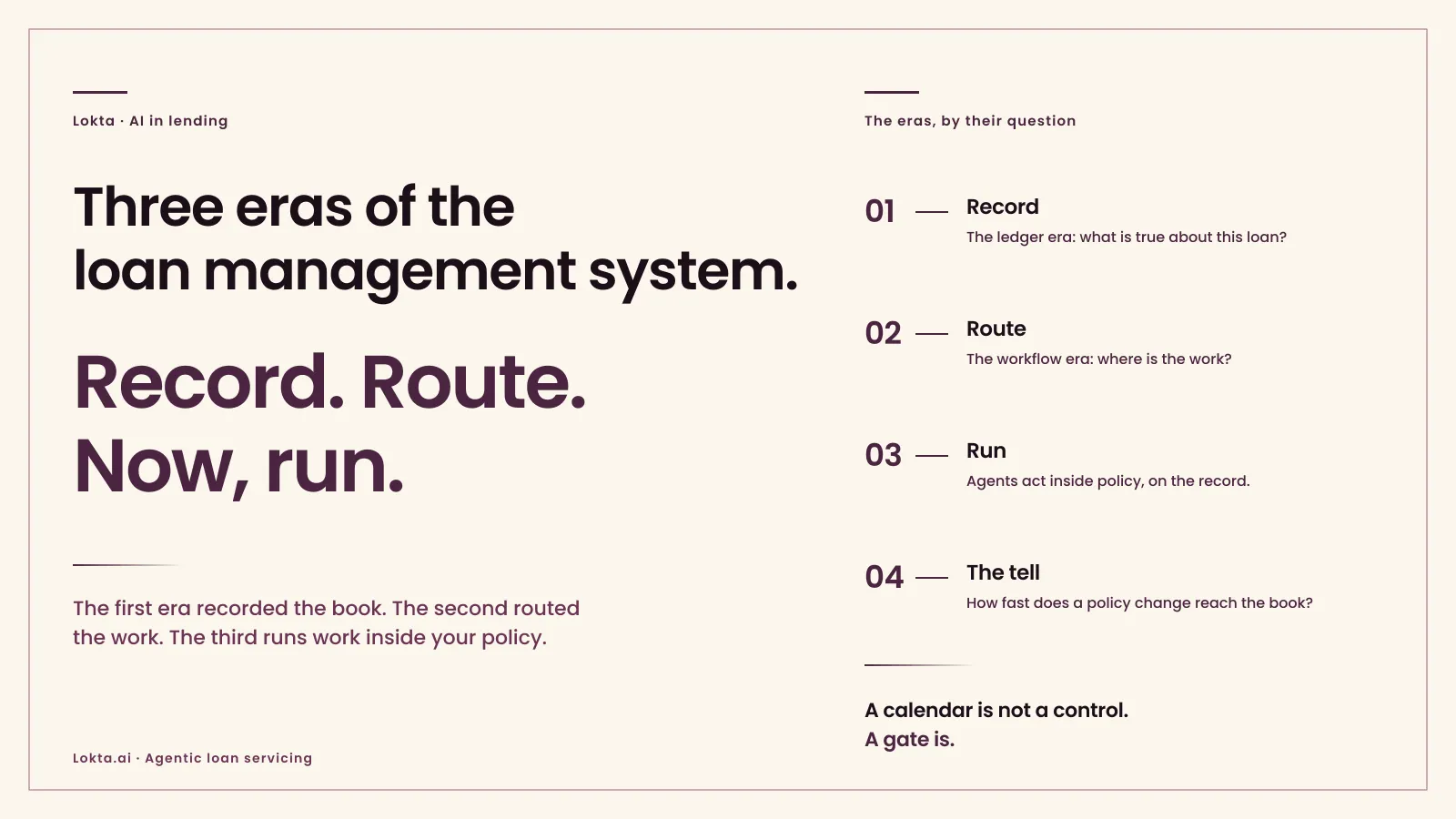
Loan management systems have moved through three eras: record (hold the facts about a loan), route (move work through queues and integrations), and run (agents propose, a deterministic core checks each action against policy, and tested policy changes go live in days rather than quarters). The dividing line between eras is not the feature list. It is cycle time: how fast a tested policy change reaches the live book.
Somewhere in your vendor pipeline is an AI upgrade for your loan management system. The deck will be good: agents that draft borrower replies, summarise accounts, flag risk before it rolls. Before you take the meeting, it is worth asking what has actually moved the LMS a generation in the past. It was never the feature list.
The system has jumped twice. First it learned to record the book: balances, schedules, ledger entries, the facts of every loan in one place. Then it learned to route the work: queues, workflows, and integrations that carried a task from screen to screen. Each jump changed what the system did with your servicing policy. Neither changed how fast that policy could change.
That is the third era’s real break. Not intelligence: cycle time. If a tested change to your servicing or collections policy still takes a quarter to reach the live book, your LMS has not moved eras, whatever the demo showed.
- The LMS has moved a generation twice, and never on a feature list. The first era recorded the book. The second routed the work around it.
- AI features on a second-era LMS speed up drafting and leave the policy loop untouched. The bolt-on inherits the calendar it was bolted onto.
- The third era is defined by cycle time. How fast a tested policy change safely reaches the live book is the number that tells you which era a system is in.
- Machine pace needs a gate, not a calendar. Every proposed action is checked against policy before it runs, and lands on the record with the evidence attached.
- The questions that expose a vendor’s era are about the loop, not the model. Ask how a policy change ships, who decides, and what the record shows afterwards.
01 · The record era: what did the first loan management systems do?
The first generation of the LMS had one job: hold the truth about the book. Balances, repayment schedules, interest accrual, days past due. The work of lending happened elsewhere, with officers on the phone, files on a desk, and a spreadsheet for anything the system had no field for. When the work was done, someone keyed the outcome in.
The question a record-era system answered was narrow and vital: what is true about this loan, right now? Get that wrong and nothing downstream survives, which is why the record era’s values never expired. Correctness, reconciliation, an unbroken ledger. They became the floor every later era stands on.
Policy in this era lived in a credit manual and in people’s heads. The system did not know your policy existed. It recorded what your people did, including on the days they did not follow it.
02 · The routing era: what changed when the LMS learned to route work?
The second generation noticed that the expensive part of servicing was not storing facts. It was moving work. So the LMS grew queues and workflow engines, then APIs, and a stack grew around it: a CRM for borrower contact, a dialer for collections, a payments gateway, a bureau connection, a reporting warehouse. The LMS became the hub of the spider-web.
The gains were real. Tasks stopped dying on desks. Turnaround times became measurable. A collections queue could follow DPD buckets instead of a supervisor’s memory.
Two things did not change. Policy still shipped like software from the pre-cloud years: drafted by the risk team, argued in committee, then held for a vendor release or an IT window. In our years building this era’s rails, a capable risk team getting one meaningful policy change onto the book in a quarter was the norm, not the failure mode. And every system added to the web added reconciliation. The truth about one loan now had to be reassembled from five places before anyone could swear to it.
- Reconciliation across the web: the facts of one loan are assembled from the LMS, the CRM, the dialer log, and the warehouse.
- Compliance after the fact: reports prove what happened weeks ago, and the gap between action and evidence is where audits get long.
- Servicing cost that climbs with the book: the next ten thousand loans arrive with the headcount to serve them.
03 · The bolt-on test: why do AI features not make a third era?
Here is the pitch you will hear this year: keep your LMS, add an AI layer. Agents summarise accounts, draft the borrower reply, score the queue. It demos well, because drafting is where language models shine.
Run the bolt-on test on it. Ask what happens when the AI wants to act: reorder tonight’s collections queue, send a pre-due reminder to a cohort the early-warning model says is about to slip, schedule a field visit. On a second-era stack that action crosses three systems, and none of them can check it against your policy before it happens. So the vendor routes every action into a human review queue, and the human review queue is the second era. You have added a faster way to draft inside a system that ships change at the old pace.
The loop is the tell. An LMS with AI features still closes its policy loop on the release calendar. The model may be new, but a proposal still travels through committee, release, and IT window before the book feels it. Capability went up. Control stayed where it was. In lending, that gap is the risk.
A calendar is not a control. A gate is a control. A gate checks every change at any pace. A calendar just keeps the pace slow enough for people to inspect a sample.
04 · The running era: what defines a third-era LMS?
The third era changes the question again: what should happen next on this loan, and how fast can what we learn become what we do?
An agent-native LMS is built so that answer can be computed, checked, and executed in one place. AI agents read the whole book and propose: the next action on an account, a change to the contact sequence for a cohort, an early-warning flag with the evidence attached. The deterministic core checks each proposal against your policy as written, executes what passes, and refuses what does not. The record captures all of it at the moment it happens. The AI proposes, your core decides, and the record proves it.
That gate is what collapses cycle time. When policy is executable, a change to policy is a change you can test: run the candidate strategy against the book, compare it to the incumbent, promote the winner inside guardrails you set. A risk team on third-era tooling can trial hundreds of collection and servicing strategies in the time committee-and-release lets one through. The book stops waiting for the calendar.
| Dimension | Second era (routing) | Third era (running) |
|---|---|---|
| Question answered | Where is the work? | What should happen next, and is it allowed? |
| Where policy lives | Documents, committee minutes, release notes | Executable rules the core enforces on every action |
| Pace of policy change | Quarterly, gated by release cycles | Continuous: tested against the book, promoted inside guardrails |
| Who acts on the book | Humans, across five systems | Humans and agents, through one permission and approval model |
| Compliance model | Reports reconstructed after the fact | Checked before the action, recorded during it |
| Cost curve | Headcount grows with the book | Agents carry routine volume; people carry judgment and approvals |
The cost curve line deserves one caveat, because it is where vendors overclaim. A third-era LMS does not delete servicing work. It is built so the routine share of it, the status queries and reminders and queue ordering, no longer scales headcount with the book, and so the metric that moves over time is profit per loan disbursed. How far that goes depends on your product mix and your policy, not on the software alone.
05 · Machine pace: how does the book stay safe when agents can act?
The reasonable objection to everything above is speed itself. An agent that can act on ten thousand accounts can be wrong on ten thousand accounts. What stops it?
Three boring mechanics, none of them a model. First, the agent holds no pen. It reads the book and writes proposals. The deterministic core is the only thing that posts to the ledger, and it executes a proposal only after the policy check passes. Second, the gate runs before the action, not after. A proposal outside policy is refused at the moment it is made, and the refusal itself lands on the record, which is how you find out early that your policy and your agents disagree. Third, sensitive changes keep maker-checker. An account-level action with money or hardship attached routes to a human approver, exactly as it would for a junior officer, with the agent’s evidence attached to the queue item.
None of this slows the loop down, because the checking is computed, not scheduled. That is the whole trade the third era offers: you write policy precisely enough for a machine to enforce it, and in exchange the pace of change stops being gated by meetings. The lender runs the book. The platform supplies the agents, the gate, and the record.
06 · The vendor test: which questions expose a system’s era?
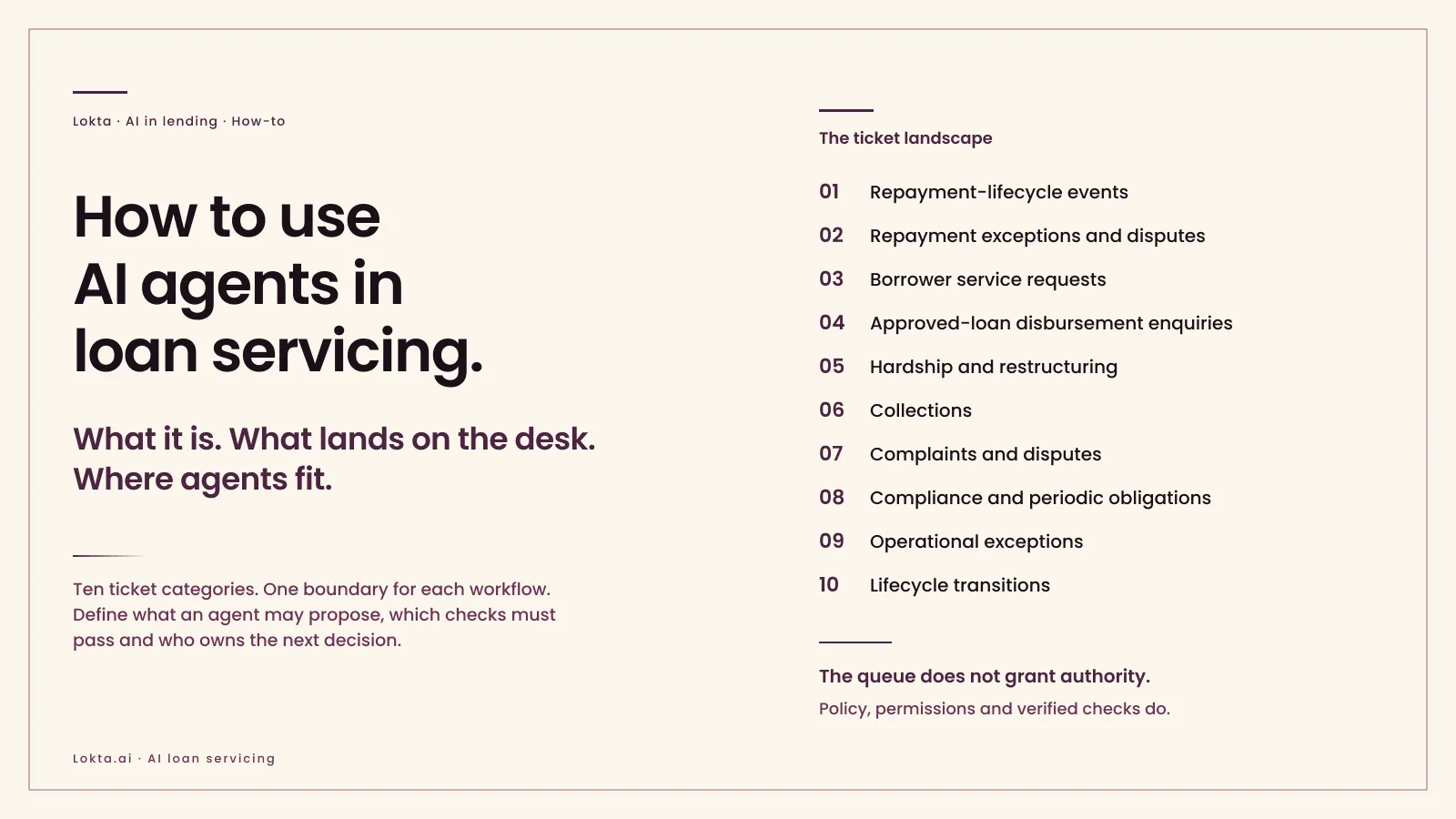
You do not need an architecture review to place a vendor on this timeline. Four questions and the shape of the answers will do. If you are mid-evaluation, the legacy LMS vs AI-native LMS comparison runs the same test in more depth.
| Ask the vendor | The third-era answer | What the second-era answer sounds like |
|---|---|---|
| How does a tested policy change reach my live book? | Tested against your book, checked against your policy, promoted. Days, with each step on the record. | Raise a change request. It lands in an upcoming release. |
| What happens when the AI proposes something outside policy? | The core refuses it before it runs, and the refusal is on the record with the reason. | A human reviews everything before it goes out. |
| Show me one agent action, end to end. | Proposal, policy check, decision, ledger effect, approver where one was needed. One screen. | We can pull the logs together for you. |
| Who can act on the book? | Humans and agents, through the same permissions, approvals, and record. | Users, via role-based access. The AI runs alongside. |
Notice what the questions never mention: model choice, accuracy benchmarks, roadmap. Those change quarterly and prove nothing about the architecture underneath. Gates, records, and cycle time are hard to retrofit, which is exactly why they are worth asking about.
The takeaway
Eras of the LMS end the way this one is ending: not when the old systems stop working, but when the question they answer stops being the expensive one. The record is table stakes. The routing is table stakes. The expensive question on a live book today is how fast what you learn becomes what you do, safely.
From here a lender has three honest paths. Keep the second era: the stack you know, the release calendar you know, and a policy loop that closes four times a year while the book moves daily. Run an agentic loan servicing layer on a core built around the gate, inside your policy and your guardrails. Or build the third era yourself on the core you have: own the executable policy, the gate, and the record, and budget years of engineering on a stack that was not designed to host them. The middle path costs something too: the first weeks go on wiring your book and your policy into the core, and the agents propose nothing until that is done.
We have made this bet before. The team behind Lokta built Apache Fineract, the open-source lending core, then built and scaled a commercial lending platform on those foundations. Lokta is what we would build starting today: third era from the first commit. If you want to be the lender whose auditor gets the answer from one screen, start by asking your vendors the four questions above.
Frequently asked questions
How have loan management systems evolved over time?
In three eras, each defined by what the system does with the lender's policy. The first era recorded the book: balances, schedules, and ledger entries, with the work of lending happening outside the system. The second era routed the work: queues, workflow engines, and integrations that carried tasks between the LMS, the CRM, the dialer, and the collections stack. The third era runs work on the book directly, with AI agents proposing actions that a deterministic core checks against policy before anything executes. The break between eras was never a feature list. It was a change in the question the system answers.
Is an LMS with AI features the same as an agent-native LMS?
No. An LMS with AI features adds drafting and summarising on top of a second-era architecture, so an agent's actions still cross systems the record cannot gate, and policy changes still ship on the release calendar. An agent-native LMS is built so humans and agents act through the same permissions, approvals, and record, with every proposed action checked against executable policy before it runs. The practical test is cycle time: ask how long a tested servicing policy change takes to reach the live book, and how many meetings stand between the two.
How do AI agents stay auditable in loan servicing?
By separating proposal from execution. The agent reads the book and proposes an action. The deterministic core checks the proposal against the lender's policy and executes only what passes. The record captures actor, input, decision, and outcome at the moment of action rather than reconstructing them later. Sensitive changes keep maker-checker approval, exactly as they would for a junior officer. An auditor does not sample and hope: every agent action on the book carries the same evidence trail a human action does, so the question of why something happened is answered from the record, not from a model log.
What should a lender ask before buying an AI loan management system?
Ask about the loop, not the model. How does a tested policy change reach the live book, and how long does that take? What happens when an agent proposes an action outside policy, and where is the refusal recorded? Can the vendor show one agent action end to end: the proposal, the policy check, the decision, and the ledger effect? Do humans and agents share one permission and approval model? Answers about model accuracy and feature roadmaps are second-era answers wearing new clothes. Answers about gates, records, and cycle time are third-era answers.
Does the era of your LMS matter for a loan against property (LAP) or home loan book?
More than for shorter-tenure books, and the feature list is still not the deciding dimension. What matters is how fast the system lets you change collections and servicing policy, and whether every officer or agent action is checked against that policy before it executes. LAP and mortgage books carry longer tenures, larger tickets, and more hardship and workout events than unsecured lending, so the policy loop and the maker-checker trail matter more here, not less. Ask any vendor, specialist or general, the same four questions: how fast a tested policy change reaches the live book, what happens when an action falls outside policy, whether they can show one action end to end, and whether humans and agents share one permission model.
How does the era test apply to Indian lenders (NBFCs, fintechs, LSPs)?
The same four architecture questions apply, and India adds its own rails on top: NACH and BBPS for collections, bureau and CKYC connectivity for credit checks, and room for RBI's evolving guidance on model risk and outsourcing. Banks and NBFCs typically need on-premise, VPC, or single-tenant cloud deployment, maker-checker enforced at every policy boundary, and a full audit trail on every state transition. LSPs running work across multiple lending partners need per-partner data isolation and co-lending reconciliation in the data model rather than bolted on. Whichever category you sit in, cycle time, the policy gate, and one-screen auditability decide the answer before any India integration checklist does.
Read next:
- The loan book that learns: why the third era’s loop compounds, and what is different about a book whose own decisions shape the data it learns from.
- The Bullet Train Problem: Legacy LMS vs. AI Lending: the systems-property argument, and why AI-readiness cannot be bolted onto narrow-gauge rails.
- What We Learned Building Apache Fineract: the first-hand story of eras one and two, from the team that built the rails.
- Loan management on Lokta: what a third-era system looks like when the policy is a versioned contract the core enforces rather than a document the team remembers.
Sources:
- Apache Fineract, the open-source core banking platform: the record-era and routing-era rails this post draws its first-hand history from.
Chandramouli is the co-founder and CEO of Lokta, the agentic loan servicing platform. He has spent two decades building AI for decisions that change people’s lives, and has served as an independent director on an NBFC board. He is on LinkedIn, reachable in one hop.