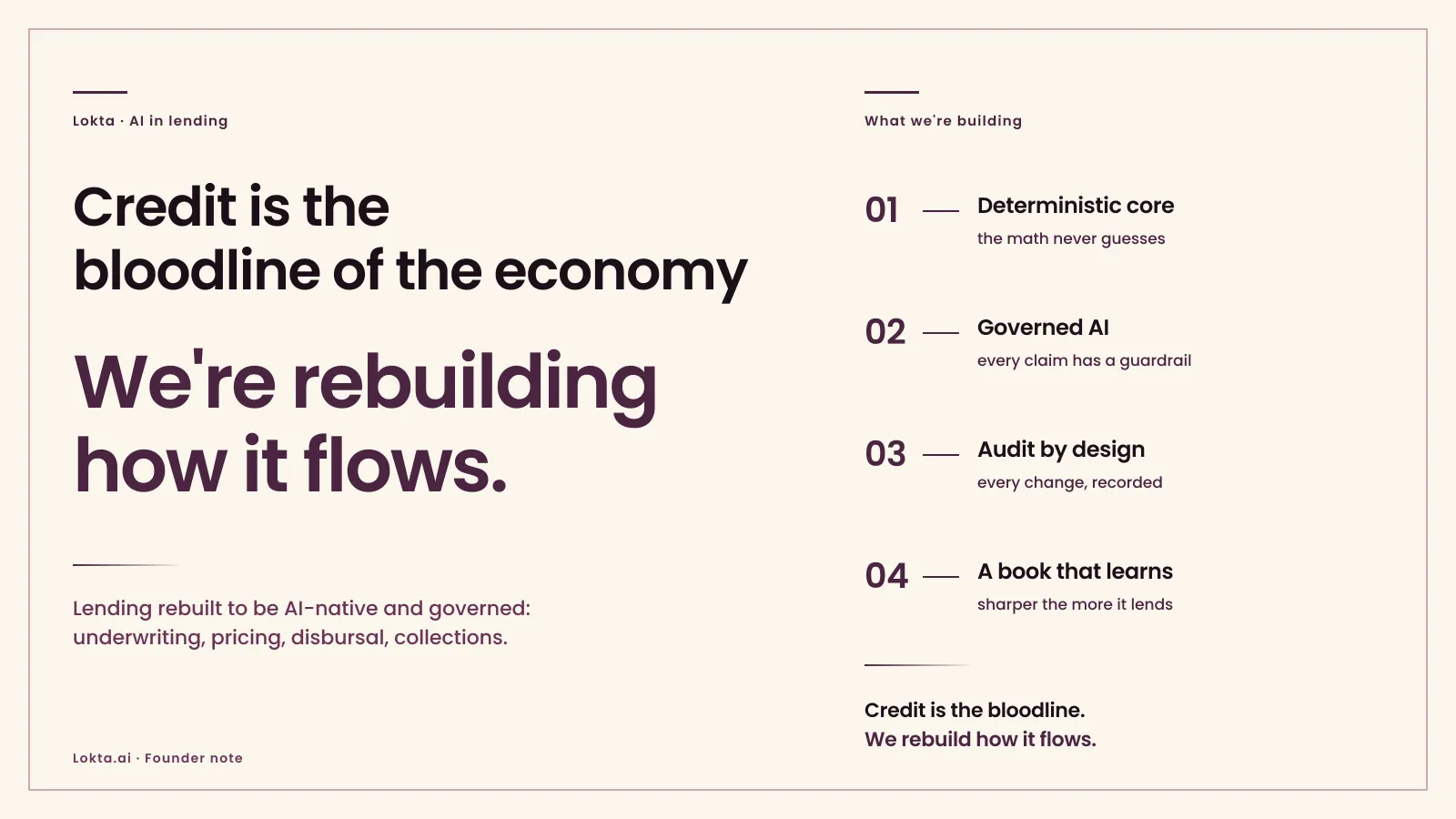
Credit is the bloodline of the economy
I'm co-founding Lokta, the agentic loan servicing platform lenders, fintechs and LSPs use to run the live book: servicing, monitoring, collections, recovery.
Contents 10 sections
I’ll start with the belief underneath the whole decision: credit is the bloodline of any economy. NBFCs, banks, fintechs, and the lending service providers behind them are the ones who keep it flowing, carrying the risk, serving the borrower.
Our job is to give them better tools to do it. Lokta builds the technology that lenders and their partners run their business on. We don’t lend ourselves.
I’ve spent my career close to that machinery, building the rails a lot of the industry quietly runs on. And the same thing kept bothering me: most lending still runs on technology built for a slower world. Risk teams ship one policy change a quarter. Models go stale the moment they ship. The cost of running a book scales with the book. And it runs on a patchwork of disconnected systems that won’t carry lenders through the next decade.
That’s why I’m co-founding Lokta with Ashok Auty, a friend of 26 years and the co-creator of Apache Fineract, the largest open lending platform in the world. We built a lot of those rails. Lokta is what we’d build today: the agentic loan servicing platform, agent-native from the ground up.
The bet is simple: the loan book should run with autonomy you can audit, and get sharper the more it lends.
We don’t sell AI as magic.
We don’t run the loan book. Lenders do.
We build the platform that keeps it governed while it gets smarter.
Credit is becoming agentic and partner-based, mediated by agents, delivered through partners. Someone has to build the layer that lets lenders do it responsibly. We’d rather it be us.
We’re early. We’ll get things wrong, ship things twice, learn in the open. But the vision is worth the stumbles.
Chandramouli, co-founder, Lokta
The longer view
If you want the fuller argument, what’s broken, what we’re building, and how it stays governed, here it is.
- Credit is the mechanism that lets an economy act ahead of its cash. When it flows well, activity compounds; when it seizes, everything downstream slows.
- The way we lend is built for a slower world. Risk teams ship roughly one policy change a quarter, models go stale on arrival, and the cost of running a book scales with the book.
- Lokta is being built agent-native and governed. Underwriting, pricing, disbursal, and collections run on a deterministic core, and AI never runs the book unsupervised.
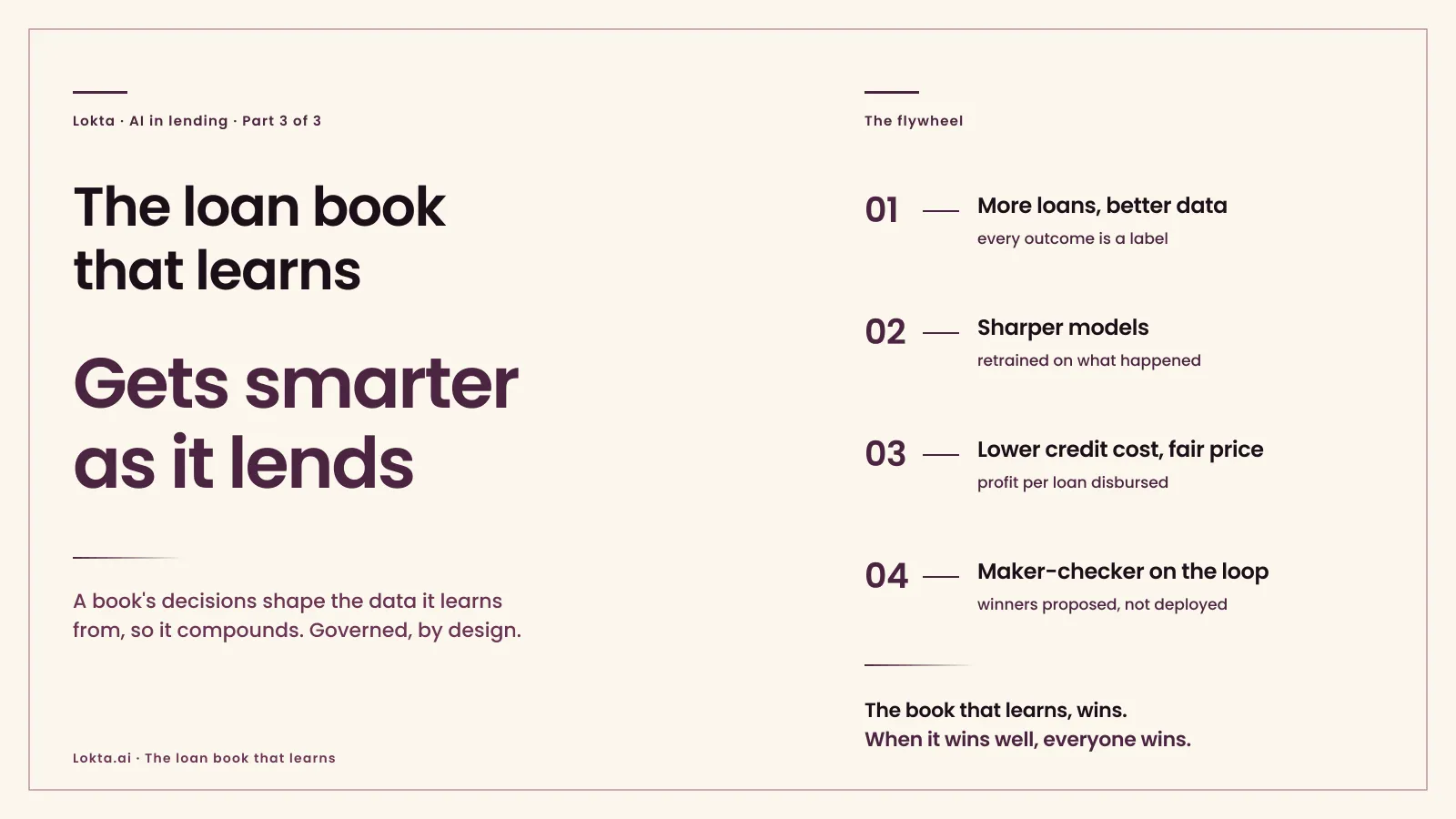
- The aim is a book that sharpens the more it lends. Policy and pricing variants are tested against outcomes; only evidence-backed winners are promoted, with a human in the loop and an audit trail behind every change.
- We’re early and founder-led. We’re building with a small set of co-design partners, not selling a finished product.
Why does credit decide everything downstream?
Credit is not one industry among many. It sits underneath most of them. The terms on which a small business can borrow decide whether it hires this quarter or next year. The price of a mortgage decides which families build and where. The speed of a disbursal decides whether a farmer plants this season at all.
Get credit right and the effects compound quietly across an economy. Get it wrong, too slow, too expensive, mispriced against real risk, and the cost is just as quiet, and just as large. That is the scale of the problem worth working on, and it is why I keep coming back to it.
What’s actually broken in how we lend today?
Lending is a multi-trillion-dollar activity still running on tools built for slow, manual decisioning. The constraints are structural, not cosmetic.
A risk team ships maybe one meaningful policy change per quarter. The market, the borrower, and the fraud move faster than the operation can respond.
A credit model is most accurate the day it ships and decays from there. By the time the next version is approved, the world it was trained on has already moved.
Manual decisioning and reactive collections mean the cost of running a book grows with the book. Scale becomes a tax instead of an advantage.
None of this is for lack of talent. It is the shape of the tools. The gap between what is possible and what is shipping is enormous, and that gap is the opportunity.
Who’s building Lokta?
I’m building it with Ashok Auty, who has spent the better part of two decades on this one problem. Ashok co-created Apache Fineract, the largest open-source lending platform in the world. An estimated ~$500B in loan principal has been disbursed through the Mifos → Apache Fineract ecosystem across 70 countries. That is the full methodology and central estimate, and the figure is aggregate ecosystem impact, not Lokta’s own.
Aggregate impact attributed to the Mifos/Fineract ecosystem, not Lokta directly.
Ashok and I have known each other for 26 years; we met in college. I’ve watched him shape the lending ecosystem ever since, through Apache Fineract and the commercial platforms that followed, and admired the work the whole way. Building the future alongside a friend I trust that completely is a privilege, not just a partnership.
I’m not new to it either. I advised a commercial lending platform through its scale-up and acquisition, and I sit on the board of Digamber Capfin, a public NBFC, so I’ve seen the challenges from the lender’s side of the table, not just the technology side.
Between us, we’ve built a lot of the rails the industry quietly runs on. Lokta is what that experience points to next: not a patch on the old stack, but lending rebuilt to be agent-native from the ground up. That depth of experience is rare, and it is what rebuilding lending for the next decade asks for.
What are we betting on?
The bet is simple to state. The live loan book should run with autonomy you can audit, across servicing, monitoring, collections and recovery, learning from every loan it makes.
It starts with the architecture. Most lenders run a patchwork of narrow, disconnected systems: origination in one tool, servicing in another, collections in a third, the bureau somewhere else. You cannot run a bullet train on narrow-gauge rails. We’re building a connected lending stack instead, underwriting to collections on one canonical model, with one audit trail.
Not AI as a magic black box. Governed, auditable, policy-bounded decisioning that gets sharper the more it lends. Every application, repayment, and recovery feeds a richer view of risk. Variants of policy and pricing are tested against real outcomes, and only the evidence-backed winners are promoted. The cost of running a book should not scale with the book. The quality of every decision should.
Why does governance come first?
Because lending is not a place to be clever without being accountable. Every credit decision affects a real borrower and real money, and most of it is regulated.
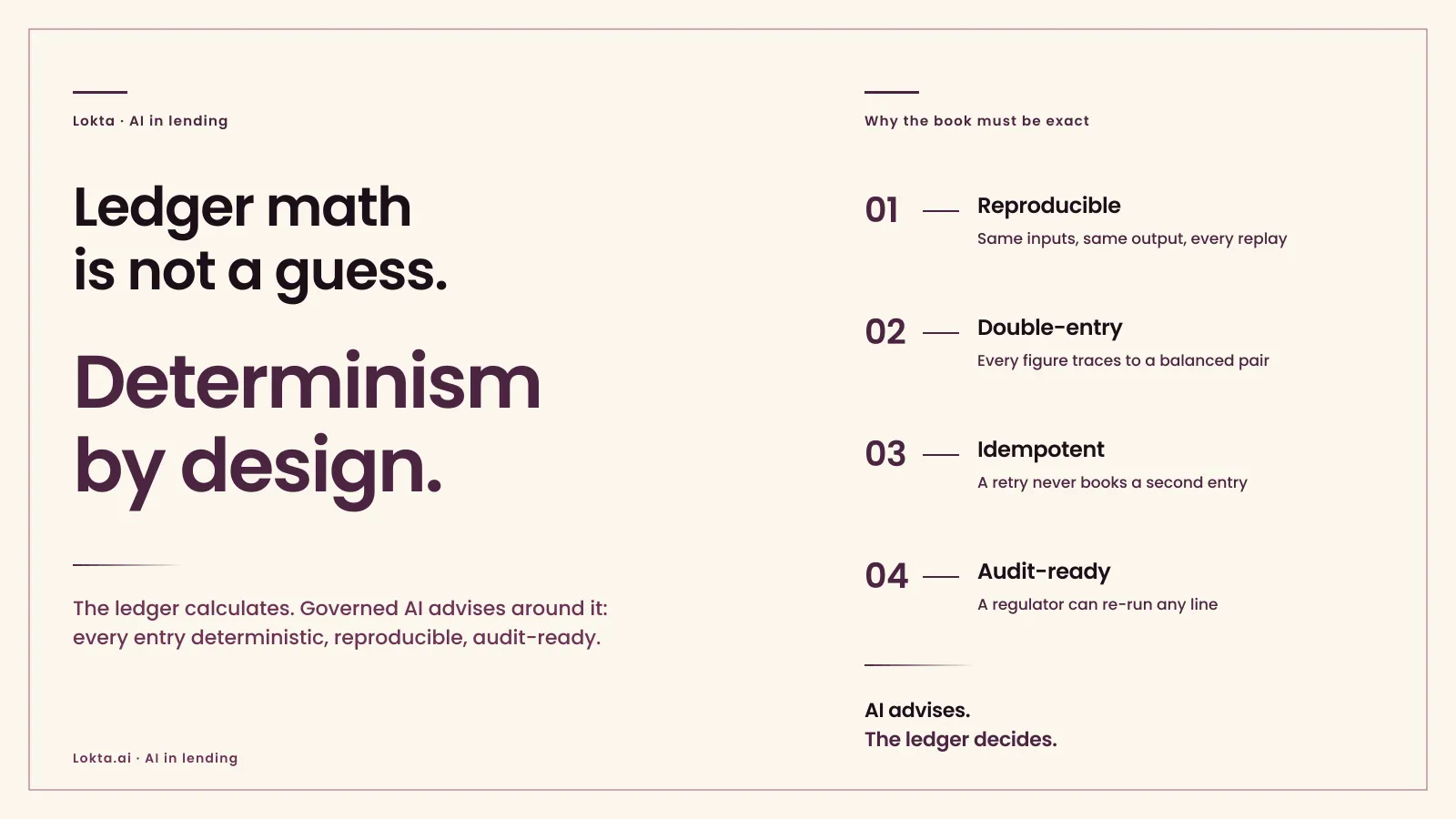
So the architecture starts with a deterministic core: the math and the ledger never guess, and every state change is recorded with who did it, on what evidence, and what changed. AI works around that core, not over it: workflow AI to move work along, agents under explicit guardrails on top. Every AI claim is paired with a control; every state change with an audit trail. AI never runs the book unsupervised. That is the only way an operation this consequential earns the right to move faster.
Where does this go?
Credit is becoming agentic and partner-based, increasingly decided by agents rather than forms, and delivered through networks of partners rather than a single lender’s branch. That shift is coming whether or not anyone builds it responsibly. Someone has to build the layer that does. We’d rather it be us.
We’re early, and that’s the point
We’re founder-led, building with a small set of lenders who shape the platform with us rather than buying it off a shelf. That is deliberate: the people running real books shape what we build before it hardens. The direction feels inevitable, and we would rather get there with the operators who live the problem.
I’ll name one debt I can’t repay directly: I’ve learned a great deal about modern lending by following SoFi over the years. Anthony Noto and his team don’t know me, but their work has been a quiet teacher in what a lending business can be when it’s built with intent.
If you’re working at the edge of lending and AI, start a conversation.
Why is credit the bloodline of an economy?
Because almost nothing in an economy waits to be fully funded before it happens. A business hires before the revenue lands. A family builds before it has saved the full amount. An idea gets a shot before it can pay for itself. Each of those depends on someone, somewhere, deciding to lend. When credit is decided well and flows where it should, that activity compounds. When it seizes or misprices risk, everything downstream slows with it. Credit is the mechanism that lets an economy act ahead of its cash.
Who is building Lokta?
I'm co-founding Lokta with Ashok Auty, who has spent the better part of two decades building lending infrastructure. Ashok co-created Apache Fineract, the largest open-source lending platform in the world, an ecosystem through which an estimated ~$500B in loan principal has been disbursed across 70 countries. That figure is a central estimate of aggregate ecosystem impact, not Lokta's own, and we publish the full methodology separately. Lokta is what that experience points to next: lending rebuilt to be agent-native, and governed from the ground up.
What does it mean for a loan book to get sharper the more it lends?
Every application, repayment, and recovery is a signal about what actually predicts risk and what a borrower will pay. In most lending operations that signal is lost, because decisioning is manual and policy changes ship slowly. Lokta is built so the book learns from each loan under governance: policy and pricing variants are tested against outcomes, and only evidence-backed winners are promoted, with a human in the loop and an audit trail behind every change. The aim is a book that improves with volume rather than one that ages.
Is Lokta available today?
Lokta is early and founder-led. We're working with a small number of co-design partners, lenders building this alongside us rather than buying a finished product off a shelf. That's deliberate: the people running real books shape what we build before it hardens. We're honest that we're early and that we'll get some things wrong on the way. If you operate a lending book and want to help shape the platform, the right next step is a conversation, not a purchase order.
Read next
- What we learned building Fineract, and why we started over: the heritage behind Lokta, and why a new platform rather than another patch.
- AI in lending starts with a deterministic core: how governed AI sits on top of a core that never guesses.
- The cumulative impact of Fineract on lending: the full methodology behind the ~$500B estimate.
Sources
Chandramouli is co-founder of Lokta. He is building the layer that runs the live loan book under governance, on a core a lender can own, change, and prove, and is on LinkedIn for lenders who want to build a book that learns.