Platform · Loan Product Studio
Ship the product everyone approved.
Build, test and launch one loan product version, with the evidence your teams need to approve it.
Loan Product Studio in 60 seconds
The film’s on-screen text
- Launching a loan product is a team sport. You want a new loan product. You get a one-person form. A change request for every fix. A vendor quote in weeks.
- A loan product is a workflow, not a form. Introducing Loan Product Studio, the product workflow for personal loans, education loans, two-wheeler loans and loans against property.
- Build, Simulate, Integrate, Launch. All four, inside Loan Product Studio.
- Build. Ready-to-use loan product templates. Set broken-period interest in the product. And the charge for each situation. Second opinion checks every rule as you set it, and points to the fix.
- Simulate. Real test loans, on a sandbox ledger. See what the schedule computes before any borrower does.
- Integrate. Technology receives the product as ready APIs. Your origination system sources loans into it. Collections picks them up.
- Launch. Pilot it in a limited market. Widen it when the first cohort holds. Caught on sandbox: expected 24, got 25. Need a change? Make a new version. Every past test comes with it.
- Bring us the product you have been afraid to change. Loan Product Studio. Talk to us, lokta.ai. The agentic loan servicing platform, from the team behind Apache Fineract.
Four stages, one version
Build. Simulate. Integrate. Launch.
Each stage hands the next one something it can check. These are the screens your teams work in.
01Build
Set each rule in business terms, on one version.
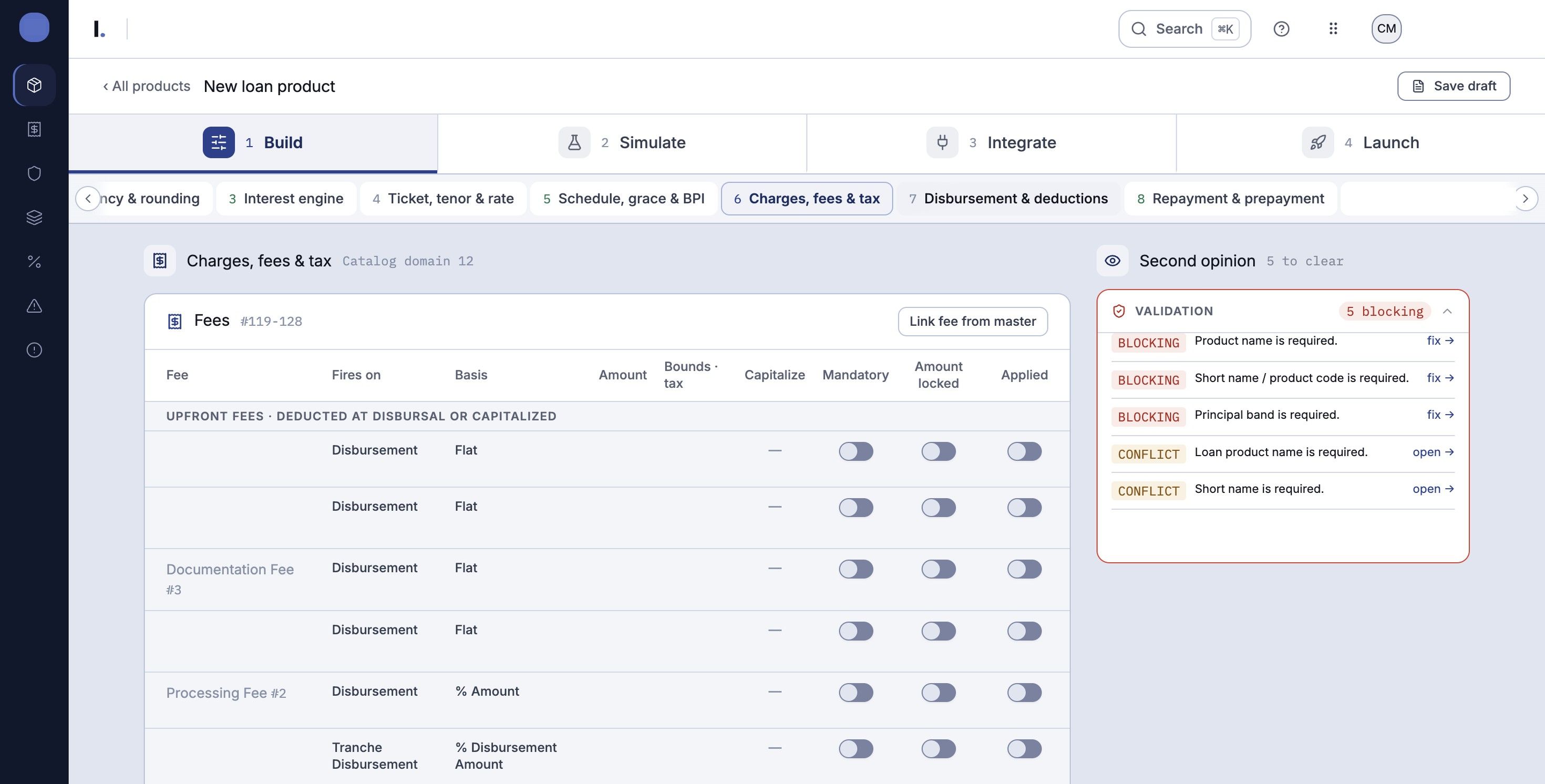
Second opinion on a draft with five items to clear. Each one names the rule and links to the field that fixes it. Start from a template and the workbook shows only the parameters that apply to that product type. Interest, schedule, charges, repayment and NPA treatment sit together, so everyone who signs off reads the same product.
- Templates by product type, or the full parameter surface for a custom product
- Second opinion checks each rule as you set it and links to the field that fixes it
- Nine catalogue domains, from identity to risk, NPA and accounting
Explore the nine product domainsFrom interest and charges to repayment and accounting. Your template determines which parameters apply.
- 01Identity & classification
- 02Currency & rounding
- 03Interest engine
- 04Ticket, tenor & rate
- 05Schedule, grace & BPI
- 06Charges, fees & tax
- 07Disbursement & deductions
- 08Repayment & prepayment
- 09Risk, NPA & accounting
The template sets the product type. No value is pre-filled and nothing is locked. 02Simulate
Book test loans before a borrower sees the schedule.
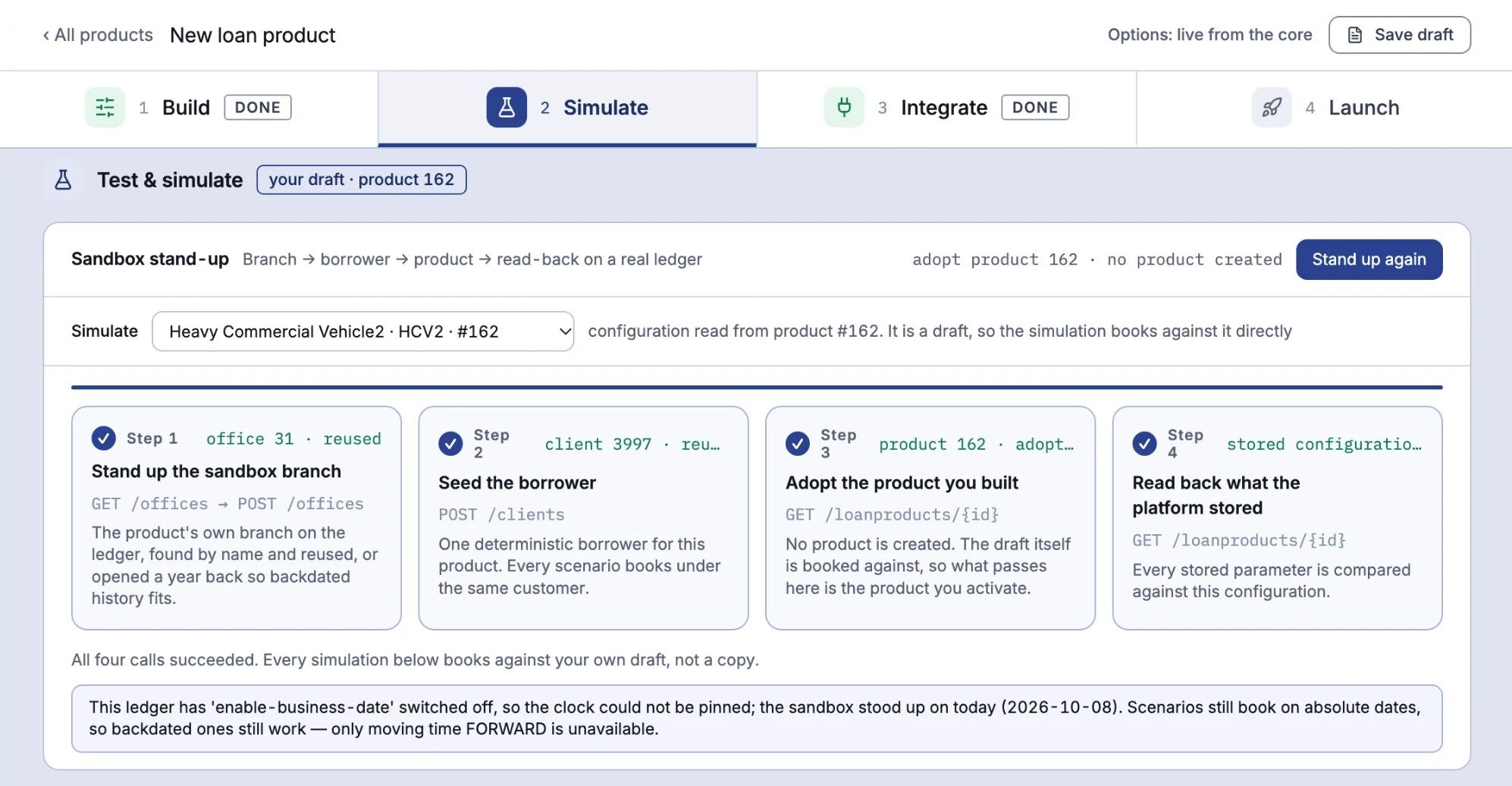
Four calls stand the draft up on a sandbox ledger. No copy of the product is created, so every scenario books against the version you will activate. Stand the draft up on a sandbox ledger in four calls: the branch, a seeded borrower, your product, and a read-back of what the platform stored. Each scenario then books a real test loan, states what it expects, and stays in the regression set for the next version.
- The draft itself is booked against, so what passes is the product you activate
- Every stored parameter is read back and compared with your configuration
- Each run leaves a loan account you can open
Explore the nine starter scenariosTest arrears, overpayments, foreclosure and more. Which scenarios apply depends on the product and the ledger.
- 01Book backdated, already in arrears
- 02Book on the default ticket
- 03Book with an explicitly requested tenor
- 04Overpay an installment
- 05Part payment while overdue
- 06Quote a foreclosure
- 07Bill through the moratorium
- 08Let the first installment fall due
- 09Release a second tranche
03Integrate
Give technology an API reference, and agents a bounded set of tools.
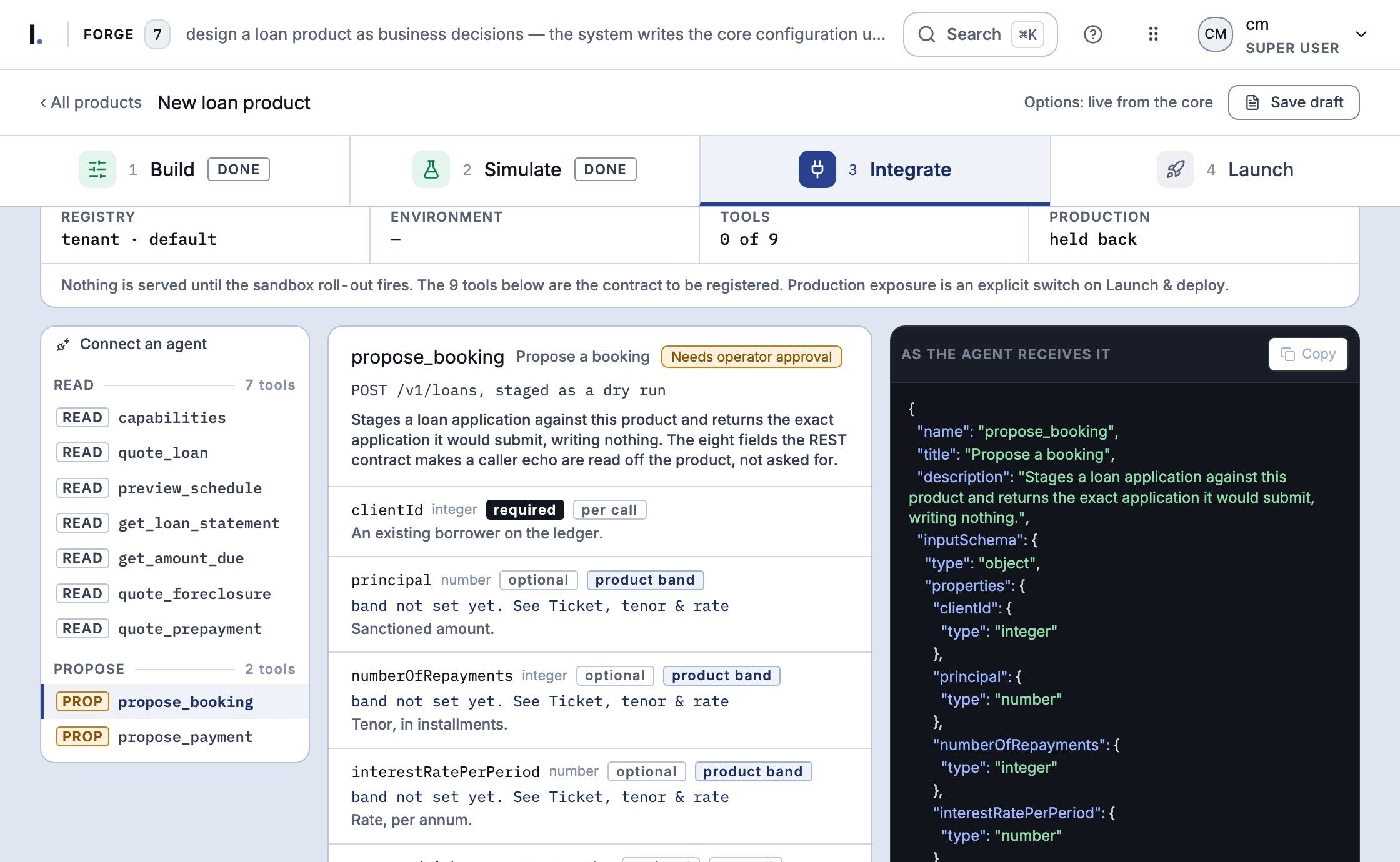
propose_booking returns the exact application it would submit and writes nothing. It carries the badge Needs operator approval. The Booking API reference is generated from the product you built: each call, each field, which values the product fixes and which arrive with each loan, with cURL, Node, Python and Java samples. Agent tools expose the same product over MCP, pinned to this product and tenant.
- Seven read tools quote, preview and report, and change nothing
- Two propose tools stage a booking or a payment as a dry run and wait for an operator
- Nothing is served to agents until the sandbox roll-out; production is a separate switch
04Launch
Pilot it in a limited market. Widen it when the first cohort holds.
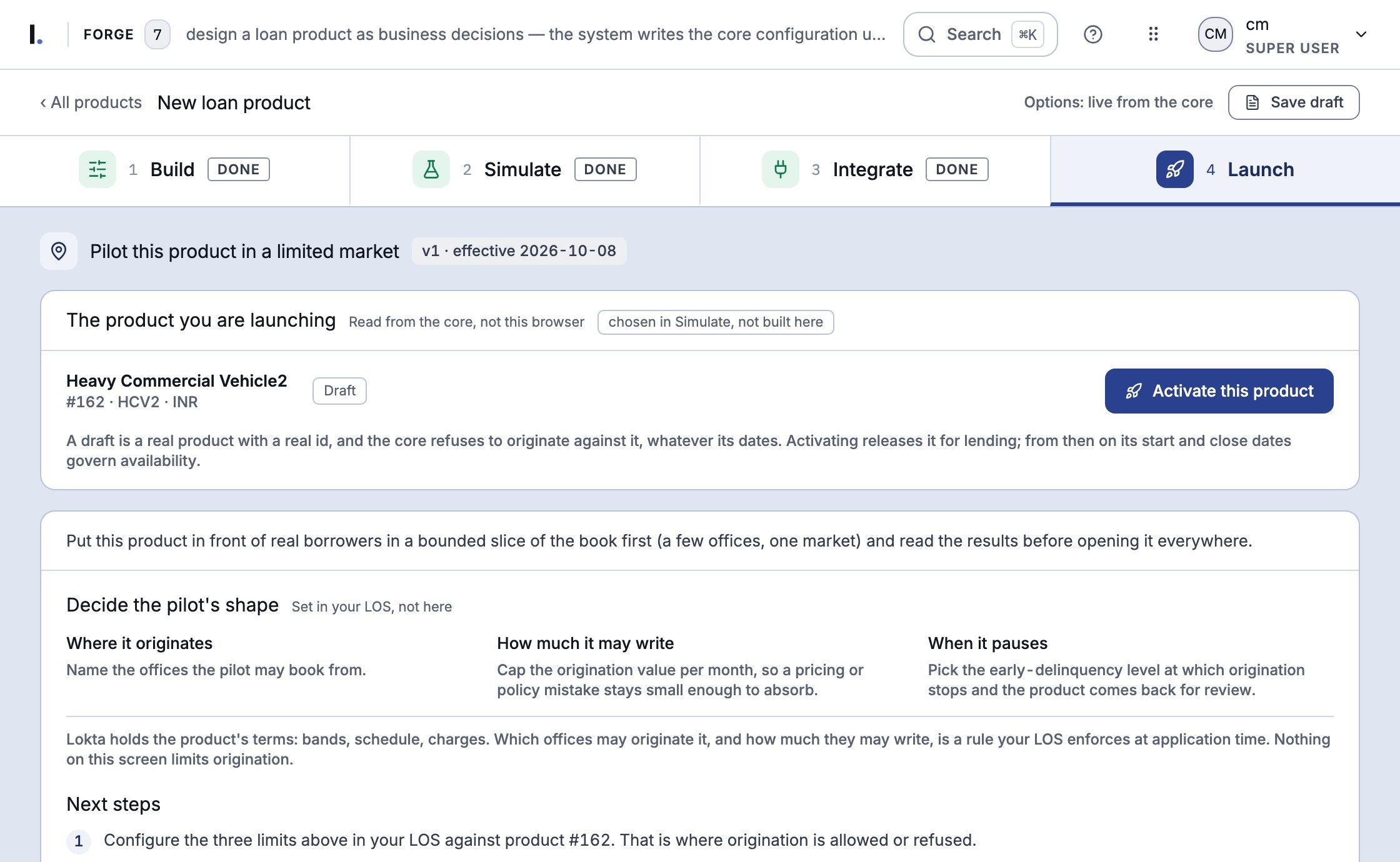
The pilot’s three limits are set in your LOS against product #162. The Studio records them. Your LOS enforces them. A draft is a real product with a real id, and the core will not book against it until you activate it. Launch sets out the pilot for your LOS to enforce: which offices may book it, how much it may write each month, and the early-delinquency level at which it pauses for review.
- Read the first cohort on early delinquency, approval-to-disbursal time and yield against plan
- A change becomes a new version, and the past tests come with it
- Opening the tools to production agents is its own switch; moving money still needs an operator
Product creation is a team sport
The product splits at the handoffs.
Each function reviews the same product version, at the stage where its decision is made.
Product
BuildStarts from a template and sets each rule, with the reason for it.
Credit and risk
Build and SimulateReads Second opinion and the sandbox results before sign-off.
Compliance
SimulateReviews the version and the evidence from its test bookings.
Finance
BuildChecks charges, tax and the accounting domain on the same version.
Operations
LaunchTakes the pilot’s shape and the next steps for the first cohort.
Technology
IntegrateBuilds against the Booking API and the agent tools for this product.
A precise boundary
The Studio prepares the product. You control the launch.
Loan Product Studio defines a loan product and proves how it behaves on the ledger. Agents can quote and propose against it. A proposal books nothing until an operator approves it, and the deterministic core does the arithmetic.
The product and its proof
- Product rules on one version, from a template or from scratch
- Second opinion on each rule as it is set
- Sandbox bookings with expected results, kept as a regression set
- A Booking API reference and agent tools generated from the product
- The pilot’s shape, recorded with the product
Applicant decisions and rollout
- Applicant underwriting and applicant-level pricing
- Approving applications and disbursing funds
- Which offices may book the product, and how much
- Pausing new lending when the stop level is reached
Loan Product Studio, plainly answered
The boundary, the sandbox, and what agents can and cannot do.
What is Loan Product Studio?
Loan Product Studio is where a lender builds a loan product, tests it on a sandbox ledger, hands it to its systems and pilots it. The work runs in four stages, Build, Simulate, Integrate and Launch, on one product version.
Does Loan Product Studio replace a loan origination system?
No. Loan Product Studio does not underwrite an applicant, set applicant-level pricing, approve an application or disburse funds. Your LOS remains responsible for those decisions and for enforcing which offices may book a product, how much they may write and when it pauses. Loan Origination on Lokta is on the roadmap.
How does a sandbox simulation work?
The Studio stands your draft up on a sandbox ledger: a branch, a seeded borrower, the draft product itself, and a read-back of every stored parameter. Each scenario then books a real test loan and compares the result with what it expects. The starter set has nine scenarios, and which ones apply depends on the product and the ledger.
What happens when the product changes?
A change becomes a new version. The scenarios you ran stay in the regression set, so you can run the new version against the same cases. Your review and approval process stays authoritative.
Can AI agents act on a product?
Only through the nine agent tools, and only within them. Seven read: they quote, preview and report, and change nothing. Two propose a booking or a payment; both default to a dry run and stay proposals until an operator acts. Nothing reaches agents until the sandbox roll-out, and production exposure is a separate switch.
Is AI used to calculate schedules or charges?
No. Schedules, charges, postings and loan state come from the deterministic core. AI may help people navigate or prepare work around the product; it does not compute the product.
Start with the hard one
Bring us the product you have been afraid to change.
We map it with your team, agree the scenarios it has to pass, and show you the sandbox results before any implementation decision.
Talk to usSee the loan management core it runs onLoan Product Studio is part of Lokta, the agentic loan servicing platform, built by the team behind Apache Fineract.