Inside Moneyview's technology and AI strategy
Moneyview's DRHP reads like a technology company's filing: AI across underwriting, collections and servicing, a hybrid LSP-plus-NBFC book, and a widening product line.
Contents 13 sections
Moneyview filed its Draft Red Herring Prospectus earlier this year. I noted the filing when it became public, but only read it closely later, and what stayed with me was not the IPO or the financials. It was how one of India’s largest digital lending platforms describes its own technology, its AI, and where it wants to go next.
Read the document that way and Moneyview stops looking like a loan app. It looks like a platform that connects customer acquisition, underwriting, regulated lending partners, its own NBFC, servicing, collections and an expanding line of financial products, with AI threaded through the whole thing. This piece is about that stated strategy and those technology investments, not the valuation.
- Technology is the operating model, not a support function. Moneyview says it built its platform internally over ~11 years, processes 200,000+ applications a day, and kept over half its permanent staff in technology and data roles.
- The company is making three transitions at once: from pure LSP to hybrid lender, from personal loans to a multi-product platform, and from digital acquisition to data-led monetisation.
- AI runs across the flywheel, not inside one module. Credit evaluation, collections, customer support, onboarding and software development each get their own AI stack.
- The most tangible AI claim: up to a 7× difference in credit-risk outcomes among customers with near-identical bureau scores, which is AI separating people a coarse score treats as the same.
- The IPO funds both models in parallel: ~₹650 crore to back partner-funded lending through DLG, ~₹450 crore into its own NBFC.
- What the DRHP does not isolate is the financial benefit of AI itself, the piece that still has to be proven.
What is Moneyview’s business model?
Moneyview runs two lending models side by side. As a lending service provider it originates and services loans for 22 regulated personal-loan partners, earning origination and servicing fees with limited credit-loss exposure through default-loss guarantees. Through its own NBFC, WFPL, it lends from its balance sheet and earns the interest spread. Interest income rose from 6.91% of operating revenue in FY23 to 39.39% by December 2025.
Why is Moneyview’s DRHP worth reading closely?
Most coverage of a filing like this stops at the growth and profit numbers. The more useful read is the strategy underneath them: how a lender that has already reached scale thinks about technology, AI, product expansion and operating leverage.
Moneyview’s real story is the technology and data layer it is trying to own between borrowers and capital: a lending service provider that also holds a balance sheet, servicing and collecting across multiple regulated relationships at once. The DRHP is one of the clearer public descriptions of what building that actually takes.
What strategic transitions is Moneyview making?
Three shifts are happening at the same time, and each one changes the shape of the book.
The two models make money in opposite ways. Partner-funded loans generate origination and servicing fees with limited credit-loss participation through DLG. Own-book lending earns interest spread but requires capital, borrowings, provisioning and full credit-risk management. Moneyview is not choosing. It is investing in both.
What are Moneyview’s six stated priorities?
Before the machinery, the destination. The DRHP is unusually explicit about where the company says it is going: six stated priorities.
Performance marketing, brand, embedded partnerships, and employer distribution through Jify.
More monetised users, better personalisation, higher repeat usage.
Expansion from a personal-loan platform into credit, savings, insurance, investments and payments.
More platform partners, co-lending, product and insurance partners, and more banks and debt investors for WFPL.
Expansion across onboarding, credit evaluation, collections, support, product development and operating workflows.
Four levers: revenue and volume growth, operating efficiency, better credit quality, and lower cost of capital.
Notice the dependency. Five of the six are, underneath, technology claims: growth, monetisation, lifetime value, partner integrations and AI all lean on the same platform. Which makes the technology disclosures the centre of the filing.
Is technology a support function or the operating model?
Moneyview says it developed its technology platform internally over roughly 11 years, covering onboarding, identity verification, credit-bureau integrations, fraud checks, underwriting, e-sign and mandate registration, partner integrations, servicing, collections, product configuration and portfolio monitoring.
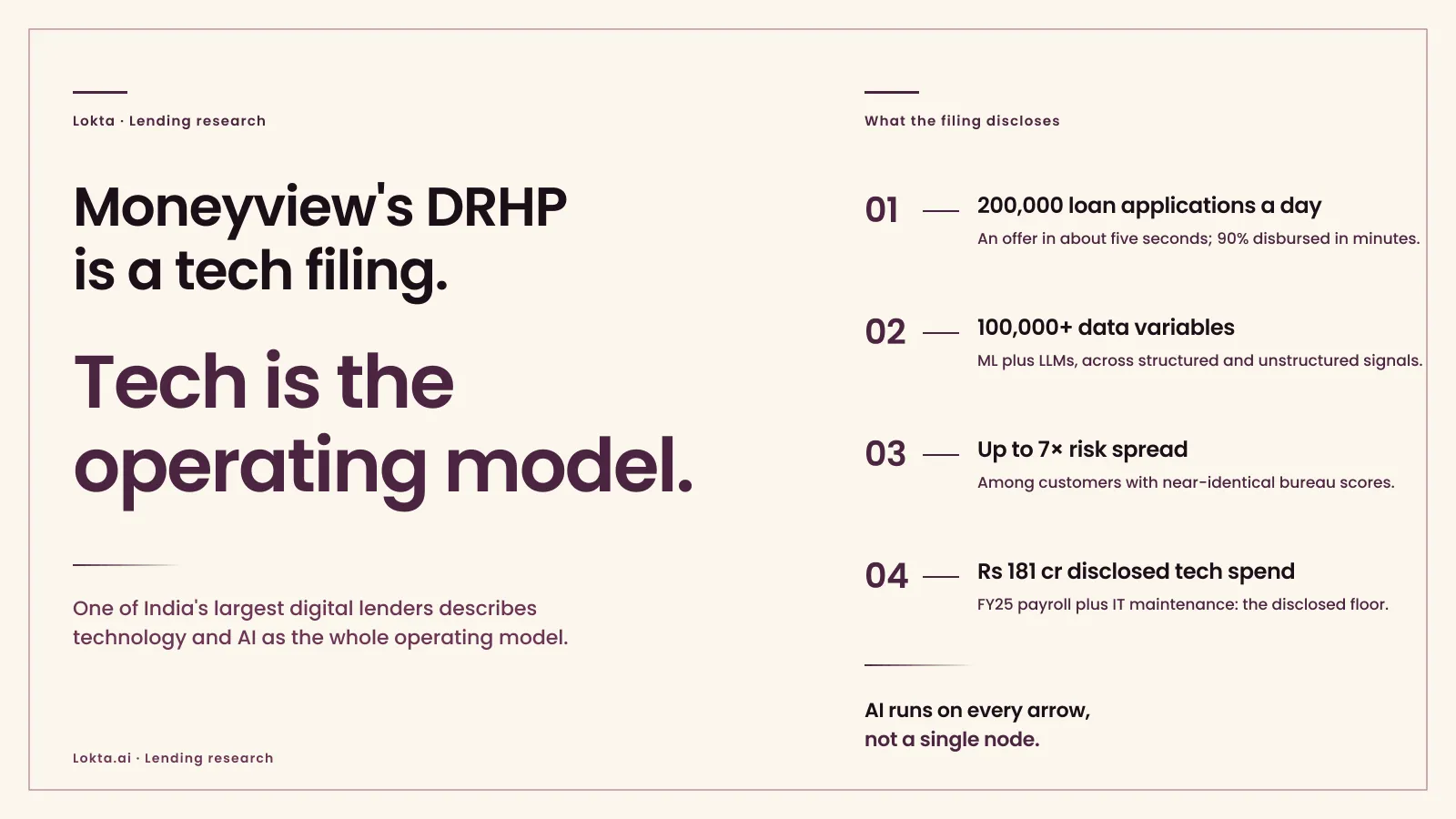
The throughput it reports is the tell: more than 200,000 loan applications a day, an offer typically generated within five seconds, and around 90% of disbursals completed within minutes of acceptance. The architecture is described as modular and configurable, with differentiated repayment schedules, dynamic pricing, partner-specific product structures, and faster experimentation.
That is the moat worth naming. It is not the consumer app. It is the ability to absorb the integration and operational complexity between borrowers, Moneyview, and multiple regulated entities, and keep it running at that volume. The headcount reflects it.
| Metric | FY23 → Dec-25 | What it signals |
|---|---|---|
| Technology employees | 234 → 371 | Engineering, product, risk and data analytics counted together. |
| Total permanent employees | 330 → 702 | The company roughly doubled headcount over the period. |
| Technology share of staff | 70.9% → 52.8% | Falling as the company scales, but still over half the workforce in tech and data. |
How much is Moneyview actually spending on technology?
Two lines in the DRHP can be added up directly: technology employee cash cost and IT maintenance. In FY25 those came to roughly ₹181 crore, up from ₹92 crore in FY23. But that is a floor, not the full figure, and it is worth being precise about why.
- Technology payroll and IT maintenance are itemised: ₹116.76 crore and ₹64.66 crore respectively in FY25.
- Cloud, security, SaaS, bureau, data-provider and AI infrastructure costs are not separately identified in the filing.
- So the precise statement is narrow: Moneyview directly disclosed ₹181 crore of technology payroll and IT maintenance in FY25. Total technology-related spend is likely higher, but cannot be determined from the DRHP.
How is Moneyview using AI, function by function?
The useful way to read the AI disclosures is not “Moneyview uses AI.” It is which function, doing what, with what evidence. Five stand out.
- ML models combined with LLMs across structured and unstructured signals: affordability, cash-flow sustainability, transaction and device signals, engagement, employment and bureau data.
- More than 100,000 data variables in the internal models.
- Moneyview reports up to a 7× difference in credit-risk outcomes among customers with bureau scores of 725-750, which is AI separating people a coarse score treats as identical.
- Payment-intent and default-likelihood prediction, risk-based segmentation, automated reminders and dynamic calling cues.
- Allocation across bots, internal callers, agencies and field, with multilingual conversational voice systems and call-recording analysis.
- The plan: turn call transcripts into structured ability-to-pay, intent-to-pay and hardship signals that drive account-level treatment.
- AI chatbots and conversational agents for 24×7 support, query classification and multilingual interaction.
- Contextual memory and guided resolution, with escalation to humans on the cases that need it.
- GenAI for code assistance, review, test generation and execution, prototyping and simulation.
- Described as an augmentation layer, with control frameworks, escalation protocols and human oversight, not autonomy.
- AI-driven onboarding journeys, multilingual interfaces and dynamic document verification.
- The stated aim is not headcount reduction. It is letting people handle the complex cases while machines process the high-volume, repetitive work.
Read together, the disclosures describe AI spread across the whole operating flywheel, covering perception, decisioning, recovery, support and even the building of the software itself, rather than a single underwriting model. That is priority 05 made concrete.
How will Moneyview use the IPO proceeds?
Capital allocation is where a strategy stops being a narrative and starts being a bet. Two allocations carry most of the weight.
This funds the fixed deposits and bank guarantees that back default-loss-guarantee arrangements with regulated partners. It is, in effect, capital to expand the capital-light, partner-funded side of the book: the LSP model, scaled.
This strengthens Tier I capital at the NBFC to increase lending capacity and grow the own book, and, Moneyview hopes, improve WFPL’s credit profile, broaden access to debt, and reduce funding costs over time.
The balance goes to general corporate purposes. The point is that Moneyview funds both models at once. It is building the consumer relationship, owning the technology and data layer, integrating multiple capital providers, and taking selective balance-sheet exposure where it improves control and economics.
What does the strategic flywheel look like?
Strip the DRHP down and one loop is doing the work. It is worth drawing, because AI sits across the whole thing rather than at any single point on it.
More users produce more behavioural and repayment data; the data sharpens models, the models personalise offers, and the offers lift monetisation and repeat usage, which generates more data, plus the partner confidence and capital to widen products. AI operates on every arrow, not at one node.
What remains to be proven?
A filing describes intent. It does not settle whether the intent works. Four questions the DRHP raises but does not close.
| Open question | What the DRHP shows | What it does not yet prove |
|---|---|---|
| Does AI improve outcomes, or just automate activity? | Reported improvements in annualised platform losses, bounce rates and operating efficiency. | The benefit attributable specifically to AI, versus policy changes, customer mix, and operating maturity. |
| Can the platform carry a broader product portfolio? | A modular architecture built for personal loans at high volume. | That secured lending, insurance and investments, far less standardised, will fit the same rails. |
| Can the NBFC get cheaper capital? | Average cost of borrowings rose from 12.71% in FY24 to 14.44% in FY25. | That better ratings, capitalisation and funding diversification actually lower it from here. |
| Can it balance growth and credit quality? | A hybrid model with more revenue potential. | That it holds credit losses, provisioning, funding and capital adequacy while scaling both sides. |
The through-line is one honest gap: the DRHP describes AI deployed widely, but does not isolate the financial value the AI itself created. That is the number the next few years have to produce.
What does this mean for lenders building their own stack?
Here is the part that maps onto the work we do. Moneyview spent roughly eleven years and over half its workforce building the platform that makes its flywheel turn. Most lenders do not have eleven years, and the capability that compounds is not the consumer app. It is the layer underneath it, especially after approval.
The AI Moneyview describes in collections and servicing is exactly where a live book either keeps or loses the margin underwriting tried to protect: predicting which accounts cure on their own, routing recovery effort where it changes the outcome, turning every repayment and recovery into another labelled signal. That is post-approval work, and it is the wedge Lokta is built around: the book sharpens itself the more it lends, under governance a lender can audit. Moneyview built its version internally; the thesis it validates is that the servicing-and-collections layer, learning from realised outcomes, is where the compounding actually lives.
Takeaway
Moneyview’s DRHP makes one thing clear: it is trying to build much more than a lending app. The durable question is whether it can convert technology and AI investment into better credit outcomes, lower operating cost, stronger retention and cheaper capital, and prove that the AI, specifically, is what moved them.
Frequently asked questions
What does Moneyview's DRHP reveal about its technology strategy?
That technology is the operating model, not a support function. Moneyview says it built its platform internally over roughly 11 years, covering onboarding, bureau integrations, underwriting, partner integrations, servicing, collections and portfolio monitoring. It reports processing more than 200,000 loan applications a day, generating an offer in about five seconds, with around 90% of disbursals completed within minutes of acceptance. More than half its permanent staff sat in technology and data roles as of December 2025. The moat it describes is not the consumer app. It is the ability to absorb the integration and operational complexity between borrowers, Moneyview and multiple regulated lenders.
How is Moneyview using AI across its lending operation?
By function, not as a single feature. In credit evaluation it combines machine-learning models with large language models across more than 100,000 data variables, and reports finding up to a 7× difference in credit-risk outcomes among customers with near-identical bureau scores. In collections it predicts payment intent, segments accounts by risk, and routes work between bots, callers and field agents, with plans to turn call transcripts into structured ability-to-pay and intent-to-pay signals. It also applies AI to customer support, onboarding and its own software development. The pattern is AI spread across the whole operating flywheel rather than bolted onto underwriting alone.
What is Moneyview's hybrid LSP and NBFC lending model?
Moneyview both originates and services loans for regulated partners as a lending service provider, and lends off its own balance sheet through its NBFC, Whizdm Finance (WFPL). As of December 2025 it reported 22 regulated personal-loan partners, with its own NBFC representing 27.4% of managed AUM and interest income at 39.39% of operating revenue, up from 6.91% in FY23. Partner-funded loans earn origination and servicing fees with limited credit-loss participation through DLG; own-book loans earn interest spread but require capital, borrowings, provisioning and full credit-risk management. The DRHP shows Moneyview investing in both models at once, not choosing between them.
How does Moneyview plan to use its IPO proceeds?
The DRHP proposes roughly ₹650 crore to support DLG-backed disbursal growth through regulated partners, and ₹450 crore as a capital infusion into its own NBFC, WFPL, with the balance to general corporate purposes. The ₹650 crore effectively funds the fixed deposits and bank guarantees that back default-loss-guarantee arrangements with partner lenders, which is the capital-light side of the book. The ₹450 crore strengthens Tier I capital at WFPL to expand own-book lending and, Moneyview hopes, improve the NBFC's credit profile and access to cheaper debt. The allocation funds both the partner model and the balance-sheet model in parallel.
Read next:
- The loan book that learns: why a book’s own decisions shape the data it learns from, and what it takes to run that loop under control.
- Post-approval lending: where loans actually make money: the servicing-and-collections layer where margin is kept or lost after disbursal.
- How to use AI agents in loan servicing: the governed way to put agents on a live book, the layer Moneyview builds internally.
Sources:
- Moneyview Limited (Whizdm Innovations), Draft Red Herring Prospectus, filed with SEBI, 2026. All figures in this piece are drawn from that public filing.
- SEBI: public issues and draft offer documents
This article is based on publicly available information and my interpretation of Moneyview Limited’s Draft Red Herring Prospectus and related disclosures. It is intended solely for informational and educational purposes and is not investment advice, an offer, a recommendation, or an assessment of the proposed IPO’s valuation.
Chandramouli is co-founder of Lokta and reads lending DRHPs closely, because how a lender describes its own technology and AI tells you where it thinks the next decade of margin lives. He is on LinkedIn for lenders building the post-approval layer.