Loans against mutual funds: fast to pledge, painful to exit
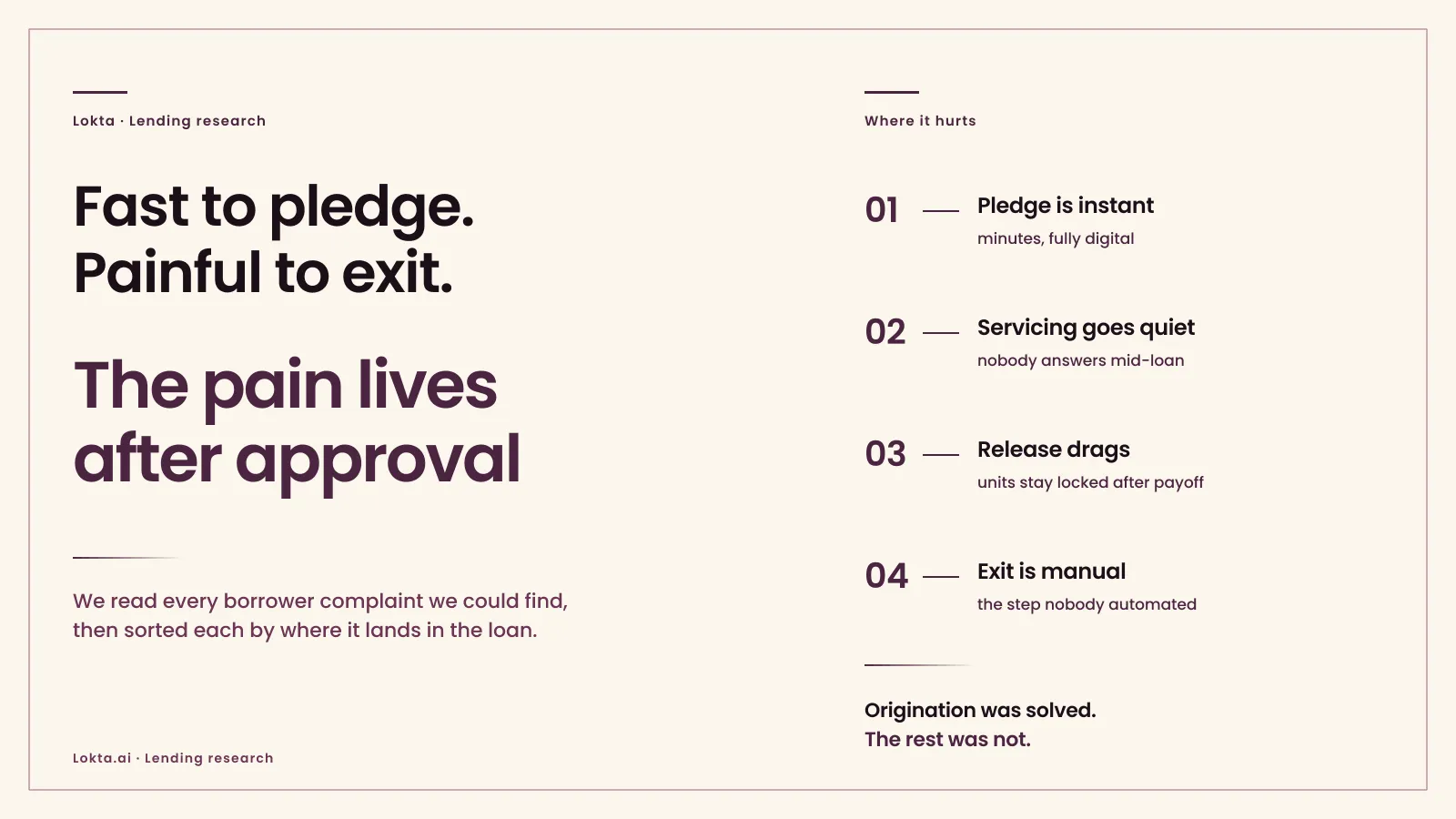
We read every borrower complaint we could find on loans against mutual funds and shares, then sorted each by where it lands in the life of the loan. The pain clusters after approval.
A loan against mutual funds (LAMF), and its close cousin, a loan against securities (LAS), is one of the cleanest products in consumer lending. You pledge units you already own, keep them invested, and borrow against them. Interest is charged only on what you draw. The onboarding is fast, sometimes genuinely good.
So we expected the complaints to sit where onboarding friction usually sits: at the start. Getting approved, getting the money out. We were wrong. We read every public borrower complaint we could find on loans against mutual funds and shares across eleven lenders, sorted each one by where it falls in the life of the loan, and the pain did not cluster where we expected. It clustered at the other end, after the borrower had already repaid.
The pledge takes minutes. Getting the pledge released can take weeks, with the borrower chasing the fund house to finish the job. Fast in, painful out. This post is the structured map of that pain, in borrowers’ own words, with lender names masked because the pattern is structural rather than specific to any one brand.
- The pain is at the two ends, not the middle. Entry friction and exit friction dominate. The routine middle, actually repaying the loan, barely draws a complaint.
- Most of it is post-approval. Seven of the nine complaint categories we found appear after the loan is already approved, at disbursal, in fees, in servicing, and at exit.
- The single worst moment is the exit. A lien or NOC release that runs for weeks, and pushes the coordination work onto the borrower, is the most-cited grievance.
- Hidden fees are the sharpest trust-breaker. A headline rate that omits processing, penal, and per-holding charges turns a five-star signup into a one-star review.
- Origination is mostly solved. The friction moved downstream. The design attention has not followed it.
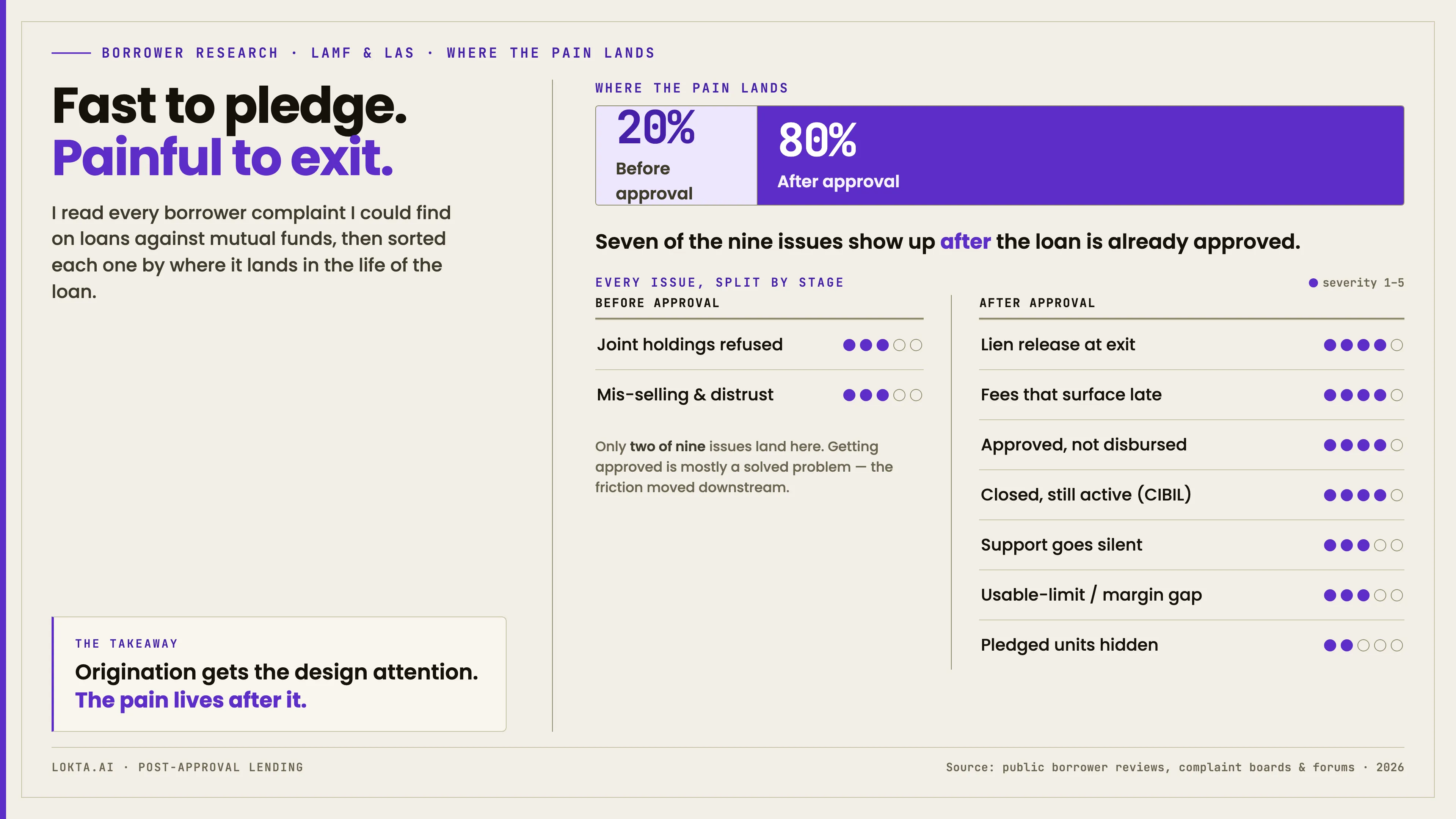
Where does the pain actually land in a loan against mutual funds?
We sorted every complaint at a single line: the moment of approval. Everything before it (application, eligibility, the credit decision) is pre-approval. Everything after (disbursal, servicing, closure, the release of the pledge) is post-approval.
Two of the nine complaint categories sit before approval. Seven sit after. Count them or weight them by severity, the answer holds: the pain lives after the money goes out. Origination is the part the industry has spent a decade making smooth, and it shows. The pain moved downstream to the parts nobody demos.
What do borrowers say about getting their money unlocked?
The most-cited grievance is not about getting the loan. It is about getting out of it. The pledge is quick; the release is not, and the borrower is left doing the coordination.
“Unpledging and lien removal was very time-taking, despite pledging being quick. I had to contact the AMCs separately for complete lien removal, contrary to the one-stop promise.”
Source: borrower review, a mutual-fund-pledge lending app (Apple App Store, December 2023).
This is the structural heart of the problem. Pledging is a single digital step the lender controls end to end. Releasing runs back through asset management companies, registrars, and bank back-offices, and few lenders commit to a turnaround time on it. The borrower who was promised a one-stop experience discovers, at the exit, that the last mile is theirs to walk.
Why do the fees feel like a bait-and-switch?
The second-sharpest theme is money the borrower did not see coming. The headline rate is competitive. The total cost is not the headline rate.
“Misleading claims, hidden charges never disclosed, repayment-schedule discrepancies, and extra charges without proper explanation.”
Source: borrower review, a mutual-fund-pledge lending app (Apple App Store, January 2025).
Processing fees, bounce charges, penal interest, and per-holding pledge fees surface after the loan is live, not before it is signed. This is the fastest way to convert an enthusiastic new borrower into a one-star reviewer, because it reframes the whole relationship: the borrower stops trusting the number they were shown, and starts assuming there is always another charge they have not been told about.
Why does “KYC done” not mean “money in the account”?
At the entry end, the one complaint that recurs is the gap between “approved” and “funded.” Borrowers finish KYC, sign the mandate, believe they are done, and then the money does not arrive.
“Amount has not been disbursed yet, despite completed KYC and EMI mandate. Documentation complete, but the money never arrived.”
Source: borrower complaint, a large diversified NBFC (consumer-complaint board, 2024-2025).
The distance between a signed application and a credited account is where trust breaks at the front of the loan. Some borrowers, left without money or an explanation, escalate to the language of fraud. The lender has, on paper, done its job: KYC complete, mandate registered. The borrower, in reality, has nothing yet. That gap is the entry-side twin of the exit-side lien delay: a moment when money should move and does not.
What happens to support at the worst possible moment?
The complaint that makes every other complaint worse is support that disappears exactly when the borrower is anxious.
“There is no customer-care telephone line, only email.”
Source: borrower complaint, a large diversified NBFC (consumer-complaint board, February 2025).
Lean digital lenders run support on email and tickets. That model holds fine for routine questions and collapses precisely when it is needed most: a stuck disbursal, a pending release, money in limbo. A borrower watching a five-figure sum sit in an undefined state, with no one to call, is a borrower writing a review. Support is not a cost center in this product. It is the difference between a recoverable bad moment and a public one.
Which borrowers get shut out before they even start?
Not all the pain is post-approval. The clearest pre-approval complaint is exclusion: the digital rails are often built for a single primary holder, so joint and family holdings fall out of the flow.
“Applications from joint account holders are not eligible; only the primary account holder can apply.”
Source: product documentation, a wealth-platform LAMF product.
A large share of household wealth in India is held jointly. A product that can only pledge a single holder’s units either turns those households away or pushes them into a slow offline process. It is a structural gap at acquisition, and, unlike the post-approval issues, it is one the borrower hits before they have any relationship with the lender at all.
How can a repaid loan still wreck a credit score?
One category rests on lighter evidence than the rest, but it is severe enough to name: a closed loan that keeps reporting as active. Borrowers have reported loans repaid in full still showing open months later, dragging down a credit score that should have recovered. We hold this one more loosely, because the public evidence is thinner, but the mechanism is real, and it belongs on any list of what a lender must get right after closure. A clean exit is not just the lien release. It is the bureau report that confirms the loan is closed.
How did we classify the complaints, and what does the split mean?
We placed each of the nine recurring complaint categories on two axes: which stage of the loan it belongs to, and how severe borrowers reported it to be. The result is the table below.
| Complaint category | Loan stage | Borrower-reported severity |
|---|---|---|
| Lien / NOC release at exit | Post-approval | 4 / 5 |
| Fees that surface late | Post-approval | 4 / 5 |
| Approved, not disbursed | Post-approval | 4 / 5 |
| Closed, still active (credit bureau) | Post-approval | 4 / 5 |
| Support goes silent | Post-approval | 3 / 5 |
| Usable-limit and margin-call gap | Post-approval | 3 / 5 |
| Pledged holdings not visible | Post-approval | 2 / 5 |
| Joint holdings refused | Pre-approval | 3 / 5 |
| Mis-selling and reputation distrust | Pre-approval | 3 / 5 |
The table makes the imbalance plain. And the middle of the loan is conspicuously quiet: because interest is charged only on the drawn amount, borrowers treat the facility like a revolving line and rarely complain about the act of repaying. The trouble starts at the edges.
What does a post-approval split actually mean for a lender?
The borrower experience is won or lost after the money goes out, not before. The tools built to make onboarding fast do nothing for the borrower stuck at the exit.
- Before approval. Two categories, joint-holding exclusion and reputation distrust. Getting approved is mostly a solved problem.
- After approval. Disbursal, fees, support, the exit. This is where trust is built or broken.
What should a lender build first?
Fix the exit. The single highest-leverage thing a lender can do in this product is guarantee the release: a committed turnaround on the lien or NOC after repayment, with the coordination handled for the borrower instead of by them. Put every fee on the table before the loan is signed. Keep the borrower informed at disbursal and at release, the two moments support usually goes quiet. None of this is exotic. It is the unglamorous post-approval work the whole category has under-built.
This is the case for treating the loan as something you operate after approval, not something you originate and forget. It is also, for what it is worth, the order we build in at Lokta: read the customer first, then design the process. The borrower research says the process to fix is the one that starts the day the money goes out.
Frequently asked questions
Where do borrowers face the most problems with a loan against mutual funds?
After approval, not before it. When we sorted every complaint we could find by loan stage, roughly 80% of the pain landed after the loan was already approved: at disbursal, in servicing, and at the exit. Getting approved is mostly a solved problem: the pledge is quick and often praised. The anger concentrates at the two moments money should move and does not, the disbursal that stalls after KYC is done, and the lien or NOC release that drags on for weeks after the borrower has repaid.
Why is releasing the lien after repaying a loan against mutual funds so slow?
Because pledging and releasing run on different rails. The pledge is a slick digital step the lender controls end to end. The release runs back through asset management companies, registrars, and bank back-offices, and few lenders commit to a turnaround time on it. Borrowers report having to chase the fund houses themselves to get a lien lifted, weeks after the loan is closed, the opposite of the one-stop experience they were sold at the start.
What are the most common complaints about loans against securities in India?
The recurring themes, worst-first by borrower-reported severity: a slow lien or NOC release at exit; fees that surface late and feel like a bait-and-switch; money not disbursed after KYC and mandate are complete; a closed loan still showing active and denting the credit score; support that goes silent during a stuck disbursal or release; joint and family holdings excluded from the digital flow; and advertised limits that shrink to a fraction of the pledged value once you read the fine print.
How was this borrower research compiled and anonymized?
We read public borrower reviews, complaint boards, and forum threads across eleven lenders offering loans against mutual funds and shares in India, then classified each complaint by loan stage and by borrower-reported severity. Top claims were cross-checked against their original sources. Lender names are masked in the write-up because the pattern is structural, not specific to one brand. This is a qualitative signal map, not a statistically representative survey: the value is in the shape of the pain, not a precise percentage.
Read next:
- Post-approval lending: where loans make money: the thesis this research supports, with the economics of operating the book after approval.
- We read 100 loan-officer reviews of LMS and LOS platforms: the same method turned on the lender side. Six complaints recur across every vendor.
- How to use AI agents in loan servicing: what it looks like to actually operate the post-approval work borrowers are complaining about.
Sources:
Public borrower reviews and complaint threads on app stores (Apple App Store, Google Play), consumer-complaint boards, investor forums, and lender product documentation, across eleven providers of loans against mutual funds and shares in India, 2023-2026. Lender names are masked in the write-up; the underlying classification is available on request. Quotes are reproduced from public reviews with descriptive attribution and dates; this is a qualitative signal map, not a statistically representative survey.
Chandramouli is a co-founder of Lokta and part of the team behind Apache Fineract, the open-source lending core the industry runs on. He reads borrower reviews because the recurring lines tell you where the product actually breaks, and, in loans against mutual funds, they point almost entirely at what happens after the money goes out.