Before your first repayment cycle: rehearse loan management and servicing
Test loan management and servicing before the repayment cycle. Use a four-account rehearsal to expose gaps in reconciliation, ownership and borrower replies.
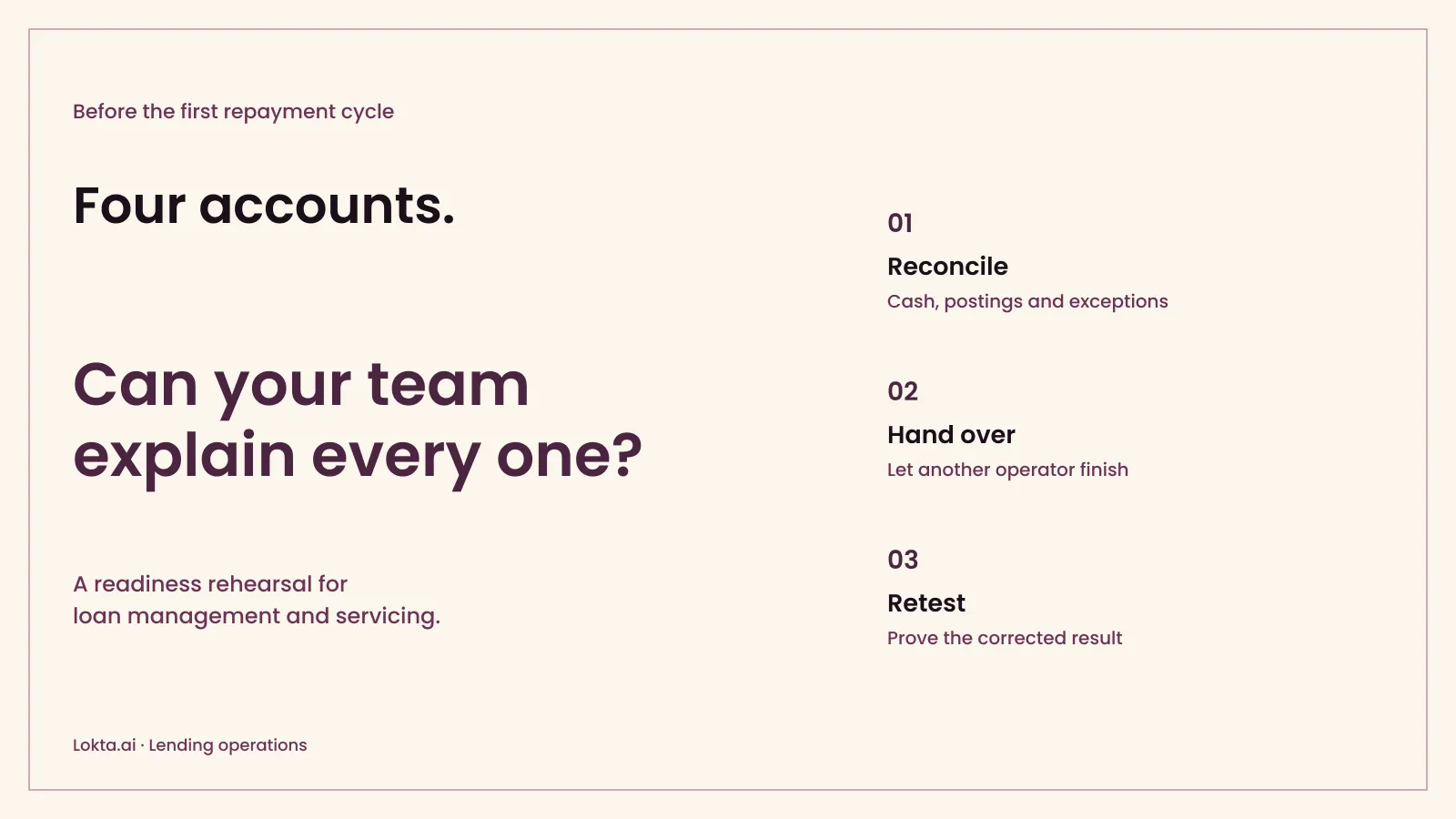
For the operations head of a new NBFC, the first repayment cycle is a test of the organisation as much as the software. The Loan Management System (LMS) may calculate an instalment correctly while the team still cannot explain an unmatched receipt or decide who should answer the borrower.
The LMS maintains the account; servicing is the work of collecting, investigating and explaining it. Rehearse both with the people who will carry that work. A small, deliberately awkward cohort can expose a responsibility gap that a successful screen demonstration leaves untouched.
Start with four accounts and a known answer
Set up four synthetic accounts, each with ₹10,000 due in the selected cycle. To keep the exercise readable, assume no previous arrears, fees, interest changes or other movements during the test window. These simplifying assumptions are for the exercise, not a model of every production loan.
Account A pays ₹10,000. B pays ₹6,000. C has a failed debit with no settled receipt. A fourth ₹10,000 receipt arrives, but the matching reference is deliberately missing. The test designer knows it belongs to D. The operator must establish that from approved evidence before allocating it.
Do not give the operator the designer’s answer. Otherwise you are testing the ability to follow a script rather than the ability to resolve an exception.
| At the first reconciliation | Amount | What the team must explain |
|---|---|---|
| Scheduled dues | ₹40,000 | Four instalments of ₹10,000 |
| Settled receipts observed | ₹26,000 | ₹10,000 + ₹6,000 + ₹10,000 |
| Receipts posted to identified loans | ₹16,000 | A and B only |
| Receipt awaiting verified matching | ₹10,000 | Visible exception with its accounting treatment and owner |
| Unpaid scheduled amount in the loan records | ₹24,000 | B ₹4,000, C ₹10,000 and D ₹10,000 |
After the team verifies D’s receipt and posts it once, the loan postings total ₹26,000 and unpaid scheduled dues total ₹14,000. That remaining amount belongs to B and C. The example concerns cycle dues, not the entire principal balance of the book. A duplicate callback must not change either total.
The loan reconciliation guide covers the matching and posting controls. Here, the test is whether operations and finance can jointly explain the difference while the exception is still open.
Add a pending-mandate test before presentation
Run a fifth case separately so the four-account control totals above stay unchanged. The first instalment is approaching, but the debit mandate is still pending. An operator should be able to distinguish a request submitted for registration, an active mandate and a payment collected under it.
Before the presentation cut-off, check the latest acknowledged mandate state and its source. Route an inactive or unknown mandate to a named owner. The borrower communication should explain the permitted next payment step; a registration request must not be described as an active collection instruction.
Then send a late activation acknowledgement and a duplicate of it. Verify whether the payment remains eligible for presentation under the lender’s timing rules, and that replaying the acknowledgement does not create a second debit instruction. Keep the mandate problem separate from delinquency: it does not change the contractual due date or prove that money has been collected.
Follow the account into the next queue
A correct loan posting does not prove that the next team received the updated state. Ask the collections operator what they see for A after payment. Ask the borrower-support operator what they would say about B’s remaining amount. Ask who owns C’s failed attempt and D’s unresolved receipt.
For D, the answer must acknowledge that evidence is being checked. It should not state that the borrower failed to pay merely because the amount has not reached the loan account. For B, a partial payment should not produce a full-payment confirmation.
Advance the test clock through the relevant processing steps. Compare the account, work queue, statement and approved communication. If they update on different schedules, record the delay and the process used while they disagree. The lender’s policy determines which actions are permitted during that interval.
Remove the person who knows the answer
Hand one exception to an operator who did not attend the implementation workshop. Give them the same access and records they would have in normal work. Observe where they stop.
A missing permission is a readiness finding. So is an instruction that says “ask the vendor” without a contact, evidence bundle or escalation route. If the operator must reconstruct the case from a private chat, the handover record is incomplete.
Now introduce a borrower complaint about the paid account. Can the new operator find the receipt, explain the remaining dues and identify any communication that no longer matches the account? The EMI dispute investigation provides a separate worksheet for that deeper case review.
This is also where training becomes measurable. Record the evidence the operator found, the decisions they could make and the points at which an authorised reviewer was needed. Completion of a screen tour does not provide those observations.
Decide what blocks the first cycle
A rehearsal should end with a decision record. For every failure, write the account state, affected output, owner, proposed correction and retest result. Keep a missing receipt reference separate from a calculation error, because they need different remedies.
An unresolved financial mismatch needs correction and verification before the affected workflow is accepted. A wording issue may follow a different release path. The lender’s accountable owners must define those acceptance conditions in advance, so a project deadline does not quietly become the reason a failed case passes.
- The starting accounts, assumptions and expected totals.
- Evidence of each payment, exception and resulting loan state.
- The handover record and the role authorised to resolve each failure.
- Corrected outputs and a repeat of the failed scenario.
- The remaining limitations accepted by the launch decision-maker.
Four accounts will not test throughput, every loan product or disaster recovery. They establish whether the institution can follow a small amount of money and work through the systems it intends to use. Extend the cases and operating conditions before treating the wider implementation as ready. The implementation timeline sets out the surrounding project work.
Choose how to run the rehearsal
A lender can run this rehearsal with controlled manual records and a simple book, build the supporting workflow internally, or require a platform provider to demonstrate it with the lender’s team. Each route needs the same named decisions and reconciled outcomes.
Lokta’s Loan Management and AI Loan Servicing address the post-approval account and its operating work. Evaluate their fit using your cases, including the failed ones. Preparation still takes product mapping, accessible source records and time from the people who will operate the book.
The readiness decision belongs to the people who will run the next cycle. Have them sign the reconciled results and demonstrate the handover. Plan the rehearsal with Lokta around those acceptance conditions.
Frequently asked questions
What should an NBFC test before its first repayment cycle?
Start with successful, partial, failed and unmatched payments, then test a pending mandate separately before the first presentation. Follow account state, reconciliation, work queues and borrower replies. Give an exception to an operator who did not run the original test and see whether the record supports a complete handover.
Why can total cash received differ from payments posted to loans?
Money can be received while its intended loan account remains unresolved. In that case, it belongs in the lender’s controlled exception process until verified, rather than being allocated by guesswork. A bank or rail total and an LMS posting total answer different questions. Reconcile the difference using identified pending items, their accounting treatment and owners. The synthetic example shows why a received amount must not disappear merely because it has not reached a loan account.
Who should participate in an LMS readiness rehearsal?
Include the people who will operate repayments, resolve exceptions, reconcile finance records and answer borrowers, alongside the technology and risk owners needed for the selected cases. Assign decisions to actual roles rather than assuming that the implementation team will remain available after launch. The exercise should demonstrate both system behaviour and a workable handover. A supplier can support the rehearsal, but the lender must accept the operating result.
Does a successful rehearsal guarantee a safe go-live?
No. These cases test whether the team can explain money and work moving through the systems. Add product coverage, volumes, security, recovery and interface failures before the authorised launch decision. Retain failed cases and their retest results.
Read next
- LMS implementation timeline: plan the broader implementation dependencies
- EMI dispute investigation: test whether another operator can reconstruct a complaint
Sources
- Lokta: loan reconciliation in an LMS: the separate receipt-matching and posting controls used in the rehearsal. All four accounts and amounts in this article are synthetic
Lokta editorial analysis by Chandramouli, co-founder and CEO.