How Long an LMS Implementation Actually Takes
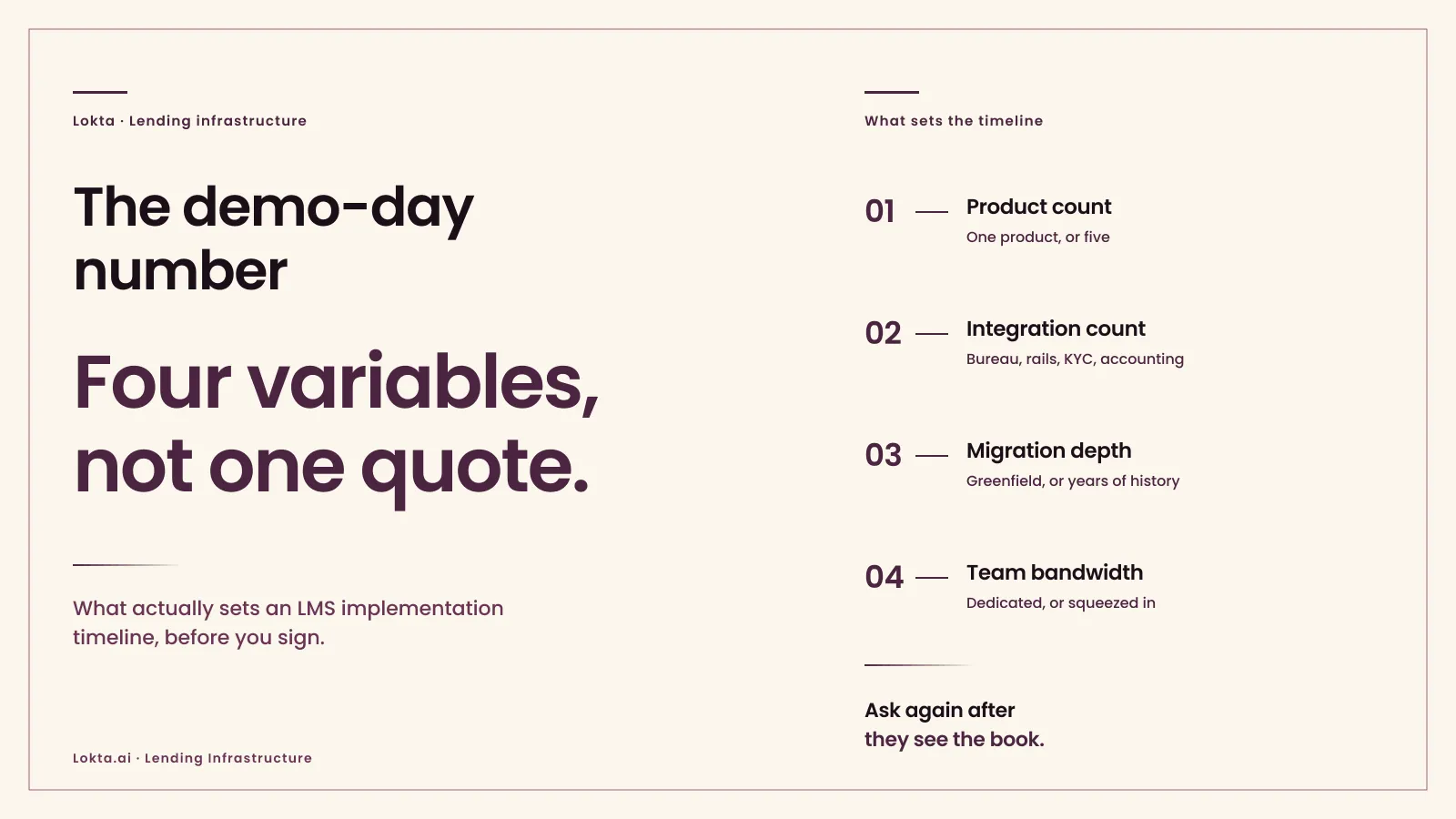
Vendors give a demo-day number before they have seen your book. The real timeline is set by four variables: product count, integrations, migration depth and team bandwidth.
Every vendor in the room gives you a number on demo day. Six weeks. Eight weeks. A quarter. The number sounds precise, and it is not, because the vendor has not seen your product catalog, your integration list, or how many years of classification history your current system is holding. The number is a best case wearing a plan’s clothes.
An LMS implementation timeline is set by four variables the vendor rarely sees before quoting: how many loan products need configuring, how many external systems need integrating, how much history has to migrate from an existing platform, and how much of the lender’s own team can actually be freed up to do the work. A single-product, greenfield lender can go live in weeks. A multi-product lender migrating years of history through a full parallel run is realistically a quarter or more.
That gap between the demo-day number and the real one is not dishonesty. It is a number given without the information that determines it. The four variables below are the same ones every lender should ask about before comparing timelines across vendors, because comparing two numbers built on different assumptions is not a comparison at all.
The four variables that actually set the timeline
Each loan product (personal, BNPL, LAP, gold, co-lending) needs its own day-count convention, appropriation order, charges and foreclosure logic configured and tested. Five products is not five times the work of one, but it is not one-fifth of the risk either.
Every external system is a separate contract, a separate test environment, and a separate failure mode. A bureau integration alone can run weeks once you count the vendor’s own onboarding queue, not just the API work.
A brand-new book has nothing to migrate and no parallel run to prove. A lender replacing an existing system has to carry classification history, charges and bureau linkage across intact, which is a sequencing problem before it is a technical one.
Configuration and UAT need the lender’s own product, ops and compliance people, not just the vendor’s implementation team. A team running the current book full-time while also testing the new one adds real weeks the project plan rarely names out loud.
Phase one: discovery and product configuration
The first weeks are not building software. They are the vendor learning the lender’s actual product catalog and the lender learning what the platform can and cannot configure without a change request. This phase ends with every product’s terms, schedule logic and charge structure defined in the new system and checked against a handful of real accounts, not a demo dataset.
A lender that walks into this phase with its product rules written down, rather than known only by the two people who have run them for years, moves through it noticeably faster. The opposite failure, discovering mid-configuration that a waiver rule nobody documented has been running on tribal knowledge, is the single most common cause of this phase overrunning.
Phase two: integrations
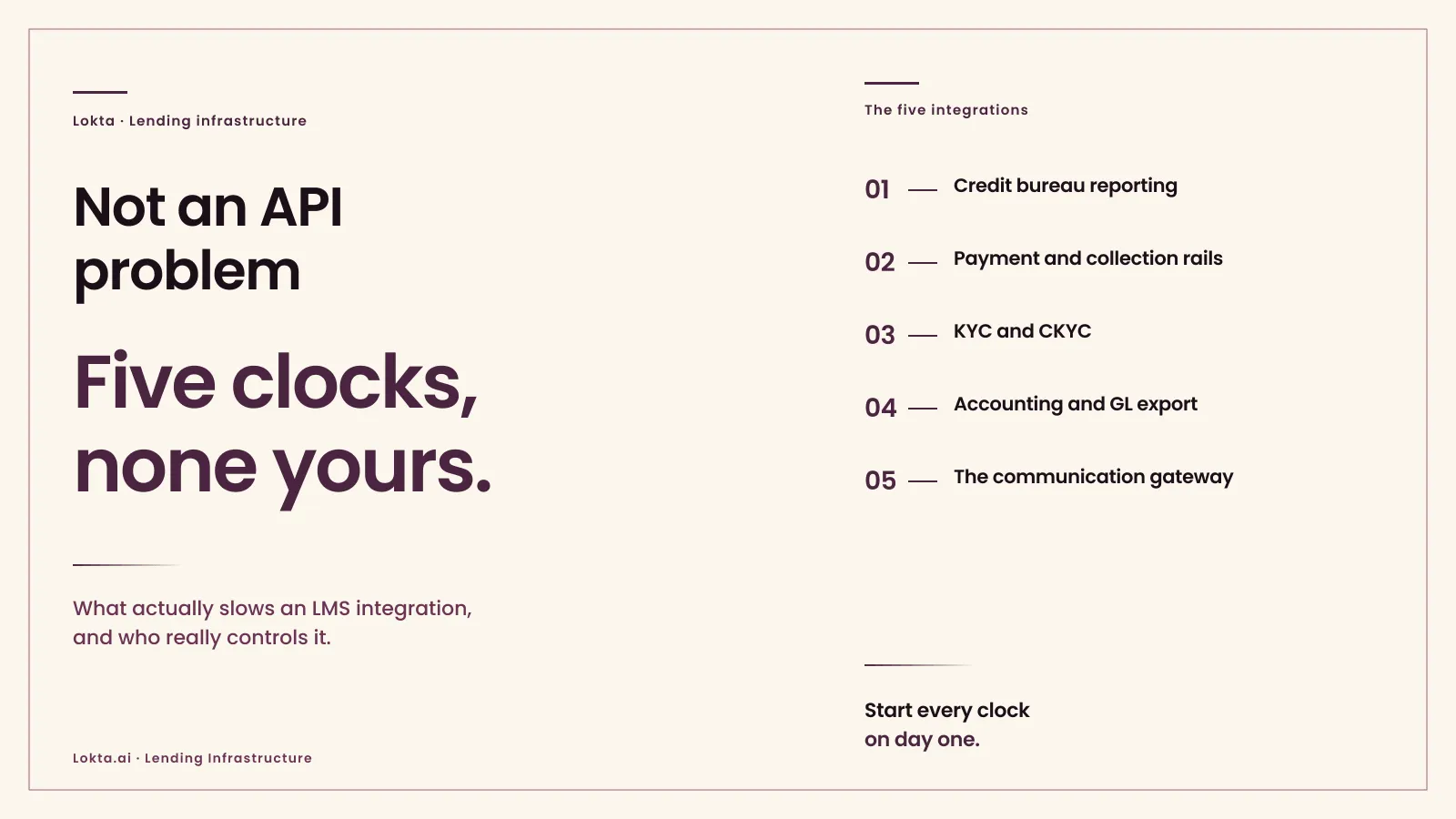
Bureau reporting, payment rail connections, KYC and accounting integrations run in parallel with configuration, but each has its own external dependency the lender does not control. A payment gateway’s own onboarding and testing window, a bureau’s own certification queue, an accounting system’s own change-approval process: none of these move at the LMS vendor’s pace, and a project plan that assumes they do is the plan that slips first.
The honest move here is to start every external integration’s own process on day one, in parallel with configuration, rather than sequencing them after the LMS side is done. Integrations rarely fail for technical reasons. They fail for calendar reasons, because someone waited for step one to finish before starting step two on a system that was never going to move at the same speed. What each of the five core integrations actually requires goes deeper into the specific external queue behind bureau reporting, payment rails, KYC and accounting.
Phase three: parallel run and cutover
If this is a new lender’s first system, this phase does not exist, and the timeline is shorter by exactly this much. If this is a replacement for an existing LMS, this phase is not optional and should not be compressed: at least one full billing cycle running the old and new systems side by side, reconciling every ledger balance and classification bucket before the old system is switched off. The order that keeps a cutover safe matters more than the speed of getting through it, because a rushed parallel run is how a classification error reaches production instead of a test account.
Vendors quoting a fixed timeline before knowing whether this phase applies are quoting two different projects with one number.
Phase four: training and go-live
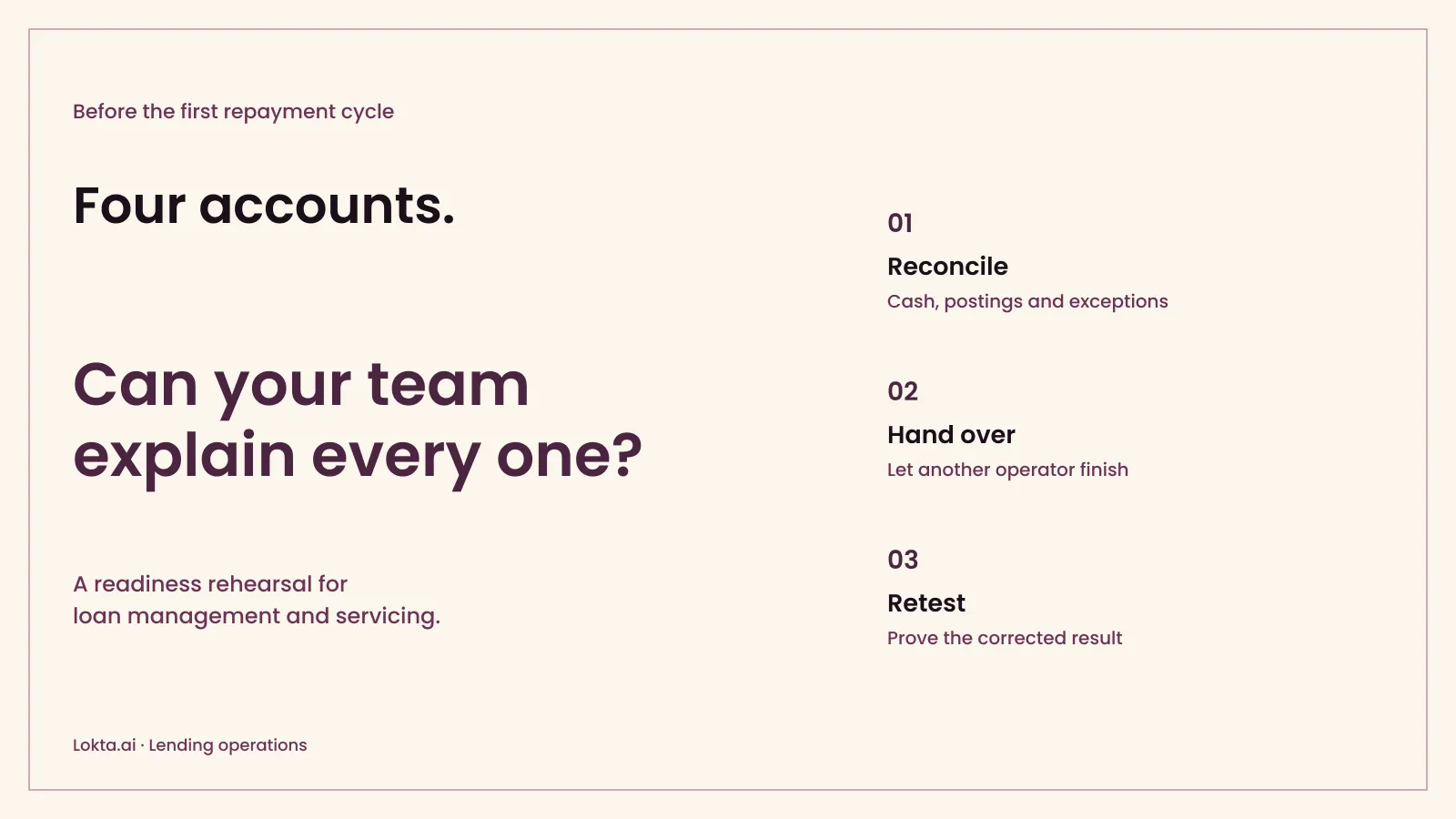
The last phase is the one that gets the least attention in a sales conversation and the most attention from the operations team living through it: getting collections, servicing and finance staff actually comfortable running their daily work in the new system, not just passing a UAT script. A repayment-cycle rehearsal gives that acceptance stage reconciled control totals, a pending-mandate case and an operator handover to evaluate. A platform that took eight weeks to configure and one week to train staff on is a different rollout from one where training takes a month because every screen looks unfamiliar to the people who use it forty times a day.
Learning the screens is the earlier and easier problem. Training a team to actually work alongside AI agents once the platform is live is a separate, later one, and it takes longer than getting comfortable with a new interface.
Go-live itself should be uneventful if the first three phases held. If it is not, the first place to look is whichever of the four variables above got the least honest estimate at the start.
Why vendor quotes vary so much
Two vendors can look at the same lender and hand back timelines that differ by a factor of three, and both can be telling the truth about their own assumptions. One assumed a single product line and no legacy migration. The other asked about the product catalog, the integration list and the data history before naming a number. Neither vendor is lying. Only one of them is quoting the lender’s actual project.
The question that separates a real estimate from a demo-day number is simple: has the vendor seen the product list, the integration list and the migration scope, or is the number a template answer given to every prospect in the room. Ask for the estimate again after showing the vendor those three things, and watch whether the number moves.
Build your own timeline from the four variables, not the vendor’s number
There are three honest ways to size this project. Trust the vendor’s demo-day number and build the rest of the year’s plan around it, which works only if your book happens to match the assumptions behind that number. Build your own estimate from the four variables above, using your actual product count, integration list and migration depth, and treat the vendor’s number as one input rather than the answer. Or run a structured discovery phase with the vendor before signing anything, so the timeline in the contract reflects your book instead of their template.
None of these removes the uncertainty entirely. What they remove is the surprise of finding out three months in that the number on the slide never accounted for the book you actually run.
Frequently asked questions
How long does it take to implement a new loan management system?
There is no fixed number, because the timeline is set by the book, not the vendor. A single-product lender with clean, recent data can configure and go live in a matter of weeks. A multi-product lender migrating years of classification and charge history through a full parallel run is realistically looking at a quarter or more. A vendor who names a number before seeing your product list and your data is quoting the best case, not your case.
What determines how long an LMS implementation takes?
Four variables, in order of how often they get underestimated: how many loan products have to be configured and tested, how many external systems have to integrate (bureau, payment rails, KYC, accounting), how much history has to migrate from an existing system, and how much of the lender's own team can actually be freed up to configure and test rather than run the current book. The vendor controls almost none of these. The lender does.
Does migrating an existing loan book add to the implementation timeline?
Yes, and it is usually the single biggest driver of a longer-than-quoted timeline. A greenfield implementation with no prior system skips the parallel run entirely. A lender replacing an existing LMS has to run the old and new systems side by side for at least one full billing cycle before cutover, which is time the vendor's demo-day number rarely accounts for.
Why do different LMS vendors quote such different timelines for the same lender?
Because a demo-day quote is usually an assumption, not a plan: a simple product catalog, no legacy migration, and a dedicated lender team with nothing else to do. A quote that actually holds requires the vendor to see the real product list, the real integration list, and the real data history before naming a number. Ask for that before comparing timelines across vendors, or you are comparing four different sets of assumptions, not four platforms.
Read next:
- What has to move together when your LMS migrates: the mechanics behind phase three, for any lender replacing an existing system.
- Every Lender Replaces Their LMS Eventually: the diagnostic for whether this project should be on the calendar at all.
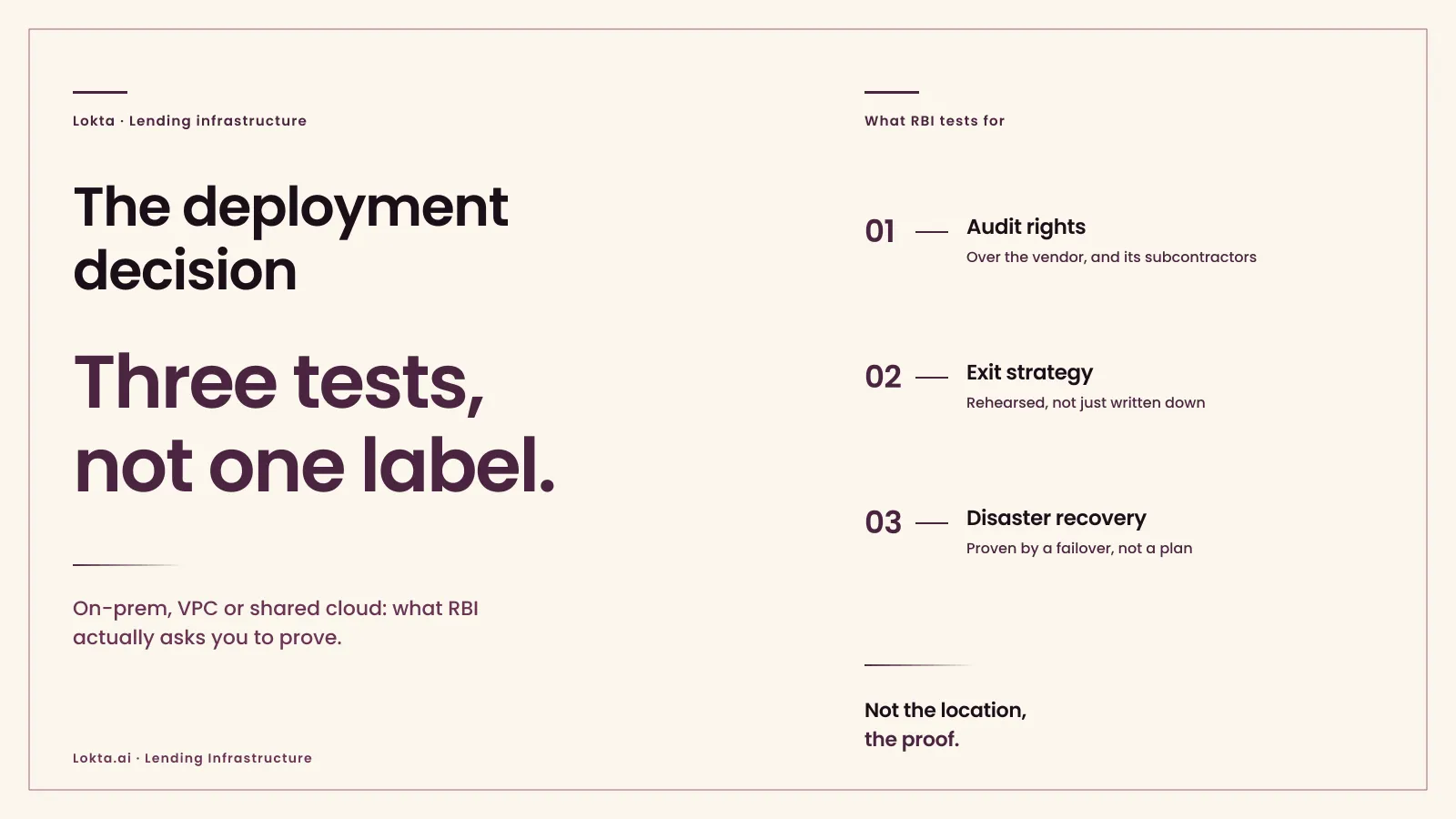
- On-Prem, VPC or Shared Cloud: the deployment decision that should be settled before phase one starts, not during it.
Chandramouli is the co-founder and CEO of Lokta, the agentic loan servicing platform. He has spent two decades building AI for decisions that change people’s lives, and has served as an independent director on an NBFC board. He writes here about the gap between what a project plan promises and what a live loan book actually requires.