A borrower disputes an EMI: can your LMS reconstruct the account?
Investigate an EMI dispute using loan terms, payment history and approved changes. A worked LMS case shows the evidence needed before correcting an account.
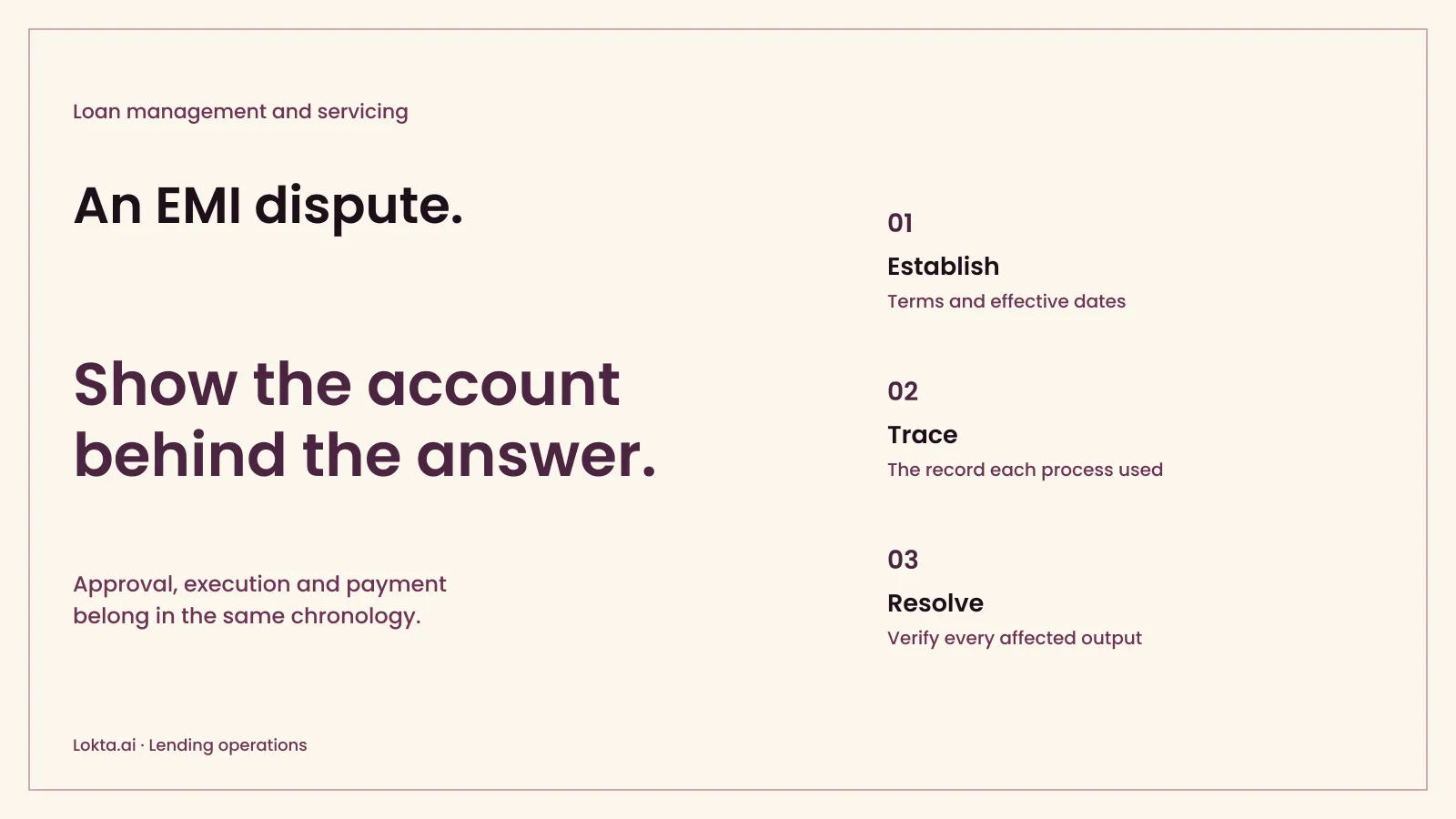
An NBFC complaints lead cannot resolve an EMI dispute from the current balance alone. The balance tells the team what the Loan Management System (LMS) holds today. The borrower is asking why it holds that amount, and whether an earlier promise was honoured.
The LMS maintains the account; servicing is the work of investigating and acting on it. Both need the history behind that answer. A confident explanation built from the wrong schedule version can close a ticket while leaving the account wrong. The useful test is whether a second reviewer can reconstruct the case from its records without asking the first operator what happened.
The complaint concerns a date, not a missing payment
Consider an illustrative dispute. A borrower has a ₹10,000 instalment originally due on 5 September. An authorised due-date change is recorded on 1 September, moving this instalment to 10 September under the lender’s agreed terms. The borrower pays ₹10,000 on 8 September. The receipt is correctly matched and posted. A late-payment notice still reaches the borrower.
For this example, assume the approval is valid, covers this instalment and has no unmet conditions. Check those conditions against the approval record before accepting the operator’s explanation.
The first operator sees a payment after the fifth and explains that it was late. That explanation is internally consistent with the old schedule. It fails to account for the approved change.
The problem is now specific: did the new due date reach the schedule that the overdue process used?
Build one chronology from four records
Collect the relevant versions, not another export of the latest account screen. Record the source reference beside each event. An approval timestamp, an effective date and a posting timestamp answer different questions.
| Record | What the example establishes | What still needs checking |
|---|---|---|
| Original agreement and schedule | ₹10,000 originally due on 5 September | Which later change supersedes this instalment? |
| Approved variation | The relevant instalment moves to 10 September | Was the authorised instruction executed? |
| Receipt and loan posting | ₹10,000 received and posted on 8 September | Which dues did the posting settle? |
| Overdue run and notice | A late-payment notice was generated | Which schedule version and account snapshot did it use? |
Suppose the execution log shows that the schedule update failed, while the support case was marked complete when approval arrived. The notice process later read the unchanged due date. We now have an explanation that connects the borrower’s experience to a specific failed operation.
Without that execution record, the conclusion must remain provisional. A reviewer should be able to write “approval found, execution unproven” instead of choosing between “borrower wrong” and “system wrong” prematurely.
Separate the decision from the correction
The investigation establishes what should have happened under the verified agreement. The correction process establishes what the lender is authorised to change now. Keep both in the case record.
For the worked case, the reviewer would confirm the applicable schedule, identify any consequences of the stale date and request the permitted correction. That may involve the overdue position, a charge, a borrower notice or downstream reporting. Each affected item needs its own check, including the rules governing penal charges and rate resets. Do not assume that updating the due date automatically repaired everything that previously consumed it.
Preserve the original events and link the corrective entries. If a later repayment, adjustment or reporting cycle has already occurred, include it in the impact review. Finance and risk need the corrected state and the explanation of how it changed.
A disputed allocation is a different investigation. If the receipt was correctly recorded but the borrower contests which dues it cleared, start with the payment appropriation rule and its version on the relevant date. Avoid treating every complaint as a missing-payment problem.
Follow the error into the credit report
A stale due date can survive beyond the notice. If it produced an incorrect late-payment record sent to a credit information company (CIC), correcting the LMS alone leaves the borrower’s credit report wrong.
RBI’s compensation framework, also reproduced in a published 2026 credit-bureau grievance policy, gives the lender and bureau a combined 30 calendar days from the initial complaint. The credit institution has 21 days from being informed of the inaccuracy to send corrected information; the bureau effectively has the remaining nine. For covered complaints unresolved beyond 30 days, compensation is ₹100 per calendar day of delay, apportioned between the responsible institutions. It is not ₹100 from each party automatically.
Put the original complaint date, lender notification date, correction submission, bureau acknowledgement and corrected-report delivery in the case. A fresh internal ticket must not restart the original clock. Record who will verify the corrected report; sending a file is not the same as resolving the borrower’s problem.
The framework has exclusions, including disputes over score-model computation and matters already before specified other forums. The operating requirement here concerns correction of inaccurate credit information. The RBI framework text sets out that boundary.
Give the borrower an explanation they can verify
An internal incident description is not yet a useful reply. “An asynchronous update failed” does little for someone who wants to know what they owe.
A reviewed response in the fictional case would explain the agreed due date, the payment received, the error found, the correction completed and any remaining amount. Attach or provide access to the corrected statement through the lender’s approved channel. Distinguish completed corrections from work that is still pending.
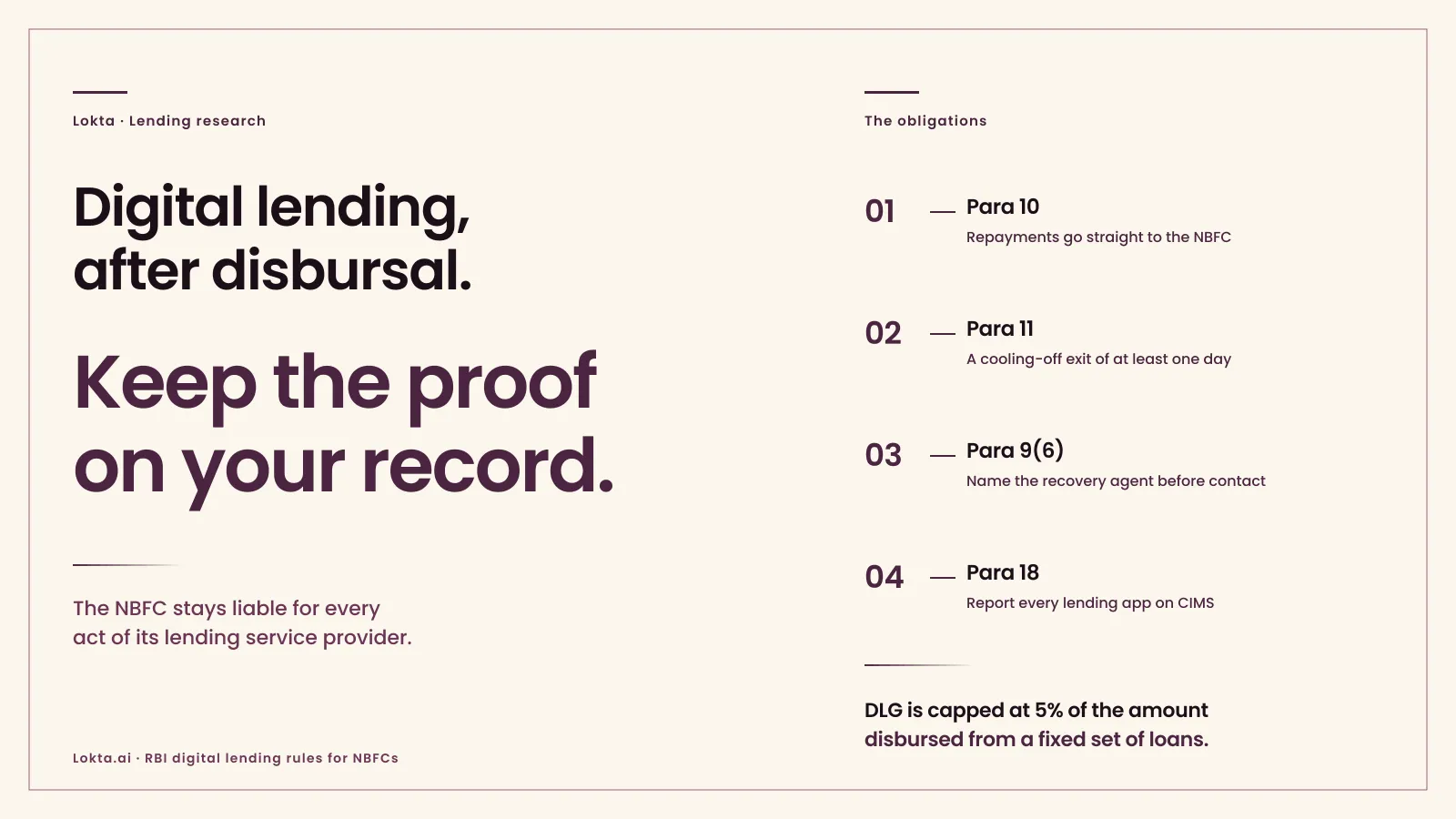
For covered digital lending, RBI’s NBFC Credit Facilities Directions address delivery of loan documents and grievance responsibilities. Apply the relevant rules to the lender and product. The chronology in this article is a proposed operating method, not an RBI-prescribed software format. The existing digital lending guide covers the regulatory context.
Keep a worksheet that another operator can finish
Use the following fields for one disputed instalment. A blank should mean missing evidence, rather than an invitation for an agent to fill the gap with an inference.
- Borrower’s disputed amount or date, and the resolution requested.
- Applicable agreement, schedule and approval references, with effective dates.
- Receipt, allocation and execution records, including failed or pending work.
- Established finding, unresolved facts, correction authority and affected outputs.
- Verified final account state, borrower response and remaining follow-up owner.
The worksheet also makes the technology decision concrete. A controlled manual investigation can work when the records are accessible and case volume permits it. An internal team can build the chronology and handovers around its existing LMS. A platform such as Lokta’s AI Loan Servicing is another route to evaluate when recurring case assembly needs governed automation.
An agent can retrieve permitted records and draft the chronology. It cannot turn an approval into evidence that execution succeeded. Deterministic checks and the lender’s authorised process govern any financial correction.
Before closing the next dispute, give the record to a reviewer who did not handle it. If they cannot explain the final amount and the downstream corrections, the case is not ready to hand over. Discuss the investigation workflow with that missing evidence in view.
Frequently asked questions
What should an LMS show when a borrower disputes an EMI?
It should let the reviewer connect the disputed amount to the applicable terms, schedule version, payment record, approved changes and borrower communications. Preserve when each event happened and when the system recorded it. Those dates can differ. The investigation should identify which source supports each conclusion, what remains unresolved and who may authorise a correction. A current balance alone cannot explain the route by which the account reached that balance.
Does an approved due-date change prove that the loan schedule changed?
No. Approval records the decision. Check the execution reference, effective date and resulting schedule to establish whether it took effect. In this example, the complaint was closed on approval even though the schedule update failed.
Should an operator remove a disputed charge immediately?
First establish the charge basis, the applicable loan terms, relevant events and the lender’s correction authority. A complaint is a reason to investigate, not automatic permission to alter financial records. Where an error is established, use the authorised correction process and verify its downstream effects. Keep the original event and the linked correction so finance, risk and the next operator can understand both the mistake and its resolution.
What is the credit-information correction deadline?
For complaints covered by RBI’s compensation framework, the lender and bureau share a 30-calendar-day resolution window. The lender has 21 days from notification of the inaccuracy to send corrected information. Delay beyond 30 days attracts ₹100 per calendar day, allocated between responsible institutions.
Read next
- RBI digital lending rules: check the applicable obligations behind the account record
- Payment appropriation: investigate disputes about how a receipt was allocated
Sources
- RBI: NBFC Credit Facilities Directions, 2025: Chapter III covers digital-loan documentation and grievance responsibilities. The investigation method and example here are editorial recommendations, checked 2 October 2026
Lokta editorial analysis by Chandramouli, co-founder and CEO.