Lokta opens its platform to NBFCs up to ₹100 crore, with no platform fee for up to two years
The programme is aimed at lenders whose credit judgment can build an institution before the book is large enough to pay for one.
Contents 9 sections
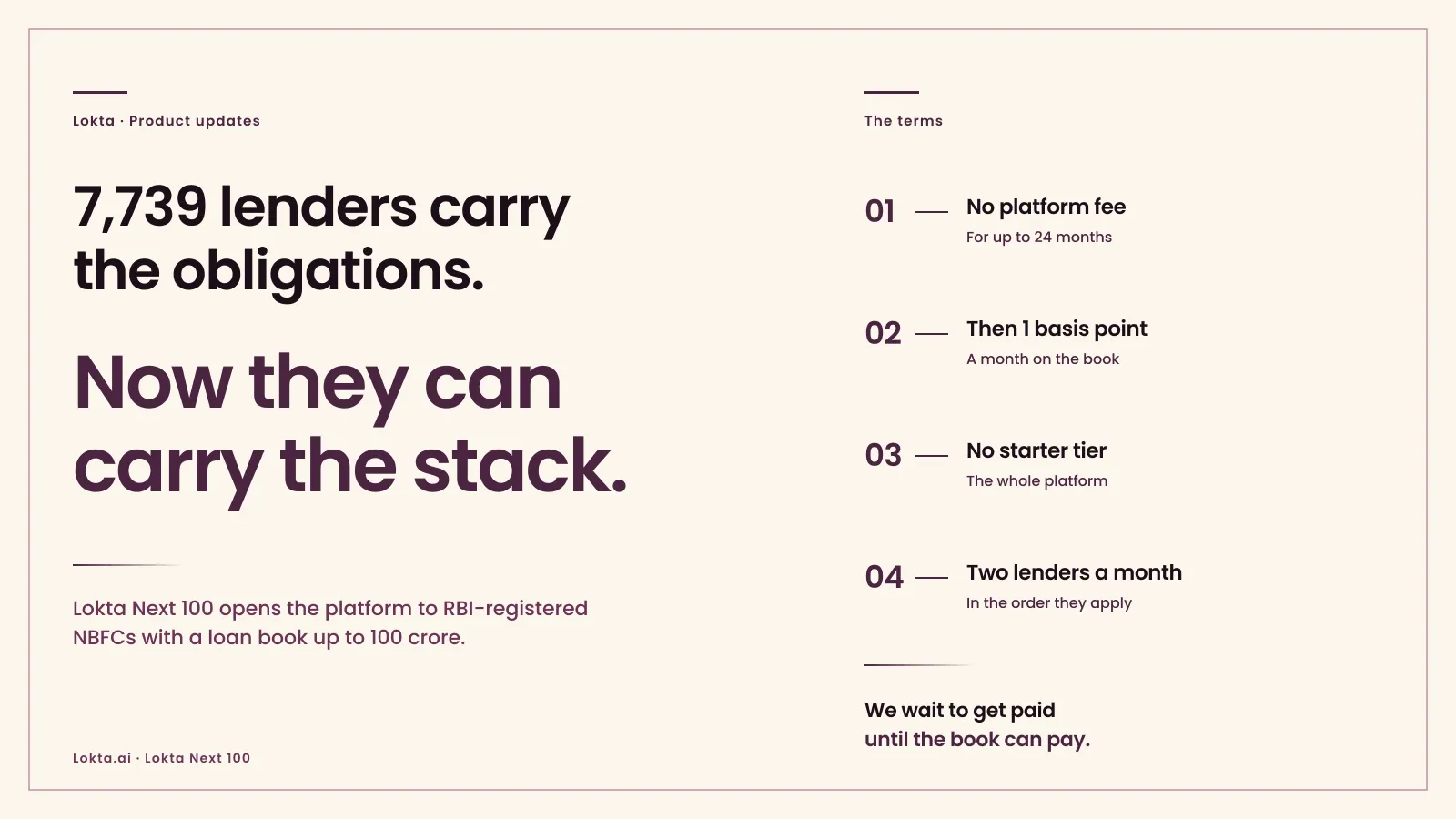
Lokta Next 100 opens Lokta’s agentic loan servicing platform to RBI-registered NBFCs with a loan book up to ₹100 crore, with no platform fee for up to two years. After that the rate is 1 basis point a month on the book. Applications are open, two lenders start each month, and pure-play microfinance NBFCs are not eligible.
On Lokta’s count of the Reserve Bank of India’s register, India has 8,315 non-banking financial companies registered in categories that lend. Just 458 of them are placed above RBI’s base layer on the ₹1,000 crore asset threshold alone. A further 7,739 sit in the base layer and carry many of the same obligations on a fraction of the budget.
Lokta today opened applications for Lokta Next 100, a programme that gives RBI-registered NBFCs with a loan book up to ₹100 crore the technology to run that book after approval, with no platform fee for up to two years. Pure-play microfinance NBFCs are not eligible. The 100 in the name is the ₹100 crore eligibility line, not a number of lenders.
- The licence is not the hard part any more. A compact in-house lending technology team costs ₹2 crore to ₹3 crore a year before a single loan goes through the system.
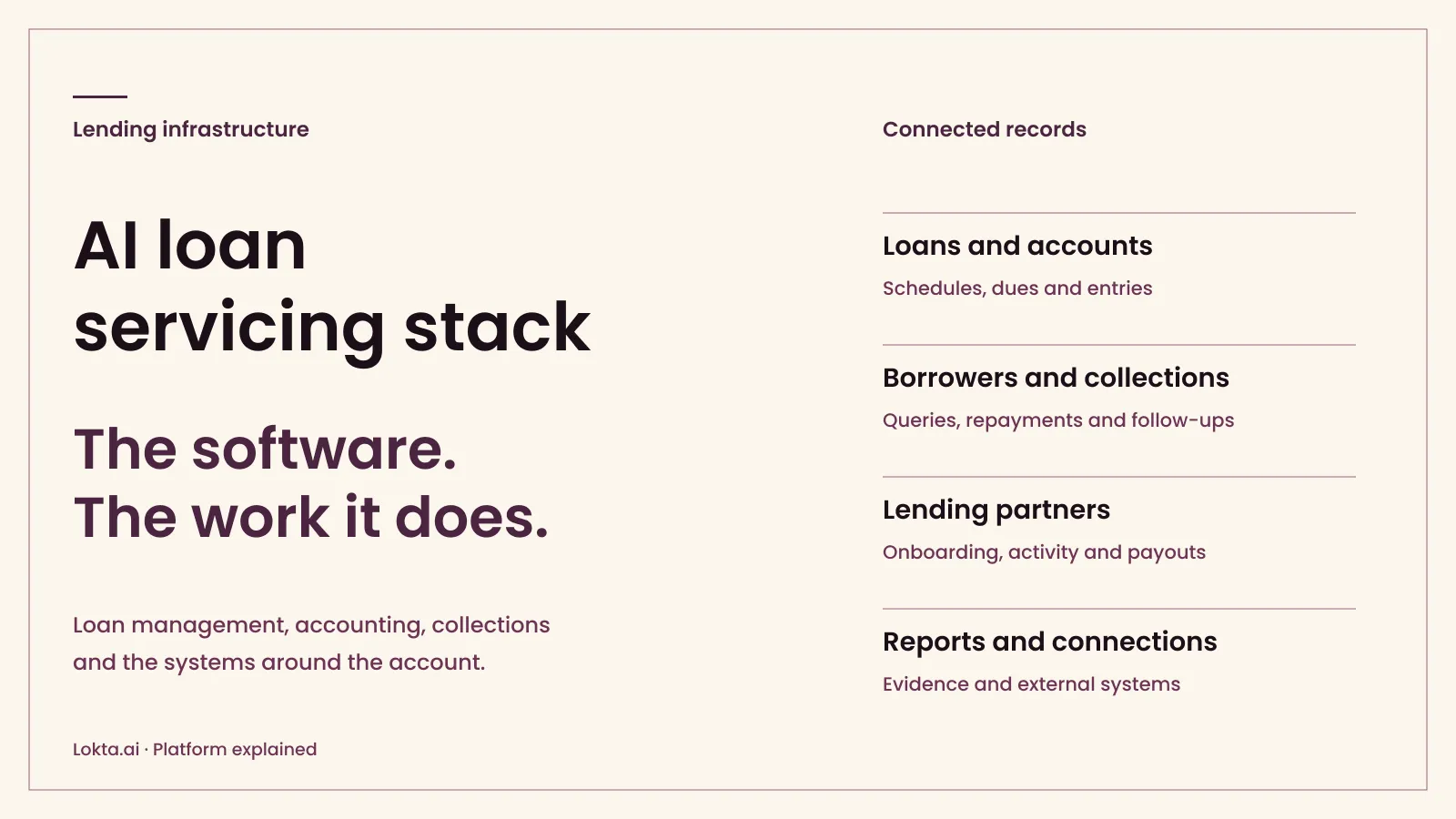
- There is no starter tier. Eligible lenders get the full platform: servicing, a loan product studio, loan-level accounting, reporting, analytics and early warning, collections and recovery, partner management, APIs and bureau reporting.
- The AI proposes and the core decides. The AI cannot post to the ledger, it is opt-in, it is priced on actual use, and it can be turned off.
- Billing starts when the book can pay. No platform fee for up to 24 months, then 1 basis point a month on the book, about 0.12% a year.
- Two lenders a month. Applications are taken in the order they arrive so that every go-live is assisted rather than self-serve.
01 · Two companies: why does a small lender end up running both?
“Most small lenders end up running two companies,” said Chandramouli C S, co-founder and CEO of Lokta. “There is the company on paper. And there is the company people actually use, which runs on phone calls, WhatsApp and spreadsheets, with the founder approving things all day.”
Lokta estimates that a compact in-house lending technology team, with product and engineering leadership, developers, QA, DevOps and security, and integration capability, can cost ₹2 crore to ₹3 crore a year before the lender has put a single loan through the system.
The licence was the hard part. The lending technology should not be.
“An experienced lender should be able to put capital into the book, into people, customers, risk and collections, not into rebuilding a servicing stack,” said Chandramouli. “Every credit and money decision stays with the lender.”
02 · The platform: what is included?
There is no starter tier. Lenders get the full loan management system: servicing, a loan product studio, loan-level accounting, regulatory and investor reporting, portfolio analytics and early warning, collections and recovery, partner management for Lending Service Providers, APIs and bureau reporting. Maker-checker sits on every change, which means one person makes it and another approves it, and the record keeps both.
Migration runs in parallel with the lender’s existing system or manual process. The lender cuts over only when opening balances reconcile line by line, and Lokta stays through the first configured policy version and its reconciliation in production. The book and its records stay the lender’s: data is hosted in-region, exportable at any point in the term, and never used to train models for anyone else.
03 · Governance: what can the AI not do?
AI loan servicing in the platform proposes. The deterministic core, the rule-based part that runs on the lender’s own policy, decides every change. The AI cannot post to the ledger. It is opt-in, priced on actual use, and can be turned off at any time. Lokta points to the report of RBI’s FREE-AI Committee of 13 August 2025, which sets out as a guiding principle that “entities deploying AI systems should be accountable for decisions of the AI systems, regardless of the level of autonomy of the systems”. The report is not a direction, and the Reserve Bank does not endorse Lokta or any other vendor.
04 · Terms: what does it cost, and when does billing start?
There is no platform fee for up to 24 months. Billing begins at the earlier of the loan book staying above ₹100 crore for two consecutive months, or the 24-month term ending. After that the rate is 1 basis point a month on the book, ₹1,000 a month for every ₹1 crore, or about 0.12% a year, plus taxes. On a ₹100 crore book that is ₹12 lakh a year.
Two one-time charges apply, ₹1 lakh for migration and ₹50,000 for bank integration, both plus taxes. A fresh licence has nothing to migrate, and Lokta waives the integration charge for it.
Lokta starts two lenders a month, in the order applications arrive, so that every go-live is assisted rather than self-serve.
“Our revenue should grow when the lender’s book does,” said Chandramouli. “We are waiting to get paid until the book can pay.”
05 · The count: how did we count India’s lending NBFCs?
The three figures in the opening paragraph are a direct count of RBI’s own register as on 30 June 2026, not an estimate and not a third-party summary. The register carries 8,561 NBFCs. Setting aside the licence categories that do not put money out as credit leaves 8,315. Of those, 7,739 sit in the base layer, 458 are placed above it on size, and 118 are placed above it by licence category or because they hold a certificate to accept public deposits.
We have published the full classification-by-layer crosstab, the reproduction method, the stated limits of the count, and the underlying figures as a CSV under CC BY 4.0: how many NBFCs are there in India, and how many of them lend. Recount it, or argue with it.
06 · What is next: where does the programme go from here?
The programme opened to RBI-registered NBFCs on 3 September 2026, and Lokta plans to extend it to lenders elsewhere in Asia-Pacific and in Africa later in 2026.
Lokta opened the programme ahead of the Global Fintech Fest, which brings the industry to Mumbai in the second week of September 2026.
Applications are open on the Lokta Next 100 programme page, which carries the full terms and the form.
Frequently asked questions
Who is eligible for Lokta Next 100?
An NBFC registered with the Reserve Bank of India, carrying a loan book up to ₹100 crore, that runs or intends to run its own book. Pure-play microfinance NBFCs are not eligible. The 100 in the name is the ₹100 crore eligibility line, not a cap on the number of lenders admitted. Applications are assessed in the order they arrive, and Lokta starts two lenders a month so that every go-live is assisted rather than self-serve.
What does Lokta Next 100 cost after the free period?
There is no platform fee for up to 24 months. Billing begins at the earlier of the loan book staying above ₹100 crore for two consecutive months, or the 24-month term ending. After that the rate is 1 basis point a month on the book, which is ₹1,000 a month for every ₹1 crore, or about 0.12% a year, plus taxes. On a ₹100 crore book that is ₹12 lakh a year. Two one-time charges apply: ₹1 lakh for migration and ₹50,000 for bank integration, both plus taxes.
Does the AI make credit decisions?
No. The AI proposes. The deterministic core, the rule-based part that runs on the lender's own policy, decides every change. The AI cannot post to the ledger. Every state change carries maker-checker, which means one person makes it and another approves it, and the record keeps both. The AI layer is opt-in, priced on actual use, and can be turned off at any time. Every credit and money decision stays with the lender, and so does accountability for it.
What happens to our data and our book?
The book and its records stay the lender's. Data is hosted in-region, exportable at any point in the term, and never used to train models for anyone else. Migration runs in parallel with the lender's existing system or manual process, and the lender cuts over only when opening balances reconcile line by line. Lokta stays through the first configured policy version and its reconciliation in production.
Read next
- How many NBFCs are there in India, and how many of them lend?: the count behind the opening paragraph, with the method and the CSV.
- A loan’s profit is decided after approval, not at underwriting: why the return is earned in servicing and collections, not at the credit decision.
- Our team is 42. Six of us are human.: what a small team can actually put agents on, and where the humans stay.
Sources
- Reserve Bank of India, List of NBFCs and ARCs registered with the RBI, as on 30 June 2026: https://www.rbi.org.in/Scripts/BS_NBFCList.aspx
- Reserve Bank of India, Report of the Committee on Framework for Responsible and Ethical Enablement of Artificial Intelligence (FREE-AI), 13 August 2025: https://www.rbi.org.in/Scripts/PublicationReportDetails.aspx?UrlPage=&ID=1306
Chandramouli is the co-founder and CEO of Lokta, the agentic loan servicing platform. He has spent two decades building AI for decisions that change people’s lives, and has served as an independent director on an NBFC board. Lokta Next 100 is the programme he wanted to exist when he sat on that board.