Payment appropriation is a configuration science
A partial loan payment can clear different dues under different allocation rules. Compare ranking, traversal and eligibility with worked examples.
Contents 12 sections
A borrower has paid, but still disputes the principal balance. For the servicing team, explaining the receipt means showing which dues it settled and which remain unpaid.
Payment appropriation is the rule behind that split. It sets the order in which money reaches principal, interest, fees and charges. The model below separates each component into overdue and non-overdue buckets. Those eight buckets describe this model; they are not a universal requirement for every loan product.
A useful review asks three separate questions: which dues are eligible on the payment date, which component has priority, and whether the engine works through one installment or one component at a time. The loan terms and approved policy constrain all three.
- Separate priority from eligibility. Ranking a component first does not make an unearned or not-yet-due amount collectible.
- Compare the unpaid amounts as well as principal retired. The recorded ₹37,440 simulation below produces four different allocations on the same assumed account.
- Test traversal explicitly. The smaller worked example shows how one ₹10,000 payment can clear the oldest installment or leave ₹900 of its principal unpaid.
- Keep the evidence beside the rule. Preserve the policy version, starting dues, allocation, remaining dues and posting reference before closing a payment dispute.
How many appropriation orders are there really?
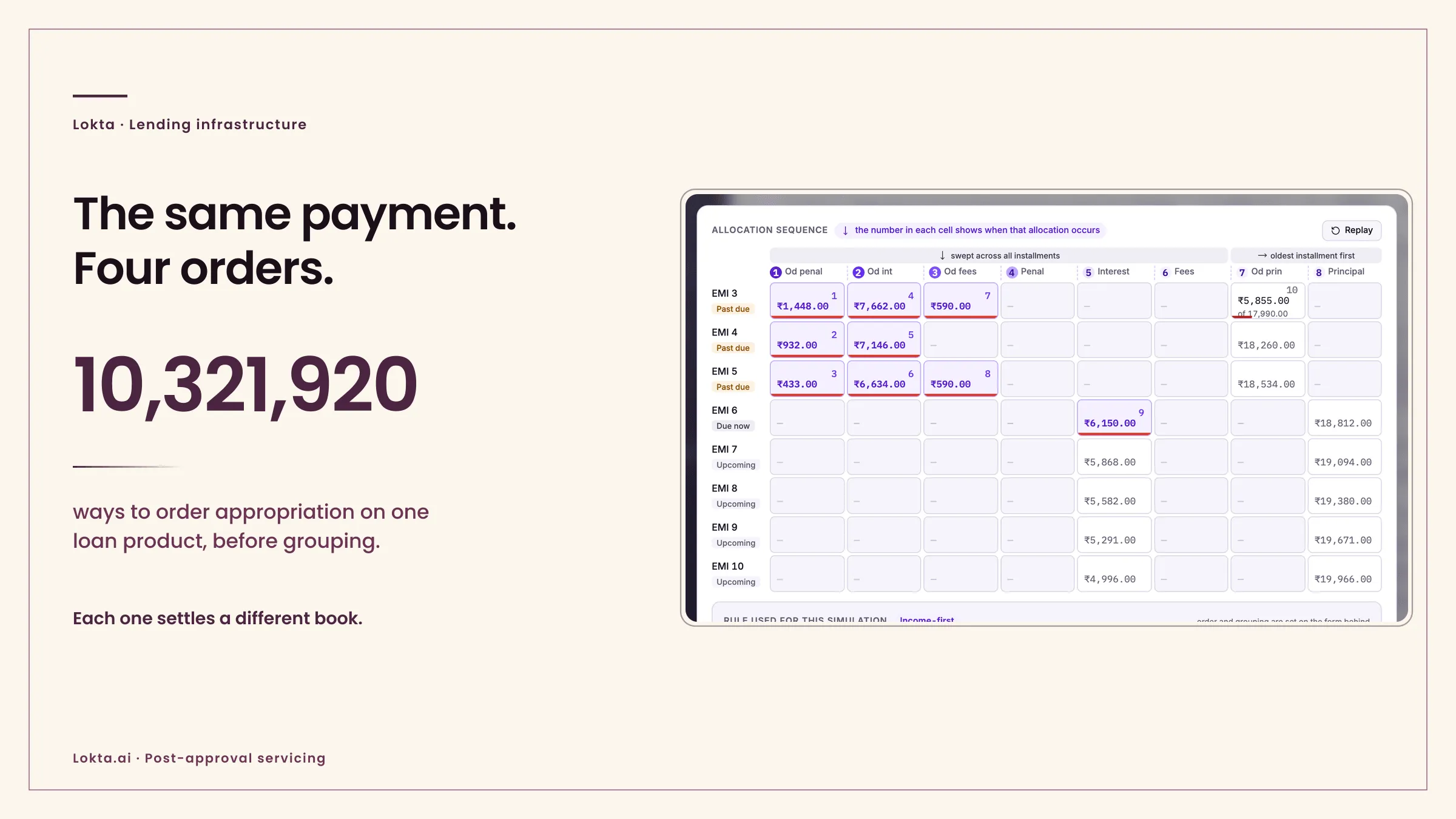
Count the choices in that one screen. Eight components can be ranked 40,320 ways. Each also carries its own traversal rule, settle this installment before the next or sweep this component across every installment, which multiplies the space by 256. That is 10,321,920 configuration combinations in this eight-bucket model, before anyone links two components into a group. They are not 10 million distinct legal policies or economic outcomes, but the defensible ones among them still diverge.
Policy review narrows that space. Two configurations may produce the same result when a bucket is empty or the payment is exhausted before reaching it.
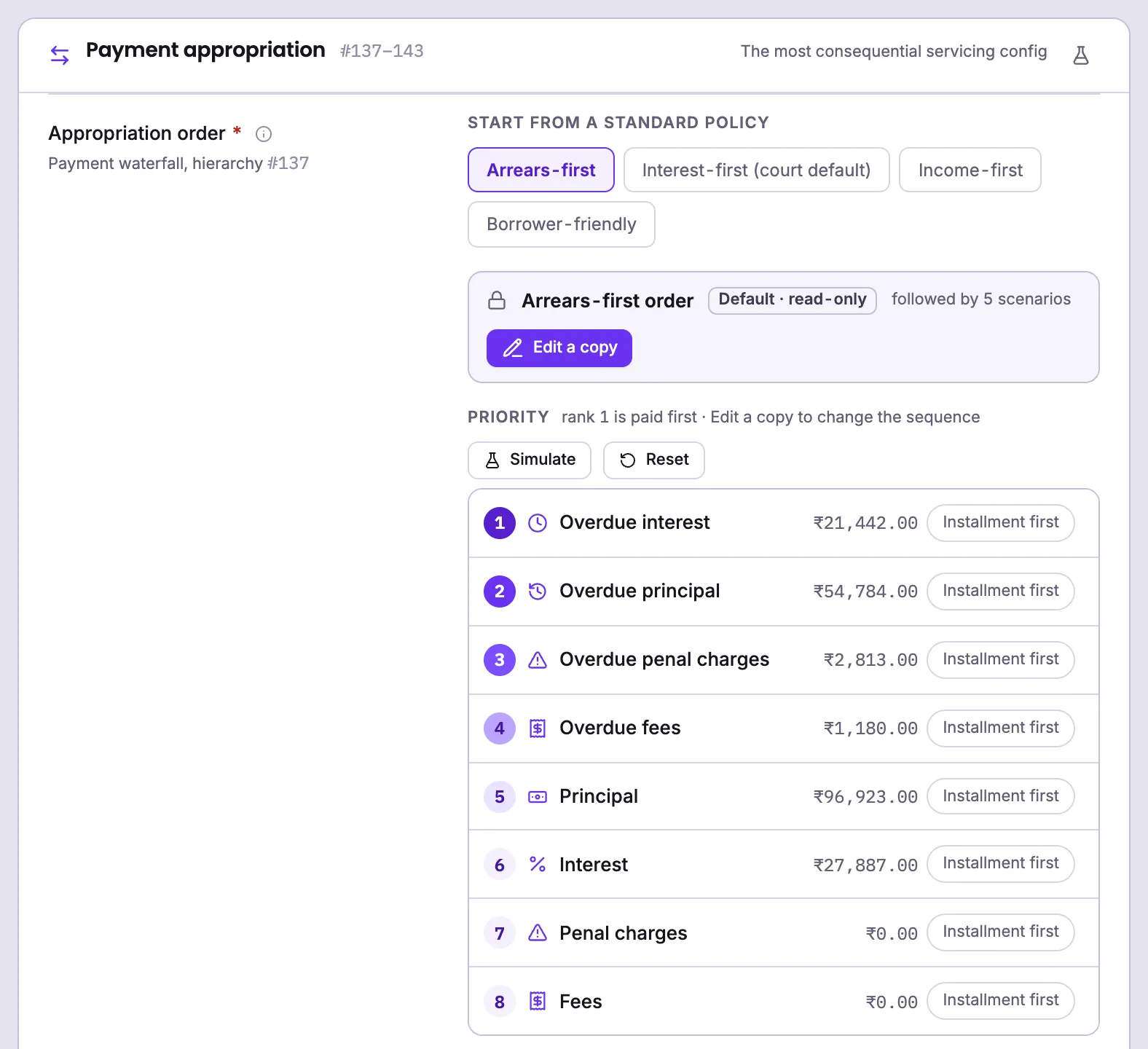
The count is 8! × 2⁸: 40,320 rankings multiplied by 256 traversal choices. It measures configuration combinations under these assumptions, not legal options or distinct economic outcomes. Review the resulting allocation against the approved policy before adopting a configuration.
What does the same payment do under four different orders?
Illustrative simulation, recorded for the August 2026 article. The account is the same in all four runs: ₹5,00,000 at 18% p.a. on a reducing balance over 24 months, EMI ₹24,962, with installments 3 to 10 open, 3 to 5 past due, and ₹2,05,029 scheduled across those eight rows. So is the payment. ₹37,440 arrives, about one and a half times the EMI.
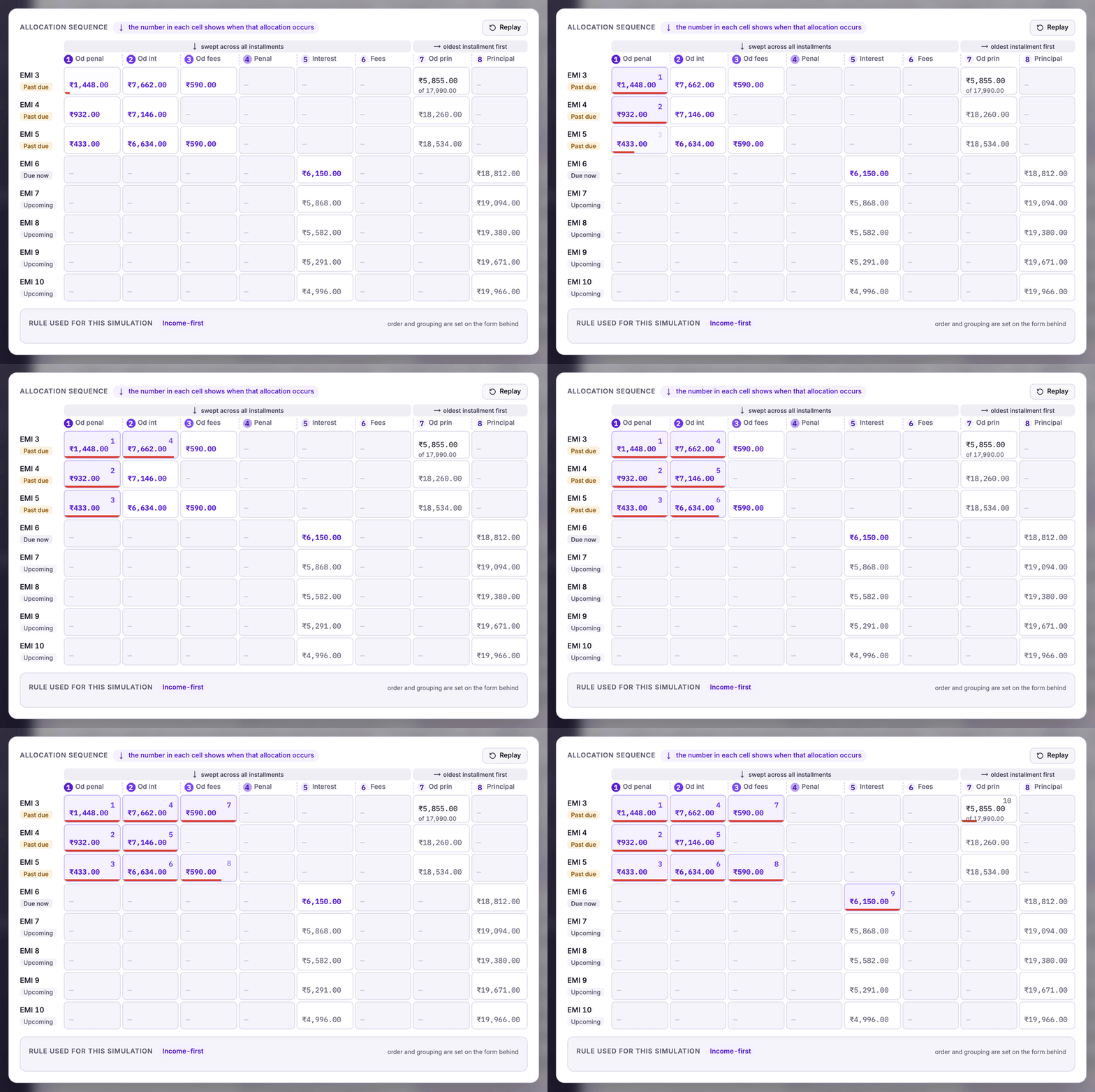
Only the appropriation order changes. Every number below comes from Lokta’s simulator on a modelled account rather than a customer file (full method). The numbered badges give the sequence the engine walked, and each cell shows what that step actually took, so the highlighted cells in every panel add up to the ₹37,440. Each panel opens full size in a new tab.
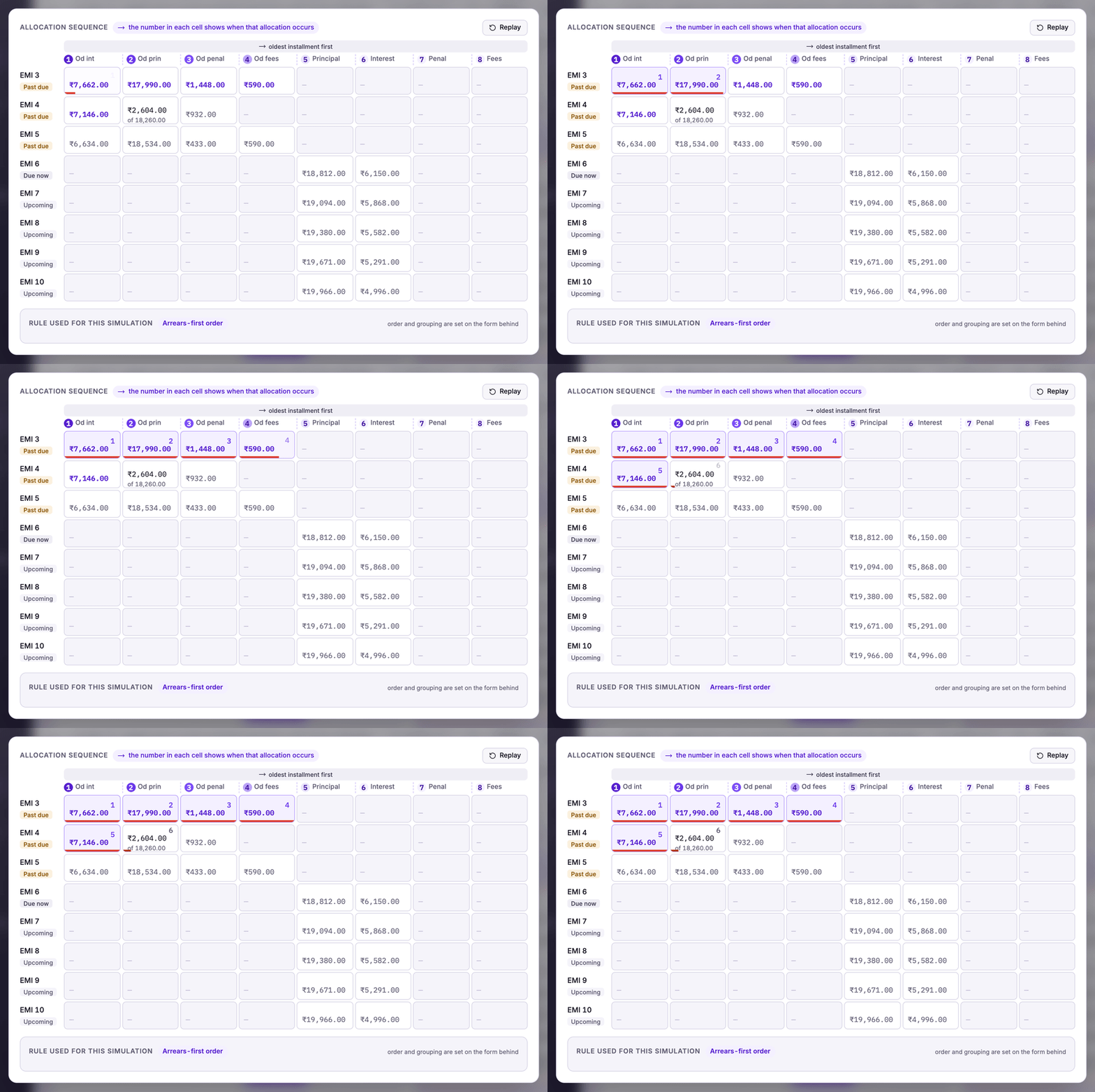
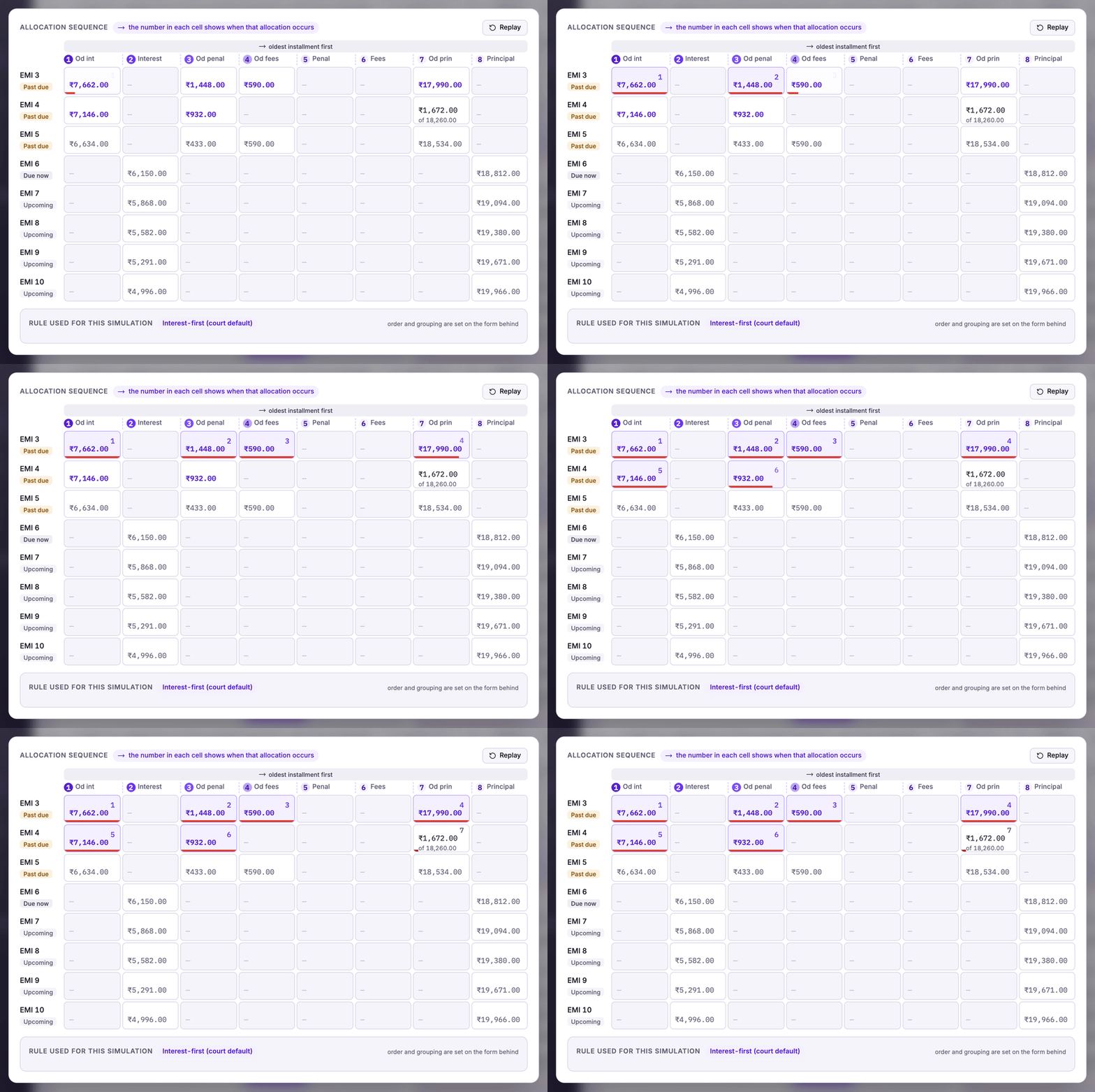
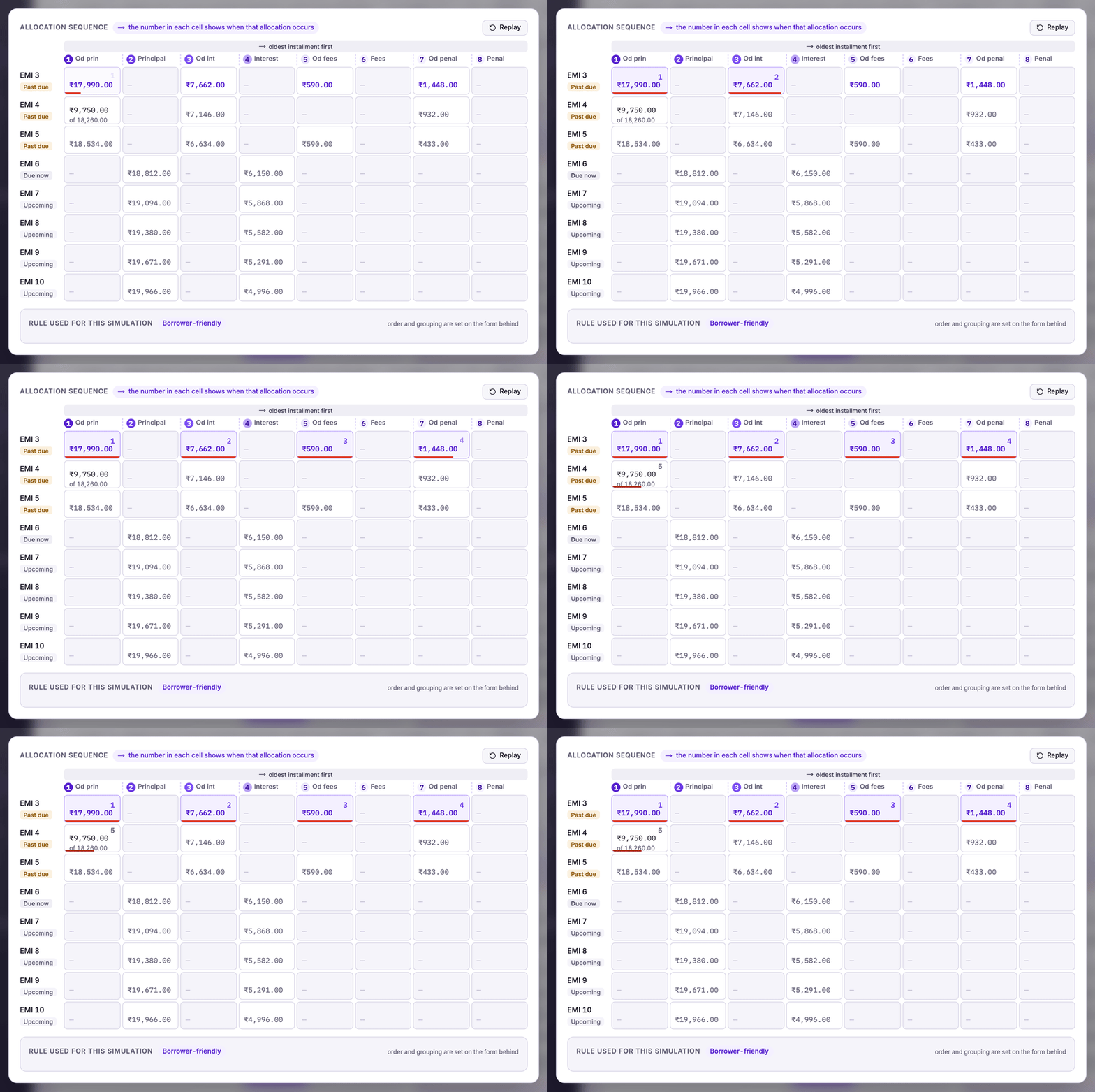
| Scenario | Principal retired | Leading components | Traversal |
|---|---|---|---|
| 1. Arrears-first (recorded default) | ₹20,594 | Overdue interest, overdue principal, overdue penal, overdue fees | Installment first |
| 2. Interest-first (screen label: court default) | ₹19,662 | Overdue interest, interest, overdue penal, overdue fees | Installment first |
| 3. Borrower-friendly | ₹27,740 | Overdue principal, principal, overdue interest, interest | Installment first |
| 4. Income-first | ₹5,855 | Overdue penal, overdue interest, overdue fees, penal | Component first for the leading charge and interest buckets; installment first for principal |
All four allocate the full ₹37,440, and all four are representable in the model. Principal retired ranges from ₹5,855 to ₹27,740 in this account, about 4.74 times as much. That comparison describes these inputs and policies. It does not identify the best policy for another account or prove a customer outcome.
Why does income-first reach principal last?
Because almost the whole payment is gone before the order gets there. Sweeping overdue penal charges across EMIs 3 to 5 takes ₹2,813. Sweeping overdue interest across the same three takes ₹21,442, which is those installments’ scheduled interest of ₹20,102 plus ₹1,340 of interest accrued on the arrears themselves. Overdue fees, the ₹590 non-penal fee on EMIs 3 and 5, take ₹1,180. Current penal charges rank next and take nothing, because only a past-due installment carries one. Then the interest on EMI 6, the installment due now, takes ₹6,150. That is ₹31,585 before overdue principal is reached at rank seven, leaving ₹5,855 to part-pay EMI 3.
In this recorded run, interest on EMIs 7 to 10 is not yet due and receives no allocation. That boundary matters: a component-first instruction does not by itself make future interest eligible.
In this simulation, ₹5,855 of the ₹37,440 payment reaches principal. The other ₹31,585 settles interest and charges.
The remaining overdue dues must still be inspected. Principal retired alone cannot tell the operator whether the oldest unpaid due has cleared, how days past due should change, or whether the account qualifies for an asset-classification change.
A lender’s recovery hierarchy must respect its loan agreement, approved policy and applicable rules. For NBFCs, RBI’s penal charges rules sit in paragraph 30 of the Responsible Business Conduct Directions, 2025, which carry forward the 18 August 2023 penal-charges circular. A penalty for breaching a material loan term must be a penal charge rather than interest added to the rate. It is levied only on the amount in default, carries no interest, and cannot be charged on earlier penal charges. The rules also cover similar charges “by whatever name called”, which brings a bounce charge for a missed installment inside them.
In this simulation the penal charge is the only charge for each missed installment. The ₹590 in the fees bucket on EMIs 3 and 5 is assumed to be a non-penal fee due with those installments, not a second charge for the same default. A product that levies a bounce charge would carry it as that one penal charge. The simulation’s assumed charge amounts are not a recommended tariff or a compliance finding.
What do traversal and grouping actually change?
Traversal determines how the engine visits eligible dues. In the installment-first examples above, it finishes the oldest eligible installment before advancing. A component-first instruction visits that component across eligible installments first. Due-date eligibility still applies: scenario 4 reaches current interest on EMI 6, but does not collect the future interest shown on EMIs 7 to 10.
Grouping is another configuration choice to verify. Ask whether a group changes only the order of its members, forces installment-first processing, or applies a proportional split. Do not infer the engine’s behaviour from the label. Demonstrate it with a payment that runs out inside the group.
A smaller worked example: the same rank, a different unpaid due
Synthetic arithmetic example. This is a hand calculation, separate from the simulator recordings. Assume two unpaid installments are eligible on 23 September: the 10 September installment contains ₹1,000 interest and ₹9,000 principal; the 20 September installment contains ₹900 interest and ₹9,100 principal. Total dues are ₹20,000. A ₹10,000 receipt is available. There are no fees, penal charges, new accruals or future dues in this example.
Both policies rank interest before principal and visit installments oldest first. Only traversal changes.
Allocation of one ₹10,000 receipt against ₹20,000 of eligible dues. Scroll the table to compare both policies.
| Result | Installment first | Component first |
|---|---|---|
| Interest settled | ₹1,000 on 10 Sep | ₹1,000 on 10 Sep + ₹900 on 20 Sep = ₹1,900 |
| Principal settled | ₹9,000 on 10 Sep | ₹8,100 on 10 Sep |
| Total allocated | ₹10,000 | ₹10,000 |
| 10 Sep dues remaining | ₹0 | ₹900 principal |
| 20 Sep dues remaining | ₹10,000 | ₹9,100 principal |
| Total dues remaining | ₹10,000 | ₹10,000 |
Installment-first uses the receipt to clear 10 September. Component-first clears both interest amounts, then uses the remaining ₹8,100 against the older principal. Both conserve the full receipt. Only the first clears the oldest installment. Any DPD or classification result still needs the lender’s applicable rules and full account state; this table does not calculate an NPA upgrade.
For a live dispute, first confirm that the payment belongs to this account and has posted once. Then compare the actual allocation with the effective policy. The loan reconciliation guide covers that receipt-to-ledger check.
How should the economics be reviewed?
Keep cash allocation, income recognition and arrears status as separate outputs. Collecting an amount already accrued as income does not create the same income a second time. The lender’s accounting rules determine when an interest or charge receipt becomes recognised income.
For a reducing-balance calculation, principal reduction may change subsequent interest, subject to the contract’s accrual, value-date and schedule rules. Show the resulting schedule instead of assuming a fixed effect from the principal figure alone.
Ageing needs the unpaid due dates and amounts after allocation. A payment may reduce principal while leaving an older due unresolved. Return on assets needs a wider analysis of income, assets, losses and costs over time. None of the single-payment examples here establishes a portfolio RoA improvement.
Three appropriation gaps worth testing in an LMS
Use a controlled test account and the lender’s signed policy to check these gaps:
- The screen and posting engine disagree. Capture the saved rule, its effective date, the expected allocation and the posted result. A simulator preview should reconcile to the posting result for the same inputs.
- A payment-type rule never fires. Supply each supported event type separately and retain the selected rule’s identifier. If the system cannot distinguish a partial payment or foreclosure, the configuration must not imply it can select a special rule for it.
- A correction loses its history. Reverse or correct a receipt through the authorised workflow, then check the linked original, revised allocation, remaining dues, accounting entries and borrower statement. Include a duplicate retry and a backdated event in the acceptance set.
What the Lokta example demonstrates
The captured configuration screen shows four presets, a protected arrears-first default and an option to edit a copy. The recorded simulations show the allocation sequence for one assumed account. They provide a concrete way to discuss a policy with servicing and finance teams.
Loan Management is available now. Use these examples to frame an evaluation of Lokta’s post-approval loan management, and require a demonstration of the saved rule, permissions and posting result for the exact workflow being considered. The screenshots alone do not verify a lender’s production configuration or integrations.
Review one disputed allocation before changing the policy
Start with the receipt reference and amount. Retain the eligible dues before posting, approved policy version, component allocation and dues remaining afterwards. Give any mismatch a named owner and next review time. A different allocation is not automatically an error; establish what the applicable rule required before proposing a correction.
Frequently asked questions
What is payment appropriation in a loan account?
Payment appropriation determines how a received payment is allocated to eligible principal, interest, fees and charges. The model shown here separates each component into overdue and non-overdue buckets. A partial payment may leave different dues unpaid depending on the priority, installment traversal and eligibility rules. The lender's approved policy and loan terms govern the allocation.
How does the payment appropriation order affect a loan product's RoA?
Allocation changes the split between principal and other dues. Its effect on return on assets also depends on the interest method, income-recognition rules, remaining overdue amounts, losses and operating costs. Cash collected is not automatically income earned, and principal reduction alone does not determine days past due. A single-payment simulation cannot establish a portfolio RoA improvement.
What is the difference between component-first and installment-first traversal?
In the examples here, installment-first applies the ranked components within the oldest eligible installment before moving to the next. Component-first applies a component across eligible installments before moving to the next component. Eligibility is a separate rule: component-first does not, by itself, authorise collection of future interest.
How is the arrears-first order different from interest-first?
In the recorded simulation, both clear EMI 3 and then reach EMI 4. Arrears-first reaches EMI 4 principal before its penal charge; interest-first pays that charge first. The difference is INR 932: INR 20,594 versus INR 19,662 of principal retired. These are results for the assumed account, not universal results for those policy names.
Can different payment types use different appropriation orders?
Only when the system reliably identifies the event and selects the approved rule for it. Test regular repayments, partial payments, foreclosure payments and written-off recoveries separately. A rule shown in a configuration screen is not evidence that the posting engine selects it correctly.
Read next
- Post-approval lending: where loans actually make money. Why the servicing side carries the economics.
- The loan book that learns. Testing policy changes against the book instead of shipping one a quarter.
- The LMS customization trap. How configuration decisions harden into things nobody will touch.
- Loan management on Lokta. Review the available post-approval product scope.
How this was simulated
The figures come from Lokta’s payment appropriation simulator, run on an assumed account, the same way we test on non-customer data elsewhere: ₹5,00,000 at 18% p.a. on a reducing balance over 24 months, EMI ₹24,962, installments 3 to 10 open with 3 to 5 past due, ₹2,05,029 scheduled across those eight rows. The ageing, a penal charge of 2% of the EMI per month pro-rated by days past due on each past-due installment, a fixed ₹590 non-penal fee on EMIs 3 and 5, and overdue interest are assumed rather than read from a live charge register. Until 25 September 2026 this section described that fee as a bounce charge, which would have put two penal charges on one default. The displayed rupee figures are rounded. All four orders allocate the identical ₹37,440. These are retained simulation records from the original article, not a new production test. No payment was posted and no customer data was involved. The assumed charge formula is an input to the illustration, not a recommended or validated charging policy. The smaller ₹10,000 example above uses only its stated dues and can be recomputed directly from its table.
Chandramouli is the co-founder and CEO of Lokta, the agentic loan servicing platform for the live book. He has spent two decades building AI for decisions that change people’s lives, and has served as an independent director on an NBFC board. He is on LinkedIn.