A loan's profit is decided after approval, not at underwriting
The credit decision is the least important call a lender makes. A loan's profit is won or lost after approval: in servicing, monitoring, and collections.
Contents 7 sections
Every lending team organises around one moment: the yes. The policy, the bureau pulls, the alt-data, the score, the committee: all of it converges on a single binary at the top of the funnel. That is where the smartest people sit and the best models run.
It is the wrong place to look. The credit decision is the least important decision a lender makes. Not unimportant. Least important. It is one bet, placed in one moment, on incomplete information. The return on it is earned or lost over the next twelve to thirty-six months, in servicing and collections, the part of the business almost nobody builds for.
The industry aimed its cameras, its funding, and its category names at the one moment that matters least. Four reasons we think so.
We built the visual version of this argument too, the small loop and the long loop, in motion: see the long loop.
- The credit decision is the least important decision a lender makes. It is one bet on incomplete information; the return is earned over the twelve-to-thirty-six months of servicing that follow.
- The LOS and LMS split is drawn in the wrong place. The industry called origination the intelligent layer and servicing the ledger. The real line sits between the one-time decision and the continuous relationship.
- Only two profit levers are yours to move, and both are post-approval. Yield and cost of funds are fixed at approval; operating cost and credit cost are won or lost afterward, loan by loan.
- Even better underwriting runs through post-approval data. A credit model is a guess until the book pays it back. It only sharpens on realised outcomes.
- You cannot collect your way out of a bad book, and the objection still proves the point. Origination sets the ceiling; post-approval decides how much of it you keep.
The category was drawn in the wrong place
Lending software split itself into two boxes. The LOS (the loan origination system) owns the application, the decision, the approval, the disbursal. The LMS (the loan management system) owns everything after. Read those names again. One is an origination system: intelligent, competitive, the front door. The other is a management system: a ledger, a record-keeper, filing.
Watch how the market treats them. Origination gets sized as its own category, with its own funding story. Servicing is usually folded into “origination and servicing”, an appendage, not a peer. Collections is a separate tool you call in at 90 or 120 days past due, by which point the recovery you could have had is already gone. The taxonomy encodes a belief: that getting the loan is the thinking, and running the loan is the paperwork.
The belief made sense once. In a world of slow, manual, secured lending, the decision really was the hard part and servicing really was bookkeeping. But that is not the lending that is growing. The growth is unsecured, high-velocity, thin-file, digital. And in that world, the paperwork is where the money is.
The two numbers you actually control
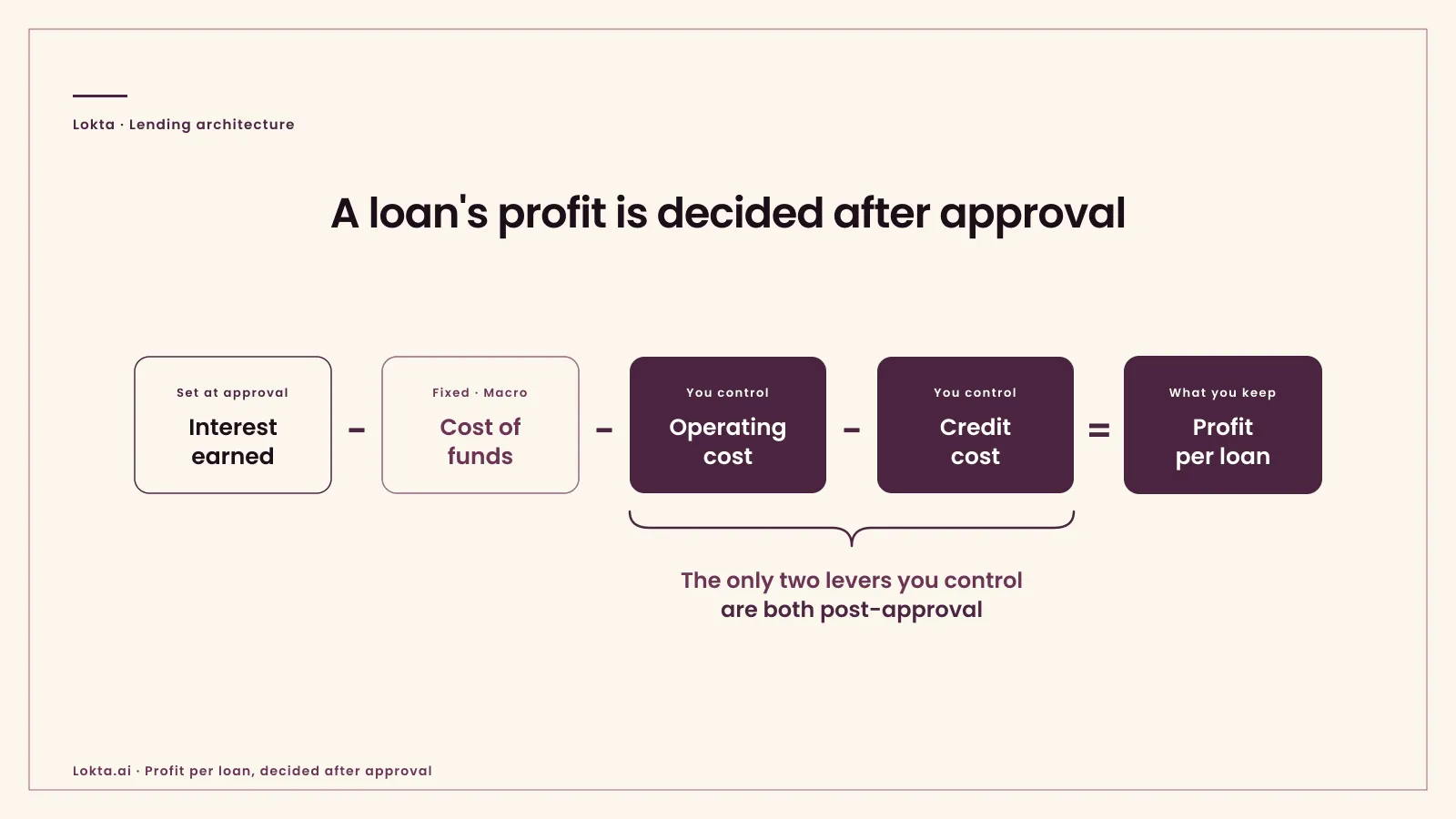
Here is the whole business in one line of arithmetic.
Now look at what you can move.
Yield is set at approval and capped by competition and the regulator: you do not reprice a live loan because you feel like it. Cost of funds is set by your treasury, your rating, and the rate cycle. Two of the four levers are macro, not management.
Operating cost is how efficiently you service the book. Credit cost is how well you monitor, intervene, and collect. Neither is a front-door decision. Each is the accumulated result of a thousand decisions made after the yes.
And they are not small. Across Indian NBFCs last year, net interest margin held near 6.7% and cost-to-income barely moved, while credit cost jumped from 1.3% to 1.7% of assets. The line you control after approval is the one that swings a book from profit to loss while yield sits still. In microfinance, it moved far enough in a single year to erase the segment’s returns.
Even the system’s clean headlines hide a post-approval story. Bank gross NPAs sit near a multi-decade low, held there by writing nearly a third of bad loans off the book after approval. It looks pristine because losses are recognised late, not because every approval was right.
Even underwriting’s prize lives downstream
Say the yes is all you care about. You still have to build for what comes after it.
Underwriting is not unimportant. It is overrated: the prize it chases is decided after it, in the running of the loan.
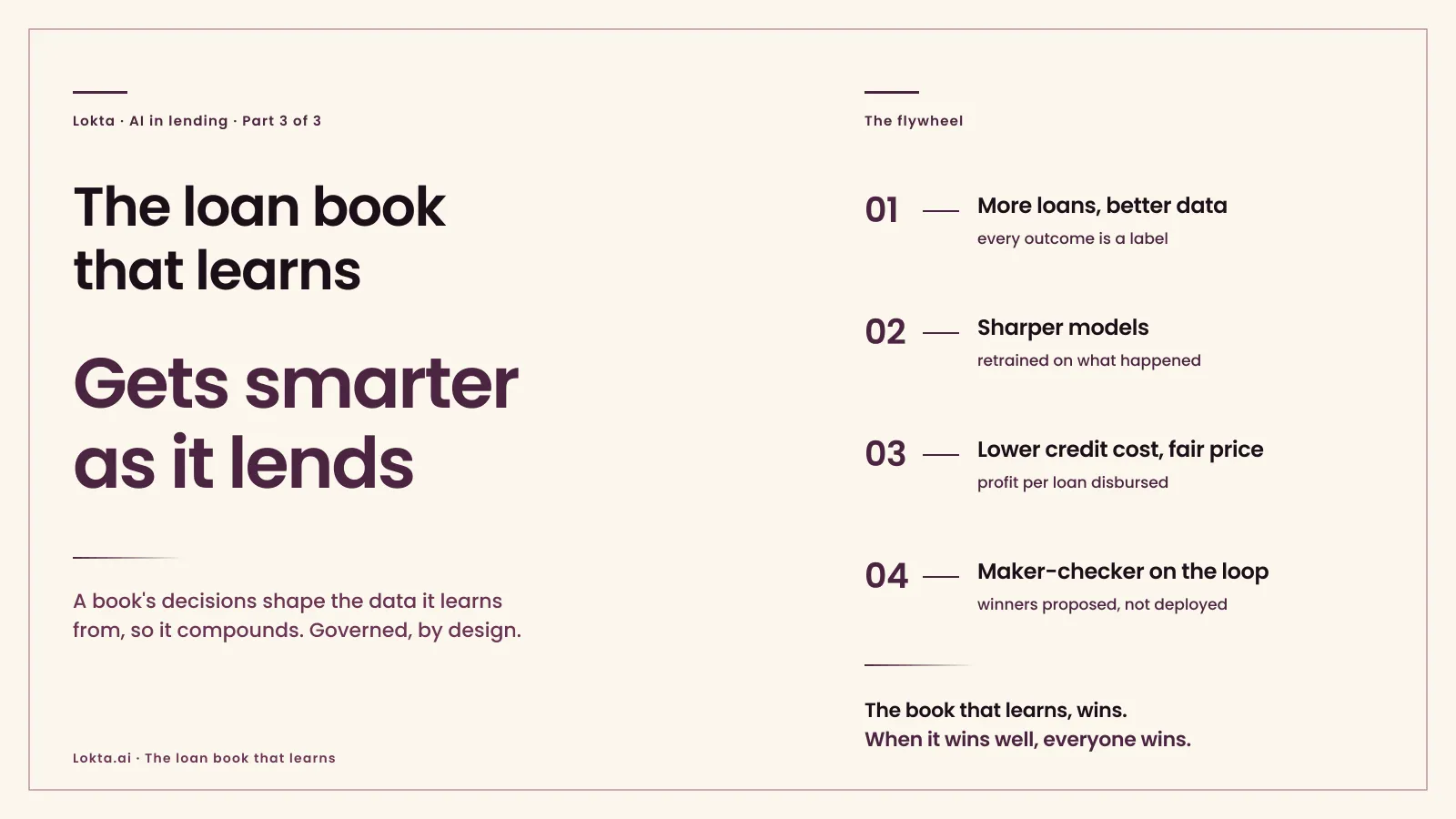
Your credit model is a guess until the book pays you back. It only gets smarter through a feedback loop that runs entirely on post-approval outcomes: which loans cured, which rolled, which vintage drifted. Vintage analysis, drift detection, reject inference: every technique that sharpens the decision learns from loans you have already booked. A book that sharpens itself the more it lends is a post-approval loop by definition. Underwrite blind to what happens next, and your model quietly goes stale.
The road to a better yes runs through everything after it.
What the lender of the future competes on
Underwriting is converging. Everyone pulls the same bureaus, buys the same alt-data, runs the same class of model. Commoditised things stop being where you win.
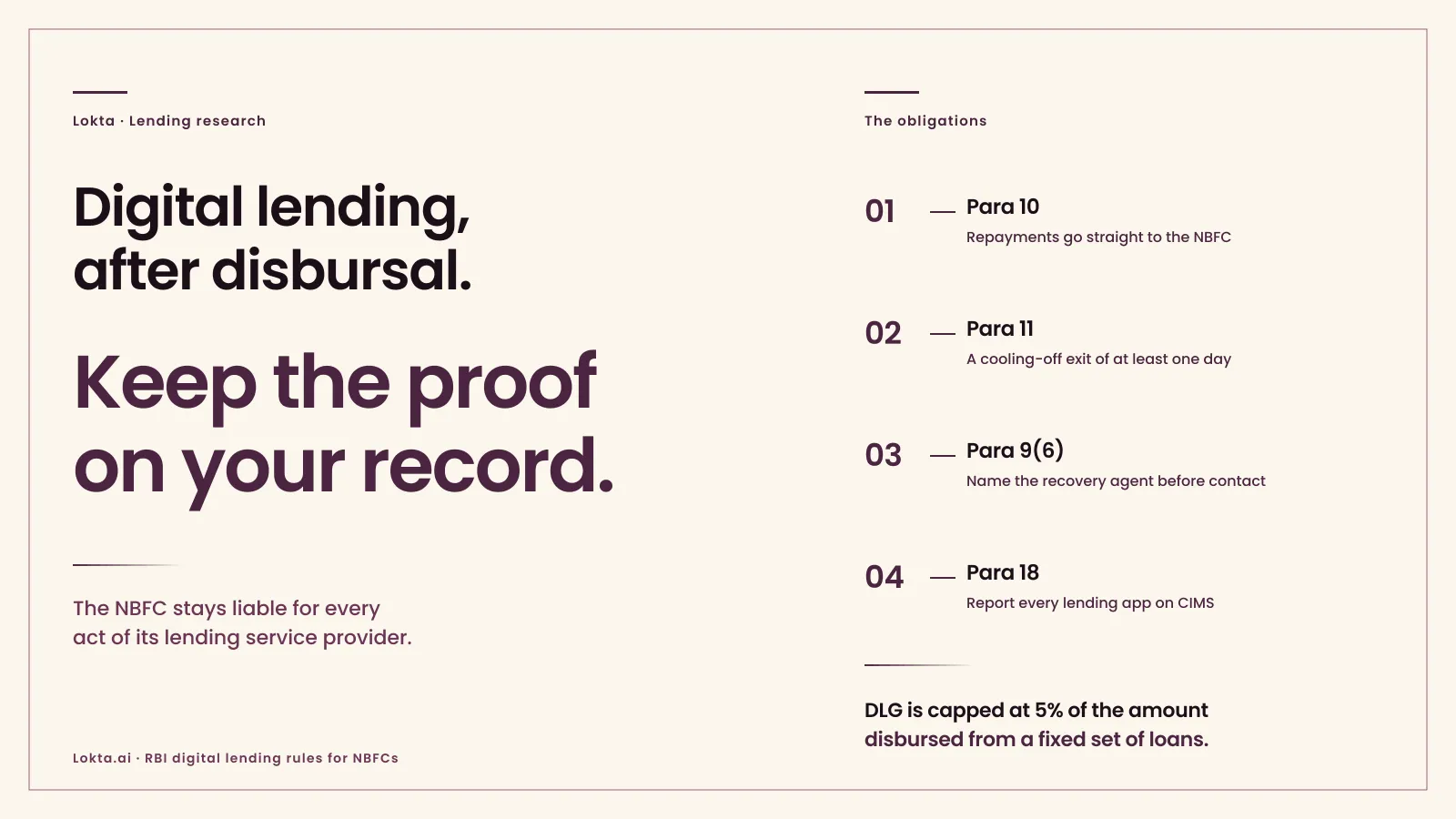
What does not converge is operating a book: servicing it for less, catching trouble at day five instead of day ninety, collecting more with fewer people, and staying inside the lines while you do it. In India that last part is not optional: the RBI’s Digital Lending Directions define a provider’s job as “servicing, monitoring, and recovery,” and regulate collections down to the hours you may call. For NBFCs those rules now sit in the Credit Facilities Directions, with the obligations after disbursal set out paragraph by paragraph. Post-approval is now a compliance surface, not just a cost centre.
The lender that wins the next decade will not out-underwrite the market by a wide margin, because nobody will. It will out-operate it.
| Where a lender competes | The lender that plays origination | The lender that plays post-approval |
|---|---|---|
| Primary edge | A sharper credit decision, using the same bureaus, alt-data, and models as everyone else. | A book operated at lower cost of service and lower cost of credit than the field. |
| Durability of the edge | Erodes as decisioning commoditises; hard to defend for long. | Compounds: every serviced loan sharpens the next decision and the next collection. |
| Regulatory posture in India | Owns the credit decision; hands servicing, monitoring, and recovery downstream. | Owns the surface the RBI now regulates: conduct, monitoring, recovery, audit trail. |
| The metric it chases | Approval rate and time-to-yes. | Profit per loan: how much of each one you keep. |
The objection worth taking seriously
“Garbage in, garbage out: you cannot collect your way out of a bad book.” True. Origination sets the ceiling, and India’s microfinance stress this past year (over-lending, not bad servicing) is the proof.
But the ceiling is not the outcome. Origination decides the best you could do; post-approval decides how much of it you actually capture, and most lenders leave a lot of it on the floor. And even that failure was only visible after the fact: in vintages going bad, roll rates climbing, loans written off. Bank NPAs sit near a multi-decade low, held there by writing nearly a third of bad loans off the book after approval. It looks clean because losses get recognised late, not because every yes was right.
We will concede the clean exception too. In secured, prime, low-delinquency lending (a loan against a house, against gold), the collateral is the recovery, and the decision really does dominate. This is a claim about unsecured, high-velocity, digital lending: the lending that is actually growing, and the lending that actually bleeds after approval.
What this means for how we build
The strongest argument against us is still a post-approval story. It is just a painful one. In the unsecured, high-velocity lending that is actually growing, the ceiling is high and the whole game is how much of it you keep.
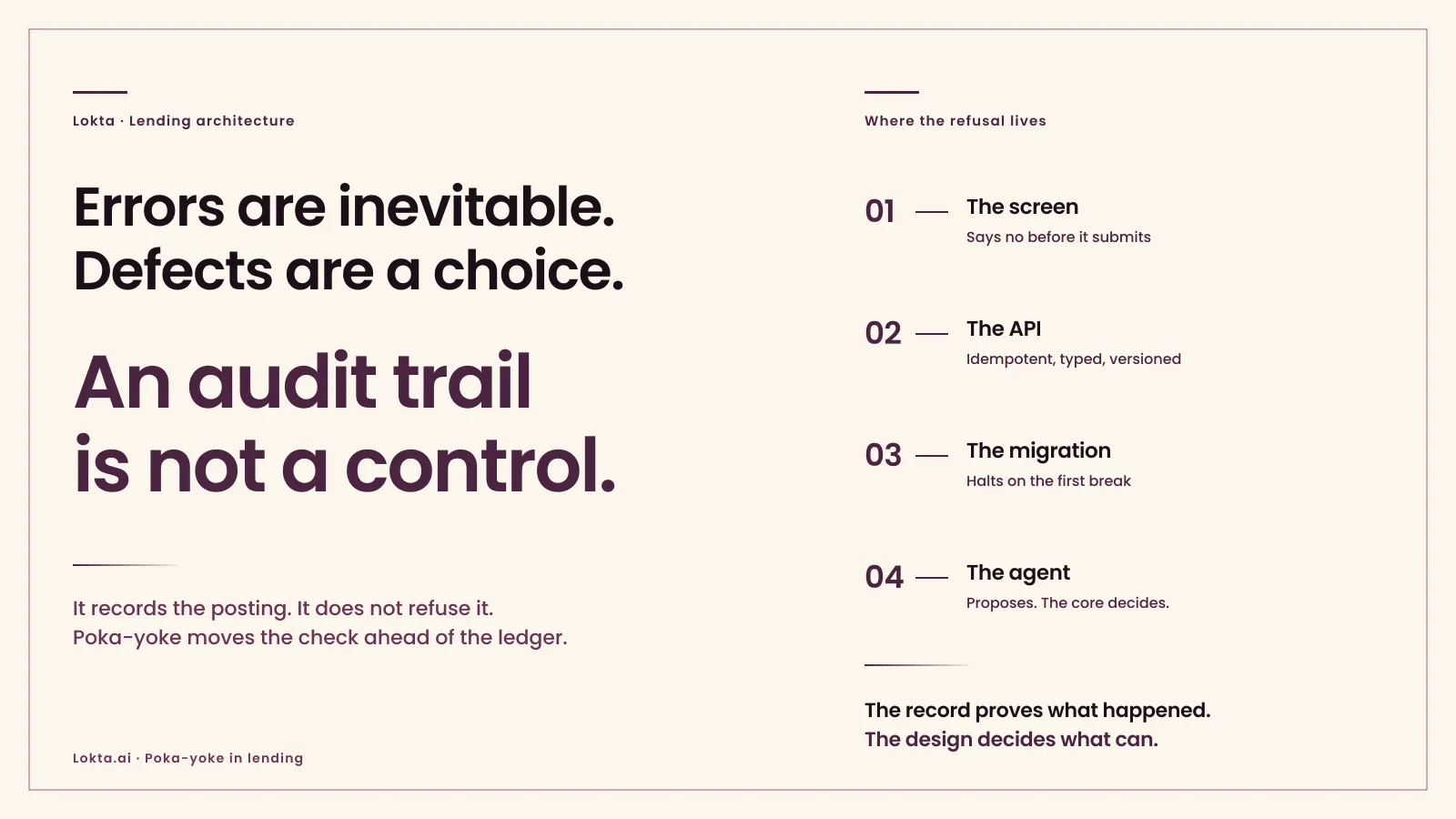
That is the game we are built for: the software that runs a book after approval, on a deterministic core that records the proof of every action, so a lender can service, monitor, and collect at lower cost without giving up the audit trail. Not because post-approval is the unglamorous work nobody else wanted, though it is. Because it is where the profit in every loan is actually decided.
We are founder-led. We work with the people who will run the book, not with procurement: lenders who want to build this with us rather than buy it past us. If that is the book you want to build, start a conversation.
Frequently asked questions
Why does loan servicing matter more than the credit decision?
The credit decision is a single bet placed on incomplete information; the return on it is earned over the next 12 to 36 months of servicing and collections. Two of the four levers in a loan's profit (operating cost and credit cost) are fixed the moment you approve and can only be moved afterward, loan by loan. Yield and cost of funds are set at approval and capped by competition and the regulator. So the decision sets the ceiling, but post-approval management decides how much of it a lender actually keeps. That is why servicing, not underwriting, is where a book's economics are won or lost.
What is the difference between an LOS and an LMS, and why does it matter?
An LOS, or loan origination system, handles the application, the credit decision, the approval, and the disbursal. An LMS, or loan management system, handles everything after: servicing, repayments, monitoring, and collections. The industry treats the LOS as the intelligent, competitive layer and the LMS as a passive record-keeper. We think that split is drawn in the wrong place. The line should sit between the one-time decision and the continuous relationship that follows it, because nearly everything that determines whether a loan makes money lives on the servicing side, not the origination side.
Can better loan servicing make up for weak underwriting?
Not entirely: you cannot collect your way out of a book of borrowers who were never going to repay. Origination sets the ceiling on how well a loan can perform. But the ceiling is not the outcome. Post-approval management decides how much of that ceiling a lender captures, and most lenders leave a large gap on the floor: delinquencies caught late, mandates not retried, recoveries pursued after the economics have collapsed. Even a pure origination failure only becomes visible through post-approval data: vintages going bad, roll rates climbing, loans written off. Underwriting and servicing are not rivals; servicing is where underwriting's promise is kept or lost.
Why is post-approval loan management a regulatory priority in India?
Because the RBI has put its attention there. The Digital Lending Directions define a service provider's job as servicing, monitoring, and recovery; default loss guarantees are capped and time-boxed on portfolio performance; and recovery conduct is regulated down to the hours a lender may call and the agents it may use. In India, post-approval is no longer only a cost centre. It is a compliance and reputation surface where a lender can be penalised or shut down. Building for that surface, with audit-ready records of every action, is now table stakes, not a nice-to-have.
Read next:
- The loan book that learns: how a book gets smarter the more it lends, and why the learning loop runs entirely on post-approval outcomes.
- How to use AI agents in loan servicing: what agentic servicing looks like in practice, workflow by workflow, under governance.
- The bullet train problem: legacy LMS vs. AI lending: why the system that runs the loan, not the one that approves it, decides whether a lender can ship AI at all.
- RBI’s proposed revolving-credit restriction: what a term-loans-only draft would change about how NBFCs design, book and service credit.
- Payment appropriation is a configuration science: one product can order its appropriation more than ten million ways, and the order it picks lands on RoA.
Sources:
- Financial Stability Report, June 2025 (Reserve Bank of India): bank gross NPAs, the write-off-to-GNPA ratio, and microfinance asset quality.
- NBFC Sector Update, FY25 (BCG): net interest margin, cost-to-income, and credit cost as a share of assets.
- Reserve Bank of India (Digital Lending) Directions, 2025: provider functions of servicing, monitoring, and recovery; the default loss guarantee; recovery-agent conduct.
Chandramouli is co-founder of Lokta. He is building the software that runs a loan book after approval, the part where the profit in every loan is actually decided, and is on LinkedIn for lenders who want to build it with us.