RBI's proposed revolving-credit restriction: what it means for NBFC lenders
The draft goes beyond reusable credit limits. It could change how NBFCs design, book and service consumer and business credit across the live book.
Contents 13 sections
Status on September 25, 2026: still a draft. Comments closed on August 28 and RBI has not yet issued final directions, so no revolving-credit restriction is in force today.
RBI has proposed a term-loan-only rule for covered NBFC fund-based credit.
On August 6, 2026, the Reserve Bank released the draft Non-Banking Financial Companies - Credit Facilities Amendment Directions, 2026. The operative text fits on two pages: NBFCs shall only offer credit products which are in the nature of term loans, and shall not offer revolving credit products. The one exception is an NBFC that RBI has authorised to issue credit cards.
That exception turns on a licence, not on a product design. It is available to an NBFC that RBI has already authorised to issue credit cards, and to no one else. A lender that does not hold that authorisation has no exception to plan around, and redesigning a product will not create one.
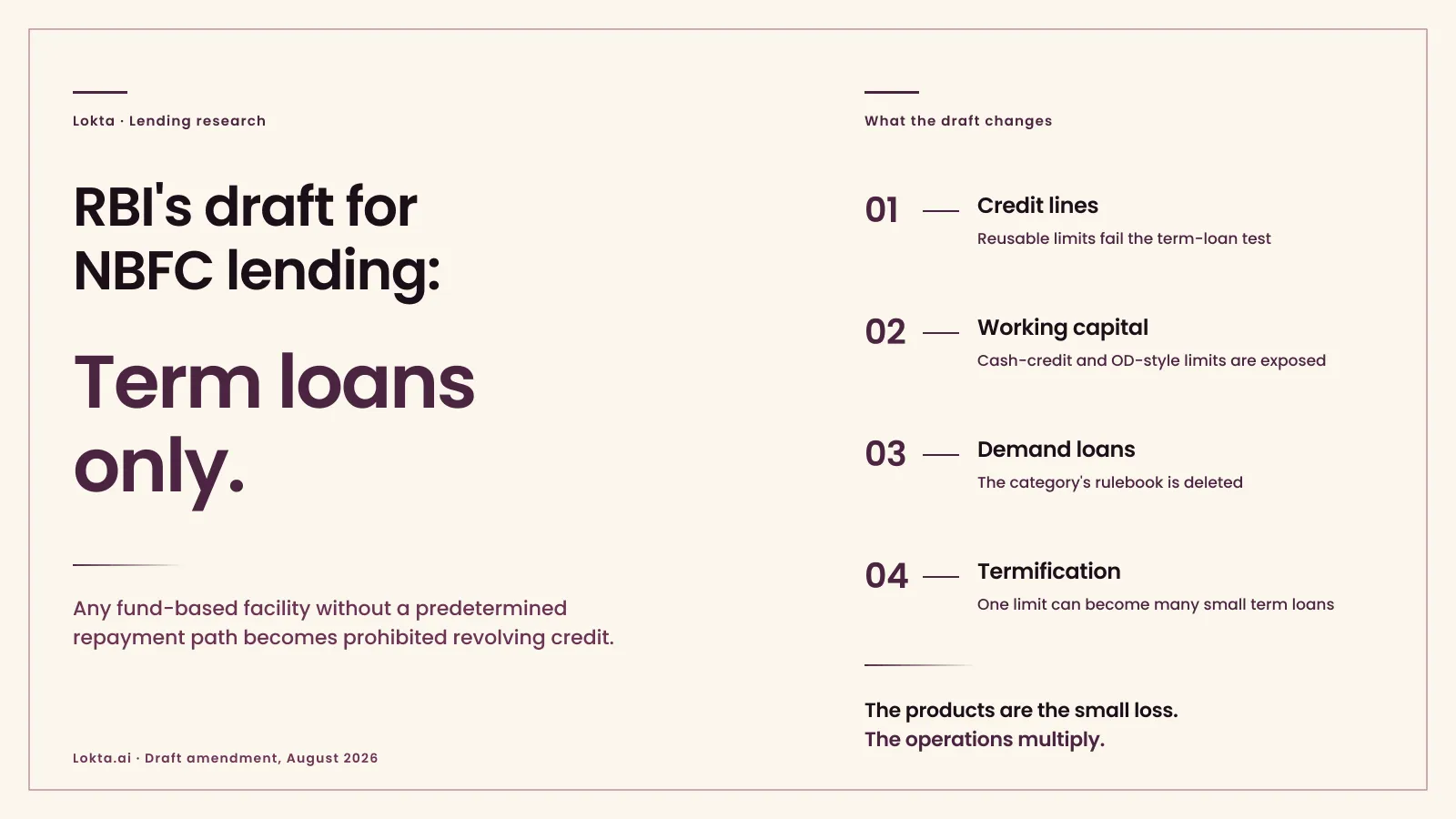
Most lenders will read that as a ban on reusable credit limits. I think that reading is too narrow. Read closely, the draft says something bigger: every covered fund-based credit facility offered by an NBFC would need to sit inside a closed-end term structure with a contractually defined repayment path. That touches far more of the book than the products with “line” in their name.
- The test has two limbs, and a product must pass both. A fixed principal repaid on a predetermined schedule, and a sanctioned limit that stays down when principal is repaid.
- This is more than a redraw ban. A loan repayable on demand, or repaid from future cash flows with no fixed schedule, fails the test even if it can never be redrawn.
- Demand and call loans disappear as a category. The draft deletes the rules that governed them, from the board policy list and from the directions themselves.
- There is no grandfathering in the draft. The amendments “come into force immediately” on final issuance, with no transition period written in.
- The real cost is operational. For repeat-draw products, one reusable limit may need to become a stream of small term exposures, each with its own schedule, records and closure. I call this the termification of the book.
- The comment window closed on August 28, 2026. One question decides more of this than any other, and it belongs at the top of every feedback letter: at what level does the term-loan test apply, product, sanction, facility or individual draw? The open questions and the six actions are below.
What did RBI actually propose?
Two definitions and one restriction. That is the whole draft.
It amends the NBFC Credit Facilities Directions, 2025, which cover deposit-taking NBFCs, investment and credit companies, factors, microfinance NBFCs, infrastructure finance companies, infrastructure debt funds and housing finance companies. Into those directions it inserts a definition of a term loan, defines revolving credit as anything fund-based that is not one, and adds new paragraph 108A: term loans only, no revolving credit, credit-card issuers excepted.
A fixed principal, disbursed in one or more instalments, repayable on a predetermined amortisation schedule. Periodic instalments or a bullet on stated due dates both qualify. “Repayable on demand” does not.
Once disbursed, the sanctioned limit cannot be restored when principal is repaid, in whole or in part. Repayment reduces the outstanding but never restores availability under the sanctioned limit.
Take a ₹10 lakh facility. The borrower draws ₹4 lakh and later repays ₹2 lakh. If the available limit climbs back from ₹6 lakh to ₹8 lakh, the facility is revolving. That part is obvious.
The less obvious part: a ₹10 lakh loan that can never be redrawn may still fail. If it is repayable on demand, or repayment depends entirely on future cash flows, there is no predetermined schedule. Limb one fails, and the facility is revolving credit by definition. Switching off redraws is not, by itself, compliance.
The proposal is still a draft. Comments closed on August 28, 2026, and the final wording, transition treatment and product-level clarifications can change. The core direction is clear, even though the implementation perimeter is not.
01 · Consumer credit lines: does every draw become a loan?
Flexi personal loans, app-based credit lines, reusable BNPL limits. These are the products everyone will name first, and they are the most exposed. If repayment makes the limit available again, the product fails limb two.
A one-time BNPL loan with a fixed schedule can still qualify. A reusable BNPL limit is much harder to save. One possible redesign: the customer keeps a pre-approved eligibility, and each draw or tranche sits within a compliant fixed-principal, non-replenishing term facility with a predetermined repayment path. Depending on the final clarification and other applicable regulations, this may require separate sanctions, disclosures, schedules and loan-level records. Renaming the same replenishing limit as “a series of term loans” without that draw-level substance would be circumvention, and the residual definition is built to catch exactly that.
One more perimeter point. The exception covers NBFCs authorised by RBI to issue credit cards. Distributing, co-branding or servicing someone else’s card does not qualify. The exemption follows the issuer and the authorisation, not the brand on the plastic.
02 · MSME working capital: what replaces the reusable limit?
Cash-credit-style limits, overdraft-style facilities, reusable working-capital lines. Directly exposed, and this is where the draft will reach real borrowers first: small businesses that use credit episodically to manage inventory, receivables and seasonal gaps.
A possible redesign is a sequence of short-tenor term loans, or draw-level loans written under a master eligibility, each with a fixed principal and its own end date. Some of this demand may migrate to banks, where cash credit and overdraft remain ordinary products.
03 · Demand and call loans: why did the whole category disappear?
The draft does not just fail these products against a definition. It deletes their rulebook. Demand and call loans come out of the board-approved credit policy list, and the part of the directions that governed them is removed entirely. When a regulator deletes a category’s rules rather than tightening them, it is not expecting the category to continue.
This lands on books far from any consumer app:
- Loans against securities documented as repayable on demand
- Promoter and inter-corporate funding without a fixed maturity
- Capital-market bridge facilities
- Bullet loans without clearly stated due dates
Not everything here dies. A fixed-principal, non-replenishing loan with a stated maturity still qualifies as a term loan. But the paper has to say so, and the systems have to behave that way. Where capital-market facilities are documented as repayable on demand, they may need to be converted to fixed-maturity structures.
04 · Dealer and supply-chain finance: does a master limit survive?
A master facility under which invoices or dealer purchases are financed again and again, with repayment restoring availability, is revolving on its face.
The redesign candidate is to keep the master sanction as an eligibility ceiling and book each invoice or dealer draw as a separate, non-replenishing term exposure. Whether that works depends on a question the draft does not answer: at what level does the test apply. Product, sanction, facility or individual draw. That single clarification decides the future of dealer finance, invoice finance and supply-chain finance at NBFCs, and it is the first thing to check when the final directions arrive.
05 · Revenue-linked finance and factoring: where is the line?
A revenue-linked facility whose repayment timing or amount depends entirely on future sales, without a predetermined amortisation schedule, would fail limb one even if nothing can be redrawn. Some revenue-linked products may already include minimum instalments, fixed dates or an outer bullet maturity. An expected tenor, though, is not a schedule. Products without contractual repayment dates would need them to survive, and that changes their economics.
Factoring is the genuinely hard case. NBFC-Factors are squarely within the directions, but the Factoring Regulation Act, 2011 treats factoring as the acquisition of receivables by assignment. A genuine purchase of receivables is arguably not a loan to a borrower at all. The same Act also recognises financing through loans or advances against receivables. So the final directions will need to distinguish outright purchase, recourse factoring, loans secured by receivables, and reusable factoring limits. A blanket answer in either direction would be wrong, and I expect the industry to ask for exactly this distinction.
Which products are less likely to be affected?
Ordinary closed-end lending passes, provided the documents and the systems match the definition. That proviso is doing more work than it appears to.
| Product | Why it can pass | What to check |
|---|---|---|
| Fixed-EMI personal, vehicle and equipment loans | Fixed principal, predetermined instalments. | Prepayment closes exposure. Nothing restores a limit. |
| Housing and loan-against-property term loans | Same closed-end shape. | Top-ups sanctioned as fresh loans, not redraws under the old limit. |
| Microfinance and consumer-durable loans | Predetermined instalments. | Renewals documented as new sanctions, not rollovers. |
| Gold loans with a stated bullet date | A bullet on stated due dates is expressly allowed. | The due date is stated in the contract, not “on demand”. |
| Project and construction finance | Disbursal in instalments is expressly allowed. | Total principal fixed. Repaid amounts cannot be redrawn. |
| Guarantees and letters of credit | The revolving-credit definition covers fund-based facilities only. | Devolved amounts get a fixed repayment path. Worth seeking express clarification. |
Why is RBI doing this?
The draft gives no statement of reasons. What follows is my reading of the design, not RBI’s words.
A predetermined schedule makes the obligation, the maturity and the repayment burden explicit from day one. Nothing in the book runs open-ended.
A borrower can cycle a limit for years without the exposure reaching a contractual end. Persistent indebtedness becomes hard to tell apart from short-term liquidity use.
Flexi, pay-later, drawdown, merchant limit. RBI did not list prohibited products. Anything fund-based that fails the term-loan test is revolving credit. Behaviour decides, not the label.
Banks got pre-sanctioned credit lines on UPI. NBFC card issuance needs specific approval. Revolving credit keeps being routed through specifically authorised, supervised channels.
In November 2023, RBI raised risk weights on consumer credit by 25 percentage points, citing strong growth and potential stress. This draft continues that supervisory line.
A predetermined schedule produces contractual cash flows. Reusable commitments create uncertain utilisation and uncertain liquidity needs. For an NBFC that borrows wholesale, that difference is balance-sheet real.
Taken together, my reading is that RBI wants covered NBFC fund-based credit to have a fixed principal and a defined repayment path, while reusable credit remains with banks or specifically authorised card issuers.
What still needs RBI clarification?
The core direction is clear. Several implementation questions are not, and they belong in every feedback letter:
- Existing facilities: must outstanding revolving and demand facilities be re-papered, run off or closed, and how are undrawn commitments treated?
- Level of application: does the term-loan test apply at product, sanction, facility or individual-draw level? The dealer and supply-chain redesign above turns on this answer.
- Base-Layer NBFCs: the 2025 Directions apply only conduct-related provisions to a Base-Layer NBFC with customer interface and no public funds. Is the new restriction conduct or prudential?
- Core Investment Companies: the draft deletes paragraph 107, but the CIC applicability provision still refers to paragraphs 105-107. The cross-reference needs correction or clarification.
- Partial Credit Enhancement: the existing directions describe PCE as an irrevocable contingent line of credit and permit partial drawings. RBI should confirm whether this specialised facility sits outside the intended restriction.
- Drafting alignment: paragraph 108A says credit products “in nature of term loans”, while the draft separately defines “term loan”. Lenders need to know whether every definitional element must be met exactly.
Factoring and the treatment of the existing book are open questions of the same weight; they are covered in the sections above.
What should lenders do now?
My base case: the core term-loan-only restriction survives. Industry is likely to seek transition treatment and targeted clarification for working-capital, dealer, factoring and contingent-credit structures. Whether RBI grants exemptions, permits draw-level term structures or only provides implementation time is uncertain. Consumer-facing credit lines remain the least likely to be spared: the draft already names its only exception, and it is not them.
None of that is a reason to wait. Six actions, in order:
- Inventory every fund-based credit product and every active facility.
- Test each one against both limbs: predetermined schedule, no replenishment.
- Quantify outstanding balances, undrawn limits and the borrowers affected.
- Identify which products can be rebuilt as compliant fixed-principal term structures.
- Map the contract, system, bureau-reporting and servicing changes each rebuild demands.
- Keep the product flows and borrower-impact evidence on file, with the open questions above, so each product can be re-tested the day the final directions arrive.
Two cautions alongside. Do not assume the outstanding book is grandfathered: the draft has no such provision. And do not re-paper borrower contracts yet: changing customer rights before the final directions clarify transition treatment creates its own risk.
Termification: what does this draft do to loan-book operations?
The real cost of this draft is not the products it kills. It is the operational multiplication of the book that survives.
For most lenders, the product label is the small loss. The bigger change happens at the account level. For repeat-draw products, one reusable facility may need to become multiple term exposures or draw-level repayment schedules, and the lender’s total credit exposure can stay exactly the same while the number of loan objects it must create, service, monitor and close multiplies.
- Fragmented execution is the failure mode. The sanction sits in one system, the draw in another, repayment allocation in the LMS, bureau reporting in a batch job, and borrower communication in a separate workflow.
- Each gap can become an exception. A draw booked without its Key Facts Statement, a closure that never reached the bureau, a schedule regenerated without an audit trail: every one is a servicing, reporting or compliance exception waiting to be found.
- Workload follows loan count. Operational load is likely to grow with the number of loan objects, schedules, borrower communications and closures, not only with the outstanding book. Unless the operating layer is built for it, headcount follows.
Termification cannot be handled by adding a field called “term loan”. It needs consistent control across product configuration, draw booking, schedule generation, repayment allocation, reporting, collections and closure. Exceptions need named owners. Every material action needs a record that can be reconstructed later.
This is the problem we are building Lokta for: a governed operating layer for the live loan book. Deterministic account logic does the arithmetic. Bounded automation runs the volume. Humans own the exceptions. And every action leaves evidence a supervisor can inspect.
So “do we offer revolving credit?” is the easy question. The harder one: if repeat-draw products must be restructured into compliant term exposures, can your operating stack create, service, monitor and close those exposures reliably, at scale? That is the real preparation, and it starts well before the final directions arrive.
The takeaway
RBI is proposing that covered NBFC fund-based credit be observable as discrete loans: fixed amount, dated path, closed at the end. Respond to the consultation, and fight for the carve-outs that matter to your book. But put as much preparation into the operating model as into the product list. The lenders who treat this as a product ban will cut products. The lenders who treat it as an operating-model change will be ready either way. My 2 cents: the draft asks one thing of every rupee of covered NBFC lending. Carry a date, and come back on it.
Frequently asked questions
Has RBI banned revolving credit for NBFCs?
Not yet. On August 6, 2026 RBI released a draft amendment that would limit NBFCs to term loans and bar revolving credit, except for NBFCs it has authorised to issue credit cards. Comments closed on August 28, 2026. As of September 25, 2026 RBI has not issued final directions, and the NBFC Credit Facilities Directions in force carry no revolving-credit restriction.
What does RBI's draft amendment actually prohibit for NBFCs?
The draft, released on August 6, 2026, proposes that NBFCs may only offer credit products in the nature of term loans, and may not offer revolving credit, unless the NBFC is authorised by RBI to issue credit cards. A term loan needs a fixed principal, a predetermined repayment schedule (instalments or a bullet on stated due dates), and a sanctioned limit that stays down once principal is repaid. Any fund-based facility that fails either condition counts as revolving credit. Comments closed on August 28, 2026, and the final wording can change.
Are BNPL and app-based credit lines banned for NBFCs under the draft?
Reusable versions are the most exposed products. A BNPL limit or app-based credit line that becomes available again after repayment fails the term-loan test and would be prohibited. A one-time BNPL loan with a fixed principal and schedule can still qualify. One possible redesign is that each draw sits within its own fixed-principal, non-replenishing term structure, which may require separate sanctions, disclosures, schedules and loan-level records depending on the final rules.
Will existing revolving facilities be grandfathered when the directions are finalised?
The draft contains no transition or grandfathering provision. It states that the amendments come into force immediately, meaning immediately upon the final directions being issued, not today. Lenders should not assume the existing book is protected. Industry is likely to request a transition period and explicit treatment of outstanding facilities and undrawn commitments; whether RBI grants one is uncertain. Until then, quantify exposure now and avoid writing long-duration revolving commitments that depend on the draft not being finalised.
What should NBFC lenders do before the final directions are issued?
Six things, and none of them require waiting. Inventory every fund-based product and active facility. Test each one against both limbs of the term-loan definition: a predetermined schedule, and no limit replenishment. Quantify outstanding balances, undrawn limits and affected borrowers. Identify products that can be rebuilt as compliant fixed-principal term structures. Map the contract, system, bureau-reporting and servicing changes required. And keep the product flows and borrower-impact evidence on file, so each product can be re-tested the day the final directions arrive.
Read next:
- RBI just redefined what counts as a “model”: the last time RBI moved a definition and an entire compliance perimeter moved with it.
- Loan Against Property lenders in India: the five challenges that start after disbursal: what the decade after disbursal already looks like on a secured book.
- A loan’s profit is decided after approval, not at underwriting: why servicing capacity, not origination volume, decides the margin.
Sources:
- RBI press release inviting comments on the draft Amendment Directions: Press Release 2026-2027/825, August 6, 2026. Comment window and submission channels.
- Draft Reserve Bank of India (Non-Banking Financial Companies - Credit Facilities) Amendment Directions, 2026: the operative text, including the term-loan and revolving-credit definitions, the deletions, and paragraph 108A.
- Reserve Bank of India (Non-Banking Financial Companies - Credit Facilities) Directions, 2025: the underlying directions being amended, including applicability and the demand/call-loan provisions the draft deletes.
- Operation of Pre-Sanctioned Credit Lines at Banks through UPI: RBI/2023-24/58, September 4, 2023.
- Regulatory measures towards consumer credit and bank credit to NBFCs: RBI/2023-24/85, November 16, 2023. The 25-percentage-point risk-weight increase on consumer credit.
- The Factoring Regulation Act, 2011: the statutory definition of factoring as acquisition of receivables by assignment.
This article is an analysis of draft regulatory directions and does not constitute legal or regulatory advice.
Chandramouli is a co-founder of Lokta, the agentic loan servicing platform for the live book. He has spent over two decades in technology, go-to-market, and consulting, the last several years building machine learning and GenAI, and has served as an independent director on an NBFC board.