RBI returns for NBFCs on CIMS: which ones you file, when, and which numbers come from the loan book
Which RBI returns an NBFC files on CIMS by layer, the due dates, the data-quality rules behind them since July 2026, and which figures start in the loan book.
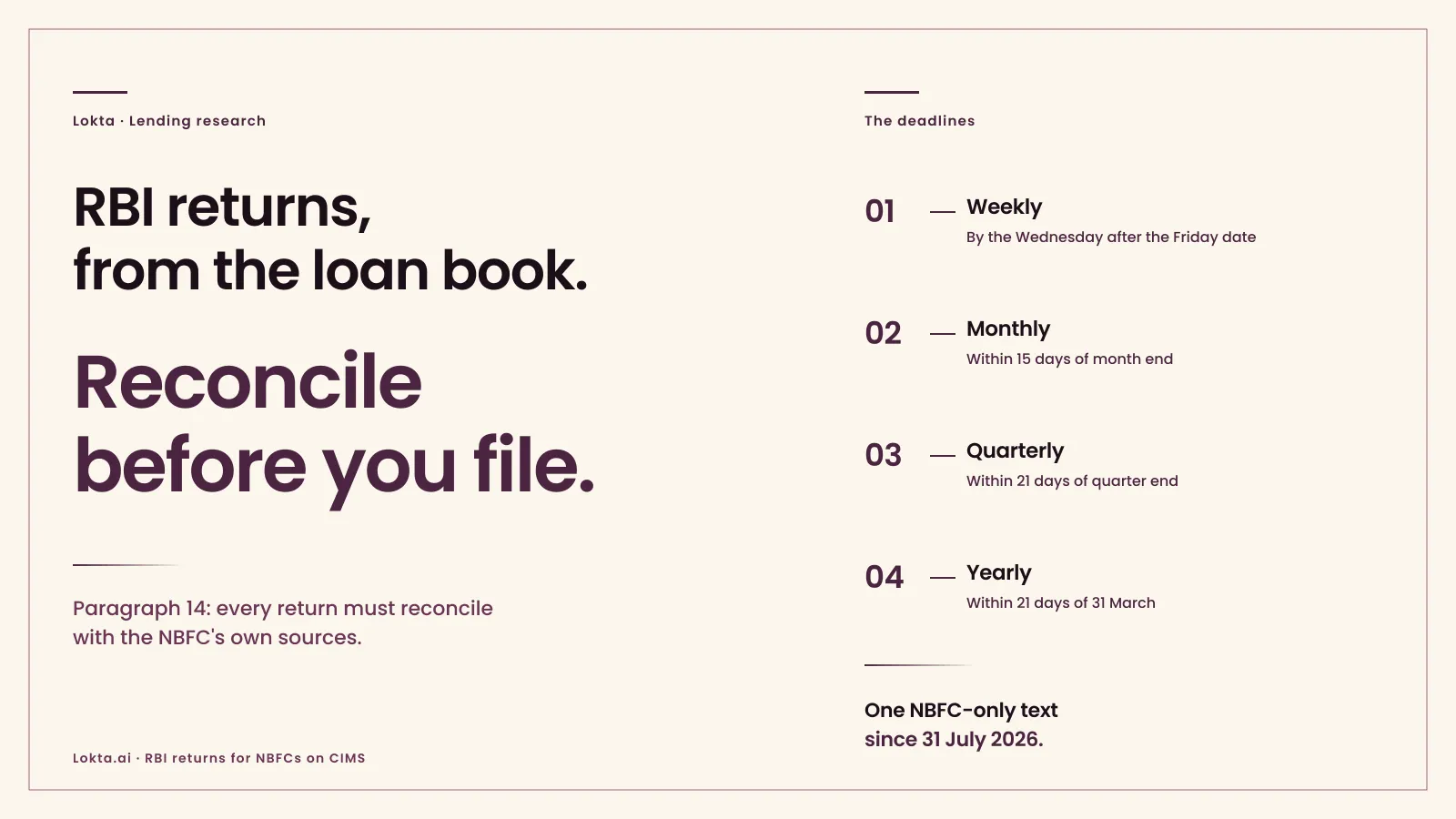
NBFCs file RBI returns on CIMS, RBI’s online filing platform. Since 31 July 2026 the list of returns, their due dates and the data-quality rules sit in the NBFC Supervisory Returns Directions, 2026, which replaced RBI’s 2024 returns Directions for NBFCs. Which returns apply depends on the NBFC’s layer and size. Monthly returns are due within 15 days and quarterly returns within 21. Every return has to reconcile with the NBFC’s own sources.
If you prepare RBI returns at an NBFC, the credit figures you file started as events on a loan: a disbursal, a receipt, a day past due, a classification. Filing on the portal is the last step. Before it, each figure has to be built from the loan book in a way you can show a supervisor.
RBI has asked for that since 2024, and the 2026 text turns “should” into “shall”. Paragraph 14 of the Supervisory Returns Directions requires every return to reconcile with the NBFC’s own sources, and paragraph 15 requires a record of where each return’s data comes from and the rules that aggregate it. A return assembled by hand from a set of extracts can be filed on time and still leave those two paragraphs unanswered.
- An NBFC-only text since July 2026. The Supervisory Returns Directions replaced the 2024 returns Directions for NBFCs and made reconciliation a “shall”.
- Layer decides the list. Base Layer files DNBS02, Middle and Upper Layer file DNBS01 and DNBS03, and size thresholds add the rest.
- 15 days for monthly, 21 for quarterly. Weekly returns are due by the next Wednesday.
- Reconcile and keep the rules. Every return must reconcile with the NBFC’s own sources, and the aggregation rules must be on record.
- The credit figures start in the loan book. Classification, delinquency, provisions, maturities and large exposures all come from loan-level data.
What is CIMS?
RBI’s Centralised Information Management System, defined in the Supervisory Returns Directions as “an online platform of RBI for return submission, data dissemination, and other related purposes”. An NBFC receives a Super User credential and creates its own users with maker and checker roles. Return formats, guidance notes and validation rules sit on the reporting portals.
Filing is online. Paragraph 18 says a return sent in hard copy, or as a soft copy by email, is not deemed submitted unless that format is prescribed for it.
Where do the rules on NBFC returns sit now?
In the Reserve Bank of India (Non-Banking Financial Companies - Supervisory Returns) Directions, 2026, issued on 31 July 2026. A repeal circular issued the same day withdrew 628 circulars across the 64 Directions RBI’s Department of Supervision issued that day. The Directions apply to NBFCs in every layer except housing finance companies, which report to the National Housing Bank.
The list of returns is the table in paragraph 21, the due dates are in paragraphs 22 and 23, and the data-quality rules are in paragraphs 6 to 17.
Which returns does an NBFC file?
It depends on layer and size. From the table in paragraph 21:
| Return | Frequency | Who files | What RBI says it holds |
|---|---|---|---|
| DNBS01 Important Financial Parameters | Quarterly | Upper and Middle Layer, except core investment companies | Assets and liabilities, profit and loss, sectoral credit, asset classification, portfolio delinquency |
| DNBS02 Important Financial Parameters | Quarterly | Base Layer, except P2P platforms | Assets and liabilities, profit and loss, prudential norms |
| DNBS03 Important Prudential Parameters | Quarterly | Upper and Middle Layer, with exclusions | Prudential norms such as capital adequacy and provisioning |
| DNBS04A and DNBS04B liquidity returns | Quarterly and monthly | Upper and Middle Layer, and Base Layer with assets of ₹100 crore and above, with exclusions | Asset-liability mismatches, interest rate sensitivity, liquidity risk |
| CRILC | Monthly | Upper and Middle Layer except core investment companies, and Base Layer investment and credit companies, microfinance institutions and factors with assets of ₹500 crore and above, with exclusions | Borrowers with aggregate exposure of ₹5 crore and above, or a NIL return |
| DNBS09 Return on Defaulted Borrowers | Weekly | The same NBFCs as CRILC | Borrowers moving into and out of default, with PAN, date of default and amounts outstanding |
| DNBS10 Statutory Auditor Certificate | Yearly | All NBFCs | Based on audited books, filed by the statutory auditor |
| DNBS13 Overseas Investment Details | Quarterly | All NBFCs | Overseas investment, or a NIL return |
| Form A Certificate | Yearly | All NBFCs | Appointment of the statutory auditor |
| Fraud returns (FMR, FUA, FMR4) | As and when, and quarterly | Upper and Middle Layer, and Base Layer with assets of ₹500 crore and above | Frauds, and robberies and thefts |
The table also carries returns for core investment companies, P2P platforms, standalone primary dealers and a quarterly large exposures return for the Upper Layer. The layer thresholds come from RBI’s scale-based regulation: a non-deposit-taking NBFC with assets below ₹1,000 crore sits in the Base Layer, and deposit-takers and NBFCs at ₹1,000 crore and above sit in the Middle Layer or higher.
When are RBI returns due?
By frequency, under paragraph 22:
| Frequency | Reference date | Due |
|---|---|---|
| Weekly | Every Friday, or the working day before | By Wednesday of the following week |
| Monthly | Last day of the month | Within 15 days |
| Quarterly | Last day of the quarter | Within 21 days |
| Yearly | 31 March | Within 21 days |
Audited returns are due within five working days of the date the auditor’s report is signed. Paragraph 23 sets the exceptions. DNBS10 is due within five working days of the auditor’s report and no later than 31 December. Form A is due within a month of the auditor’s appointment. A fraud return is due within 14 days of classifying the fraud, an update to it immediately, and the quarterly FMR4 within 15 days.
Which figures start in the loan book?
The credit side. The returns ask for totals, but the totals are built from loan-level data:
- asset classification and portfolio delinquency in DNBS01 come from each account’s days past due and classification on the reference date
- provisioning in DNBS03 follows from that classification
- sectoral credit comes from the purpose or sector each loan was tagged with
- the maturity and interest rate sensitivity buckets in DNBS04A and DNBS04B draw on each loan’s scheduled cash flows and rate type
- CRILC needs each large borrower’s aggregate exposure and special mention account status, and DNBS09 needs the date each one defaulted
- for a Base Layer NBFC, the prudential norms reported in DNBS02 rest on the same classification and provisions
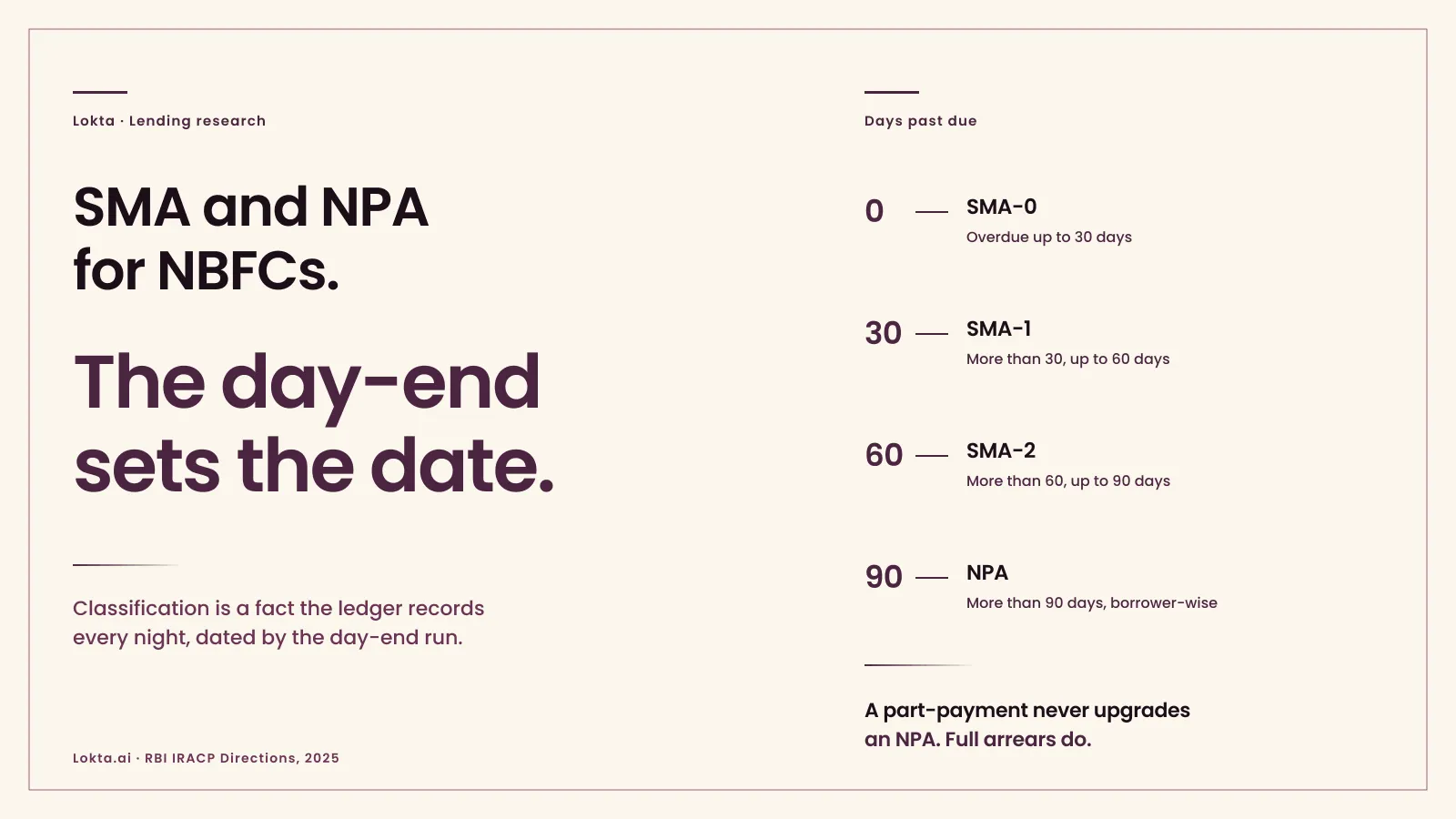
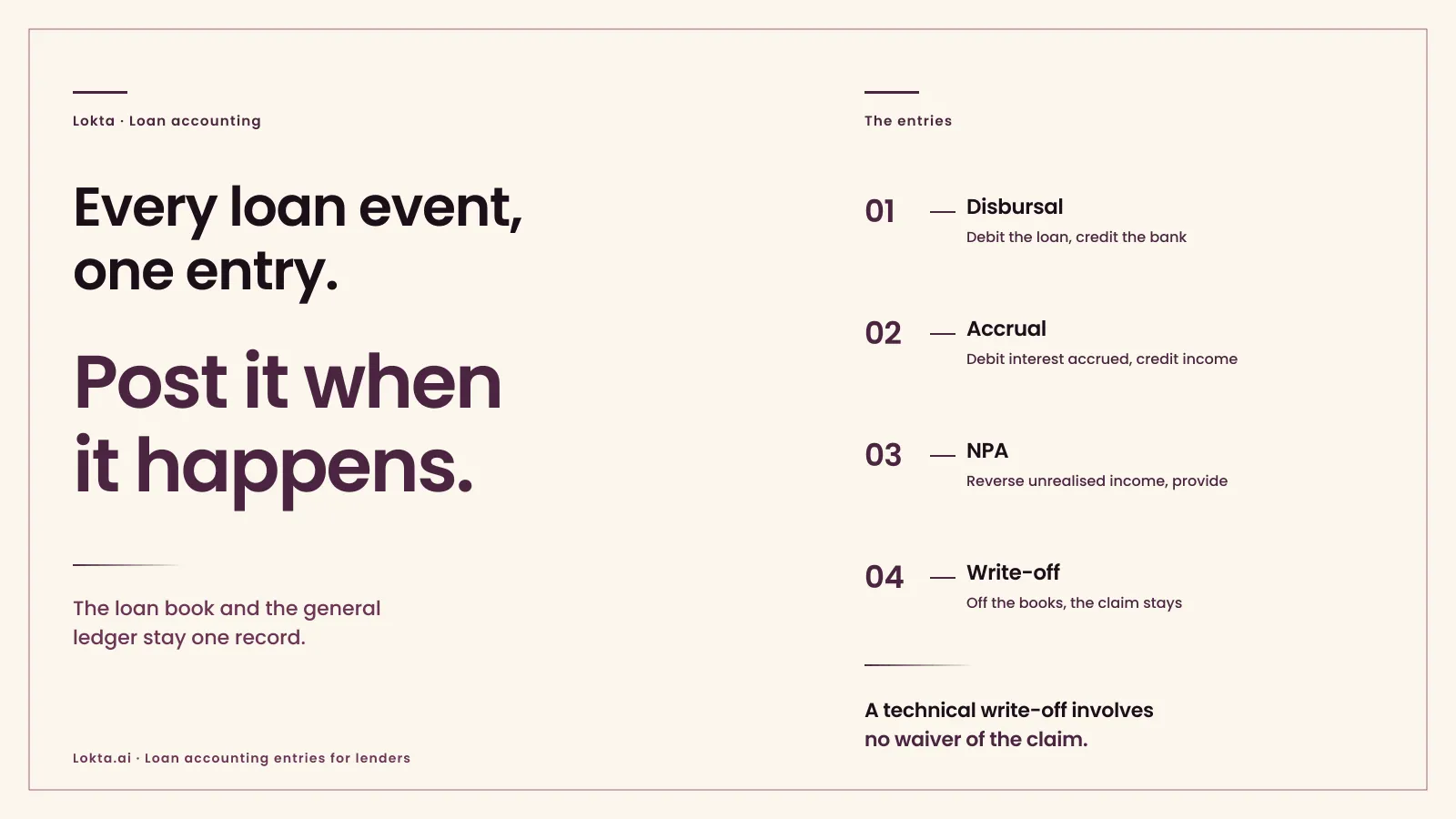
If the loan system cannot say what an account’s status was on the reference date, rather than today, each of these becomes a reconstruction. The SMA and NPA classification post sets out how the status is dated, and the loan accounting entries post covers the provisions it drives.
What does RBI expect of the data behind a return?
A controlled process, owned at the top. Paragraphs 6 to 17 of the Supervisory Returns Directions set it out:
- the board and senior management treat data quality risk as part of the NBFC’s risk management framework (paragraph 6)
- data aggregation and reporting practices are documented and validated by staff with IT, data and reporting expertise (paragraph 7)
- the data architecture works in normal times and in stress, and can answer ad hoc supervisory requests, such as exposure to a specific industry cluster in a district over a period (paragraphs 10 and 13)
- every return reconciles with the NBFC’s own sources, including accounting data where appropriate (paragraph 14)
- records of sources and aggregation rules are kept for each return (paragraph 15)
- the NBFC strives for a higher degree of automation in generating return data (paragraph 16)
- data accuracy is measured and monitored, with escalation when it slips (paragraph 17)
Paragraph 24 requires true and correct information within the timelines, and allows RBI to act, including through a penalty, under the RBI Act.
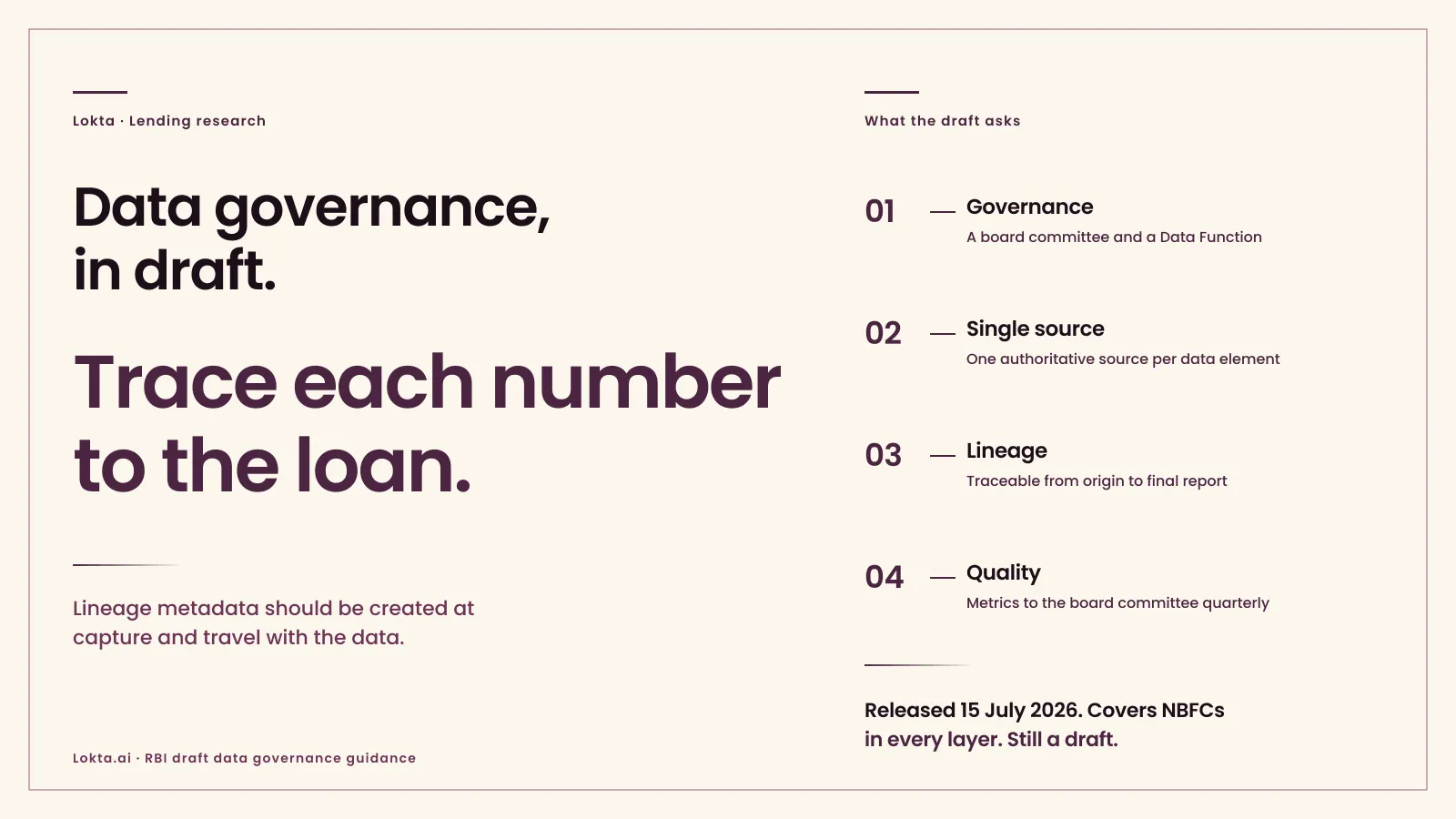
Two other texts bear on the same work. RBI’s Miscellaneous Supervisory Directions require Upper and Middle Layer NBFCs with 10 or more fixed-point service delivery units to run a Core Financial Services Solution that can generate MIS for internal and regulatory reporting. RBI’s draft guidance on data governance, released on 15 July 2026, goes further on lineage and traceability, as the data governance post sets out. It is still a draft.
Where do RBI’s own pages disagree?
In at least two places. The list of returns is a reference page, but the stressed-asset directions are binding, and paragraph 29 says the Supervisory Returns Directions add to other directions rather than override them:
- the list of returns on RBI’s website gives ₹500 crore as the Base Layer threshold for DNBS04A and DNBS04B, while paragraph 21 of the Directions gives ₹100 crore, as do the ALM Directions the list page cites
- the stressed-asset directions ask for the weekly defaulted-borrower report by close of business every Friday, while the Supervisory Returns Directions treat Friday as the reference date and allow until the following Wednesday
Where two RBI texts differ, record which reading the NBFC follows and why, and ask RBI to confirm it. Paragraph 30 makes RBI’s interpretation final.
What should the loan record hold for returns?
Everything a return reads, dated:
- each account’s days past due, classification and special mention status on every reference date, kept as history
- each loan’s sector or purpose tag, rate type and scheduled cash flows
- each borrower’s aggregate exposure across loans, and the date of any default
- the provision on each account and the rule that produced it
- the mapping from loan-level fields to each return line, with the version in force for each filing
How should an NBFC produce its returns?
If you want to be the compliance head who files on the due date and can answer a supervisor’s follow-up from the loan book, look first at where each return gets built. There are three ways to set it up.
- Build each return by hand from system extracts in spreadsheets. It needs no system change. Each figure depends on the person who built it, and the aggregation rules paragraph 15 asks for live in their formulas.
- Generate the loan-level inputs from the loan system on each reference date, apply mapped and versioned rules to produce the return, and reconcile it to the ledger before filing. Setup takes a mapping for every return line. After that each figure traces to accounts, and the rules are on record.
- Pass the whole task to a reporting vendor or consultant each period. It frees the team. Paragraph 6 keeps data quality risk inside the board’s risk framework, and the vendor works from the extracts it is given, so the NBFC still checks them against the books.
The second path asks for the most effort before the first filing. Every return line has to be mapped to loan-level fields, the mapping has to be tested against a filed return, and someone has to update it when RBI changes a format.
Lokta’s Next 100 programme covers regulatory and investor reporting, portfolio signals and early warning, on a loan-level ledger tied to the servicing record. The team behind Lokta built Apache Fineract.
Frequently asked questions
What is CIMS?
CIMS, the Centralised Information Management System, is RBI's online platform for return submission, data dissemination and related purposes. NBFCs file their supervisory returns on it, through a Super User who creates maker and checker users. RBI's Supervisory Returns Directions for NBFCs say returns sent on paper or by email are not accepted unless a return is prescribed in that format, so online filing is the rule.
Which RBI returns does a Base Layer NBFC file?
Every NBFC files the DNBS10 Statutory Auditor Certificate and the Form A certificate each year and the DNBS13 overseas investment return each quarter, with a NIL return where it has none. A Base Layer NBFC other than a P2P platform also files DNBS02 quarterly, adds DNBS04A and DNBS04B once its assets reach ₹100 crore, and joins CRILC and the weekly defaulted-borrower return at ₹500 crore if it is an investment and credit company, a microfinance institution or a factor. NBFCs with no public funds and no customer interface are excluded from both. Fraud returns apply from ₹500 crore.
What are the due dates for NBFC returns?
Under paragraph 22 of the Supervisory Returns Directions, 2026, monthly returns are due within 15 days of month end, quarterly returns within 21 days of quarter end, yearly returns within 21 days of 31 March, and weekly returns by the Wednesday after the Friday reference date. Audited returns are due within five working days of the auditor's report. Exceptions include DNBS10, Form A and the fraud returns.
Does RBI require NBFC returns to reconcile with the books?
Yes. Paragraph 14 of the Supervisory Returns Directions, 2026, requires all returns and risk reports to be reconciled with the NBFC's own sources, including accounting data where appropriate. Paragraph 15 requires records of the sources and aggregation rules used to generate each return's data, and paragraph 16 says an NBFC shall strive for a higher degree of automation in generating that data.
Sources:
- RBI, Reserve Bank of India (Non-Banking Financial Companies - Supervisory Returns) Directions, 2026, RBI/DoS/2026-27/466, 31 July 2026: paragraphs 3, 4, 6 to 19, 21 to 24, 29 and 30.
- RBI, repeal circular DoS.CO.PPG.66/11.01.005/2026-27, 31 July 2026.
- RBI, Master Direction - Reserve Bank of India (Filing of Supervisory Returns) Directions - 2024, 27 February 2024: paragraphs 4.3.1 to 4.3.3, and the reporting timelines.
- RBI, List of returns and reporting portals.
- RBI, Reserve Bank of India (Non-Banking Financial Companies - Resolution of Stressed Assets) Directions, 2025: paragraphs 20 to 22 (CRILC and the weekly default report).
- RBI, Reserve Bank of India (Non-Banking Financial Companies - Miscellaneous) Supervisory Directions, 2026: paragraphs 5 and 6 (Core Financial Services Solution).
- RBI, Reserve Bank of India (Non-Banking Financial Companies - Scale Based Regulation) Directions: paragraphs 10 and 11 (layers).
- RBI, press release on the draft Guidance on Regulatory Expectations for Data Governance, 15 July 2026.