SMA and NPA classification for NBFCs: the day-end rules
When an NBFC loan turns SMA-0, SMA-1, SMA-2 or NPA under RBI rules, why the day-end run sets the date, and what your loan system has to prove every night.
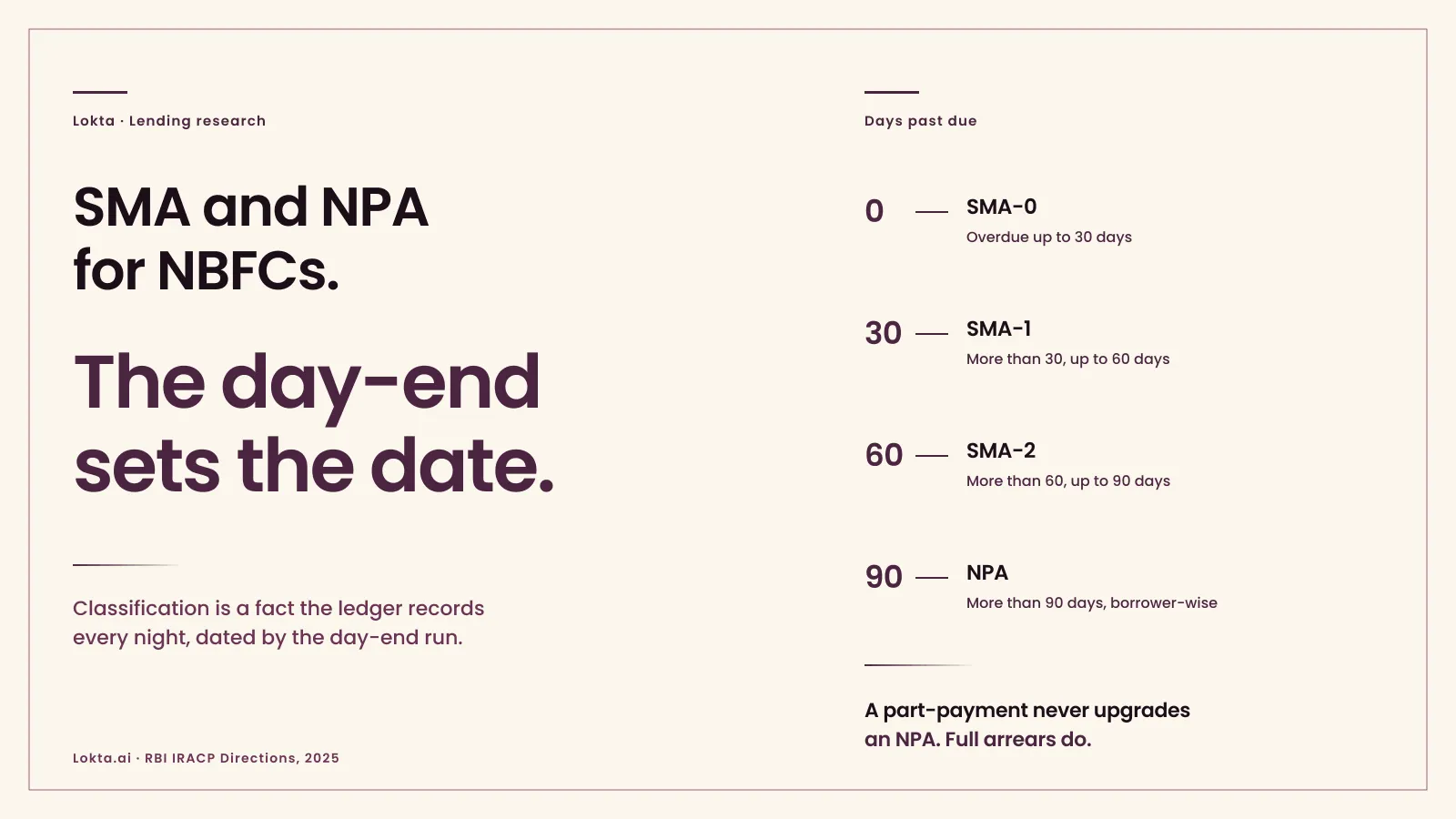
Under RBI’s rules an NBFC loan is SMA-0 when overdue up to 30 days, SMA-1 at more than 30 and up to 60, SMA-2 at more than 60 and up to 90, and NPA once overdue more than 90 days. The flag is raised in the day-end process for the due date, and that calendar date is the classification date, whenever the batch actually runs.
If you are the CRO who signs off on classification, the question an auditor asks is rarely “which bucket is this account in today”. It is “why was it SMA-2 on the sixth of March, and who changed that”. The answer has to come from the ledger, not from a report somebody rebuilt.
Classification belongs to the nightly run of the loan system, written once and dated by RBI’s rules. Compiled as a month-end report instead, it drifts from the ledger it came from. A system that cannot replay why an account sat in a bucket leaves your team to rebuild the answer by hand, and the hand-built answer is what the auditor ends up testing.
The RBI rules below carry their paragraph references. A labelled scenario follows one account through 120 days, and the post closes with eight tests your loan system should pass every night.
- The thresholds are 30, 60 and 90 days. SMA-0, SMA-1 and SMA-2 mark stress on a standard account, and more than 90 days overdue makes it an NPA.
- The day-end run sets the date. An account is flagged in the day-end process for the due date, and that calendar date is the classification date.
- Classification is borrower-wise. One NPA facility makes every facility of that borrower an NPA.
- Part-payment does not upgrade an NPA. The borrower has to clear the entire arrears, across all facilities.
- Replay is the evidence. A class the ledger can re-derive for any past date answers the auditor. A class fixed by hand becomes the finding.
At what DPD does an NBFC loan become SMA or NPA?
RBI sets the special mention bands in the NBFC Resolution of Stressed Assets Directions, 2025 (paragraph 18), for all loans including retail loans, whatever the size of the exposure (paragraph 19). The NPA line is in the NBFC Income Recognition, Asset Classification and Provisioning (IRACP) Directions, 2025.
| Class | Principal, interest or other amount overdue | What it means for the account |
|---|---|---|
| SMA-0 | Up to 30 days | Standard asset, incipient stress recognised. |
| SMA-1 | More than 30 days and up to 60 days | Standard asset, stress rising. |
| SMA-2 | More than 60 days and up to 90 days | Standard asset, last band before NPA. Reported to CRILC where it applies. |
| NPA | More than 90 days | Non-performing. Income recognised only on receipt, provisions held, all the borrower’s facilities follow. |
The 90-day line needs one qualifier. For middle layer NBFCs it is in paragraph 51(1) of the IRACP Directions, and upper layer NBFCs follow it through paragraph 56. For base layer NBFCs, paragraph 43 still reads “more than 180 days”, and paragraph 44 moves that to more than 90 days on a glide path that reached 90 days on 31 March 2026. Read the two paragraphs together: since that date, 90 days is the line across the layers.
SMA is the credit side of early warning. The early warning signals post sets it beside the separate fraud framework RBI requires of Upper and Middle Layer NBFCs.
How are days past due counted?
Days past due count from the oldest amount still unpaid, and the clock is the calendar, not the batch. Paragraph 18 of the IRACP Directions asks NBFCs to flag overdue accounts “as part of their day-end processes for the due date, irrespective of the time of running such processes.” Paragraph 19 makes the calendar date of that day-end run the SMA or NPA classification date.
Two things follow for your loan system:
- A day-end that runs at 2 am on the seventh for the sixth still classifies as of the sixth. The date on the record has to be the business date, not the server’s clock.
- RBI’s own illustration, under paragraph 19 of the IRACP Directions, counts the due date as the first overdue day. A loan due on 31 March 2021 and left unpaid is SMA-1 on 30 April, SMA-2 on 30 May and an NPA on 29 June 2021.
A failed batch still owes its classifications. The rerun has to classify every business date it missed, in order, or the dates on the record are wrong.
Where do these rules live now?
RBI consolidated its NBFC instructions into a set of Directions on 28 November 2025, so older circular names no longer point at the current text. Two instruments matter here.
NPA thresholds by layer, day-end flagging, borrower-wise classification, upgrade conditions, income recognition and provisioning.
The SMA-0, SMA-1 and SMA-2 bands, and the CRILC reporting of large exposures and their SMA status.
Both came into force on the day they were issued. Some NBFC types sit outside the IRACP Directions, among them P2P platforms, account aggregators and Type I NBFCs, so check your licence category against the applicability section before you rely on the thresholds.
Why does one NPA facility pull the others down?
Because RBI classifies the borrower, not the loan. Paragraph 23 of the IRACP Directions says asset classification “shall be borrower-wise and not facility-wise.” If a borrower has a business loan and a vehicle loan with you, and the business loan crosses 90 days, the vehicle loan becomes an NPA too, even if every instalment on it is current.
For the loan system, that means classification cannot be a property of one account. It has to read every facility held by the same borrower, which only works if the borrower is one record across products rather than a name repeated in three modules.
Co-lending carries the same logic across two lenders. Under RBI’s Co-Lending Arrangements Directions, 2025, when either partner classifies its co-lent exposure to a borrower SMA or NPA because of a default in that exposure, the other applies the same status to its share, and the information has to reach it by the end of the next working day. A co-lending book therefore needs both partners’ classifications to come from one set of events.
Can an NPA be upgraded after a part-payment?
No. Paragraph 24 allows an NPA to be upgraded to standard “only if entire arrears of interest and principal are paid by the borrower.” Paragraph 25 extends that to borrowers with more than one facility: the arrears on all of them have to be cleared.
A part-payment still matters. It reduces what is overdue and can bring days past due down. It does not move the account back to standard, and a system that upgrades on the first receipt after NPA is wrong in a way the auditor will find.
How does an NPA move from sub-standard to doubtful to loss?
By time, for the first step. For middle and upper layer NBFCs, an account is a sub-standard asset for up to 12 months after it turns NPA, and a doubtful asset once it has stayed sub-standard for more than 12 months (paragraphs 52 and 53, applied to the upper layer by paragraph 56). Base layer NBFCs take 18 months for the same step (paragraphs 45 and 46).
A loss asset is defined by judgement and evidence rather than a clock. Paragraph 11(1) covers an asset identified as loss by the NBFC, its auditors or an RBI inspection, and an asset whose recovery is threatened by eroded or missing security or by fraud on the borrower’s part.
Each step changes the provision, so the date an account crossed into a class matters as much as the class itself. That date should come from the same day-end record as the NPA date.
What happens to interest on an NPA?
Paragraph 38 of the IRACP Directions says income on an NPA “shall be recognised only when it is actually realised.” Interest that was booked as income before the account turned NPA and has not been received has to be reversed. The daily accrual behind that reversal is worked through in the interest accrual post.
Provisioning then follows the class. The IRACP Directions set these floors:
0.25% of the outstanding for base layer NBFCs (paragraph 48) and 0.40% for middle layer (paragraph 55). Upper layer rates vary by asset class (paragraph 58).
A general provision of 10% of total outstanding, for every layer (paragraph 32(1)). NBFCs on Ind AS hold their impairment allowance and use these provisions as a floor (paragraph 34).
100% of the portion not covered by realisable security, plus 20% to 50% of the secured portion: 20% in the first year as doubtful, 30% in years one to three, 50% after three years (paragraph 32(2)).
Written off in full. An asset kept on the books for any reason carries a 100% provision (paragraph 32(3)).
For a reader outside India: IFRS 9 uses the same days-past-due history. It presumes a significant increase in credit risk at more than 30 days past due and default at more than 90, both rebuttable. The ledger evidence that proves an SMA date is the same evidence that proves a stage transfer.
How does SMA status leave the lender?
Through the credit bureaus and, for large exposures, through RBI’s own repository.
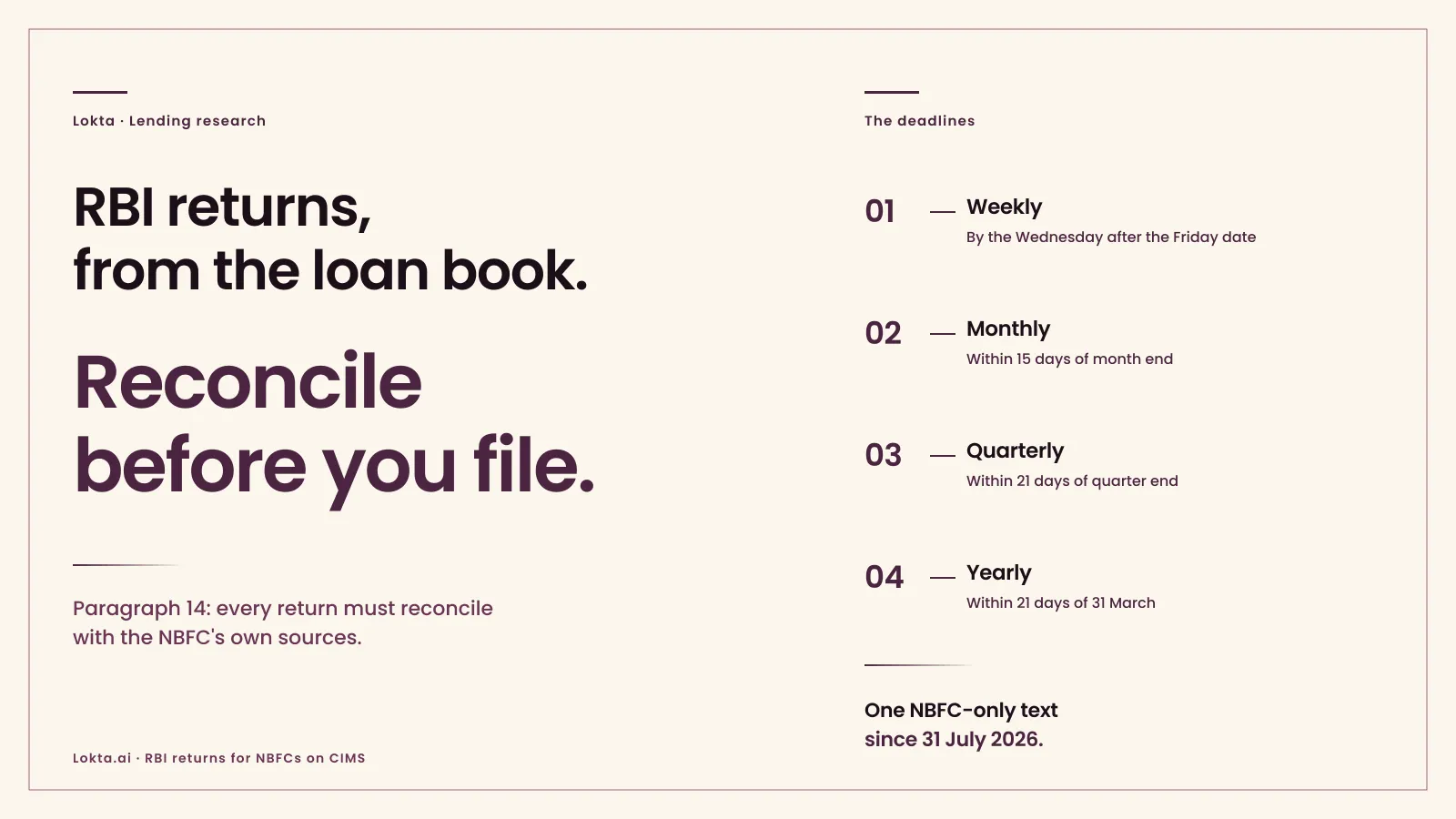
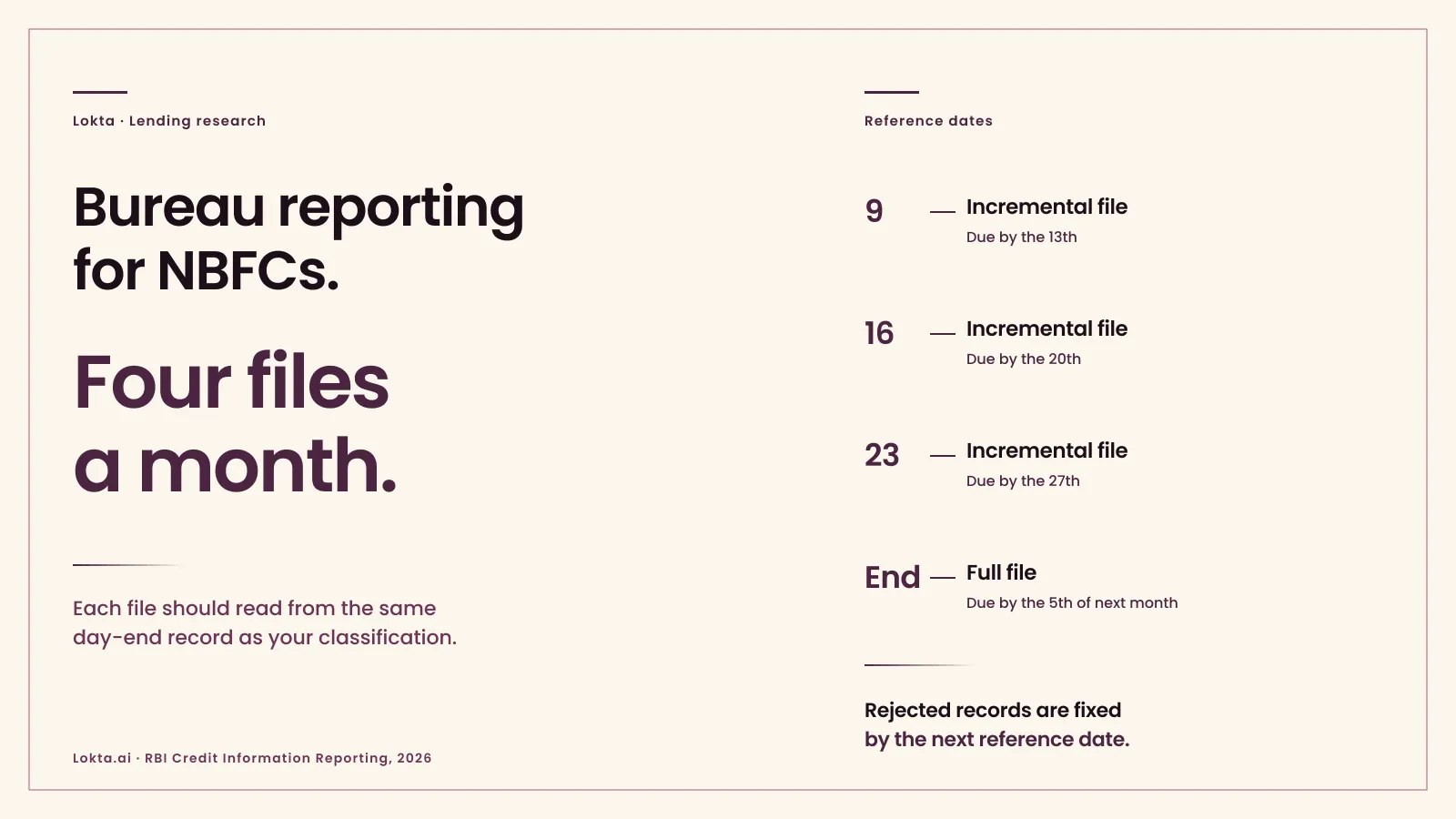
From 1 July 2026, NBFCs report to the credit information companies as on the 9th, 16th, 23rd and last day of every month (Credit Information Reporting Directions, paragraph 10(2)(i)). The bureau reporting rules cover the deadlines and rejections. The days past due in that file should match the days past due that drove classification on the same date.
RBI’s Central Repository of Information on Large Credits (CRILC) takes a monthly report, SMA status included, on every borrower with aggregate exposure of ₹5 crore and above (Resolution of Stressed Assets Directions, paragraph 20). A weekly report of defaults by those borrowers is due by close of business each Friday (paragraph 21). These paragraphs apply to deposit-taking NBFCs and to NBFCs with assets of ₹500 crore and above. Under paragraph 22, an NBFC that fails to report SMA status, or conceals it, faces accelerated provisioning on those accounts.
If the bureau file, the CRILC return and the classification report are three extracts from three places, they will eventually disagree. The reliable design is one classification, written once by the day-end, that every report reads.
What does one account look like over 120 days?
This is a scenario built to show the rules, not a real account. A borrower has a personal loan with an EMI due on the 5th of each month, and a vehicle loan with the same NBFC, fully current. The NBFC is in the middle layer.
“Core” rows are work the ledger does on its own at day-end. The “Mixed” row involves a person: the borrower making a payment. Neither kind of row is a place for a manual reclassification.
What must your loan system prove every night?
Put these tests to any loan system, including the one you run today. Each should pass from the ledger, with no spreadsheet in between.
- A day-end run late for a business date classifies as of that business date.
- A rerun after a failed day-end classifies every missed date in order.
- Days past due count from the oldest unpaid amount, after the product’s payment allocation is applied.
- An NPA on one facility moves every facility of the same borrower to NPA on the same date.
- A part-payment reduces days past due but never upgrades an NPA. Full arrears across all facilities do.
- Interest booked and not received is reversed on the NPA date, and later interest is recognised only on receipt.
- Given the account’s history, the system re-derives the class on any past date, and it matches what was reported that day.
- Any change to a class outside the day-end carries a maker, a checker, a reason and a timestamp.
Lokta Loan Management automates RBI IRAC and SMA classification on a double-entry, event-sourced ledger, and can re-derive any book from its history. AI proposes, the core decides, the record proves it, and classification belongs to the deterministic core. If you are writing requirements, the NBFC LMS RFP guide and the functional requirements template carry these tests in RFP form.
Which path fits your book?
If you want to be the CRO who can show an auditor why any account was in any bucket on any date, there are three honest routes.
- Keep the current system and reconcile at month end. There is no migration and no new vendor. The classification evidence keeps living in spreadsheets, and the bureau file, the CRILC return and the classification report keep drifting apart.
- Run the eight tests on a ledger that replays. Put them in your RFP or your renewal, and hold any vendor on the NBFC LMS shortlist, Lokta included, to passing them on a copy of your own book before you sign.
- Build the classification engine in-house. You get full control, and your team owns every RBI amendment, on the timetable RBI sets.
The second route has a cost. Replay only proves what the ledger holds, so if your loan history is split across three systems today, a migration comes first, and that is real work.
Lokta comes from the team that built Apache Fineract, the open-source lending core, where arrears ageing and NPA flagging sit inside the loan module. Classification logic is work this team has shipped before.
Frequently asked questions
At what DPD does an NBFC loan become NPA?
When interest or principal stays overdue for more than 90 days. Middle and upper layer NBFCs already used that line. Base layer NBFCs moved to it on a glide path that reached 90 days on 31 March 2026, so one threshold now applies across the layers. Classification is borrower-wise, not facility-wise.
What is the difference between SMA and NPA?
SMA is early stress on an account that is still standard: SMA-0 is overdue up to 30 days, SMA-1 more than 30 and up to 60, and SMA-2 more than 60 and up to 90. NPA is the non-performing class that follows, with income recognised only on receipt and provisions held against it.
Can an NPA account be upgraded after a partial payment?
No. RBI's directions allow an NPA to be upgraded to standard only when the borrower pays the entire arrears of interest and principal. Where the borrower has more than one facility, arrears on all of them have to be cleared. A part-payment reduces days past due but leaves the account an NPA.
Can a loan management system classify SMA and NPA automatically?
It should, as part of the day-end run for each due date, because RBI treats that calendar date as the classification date. What matters is that the classification comes from the ledger and can be replayed later, so an auditor can see why an account was SMA-2 on a given day without anyone overriding it by hand.
Read next:
- Why your LMS ledger should never be model-guessed: why classification arithmetic belongs in a deterministic ledger.
- Every lender replaces its LMS eventually: compliance exports the vendor cannot fix are one of the five symptoms.
- Lokta Loan Management for NBFCs: the LMS built as a ledger for India’s regime.
Sources:
- Reserve Bank of India (Non-Banking Financial Companies - Income Recognition, Asset Classification and Provisioning) Directions, 2025: RBI/DOR/2025-26/356, 28 November 2025. Paragraphs 11, 18-19 (day-end and illustration), 23-25 (borrower-wise, upgrade), 32, 34, 38, 43-46, 48, 51-53, 55-58.
- Reserve Bank of India (Non-Banking Financial Companies - Resolution of Stressed Assets) Directions, 2025: RBI/DOR/2025-26/357, 28 November 2025. Paragraphs 18-22 (SMA bands, CRILC) and 157.
- IFRS 9 Financial Instruments, paragraphs 5.5.11 (the 30-day presumption) and B5.5.37 (the 90-day default presumption).
- Reserve Bank of India (Non-Banking Financial Companies - Credit Information Reporting) Directions, 2025: RBI/DOR/2025-26/349, 28 November 2025, updated as on 1 July 2026, which sets the four reporting reference dates.
This article summarises RBI directions for operational readers and does not constitute legal or regulatory advice.
Chandramouli is a co-founder of Lokta, the agentic loan servicing platform. He has worked across technology, go-to-market and consulting for more than two decades, and served as an independent director on the board of an NBFC.