Loan accounting entries for lenders: GL postings from disbursal to recovery after write-off
The journal entries a loan system should post for each loan event, from disbursal, accrual and repayment to NPA reversal, provisioning, write-off and recovery.

Every loan event has a journal entry. Disbursal debits the loan and credits the bank. Accrual debits interest accrued and credits income. A receipt credits interest and principal in the product’s appropriation order. An NPA reverses unrealised income and books a provision. A write-off removes the loan against its provision while the claim survives, and a later recovery is income when received. The loan system should post each one as the event happens.
If you close the books at an NBFC, every number in your loan ledger started as an event on a loan: a disbursal, a day’s interest, a receipt, a bounce, a classification. The general ledger is only as right as the entries those events produce.
When the loan system and the ledger are separate, the entries are rebuilt at month end from extracts, and the reconciliation between them becomes a job of its own. What changes the month-end close is whether the loan system posts them itself, at the moment of each event, to the ledger heads finance has mapped.
- One event, one entry. Each loan event posts a balanced entry to mapped ledger heads when it happens.
- Interest moves in three steps. Accrued, due, received, each with its own account.
- NPA reverses income. Booked but unpaid income comes back out, and later income counts only once it is paid.
- A write-off is not a waiver. The loan leaves the balance sheet and the borrower still owes it.
- Recoveries are income when received. Nothing is booked for a recovery before the money arrives.
Which loan events need a journal entry?
Every event that changes a balance on the lender’s books: what the borrower owes, what the lender has earned, or what it has set aside for losses. The table uses an illustrative loan of ₹10 lakh at 12% a year, Actual/365, with a ₹10,000 processing fee. Account names vary by lender. The debit and credit sides do not. Tax on fees is left out for clarity.
| Event | Debit | Credit | Illustrative amount |
|---|---|---|---|
| Disbursal | Loan principal | Bank, and fee income or unamortised fee | ₹10,00,000 debit, ₹9,90,000 and ₹10,000 credit |
| Daily accrual | Interest accrued | Interest income | ₹328.77 a day |
| Instalment falls due | Interest due | Interest accrued | The month’s accrued interest |
| Receipt | Bank | Interest due, then principal, in the appropriation order | The amount received |
| Penal charge on a default | Charges receivable | Penal charge income | The disclosed charge |
| Account turns NPA | Interest income | Interest and charges accrued, unrealised | The unrealised income |
| Provision | Provision expense | Provision for loan losses | 10% of outstanding if sub-standard |
| Technical write-off | Provision for loan losses, and write-off expense for any shortfall | Loan principal and receivables | The balance written off |
| Recovery after write-off | Bank | Bad debts recovered | The amount received |
What are the entries at disbursal?
Debit the loan for the full principal and credit the bank for what actually leaves. If the processing fee is deducted, the bank credit is ₹9,90,000 and the ₹10,000 goes to fee income, or, where it is spread under the effective interest method as Ind AS requires, to an unamortised fee account netted against the loan and released to interest income over its life. A lender that disburses in tranches posts each tranche when it is paid, because interest runs only on what has actually been disbursed.
What are the entries for interest and repayment?
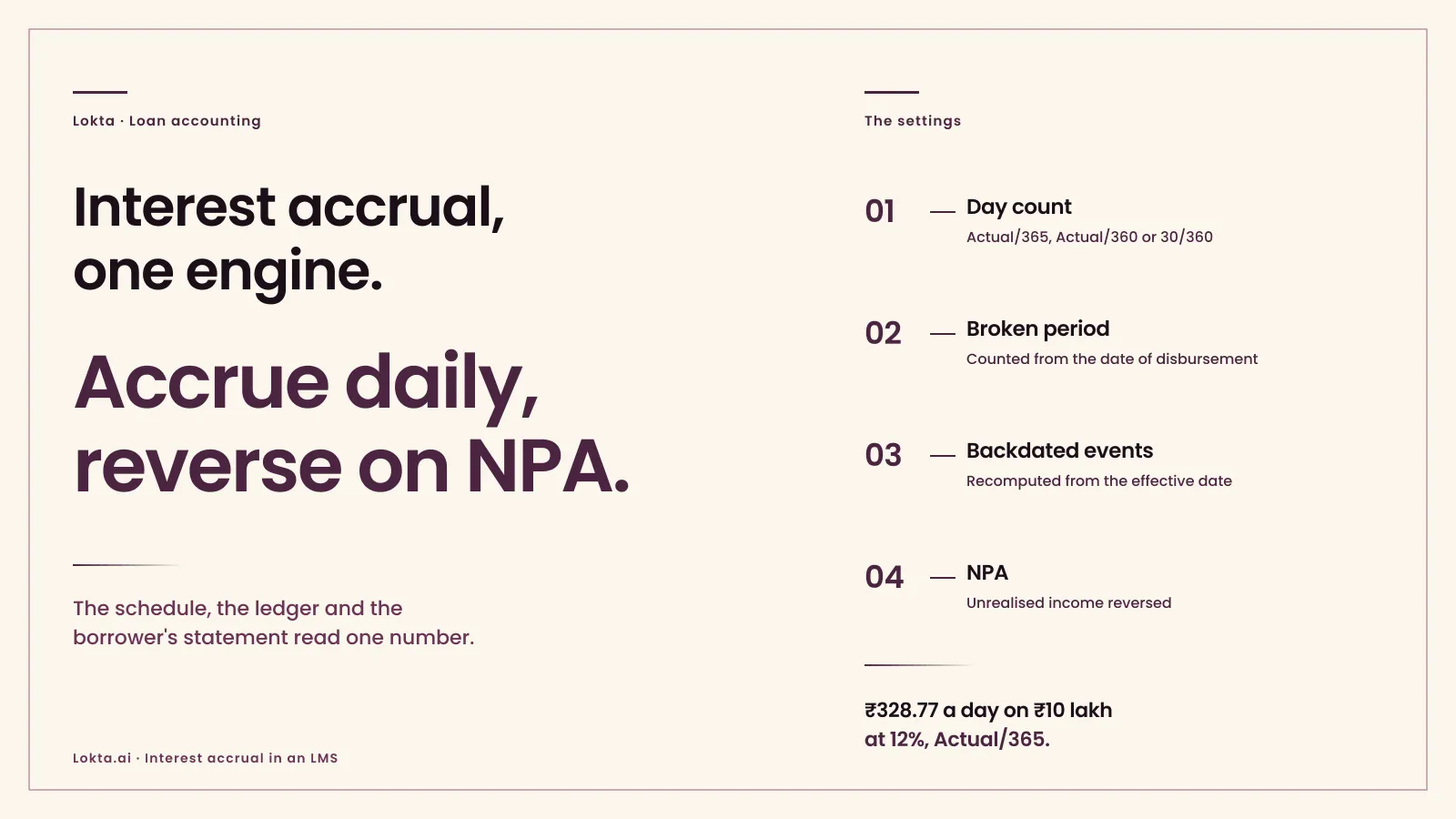
Three steps for interest, one for the receipt. Each day’s interest is debited to interest accrued and credited to income: ₹328.77 on the illustrative loan. When the instalment falls due, the month’s accrued interest moves to interest due, a receivable the borrower is now late on if unpaid. The interest accrual post covers day count, broken periods and backdated events.
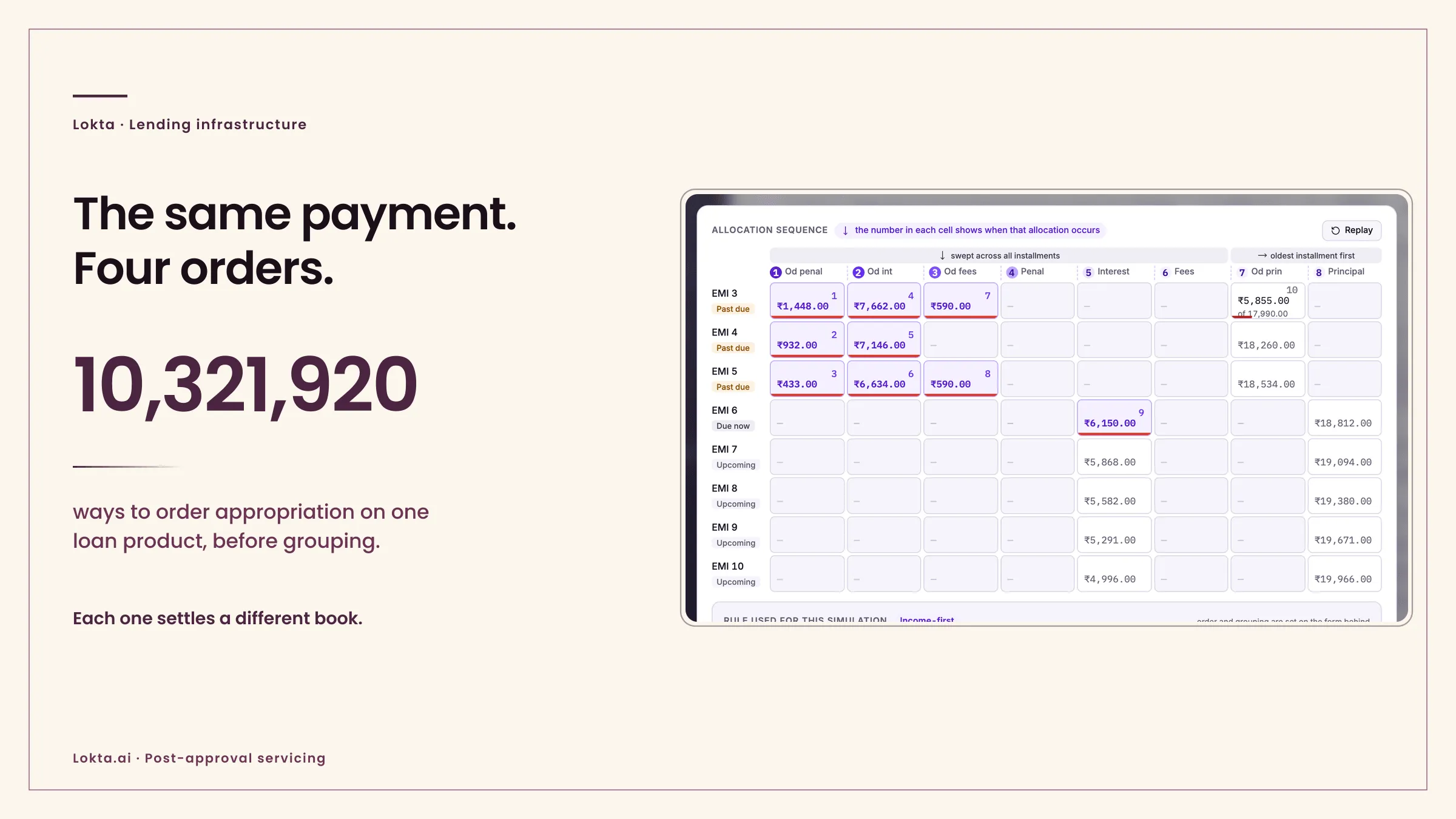
The receipt debits the bank and credits the receivables in the order the product sets, for example interest before principal, though the order is a product choice and changes which balance a part-payment clears. How that order changes the result is set out in the payment appropriation guide.
How are charges and prepayments posted?
A penal charge is its own receivable and its own income line, never an addition to the interest rate or to the principal. RBI’s penal charges rules forbid capitalising it, so it must stay out of the base that earns interest. A prepayment or foreclosure credits principal, any interest due and the interest accrued since the last instalment, and credits a prepayment charge only where the loan is allowed to carry one.
What changes when an account turns NPA?
Classification sets off the reversal, and the provision follows as its own entry. First, the reversal. Paragraph 38 of RBI’s income recognition, asset classification and provisioning (IRACP) directions lets an NPA carry income only once the money has been realised, so interest and charges booked before the slip and not yet collected come back out: debit interest income and charge income, credit the unrealised receivables. A lender may park the reversed amount in an interest suspense account to keep sight of it. The directions require the reversal, not a particular account.
Second, the provision. Outside microfinance portfolios of NBFC-MFIs, a sub-standard asset needs a general provision of 10% of the total outstanding, and the provision rises as the account moves into the doubtful and loss categories. Debit provision expense, credit the provision for loan losses. For when each category starts, see SMA and NPA classification for NBFCs.
How is a write-off posted, and what happens after?
The loan comes off the balance sheet and the claim stays. RBI’s Resolution of Stressed Assets Directions for NBFCs define a technical write-off as one made “only for accounting purposes, without involving any waiver of claims”. The entry debits the provision held against the loan, debits a write-off expense for any part not already provided for, and credits the loan and its receivables. Interest held in suspense is cleared against the suspense account, not charged again. A partial technical write-off does not reset the account: classification and provisioning on what remains stay measured against the original exposure.
The borrower still owes the full amount, so the loan system has to keep tracking the written-off balance, the collections work on it and every receipt. Any claim on a future recovery stays off the balance sheet until the money is actually realised. When money comes in, debit the bank and credit bad debts recovered, and reduce the written-off balance tracked for the borrower. The reporting format the board mandates has to cover the extent of recovery on technically written-off accounts.
What changes for an Ind AS NBFC?
The events are the same, and some measurements differ. Interest on a loan that has become credit-impaired does not stop: Ind AS 109 applies the effective interest rate to its amortised cost after the loss allowance (paragraph 5.4.1(b)), and paragraph 8 of the IRACP directions lets the standard prevail where the two are inconsistent. Under Ind AS 109, fees that are an integral part of the effective interest rate, such as origination fees, are recognised through that rate over the loan’s expected life instead of being taken to income at disbursal. The loss allowance on the books follows the standard’s expected credit loss model, and the NBFC still computes IRACP provisions alongside it as a prudential floor (paragraph 34). Where the Ind AS 109 impairment allowance is lower than the prudential floor, RBI’s directions require the NBFC to appropriate the difference from net profit or loss after tax to a separate Impairment Reserve, which does not count as regulatory capital.
Every one of those figures is built from the loan record: the disbursals, fees, receipts, classification dates and balances. The loan system has to hold them completely enough that the Ind AS numbers and the IRACP numbers can be reconciled line by line.
Why should the loan system post the entries?
So that every ledger balance traces back to the loan events that produced it. When the loan system posts each entry at the moment of the event, to ledger heads finance has mapped once, the loan book and the general ledger are the same record. When entries are rebuilt from extracts at month end, every backdated receipt, mid-month NPA and partial write-off becomes a reconciling item someone has to explain.
How should finance set up loan postings?
If you want to be the CFO whose ledger balances trace to loan events without a month-end rebuild, the choice is where the entries are generated.
- Post summary entries to the ledger at month end from loan system reports. It keeps the ledger simple. Every difference between the report and the ledger becomes a reconciliation task, and the detail behind a balance sits outside the books.
- Have the loan system post a balanced entry for every event to mapped ledger heads, as the event happens. Finance maps the heads once and signs the mapping. After that, a balance in the ledger traces to the loan events behind it.
- Keep the loan ledger in a separate accounting module that finance maintains by hand from the loan system’s data. Finance controls every entry. The loan system and the ledger can disagree, and each disagreement is found at close.
The second path asks for work before go-live. Each product’s events have to be mapped to ledger heads, including the less common ones such as reversals, write-offs and recoveries, and finance has to sign that mapping before the product goes live.
In Lokta’s loan management system, disbursals, repayments, accruals, charges, waivers and write-offs each post a double entry to the ledger heads the lender has mapped. Those postings are produced by the event-sourced ledger that also computes the repayment schedule, and finance signs off the GL mapping before the product can go live. Apache Fineract, the open-source lending core, came from the same team.
Frequently asked questions
What is the accounting entry for loan disbursement?
Debit the loan asset for the principal disbursed and credit the bank account paid out. If a processing fee is deducted from the amount paid, credit the fee to income, or to an unamortised fee account netted against the loan where it is spread under the effective interest method, and credit any tax payable on it. The bank credit is then the net amount the borrower received.
What is the journal entry when an NBFC loan becomes NPA?
Under RBI's income recognition and provisioning directions for NBFCs, reverse the income booked on the account that is still unpaid, interest and charges alike: debit the income and credit the matching receivable. After that, income on the account counts only when it is realised. Then book the provision: debit provision expense and credit the provision for loan losses, at 10% of the total outstanding while the asset is sub-standard. An NBFC reporting under Ind AS follows Ind AS 109 where the two conflict, and the standard keeps recognising interest on a credit-impaired loan at the effective interest rate on its amortised cost.
What is the journal entry for a loan loss provision?
Debit provision expense in the profit and loss account and credit the provision for loan losses held against the loans. Under RBI's IRACP directions, a sub-standard asset needs 10% of its total outstanding, and the requirement rises through the doubtful and loss categories. An NBFC on Ind AS books its expected credit loss allowance, and where that falls short of the IRACP floor it appropriates the gap from profit after tax to an Impairment Reserve.
How is a technical write-off accounted for?
Debit the provision held against the loan, debit a write-off expense for any balance not already provided for, and credit the loan asset. The borrower's liability does not change: a technical write-off is for accounting purposes only and involves no waiver of the claim, so the written-off balance is tracked outside the balance sheet and recovery continues.
How is a recovery on a written-off loan recorded?
Debit the bank for the amount received and credit a recovery income account, such as bad debts recovered, in the period the money arrives. RBI's directions keep future recoveries off the balance sheet until they are actually realised, so nothing is booked in advance, and the written-off balance tracked for the borrower is reduced by the amount recovered.
Sources:
- Reserve Bank of India (Non-Banking Financial Companies - Income Recognition, Asset Classification and Provisioning) Directions, 2025: paragraph 8 (Ind AS prevails where inconsistent), paragraph 32 (provisioning), paragraphs 34 and 35 (prudential floor and Impairment Reserve), paragraph 38 (income on NPAs and reversal of unrealised income).
- Reserve Bank of India (Non-Banking Financial Companies - Resolution of Stressed Assets) Directions, 2025: paragraph 10(18) (technical write-off), 88 (recoveries not recognised until realised), 91 (no waiver of claims), 92 (partial technical write-offs), 94 (board reporting on recoveries).
- Reserve Bank of India (Non-Banking Financial Companies - Responsible Business Conduct) Directions, 2025: paragraph 30 (penal charges, no capitalisation).
- ICAI, Ind AS 109, Financial Instruments: Appendix A, paragraph 5.4.1(b) (interest on credit-impaired assets) and paragraphs B5.4.1 to B5.4.3 (fees and the effective interest rate).