Agent Adoption Does Not Shrink a Servicing Team. It Reshapes It.
The staffing plan behind most agent rollouts assumes a smaller team doing the same jobs at a lower headcount. What actually happens is stranger: some roles shrink toward zero, a role that never existed becomes necessary, and one kind of authority never moves at all.
Every staffing plan attached to an agent rollout makes the same assumption: automate a task, remove the headcount that did it, divide the savings by the team’s fully loaded cost, present the number to the board. The actual shift in a servicing team’s shape rarely matches that arithmetic, in either direction.
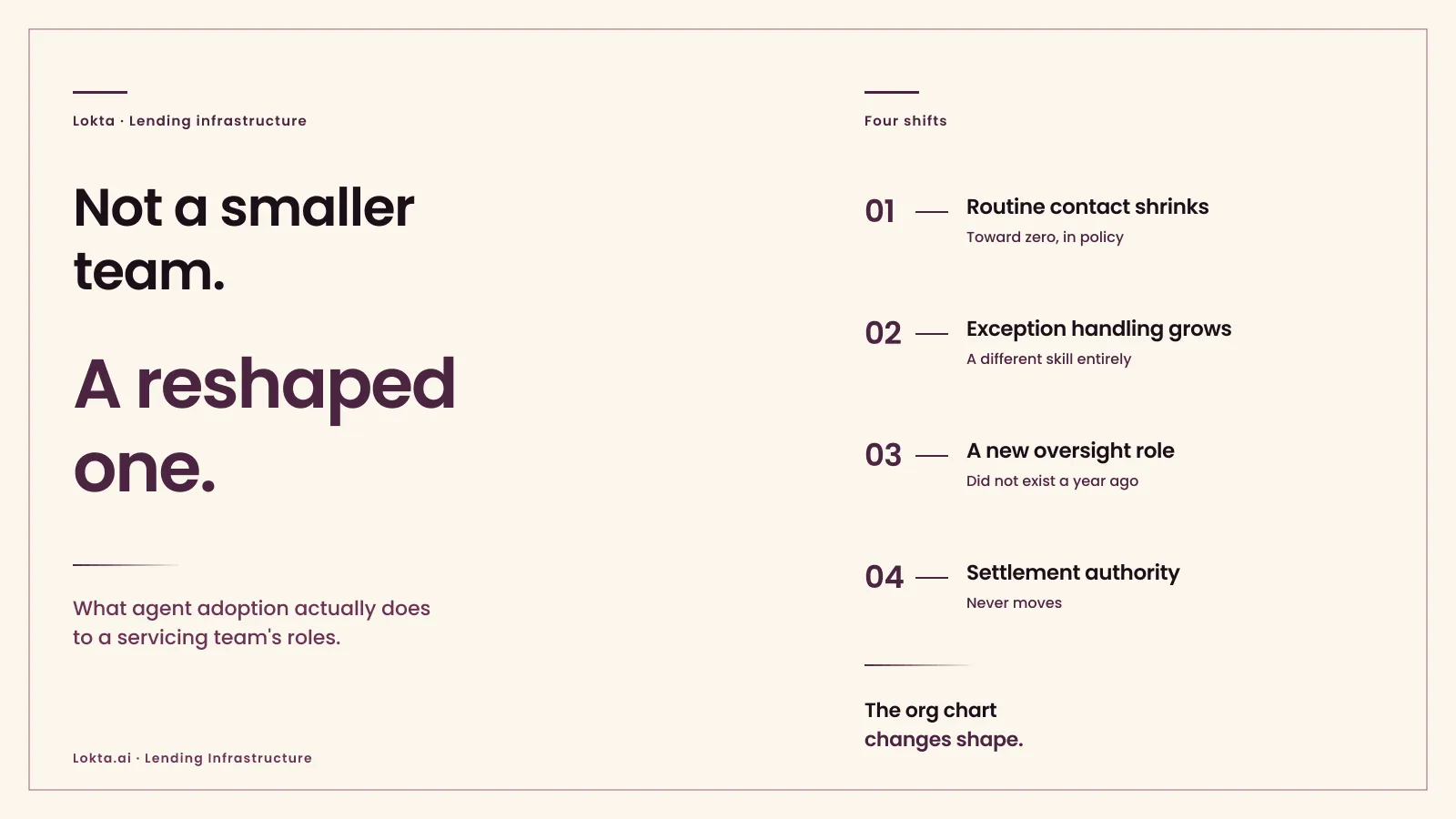
Agent adoption does not uniformly shrink a servicing team. High-volume routine contact roles shrink, sometimes close to zero. Exception handling grows, because a case an agent will not resolve on its own still needs a person, and it needs one who has seen enough exceptions to judge them well. A new oversight role appears that did not exist before: someone auditing the pattern of agent decisions, not working individual accounts. And one kind of authority, settlements, write-offs, legal escalation, hardship calls, does not move at all.
The mistake is treating “roles an agent can do” and “roles a person no longer needs to do” as the same list. They overlap less than the staffing plan assumes, and the gap between them is exactly where a servicing team’s actual shape ends up.
What shrinks toward zero: routine contact work
The clearest headcount effect is real. Reminder calls within a permitted window, routine follow-up messages, logging a standard promise-to-pay, these are high-volume, low-judgment tasks, and a well-configured agent handles the bulk of them inside policy without a person initiating each one. A team that had several people doing nothing but working through a call list can genuinely need fewer of them.
This is the part every staffing plan gets right, and it is also the part that is easiest to overstate, because it is the only part that looks like simple automation.
What grows: exception handling
Every account an agent flags rather than resolves still needs a person, and that person needs more context than the reminder-caller they are replacing did. An exception is, by definition, the case that did not fit the routine pattern: a disputed payment, a hardship signal buried in an otherwise normal account, a pattern across several accounts that looks coordinated rather than coincidental.
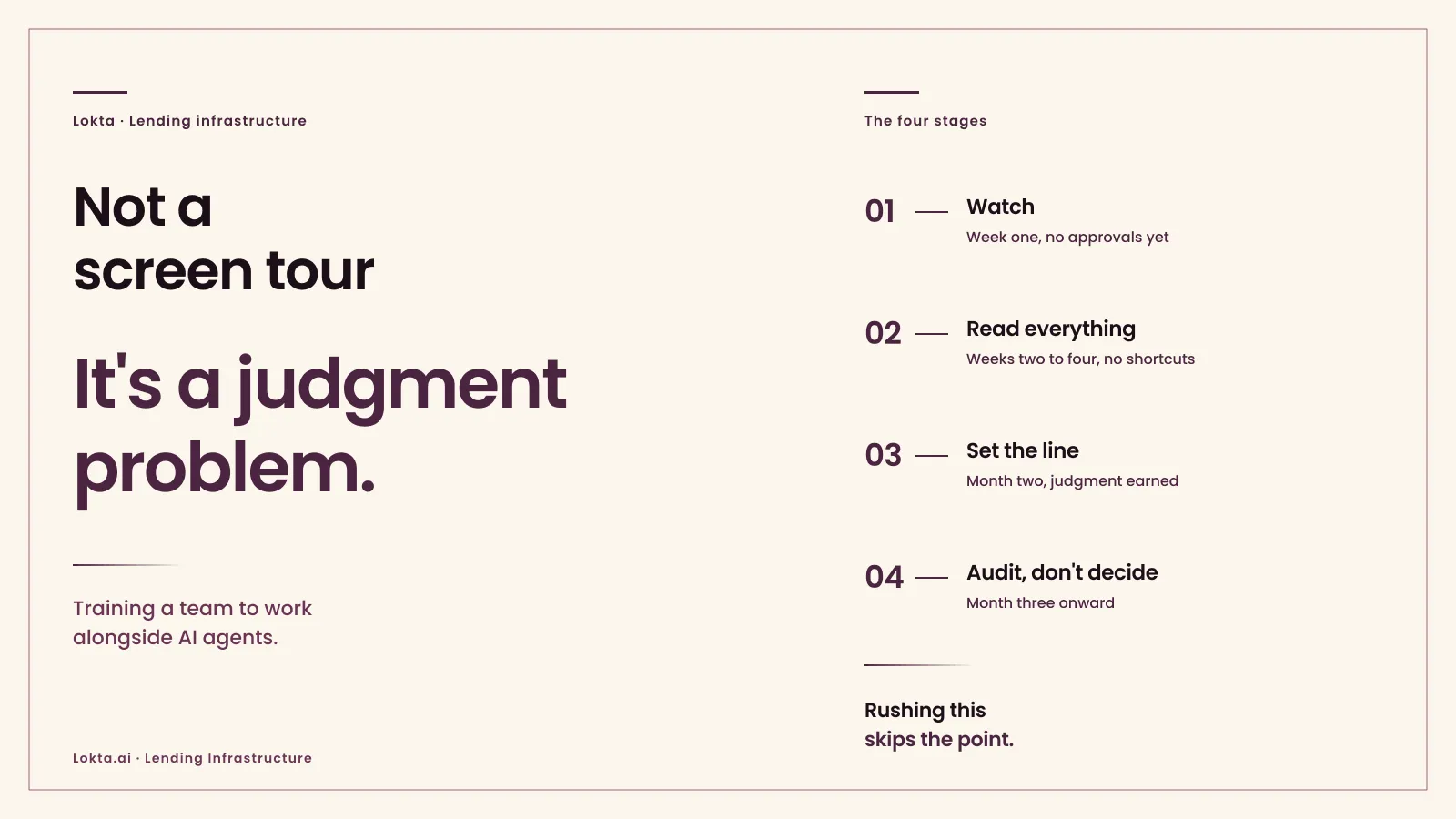
Handling exceptions well is a different skill than working through a call list quickly, and a team cannot simply reassign its fastest callers to it. The judgment a reviewer builds over a rollout’s first quarter is exactly the skill this role requires, and a team that shrank its frontline headcount before building that judgment elsewhere has cut capacity it still needs, just moved to a different desk.
The role that did not exist a year ago
A servicing team running agents at scale needs someone who is not working individual accounts at all: an oversight function that audits a sample of agent decisions across the whole book, tunes where the escalation threshold sits, and can answer, specifically, why a given class of case gets fast-tracked while another gets flagged every time. Before agents, no equivalent role existed, because there was no book-wide pattern of automated decisions to audit.
This role sits closer to a quality or policy function than an operations one, and most servicing teams do not staff for it in their first rollout plan, because it is not obviously mapped to any task an agent replaced. It is the role that answers for the pattern, not any single decision inside it, and it is usually the gap a lender discovers only once an RBI inspection or a serious borrower complaint asks a question the team cannot answer from memory.
What never moves: settlement authority
Settlements, write-offs, legal escalation and hardship decisions stay with people, full stop. RBI’s collection conduct rules assume a specific person is accountable for these calls, and a lender’s own risk appetite generally agrees even where the rule does not require it. An agent can flag that an account looks eligible for a hardship review or a settlement offer. It does not make the call, and no restructuring of the team changes that boundary.
This is the one part of the org chart that stays exactly where it was. A staffing plan that treats it as up for automation has misread what the conduct rules and the risk function are actually for.
There are three honest ways to plan a servicing team’s shape around this. Cut the routine-contact headcount immediately and staff the exception and oversight roles reactively, once the gap shows up, which is the cheapest plan and the one most likely to leave a real capability hole for a quarter or two. Staff the oversight role from day one, even before there is a full book’s worth of pattern to audit, treating it as a fixed cost of running agents responsibly. Or phase the cut to routine roles at the same pace the judgment-building sequence actually completes, so headcount and capability move together instead of headcount moving first and capability catching up.
Frequently asked questions
Does adopting AI agents in loan servicing reduce headcount?
Rarely in the way a staffing plan usually assumes. The roles doing high-volume routine contact work, reminders, follow-up calls within policy, do shrink, sometimes close to zero. But exception handling grows, because every case an agent correctly declines to resolve on its own still needs a person, and a new oversight role appears that did not exist before. The net headcount change is smaller and less predictable than a simple ratio of automated tasks to jobs eliminated.
What new roles appear on a servicing team after AI agents are deployed?
An oversight or escalation-review role, distinct from a frontline collector or servicing agent. This person does not work individual accounts. They audit a sample of agent decisions across the book, tune where the escalation threshold sits, and answer for the pattern of what got automated versus what got flagged. It is closer to a quality or policy role than an operations role, and most servicing teams do not have anyone doing it before agents arrive.
What decisions stay with people even after a servicing team adopts AI agents?
Settlements, write-offs, legal escalation and hardship decisions. RBI's conduct rules and a lender's own risk appetite both assume a person is accountable for these calls, and no restructuring changes that. A platform can flag that an account qualifies for hardship treatment or a settlement offer; it does not make the call. This is the one part of the team's structure that agent adoption does not touch.
How long does it take a servicing team's role mix to actually change after adopting AI agents?
Longer than the technology rollout. The technology can be live in weeks. The role mix shifts over months, tracking the judgment-building sequence a team goes through: heavy manual review early on, gradually loosening as trust in the agent's proposals is earned, and the oversight role only becoming a full function once there is a real pattern of decisions to audit rather than a handful of early cases.
Read next:
- Training a servicing team on AI agents: the individual judgment-building sequence behind the exception-handling and oversight roles this post describes.
- How to use AI agents in loan servicing: the task boundary a platform enforces, which sets the outer edge of what any role restructuring can touch.
- NBFC collection strategy by bucket: where settlement, write-off and escalation authority sits inside a full collections cadence.
Chandramouli is the co-founder and CEO of Lokta, the agentic loan servicing platform. He has spent two decades building AI for decisions that change people’s lives, and has served as an independent director on an NBFC board. He writes here about the roles a staffing spreadsheet gets wrong before anyone has actually run the team through it.