NBFC collection strategy, bucket by bucket
How an NBFC can design collections across pre-due, the X bucket, 1-30, 31-60, 61-90 DPD and NPA, and test a new strategy against the current one first.
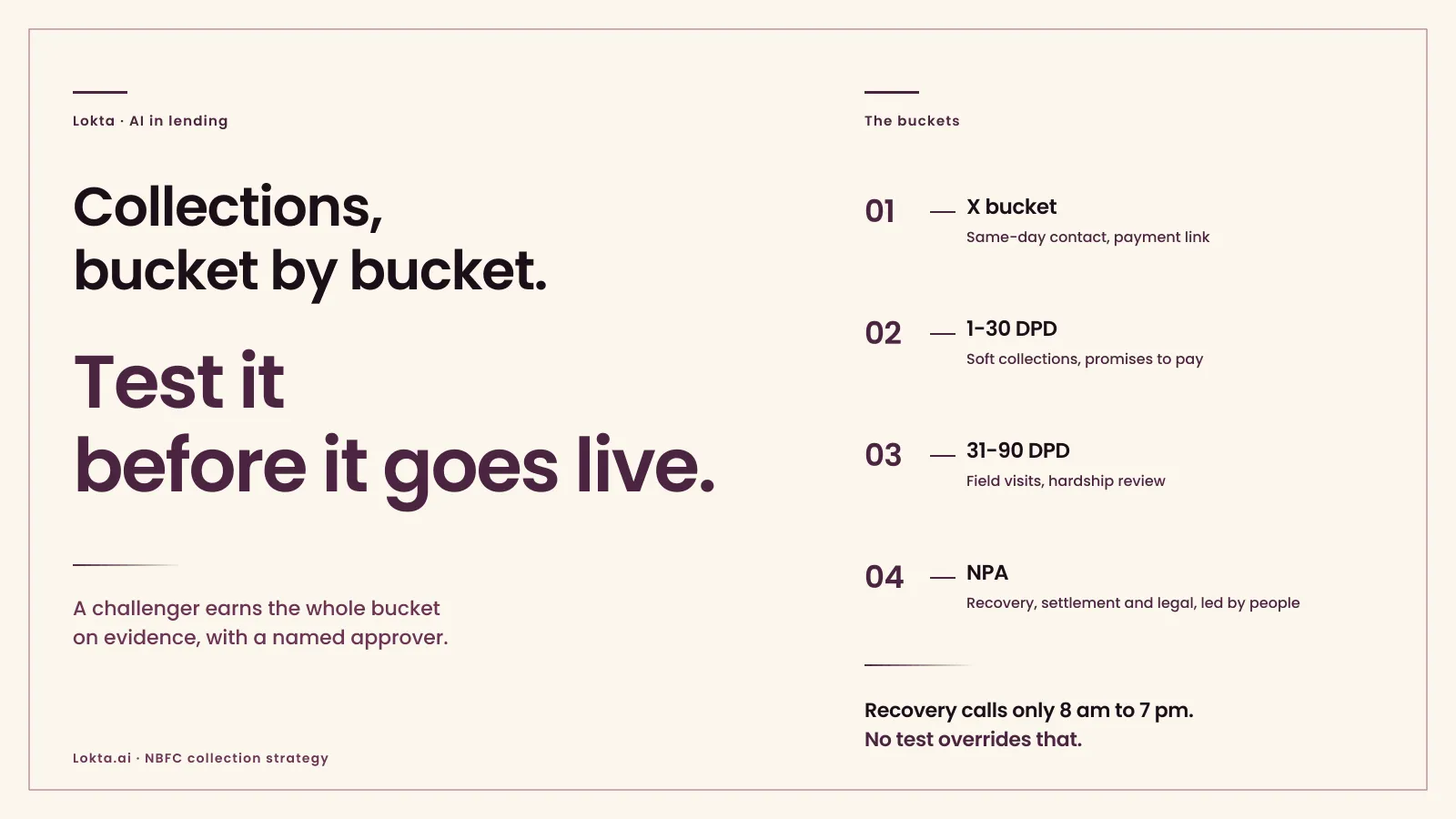
A bucket-wise collection strategy sets a different treatment for each stage of delinquency: pre-due reminders, fast contact in the X bucket, soft collections at 1-30 days past due, harder collections at 31-90, and lender-led recovery after NPA. Change it by testing a challenger against the current strategy on a slice of the bucket, and promote it only on evidence, with a named approver.
If you head collections at an NBFC, the question from the CRO after every strategy change is the same: did it work? Answering it takes a test designed before the change went live.
When strategy changes through a review, a judgement call and a new script rolled out to the whole bucket at once, nobody can say afterwards whether roll rates moved because of the new strategy, the season, or the mix of borrowers. A strategy should instead be tested against the one it would replace, on a random slice of the live book, promoted only on evidence with a named approver, and kept on the record in every version.
- Each bucket gets its own treatment. Pre-due, the X bucket, 1-30, 31-60, 61-90 and NPA need different contact, tone and people.
- Start before the miss. A reminder before the due date asks less of the borrower than a call after a bounce.
- Conduct rules bind every strategy. RBI bars recovery calls before 8 am or after 7 pm, persistent calling and intimidation, whatever a test would prefer.
- Test before you roll out. Run a challenger against the champion on a random slice of the bucket, and read it after a full cycle.
- A person promotes the winner. The search for a better strategy can be automated. The decision to adopt it should carry a name.
What is a bucket-wise collection strategy?
It is a set of treatments keyed to how far behind an account is. Days past due place each account in a bucket, and each bucket has its own channels, cadence, message and escalation path. The buckets also line up with RBI’s early-stress classes, set out in the SMA and NPA classification rules.
| Bucket | Days past due and class | Example treatments |
|---|---|---|
| Pre-due | Not yet due, standard | Reminders before the due date, mandate and balance checks |
| X bucket | First missed instalment, SMA-0 | Same-day contact, payment link, re-presentation where permitted |
| 1-30 | Up to 30 days, SMA-0 | Soft collections: calls, messages, promises to pay |
| 31-60 | More than 30 days, SMA-1 | Tele-calling with more follow-up, hardship review |
| 61-90 | More than 60 days, SMA-2 | Field visits, payment-plan review, senior escalation |
| NPA | More than 90 days | Recovery, settlement and legal action, led by people |
The treatments column is illustrative. What a lender can offer at each stage, and to whom, is its own policy.
Why is pre-due the cheapest place to cure an account?
Because the borrower has not yet missed anything. A reminder three days before the due date, a check that the mandate is live, or a prompt to top up the account costs little and asks nothing difficult of the borrower. Once an instalment bounces, the same borrower may face a bounce charge and a harder conversation.
The X bucket is the next step. It is Indian lending shorthand, not an RBI term, for accounts that were current until this month’s instalment was missed, and lenders draw its edges slightly differently. These borrowers have no history of arrears. Speed matters more than pressure: a same-day message with a payment link, and a re-presentation of the mandate where your policy and the mandate allow it. The first 72 hours after a NACH or UPI AutoPay bounce sets out the steps in order.
What works in 1-30 DPD?
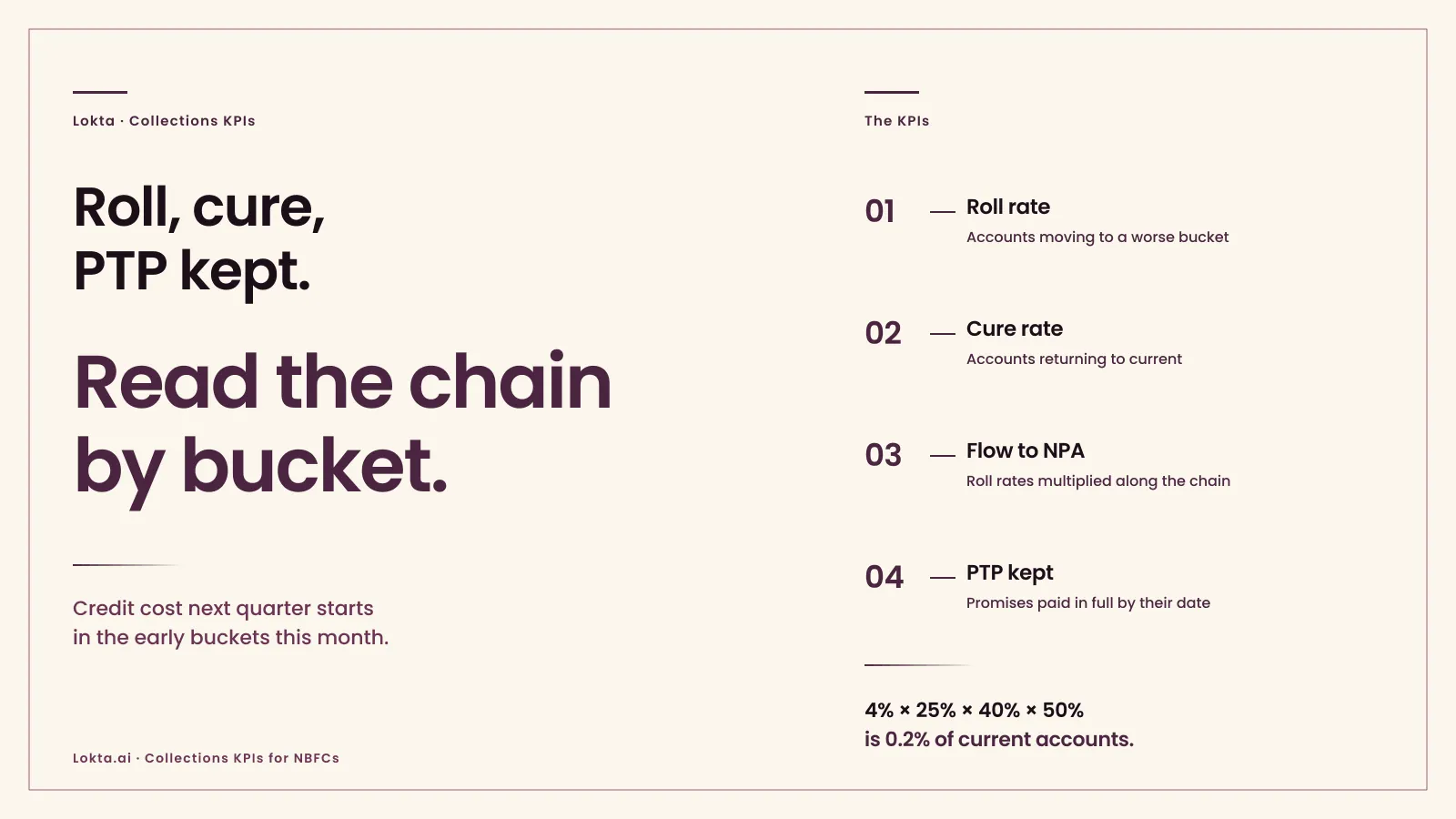
Soft collections. The borrower is behind but still inside SMA-0, and the work is mainly reminding, listening and recording. A promise to pay (PTP) is a borrower’s commitment to pay a stated amount by a stated date. It is only useful if it is recorded on the account with the amount and date, and followed up when the date passes. Before that follow-up, check whether payment has cleared the targeted dues; withdrawing stale collection tasks is part of keeping treatment aligned with the account.
This is also where hardship first shows up. A borrower who says they have lost income needs a different conversation from one who forgot, and a strategy should route the first to a person who can review options rather than send them another reminder.
How should 31-90 DPD be handled?
With more effort and more care, because the SMA clock is running. At more than 30 days the account is SMA-1, and at more than 60 it is SMA-2, the last class before NPA. Tele-calling intensifies, field visits start, and a payment plan may be on the table, each under the lender’s own policy.
Two risks rise here: contact volume can drift past what the conduct rules allow, and earlier hardship notes can get lost between teams. Both are handled the same way: one account record that every caller and field agent reads from and writes to.
What happens after an account turns NPA?
Recovery, and it stays with the lender’s people. Settlements, legal notices, repossession of security where the loan has it, and write-offs are consequential decisions about a borrower and a balance. Software can prepare the account history, the contact log and the options, but a named person decides and signs.
Classification rules still apply after NPA. A part-payment does not return the account to standard, and income on it is recognised only when received. Those are ledger facts, and a recovery team should read them from the ledger rather than work them out.
Which rules can no collection strategy override?
RBI’s conduct rules for recovery. For NBFCs they now sit in paragraph 100 of the Responsible Business Conduct Directions, 2025, which carried forward the August 2022 recovery-agent circular. Outside microfinance loans, which follow their own directions, the rule bars an NBFC and its agents from:
- intimidation or harassment of any kind, verbal or physical
- acts intended to humiliate the borrower publicly or intrude on the privacy of family, referees and friends
- inappropriate messages on mobile or social media
- threatening or anonymous calls
- calling the borrower persistently, or before 8 am or after 7 pm
- false or misleading representations
A challenger strategy is tested inside these limits, never against them. If a test would reach more borrowers after 7 pm or call them more often, it breaches the rule, and the platform should refuse the contact before it happens rather than record it afterwards. Microfinance loans have a stricter 9 am to 6 pm window, and digital loans add a notice before an agent’s first contact. RBI’s recovery-agent rules for NBFCs sets out which rule binds which loan.
How do you test a new strategy against the current one?
With champion-challenger testing. The current strategy is the champion. The new one is the challenger. The challenger runs on a random slice of the same bucket, and the two are compared on the same measures over the same period.
One bucket, one change, the measure that decides it (cure rate, roll-forward, cost per cure), the size of the slice, the review date and the approver.
The challenger decides what it would do on real accounts without contacting anyone. You check its choices against policy and conduct rules before any borrower sees them.
The challenger treats its random slice for at least one full cycle of the bucket. If it wins on the agreed measure, the named approver promotes it and the old version is kept.
Three habits make the result trustworthy. Assign accounts to each side at random, so the challenger does not get the easier borrowers. Keep every other treatment the same, so the difference has one cause. And check the result by borrower group as well as in total, because a challenger that wins overall by pressing harder on one group of borrowers has not won.
Cost per cure needs a collections cost for each bucket, and the cost-to-service model allocates one to every loan-month a loan spends there.
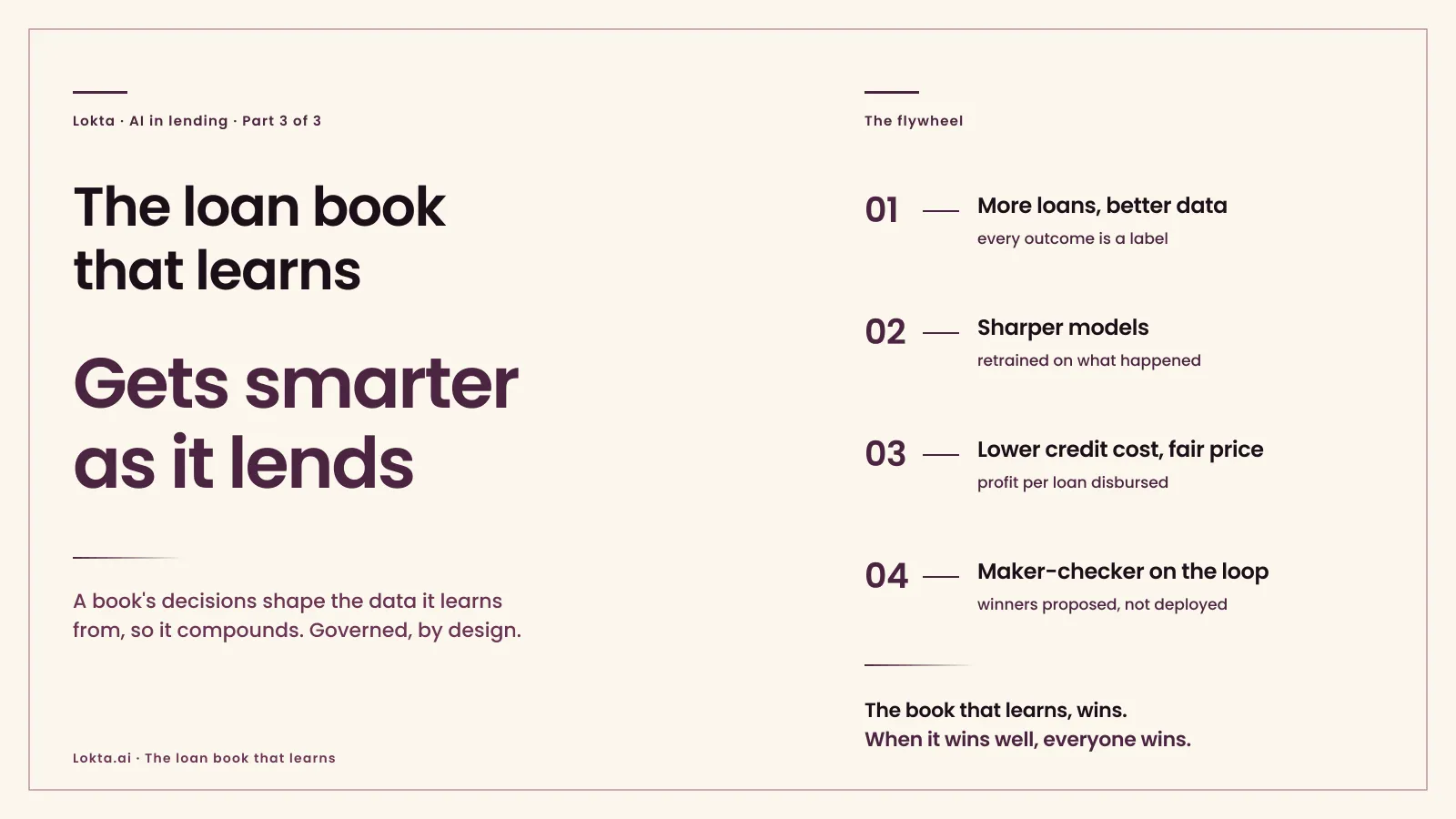
The search for better strategies can be automated, and speed there is valuable. The loan book that learns sets out why the promotion step should stay with a person: a winner is proposed, runs as a challenger in shadow mode against the champion, and goes live only when a second person approves the change.
What should the record keep?
Every contact and every strategy version, on the same record as the loan.
- Each contact: when, which channel, who or what sent it, which strategy version chose it, and the outcome.
- Each promise to pay: amount, date, and whether it was kept.
- Each hardship note and dispute, and where it was routed.
- Each strategy version: what changed, the test that justified it, and who approved it.
- The contact-window and consent check that ran before each message.
With that record, the CRO’s question has an answer, and so does a borrower complaint or an RBI inspection.
Where do agents fit in collections?
Inside the early buckets, within limits the lender sets. An agent can send reminders within permitted hours and channels, record a promise to pay, spot a hardship signal in a message and route it to a person, and prepare the account history for a caller. The lender decides the eligible accounts, the cadence, the content and the stop conditions.
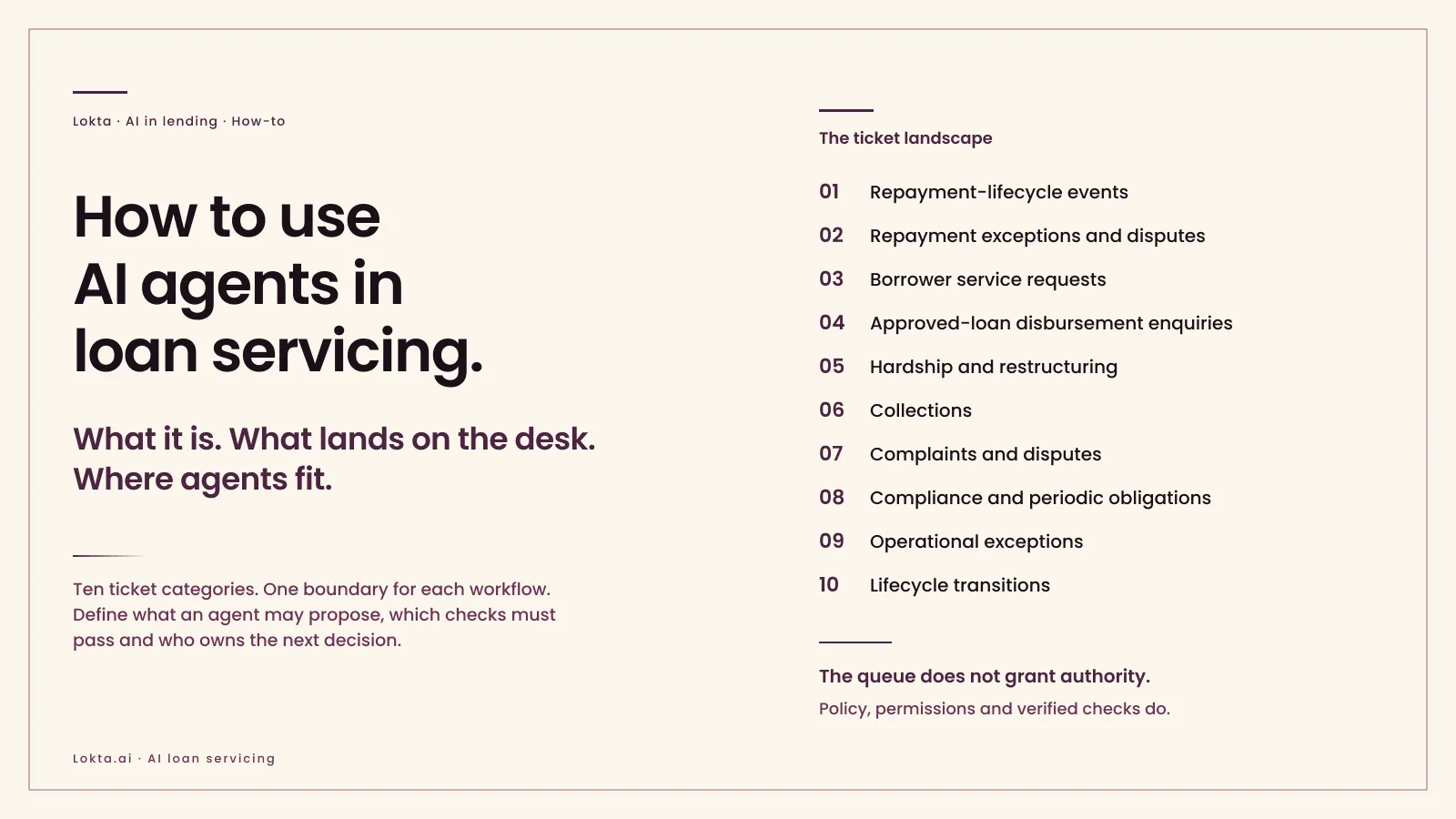
Agents stop where decisions become consequential. Settlements, payment plans outside policy, write-offs and legal escalation stay with people, with the agent preparing the context. How to use AI agents in loan servicing maps that boundary for every servicing workflow, and the AI servicing workflow worksheet turns it into a page your team can fill in.
Which path fits your collections team?
If you want to be the collections head who can show which strategy won, on what evidence, and who approved the change, there are three ways to run strategy.
- Keep changing strategy on judgement, bucket-wide, each quarter. It is quick to decide. Afterwards nobody can separate the effect of the change from the season or the borrower mix.
- Test each change as a challenger on a random slice, read it after a full cycle, and have a named approver promote the winner. Each change takes longer to adopt, and each one comes with evidence.
- Let an optimiser change strategy on its own as results come in. It moves fastest. No person signs the change, and nobody reviews it for fairness to each borrower group before borrowers feel it.
The second route has a cost. It needs clean outcome data on every contact and patience for a full cycle before a result can be read, so it is slower than a judgement call for any single change.
Lokta’s AI Loan Servicing works collections on the live loan record, from prioritising accounts and contacting borrowers to tracking promises to pay, proposing treatments and escalating. It checks the permitted contact window before a message goes out, logs each contact, and leaves legal escalation with people. The people behind Lokta wrote Apache Fineract, the open-source lending core, then built it on a deterministic core whose decisions can be replayed against the policy version that allowed them.
Frequently asked questions
What is the X bucket in collections?
It is Indian lending shorthand, not an RBI term, for accounts that were current until this month's instalment was missed. Lenders define its edges slightly differently, but the idea is the same: a borrower with no history of arrears who has just missed one payment. Speed matters more than pressure with these borrowers.
What is champion-challenger testing in collections?
The current strategy is the champion. A new one, the challenger, is run on a random slice of the same bucket, first in shadow mode and then live, and the two are compared on the same measures over the same period. The challenger replaces the champion only when it wins on evidence and a named person approves the change.
How often should a lender change its collection strategy?
When a challenger has beaten the current strategy on evidence over at least one full cycle of the bucket, and a named approver has signed the change, rather than on a calendar. A lender with a working test process can make small changes often, because each change is measured and every earlier version stays on the record.
Can AI agents run collections for an NBFC?
The lender runs collections. Agents can take on bounded work inside the lender's policy: reminders within permitted hours and channels, recording promises to pay, and routing hardship or disputes to a person. Settlements, write-offs and legal escalation stay with people, and the platform should check the contact window before any message goes out. What RBI's rules let an automated contact do is set out in AI in loan collections under RBI's rules.
Read next:
- The loan book that learns: why the search for better policy can be automated while its promotion stays human.
- How to use AI agents in loan servicing: the control boundary for every servicing workflow, collections included.
- AI Loan Servicing: collections and recovery on the live loan record, with every contact on the audit trail.
Sources:
- Reserve Bank of India (Non-Banking Financial Companies - Responsible Business Conduct) Directions, 2025: RBI/DOR/2025-26/362, 28 November 2025, updated as on 1 July 2026. Paragraph 100 (recovery conduct and the microfinance carve-out) and paragraph 106 (repeal of earlier NBFC conduct instructions).
- Outsourcing of Financial Services: Responsibilities of regulated entities employing Recovery Agents: RBI/2022-23/108, DOR.ORG.REC.65/21.04.158/2022-23, 12 August 2022. The earlier source of the same conduct list, paragraph 2.
- Reserve Bank of India (Non-Banking Financial Companies - Income Recognition, Asset Classification and Provisioning) Directions, 2025 and Resolution of Stressed Assets Directions, 2025: the NPA line and the SMA bands behind the bucket table.
Chandramouli is a co-founder of Lokta, the agentic loan servicing platform. Across two decades in technology, go-to-market and consulting, he has also served as an independent director on the board of an NBFC.