Training a Servicing Team on AI Agents Is Not a Screen Tour
The training that decides whether an agent rollout works is not which button approves a proposal. It is whether the team builds the judgment to know when to trust one, question one, or escalate one.
Every AI agent rollout starts with a training session, and every training session covers the same ground: here is the queue, here is a proposal, here is the approve button and here is the escalate button. None of it teaches the thing that actually decides whether the rollout works, which is when a reviewer should trust a proposal without a second thought and when they should not.
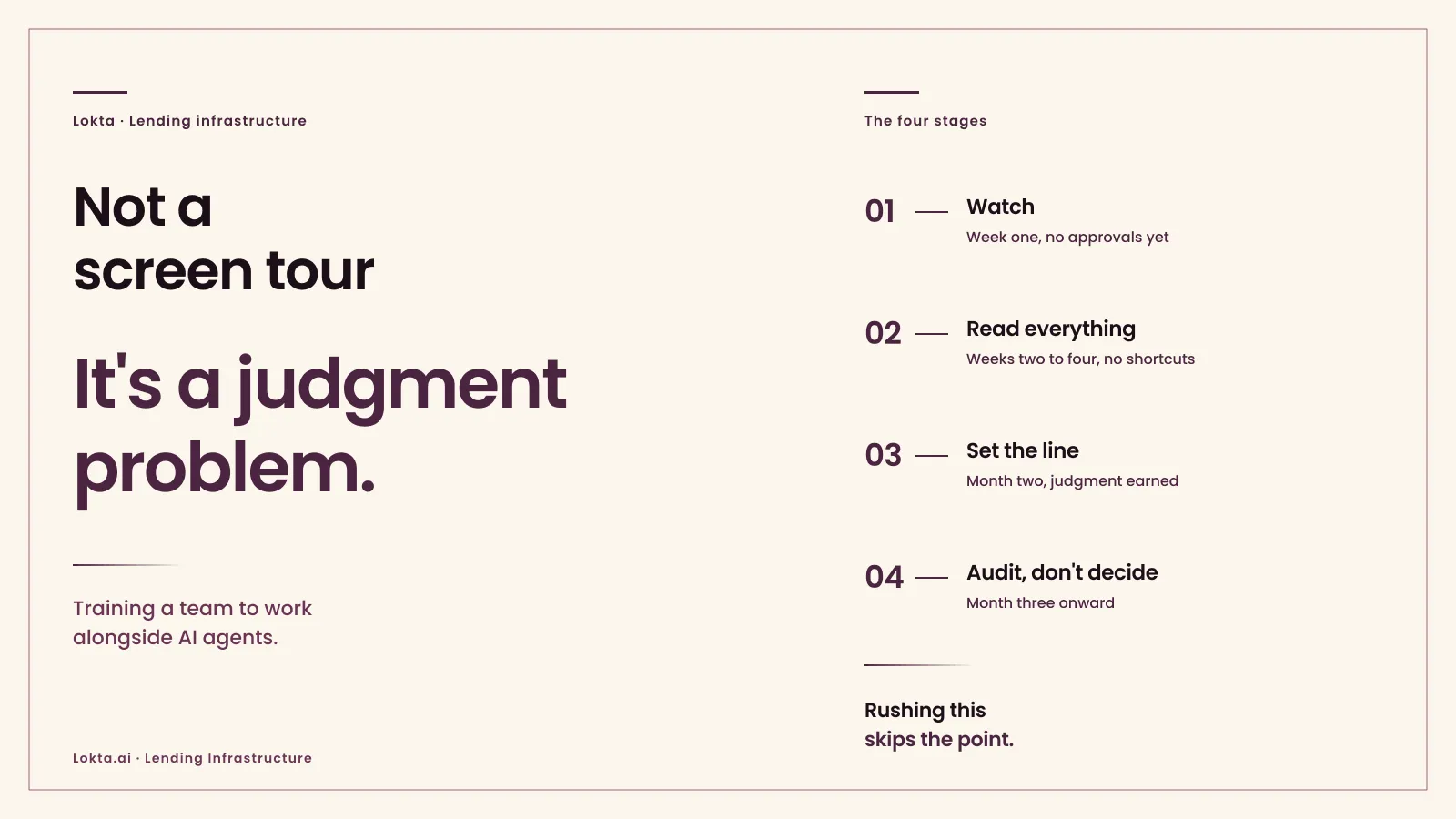
Interface training teaches which button does what. It does not teach judgment, and judgment is the actual skill a team needs to work alongside AI agents. That judgment builds in a sequence: watch the queue before touching it, read every proposal in full for several weeks regardless of confidence, set a personal threshold for what needs a closer look, then shift to auditing a sample of past decisions instead of reviewing every one. A team that skips straight to fast approvals has skipped the part where the judgment actually forms.
A screen tour can be taught in an afternoon by whoever sold the platform. The judgment cannot, because it depends on this lender’s own book, this team’s own account patterns, and mistakes this specific reviewer has not made yet. Training that stops at the interface has covered the part that was never the hard part.
Week one: watch before you touch anything
A new reviewer’s first week should involve no approvals at all. They sit with someone experienced and watch proposals come through the queue: what the agent flagged, why, what evidence it cited, and what the experienced reviewer does with it. This is the part rollouts skip most often, because it produces no visible output and looks like the team is behind schedule.
It is not wasted time. A reviewer who has never seen what a normal proposal looks like has no basis for recognizing an abnormal one later. Skipping this week does not save time, it defers the cost to the first serious mistake, which now happens in production instead of during onboarding.
Weeks two to four: every proposal gets read before it executes
Once a new reviewer starts approving, every proposal gets read in full, regardless of how routine it looks. This is deliberately slower than the platform allows, and that is the point. The reviewer is not yet building speed. They are building a mental library of what typical proposals in this book actually look like, so that an atypical one stands out later without having to be told it is atypical.
This is also where rubber-stamping either takes root or gets caught early. A reviewer clicking approve without reading is invisible in the interface, since the approval looks identical either way, but it shows up fast in a spot audit: ask a reviewer why they approved a specific proposal from that morning, and a real judgment call answers in one sentence. A rubber stamp produces a shrug.
Month two: the team sets its own escalation line
By the second month, the reviewer has seen enough proposals to know which categories in this specific book tend to need a closer look and which tend to be reliably routine. This is when the pace can pick up, not because the platform changed, but because the reviewer’s judgment now has a basis. The escalation line the team sets here should be written down, since it is exactly the kind of decision an RBI inspection or an internal audit will ask about later: what gets fast-tracked, what gets a second reviewer, and why.
Where AI agents can actually help in loan servicing sets out the task boundary the platform itself enforces. What a team decides inside month two is the human half of that boundary: not what the agent is allowed to propose, but how closely a person looks at each kind of proposal before it lands.
Month three: auditing decisions instead of making them
By the third month, a mature reviewer is spending less time approving individual proposals and more time auditing a sample of decisions after the fact, checking whether the pattern of approvals still matches the judgment the team agreed on in month two. This is the stage most rollouts assume happens automatically once a team gets comfortable. It does not. It requires someone to deliberately step back from the queue and start checking the queue’s own behavior instead.
A team that never reaches this stage stays permanently in review mode, which caps how much the agent actually saves anyone. A team that reaches it without having gone through the first two stages properly is auditing decisions it never actually understood making.
What the screen tour actually misses
None of the four stages above appears in a typical rollout plan, because none of them is a platform feature. They are a team’s own skill-building sequence, and skipping them does not make the team faster. It makes the team’s approvals faster to click and slower to actually mean anything.
There are three honest ways to run this properly. Budget the first month of a rollout as training time with no productivity target attached, which is a hard sell to a board watching for ROI. Pair every new reviewer with an experienced one for the first several weeks, which costs the experienced reviewer’s time twice over. Or accept that the first quarter of any agent rollout will look slower than the pitch promised, and treat that as the actual cost of the judgment forming correctly instead of a problem to fix.
Frequently asked questions
What does training look like for a team starting to work with AI agents in loan servicing?
It is a four-stage sequence, not a one-day interface demo. A new reviewer watches the queue before touching it, then reads every proposal in full for several weeks regardless of confidence, then sets their own threshold for what gets a fast approval versus a slower look, and finally shifts to auditing a sample of agent decisions after the fact rather than reviewing every single one. Skipping straight to the last stage is how rollouts fail quietly.
How long does it take a servicing team to actually trust AI agent proposals?
Long enough that rushing it defeats the point. Most teams need four to eight weeks of close review before a reviewer's judgment about which proposals need scrutiny becomes reliable enough to loosen. The timeline depends more on volume and how varied the account mix is than on the platform itself; a team seeing the same handful of scenarios repeatedly builds judgment faster than one seeing edge cases from day one.
What is the biggest risk when training a team to work with AI agents?
Rubber-stamping. A reviewer who approves every proposal without reading it has not actually reviewed anything, whether they realize it or not, and the audit trail records an approval that carries no real judgment behind it. The opposite failure, rejecting everything by default, defeats the point of the agent but is at least visible and self-correcting. Rubber-stamping is quieter and more dangerous, because it looks identical to a healthy process until something goes wrong.
Should AI agent training be run by the vendor or by the lender's own team?
Both, at different stages. A vendor can teach the interface and the mechanics of a proposal, approval and escalation in an afternoon. Only the lender's own team can teach the judgment: which account patterns in this specific book deserve a second look, what a bad proposal actually looks like for this portfolio, and where the line between trust and scrutiny should sit. A rollout that treats vendor training as sufficient has covered the mechanics and skipped the judgment.
Read next:
- How to use AI agents in loan servicing: the task boundary a platform enforces, which this post’s training sequence is designed to work inside.
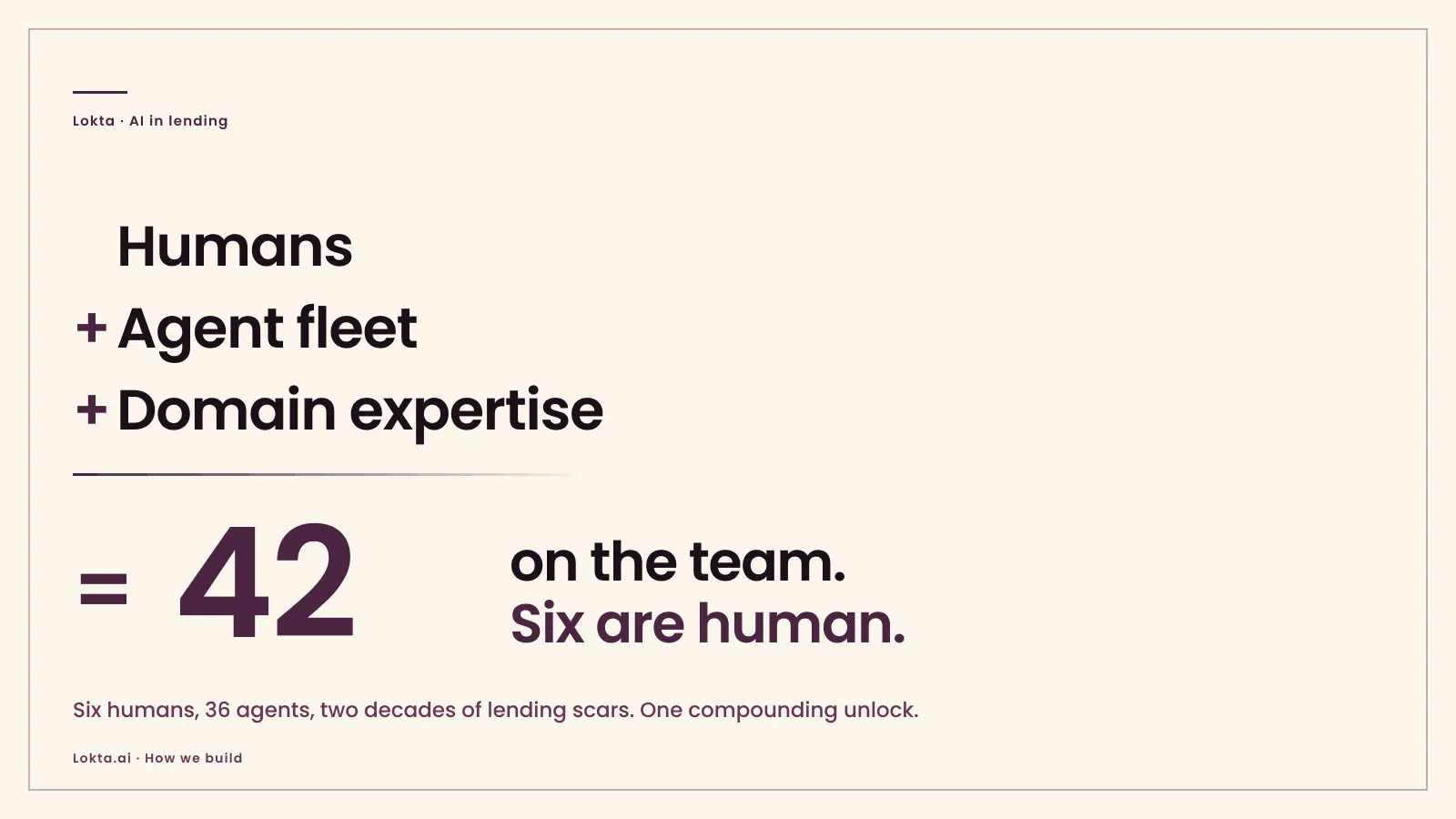
- Our team is 42. Six of us are human.: what an agent-assisted team looks like once the judgment described here is fully built.
- LMS implementation timeline: where system training on a new platform fits inside a full rollout, a different and earlier problem than the one this post covers.
Chandramouli is the co-founder and CEO of Lokta, the agentic loan servicing platform. He has spent two decades building AI for decisions that change people’s lives, and has served as an independent director on an NBFC board. He writes here about the difference between a team that trusts a system and a team that has actually earned the right to.