Credit bureau reporting for NBFCs: four reference dates a month from July 2026
Since 1 July 2026, NBFCs report to credit bureaus as on the 9th, 16th, 23rd and month end. Deadlines, rejections, corrections, and what your LMS must produce.
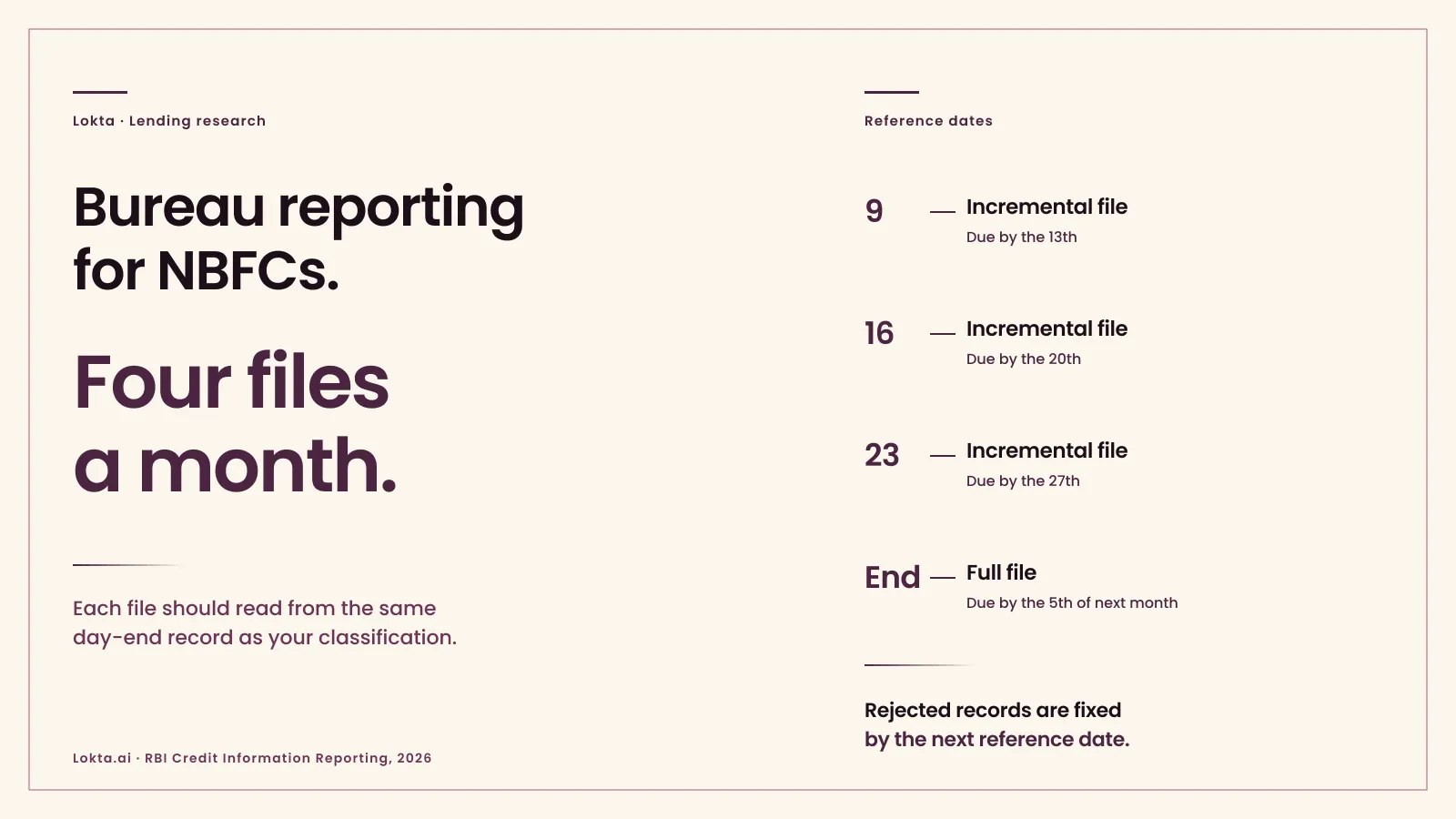
From 1 July 2026, an NBFC sends credit information to every credit bureau as on the 9th, 16th, 23rd and last day of the month. Mid-month files carry accounts that changed and are due within four calendar days. The month-end full file is due by the 5th. Rejected records have to be fixed by the next reference date.
If you head compliance or operations at an NBFC, the bureau file now leaves your building four times a month, and each copy is a public statement about your borrowers. A borrower who paid on Tuesday and still shows overdue on a lender’s report is the complaint that lands on your desk.
Four dates a month turn the bureau file into one of two things. It is either a by-product of the ledger, generated from the same day-end record that set each account’s days past due, or it is a fire drill that someone runs four times a month. Under the new cadence, a file assembled by hand from exports will disagree with your own classification sooner or later, and the borrower will be the one who notices.
- Four files a month. Reference dates are the 9th, 16th, 23rd and month end, replacing the fortnightly cycle.
- Mid-month files are due in four days. The month-end full file is due by the 5th of the next month.
- Rejections roll forward. A rejected record has to be fixed before or with the next reference date’s file.
- Late corrections cost money. A complaint unresolved after 30 days earns the borrower ₹100 a day, and the lender has 21 of those days.
- One DPD, everywhere. The days past due in the bureau file should be the days past due that drove classification that night.
What changed on 1 July 2026?
The frequency, the deadlines and the rejection window all tightened. Until 30 June 2026, NBFCs reported fortnightly, as on the 15th and the last day of the month, within seven calendar days. The Credit Information Reporting Amendment Directions, 2025 (RBI/DOR/2025-26/117, issued 4 December 2025) moved them to four reference dates a month from 1 July 2026.
What did not change: every NBFC has to be a member of all the credit information companies registered with RBI (paragraph 6) and report to each of them in the Uniform Credit Reporting Format, which has consumer, commercial and microfinance segments. The same file goes to all four bureaus, so an error goes to all four too.
You may see this called weekly reporting. RBI’s text never uses that word. It names four reference dates, and the month-end one follows the calendar, not a seven-day cycle.
What are the reference dates and deadlines?
Paragraph 10(2) of the Credit Information Reporting Directions sets them.
| Reference date | What you submit | Due at the bureaus |
|---|---|---|
| 9th | Incremental file | Within four calendar days, so by the 13th |
| 16th | Incremental file | Within four calendar days, so by the 20th |
| 23rd | Incremental file | Within four calendar days, so by the 27th |
| Last day of the month | Full file of all records | By the 5th of the next month |
Each file describes the book as on its reference date. A file built on the 12th for the 9th still has to show what was true at day-end on the 9th, which is only possible if your loan system can report a past date without recomputing it from today’s balances.
What goes in the full file and the incremental file?
The month-end full file carries every account you report, active and closed. The three incremental files carry the accounts that moved since the last reference date: newly opened accounts, relationships closed in the period, accounts with changes such as repayments or updated balances and demographic details, and accounts with overdue interest or principal.
Two fields are easy to miss.
- The Central KYC (CKYC) number goes into the record wherever the NBFC has it, and as soon as it becomes available (paragraph 12(10)).
- When a file reports default or days past due on an existing facility, the NBFC has to send the borrower an SMS or email alert wherever it holds a mobile number or email address (paragraph 34(1)(i)).
The second one ties your bureau file to your borrower communications. If the file says a borrower is 12 days past due, the alert should say the same thing on the same day.
What happens when a credit bureau rejects a record?
It becomes the next file’s problem. Paragraph 15 requires the NBFC to rectify rejected data and resubmit it before, or along with, the submission for the next reference date. With four reference dates a month, the gap between one rejection report and the next deadline is about a week.
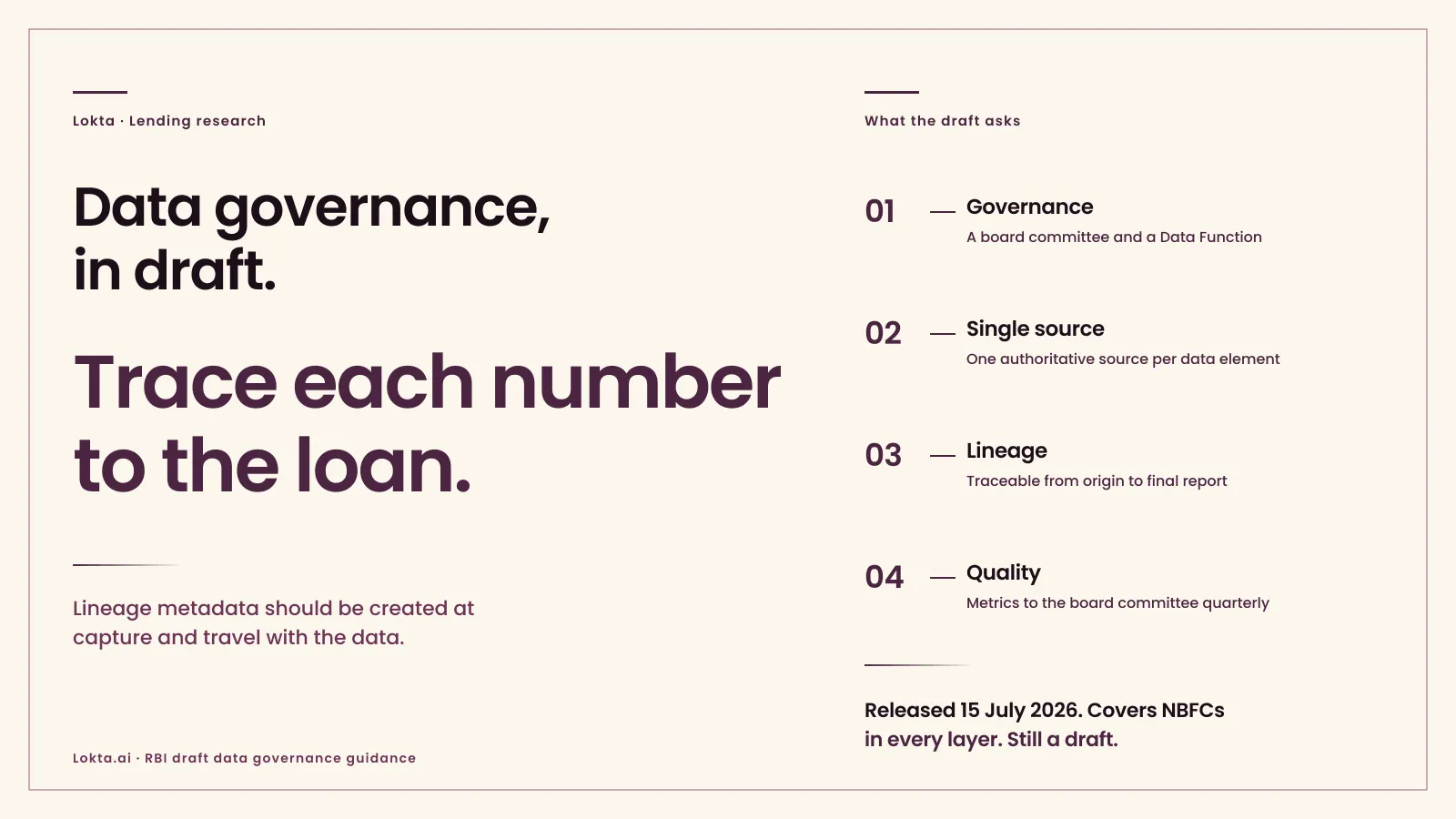
Rejections come from data problems such as a missing or malformed identifier, a date of birth that fails validation, or an address split across the wrong fields. Each one has to be fixed where it was entered. Paragraph 19 puts erroneous data on the lender to correct at source, so a patch applied only to the outgoing file will be rejected again next time. RBI’s draft data governance guidance goes further: it asks for one authoritative source for each data element. The data governance post sets out what that would mean for loan data.
Why do closed loans still show overdue?
Because the closure never reached the bureau, or reached it with the wrong status. A borrower closes a loan, the final receipt posts, and the next file either leaves the account out or sends an old days-past-due figure. The borrower pulls a report, sees an overdue account, and complains.
The rules put a clock on the fix. The lender has 21 calendar days from being told to send corrected information to the bureau. If the complaint is not resolved within 30 calendar days of filing, the borrower is entitled to ₹100 for every day beyond that, and the lender pays when the delay is on its side (paragraph 35). Closed relationships belong in the next incremental file, so a closure that posts on the 10th should be at the bureaus by the 20th.
How are co-lent loans reported?
Each lender reports its own share. Under the Co-Lending Arrangements Directions, 2025, each co-lender sends the bureaus its part of the exposure, and when a default in the co-lent exposure makes one lender classify it SMA or NPA, the other applies the same status, shared by the end of the next working day. A co-lending book therefore produces two sets of bureau records from one loan, and the two only agree if both lenders’ positions come from one set of events.
Why must bureau DPD match classification DPD?
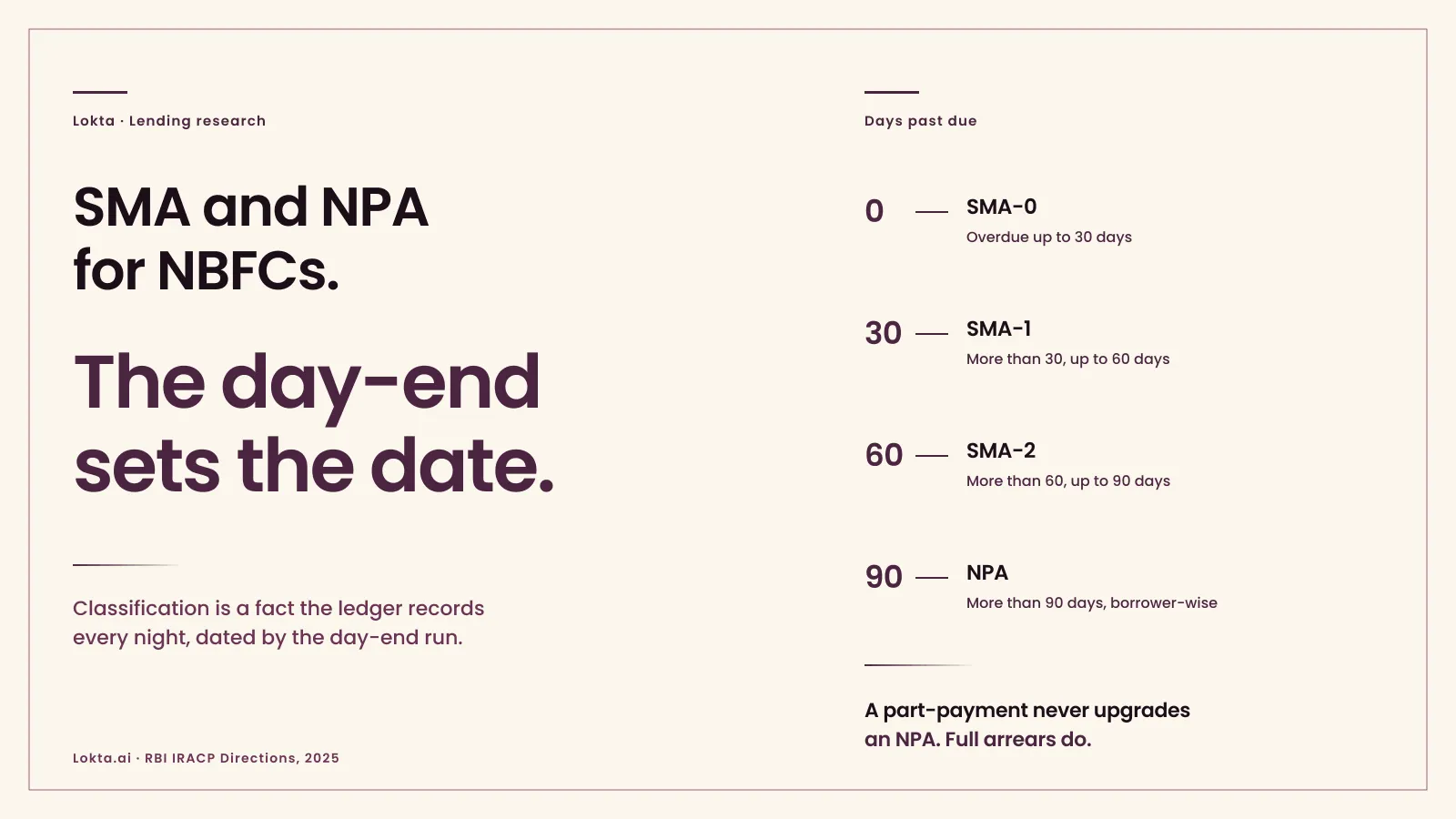
Because both are statements about the same account on the same date. The day-end run that flags an account SMA-1 on the 16th records its days past due. The file for the 16th reports days past due to four bureaus. If the two numbers differ, one of them is wrong, and a borrower, an auditor or RBI will eventually find out which.
The SMA and NPA classification rules make the day-end run the source of the classification date. Bureau reporting should read from the same record. A reporting script that recomputes days past due from a separate export will drift from the ledger the first time a payment is reversed or reallocated.
What does one month of reporting look like?
This scenario shows the rules. It is not a real account. A personal loan has its EMI due on the 5th. In October 2026 the EMI is missed, and the borrower pays the full arrears on the 20th.
Under the fortnightly cycle, the missed EMI would have been reported as on 15 October and the cure as on 31 October. Under the new one, the bureaus hold the first by 13 October and the second by 27 October.
What should you ask your LMS vendor?
Put these to any vendor, including the one you have today, and ask for the answer on a copy of your own book.
- Can the system produce the file for a past reference date exactly as the book stood at that day-end?
- Does the days past due in the file come from the same record as the classification, or from a separate export?
- Which account events put an account into the next incremental file, and is a reversal one of them?
- How are rejection reports loaded back, and where does the correction get made?
- Is the CKYC number a field on the borrower record, reported whenever it is present?
- For co-lent loans, does each lender’s file carry only its share, with the shared classification?
- When the file reports days past due, does the borrower alert go out from the same event?
The functional requirements template and the NBFC LMS RFP guide carry questions like these in RFP form.
Which path fits your reporting?
If you want to be the compliance head whose bureau file agrees with the ledger on every reference date, there are three ways to get there.
- Keep the current export and a team that cleans it before each submission. Nothing changes this quarter. The team now does that work four times a month, and each clean-up is a place where the file can drift from classification.
- Generate each file from the ledger’s day-end record and test it with the seven questions above. The file, the classification and the borrower alert then come from one source.
- Build the file in a data warehouse from nightly extracts. You control the logic, and you also own the lag between the warehouse and the ledger, which shows up the first time a payment is reversed after the extract.
The second route does not clean your data for you. A missing CKYC number or a malformed address is still missing when the file is generated from the ledger, and fixing those at source is operations work.
Lokta Loan Management includes bureau reporting in the published Next 100 terms for NBFCs up to ₹100 crore of AUM. Credit bureau connectors are delivered with deployment, sequenced to your priorities, on a double-entry, event-sourced ledger that can re-derive any book from its history. Our team built Apache Fineract, the open-source lending core, and has spent a decade on the reports a loan ledger has to produce.
Frequently asked questions
How often must an NBFC report to credit bureaus from July 2026?
Four times a month. Since 1 July 2026, NBFCs submit credit information as on the 9th, 16th, 23rd and last day of each month. The three mid-month files carry changed accounts and are due within four calendar days of their date. The month-end full file is due by the 5th of the next month.
What happens when a credit bureau rejects a record?
The NBFC has to fix the rejected data and resubmit it before, or along with, the file for the next reference date. With four reference dates a month, that leaves about a week. A rejection that is not fixed means the bureau keeps showing the old position for that borrower.
What compensation applies if a credit information complaint is not resolved in 30 days?
The complainant is entitled to ₹100 for every calendar day beyond 30 days from the complaint. The lender has 21 calendar days of that window to send corrected data to the bureau, and pays the compensation if the delay is its own.
Does Lokta include credit bureau reporting?
Yes. Under the published Next 100 terms for NBFCs up to ₹100 crore of AUM, bureau reporting is included in the platform. Credit bureau connectors are delivered with deployment and sequenced to your priorities. Ask to see a reference-date file generated from a copy of your own book before you sign.
Read next:
- SMA and NPA classification for NBFCs: the day-end rules that set the days past due your bureau file reports.
- What a loan management system costs: where reporting and integrations sit on a five-year cost sheet.
- Lokta Loan Management for NBFCs: the LMS built as a ledger for India’s regime.
Sources:
- Reserve Bank of India (Non-Banking Financial Companies - Credit Information Reporting) Directions, 2025: RBI/DOR/2025-26/349, 28 November 2025, updated as on 1 July 2026. Paragraphs 6 (membership), 10(2) (reference dates and deadlines), 12(10) (CKYC), 15 (rejected data), 18-19 (correction at source), 34(1)(i) (borrower alerts), 35 (compensation).
- Credit Information Reporting Amendment Directions, 2025: RBI/DOR/2025-26/117, 4 December 2025, effective 1 July 2026.
- Master Direction, Credit Information Reporting Directions, 2025: RBI/DoR/2024-25/125, 6 January 2025. The fortnightly cycle in force until 30 June 2026.
- Reserve Bank of India (Co-Lending Arrangements) Directions, 2025: RBI/DOR/2025-26/139, paragraphs 31 and 33. Each lender reports its own share, and classification is shared by the end of the next working day.
Read this as an operating guide to the Credit Information Reporting Directions, not as legal advice, and take questions about your own filings to counsel.
Chandramouli is a co-founder of Lokta, the agentic loan servicing platform. He has spent more than twenty years across technology, go-to-market and consulting, and has served on the board of an NBFC as an independent director.