Loan management system cost: pricing models and TCO
What a loan management system costs: the pricing models vendors use, the fees buried in implementation and change requests, and a published price to anchor on.
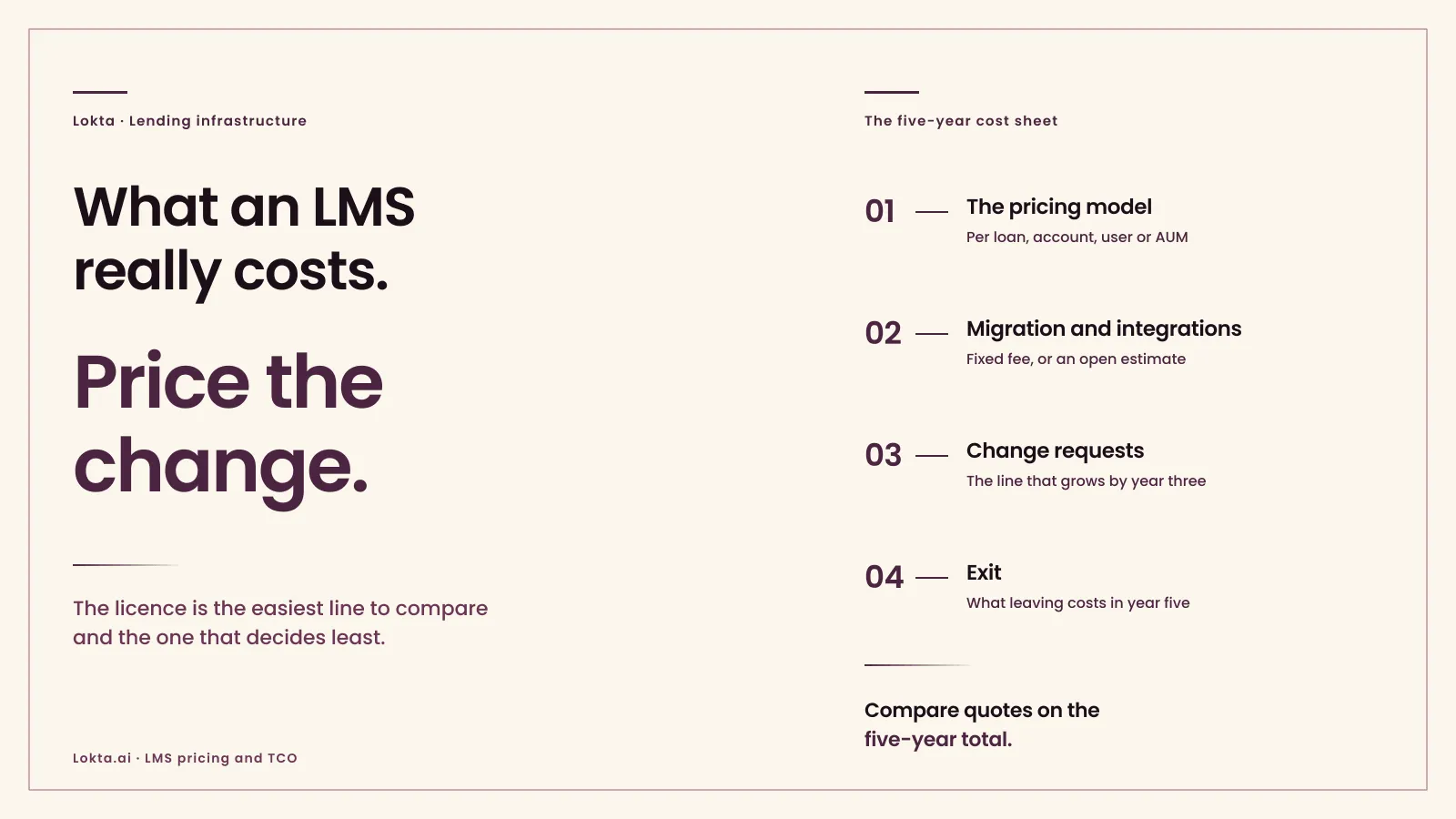
A loan management system costs whatever its pricing model charges as your book grows, plus implementation, migration, integrations and every change after go-live. Of three vendor pricing pages we checked, one publishes figures, from $1,200 a month for up to three users. Lokta’s Next 100 terms charge NBFCs up to ₹100 crore of AUM no platform fee for 24 months, then 1 bps a month on AUM. Over five years, the cost of change can decide the total.
If you are putting a Loan Management System (LMS) decision in front of a board, the number that matters is the five-year cost of running your book on it. The monthly fee on page one of a quote is easy to compare. It is only one part of that cost.
The less visible lines sit further back: what migration costs, which integrations are extra, and what happens when you need a new product variant or a regulator changes a rule. Two quotes with the same licence can be far apart by year three.
Reading a quote well means knowing the four pricing models, where the money goes after signature, and what building or running open source costs. One published price gives you a reference point.
- Four pricing models, four growth curves. Per loan, per active account, per user and basis points on AUM each get more or less expensive in different ways as your book grows.
- The licence alone cannot establish total cost. Implementation, migration, integrations and paid change requests decide five-year cost.
- A build keeps costing after launch. Every RBI circular after go-live lands on your own engineering team.
- Open source drops the licence fee. Hosting, upgrades, patches and local rules become your cost.
- Ask what one change costs. That answer tells you more about year three than any discount on the licence.
What does a loan management system cost?
There is no list price for the category, because vendors do not agree on what they are charging for. One vendor charges for seats, another for loans, another for the size of your book. Of the three vendor pricing pages linked below, one publishes prices, one publishes only its model, and one asks you to talk to sales.
So the useful answer is a method. Put every quote on the same five-year sheet, in the same units, with the same book growth, then compare the licence with implementation, ongoing operations and change.
How is loan management software priced?
Each model is reasonable. Each also puts the cost of growth in a different place, and that is the part a quote does not show.
| Pricing model | How it scales | What to watch |
|---|---|---|
| Per loan or per transaction | Rises with every loan booked or transaction posted. A published example charges a fixed monthly bundle up to a transaction volume, then overage. | Short-tenor, high-volume books (BNPL, consumer durable) pay the most per rupee lent. |
| Per active account | Rises with accounts on the book, whatever their size. One vendor’s published billing rules count billable accounts as the highest of seven metrics, rule evaluations among them. | Written-off and closed accounts still being serviced may count. Ask which states are billable. |
| Per user | Rises with staff logins. One published price is $1,200 a month for up to three users, then $400 per additional user. | Cheap at pilot size. Expensive once collections and operations staff need access. |
| Basis points on AUM | Rises with the size of the book, not the number of loans or people. | How AUM is measured: average or month-end, and whether write-offs and co-lent shares count. |
A flat annual licence is the fifth shape, common with older on-premise systems. It looks predictable until the annual maintenance fee and the upgrade project are added back in.
Where does the money go after you sign?
Four lines sit outside the licence, and together they are where quotes drift apart.
Product configuration, opening balances, reconciliation against the old system, and a parallel run. Ask whether migration is a fixed fee or a services estimate that grows with data quality.
Bank and payment rails, NACH and UPI mandates, credit bureaus, KYC, accounting. One published price list charges $10 per application for its origination integration, with a monthly minimum.
A new product variant, a changed fee rule, a new RBI return. If each one is a billable vendor project, this becomes the largest line by year three. We wrote about it as the customization trap.
The fourth line is people: training, and the consultant hours you buy when the vendor’s team is the only one that can make a change. The same published price list charges $165 an hour for online training and $185-$285 an hour for consulting.
Is it cheaper to build, buy or run open source?
Each path moves cost to a different place.
A build is budgeted as a project, but its cost continues as salaries. The first release is the cheap part. The expensive part is year two onward, when the same team has to absorb every new direction on classification, disclosure and reporting while also building product.
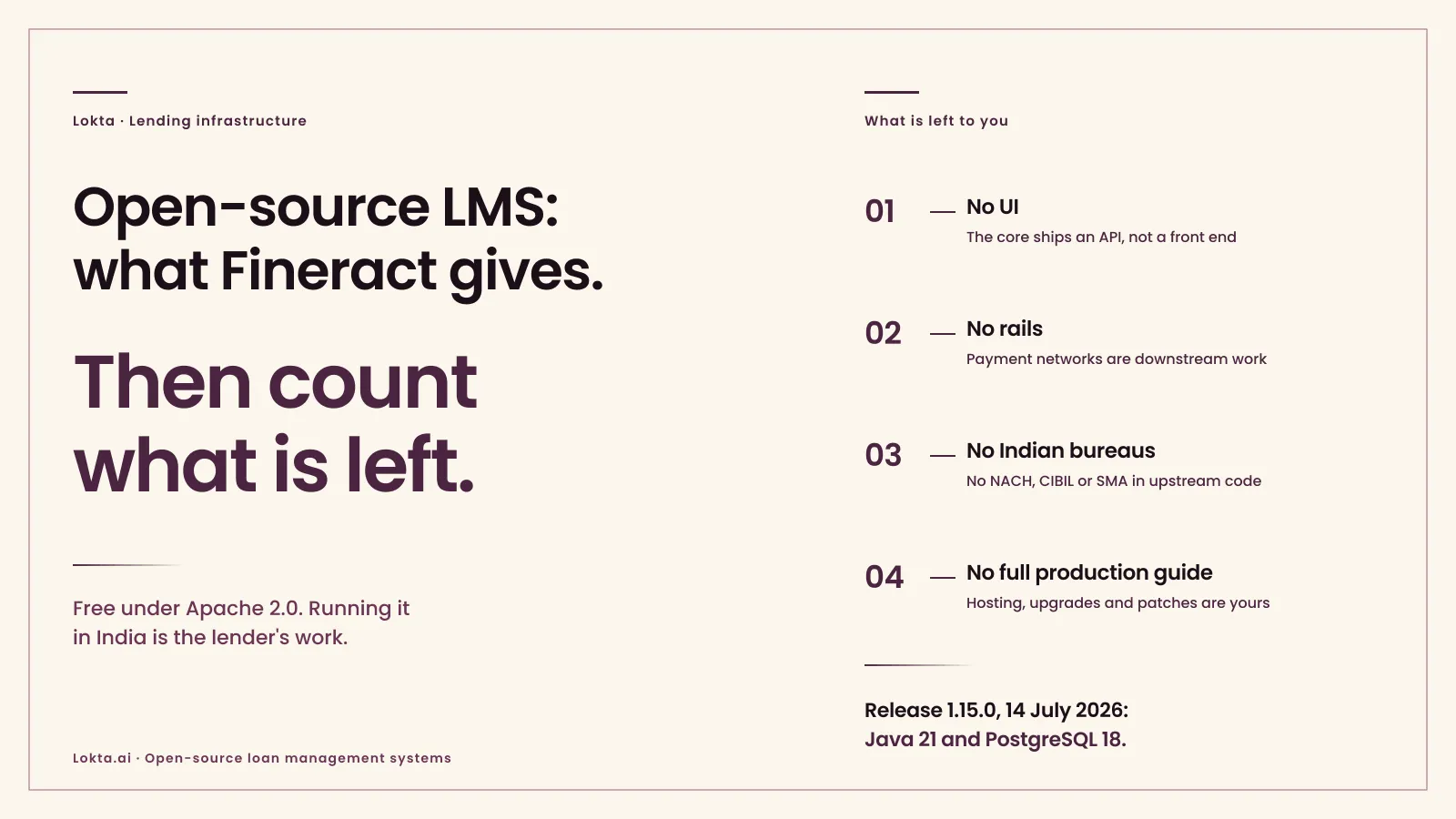
Open source is a real option for a lender with engineers, and if your team wants to own and fork the source, no other path gives it more control. Our team built Apache Fineract, and we would still say: its README notes that the project does not provide a comprehensive guide to deploying it in production. That gap is a cost. Our Apache Fineract alternative page sets out what the core gives you and what you still build.
What does a published LMS price look like?
Of the three vendor pricing pages in the sources, only one shows a number. Lokta publishes its Next 100 terms for NBFCs, which gives you one more price to anchor a quote against.
The terms that matter for a five-year sheet, as published on the Next 100 page:
- Billing starts at the earlier of two events: AUM above ₹100 crore for two consecutive months, or the 24 months ending.
- The rate after that is 1 bps a month on average monthly AUM, which is ₹1,000 a month for every ₹1 crore. AUM counts principal outstanding including write-offs, your co-lending share, and accounts assigned or securitised but still serviced on Lokta.
- Migration is ₹1 lakh one-time and bank integration ₹50,000 flat, both plus taxes. A fresh licence with no book pays neither fee.
- Bureau reporting, loan accounting, reporting, maker-checker and audit trail, and email and phone support are included.
- AI is opt-in, estimated before activation, billed on actual use, and can be switched off.
- RBI-registered NBFCs up to the cap are eligible. Pure-play microfinance NBFCs are excluded.
The trade-off is plain: capacity is 2 assisted implementation starts a month, so a lender who applies today may start in a later month.
How do you compare five-year cost across vendors?
Fill one column per vendor, in the same currency, with the same book growth. Anything a vendor will not price goes in as a question, not a zero.
| Cost line | What drives it | What to put in the cell |
|---|---|---|
| 1. Platform fee, years 1-5 | The pricing model applied to your book, year by year. | Your own growth plan, not today’s book. |
| 2. Implementation | Products configured, environments, parallel run. | A fixed fee, or the estimate and its assumptions. |
| 3. Migration | Accounts, history, data quality, reconciliation. | Fixed or variable, and who reconciles. |
| 4. Integrations | Banks, mandates, bureaus, KYC, accounting. | Price per integration and any per-call fees. |
| 5. Change requests | New variants, fee rules, RBI changes. | Vendor fees plus internal specification, testing and release effort. Track elapsed time separately. |
| 6. Hosting and support | Where it runs, support tiers. | Included, or priced separately. |
| 7. Your own people | Engineers and operations staff the platform needs. | Headcount × cost, for every path including build. |
| 8. Exit | Data export, notice periods, termination fees. | What leaving costs in year five. |
Illustration, using the published Next 100 terms and nothing else: an NBFC goes live with ₹60 crore AUM and stays under ₹100 crore for 24 months. It pays ₹1 lakh for migration and ₹50,000 for one bank integration, plus taxes, and no platform fee in years one and two. If the book averages ₹120 crore in year three, the platform fee that year is ₹1.2 lakh a month, or ₹14.4 lakh for the year. Lines 5 to 8 still need filling in against your own plan.
Compare the same operating scope
Before adding the numbers, make the inclusions comparable. “Migration included” could describe opening balances, selected transactions or a reconstructable account history. “Bank integration included” does not identify the bank, rail, environments or party responsible for reconciling a failed receipt.
Use the same acceptance scope for every proposal. The following worksheet is a starting point for loan management and servicing procurement, rather than a universal minimum specification.
| Scope line | Define before comparing price | Evidence for acceptance |
|---|---|---|
| Migration history | Products, dates, balances, events and documents to retain | Reconciled sample accounts and an agreed record of gaps |
| Integrations | Named interfaces, environments and external dependencies | Normal, duplicate, delayed and failed-event results |
| Reconciliation | Who matches counts, amounts and exceptions at go-live and afterwards | Control totals and an exception owner |
| Training and support | Roles, scenarios, access and support coverage | Operators complete agreed cases and escalation steps |
| Change requests | Included configuration, paid development and release responsibilities | One change followed through approval, testing and deployment |
Download the Excel LMS scope and cost calculator (.xlsx). Its first sheet calculates annual change cost, the delivery critical path and the contribution affected by a delay. A second sheet retains the comparison fields for two proposals, lender effort, dependencies and unresolved questions. Blue input cells are editable; formulas update the results. Put an excluded item in the comparison even when another supplier includes it. An unanswered cell is an open commercial question.
Change requests cost money and time to market
To price the change burden, use an illustrative year with eight changes, each with a ₹75,000 supplier fee and 40 hours of internal specification, testing and release work valued at ₹1,500 per hour. One change consumes ₹1,35,000 of combined economic cost. Eight consume ₹10,80,000, or ₹10.8 lakh. Supplier invoices account for ₹6 lakh and internal effort for ₹4.8 lakh.
The internal amount values capacity consumed. It is not necessarily an additional cash expense if existing salaries already cover it. Avoid counting it again under the people line of the five-year model. The illustration excludes taxes, hosting changes and any separately contracted maintenance. Replace every assumption with your own evidence.
Now examine elapsed time. In a second illustrative assumption, the same change spends two weeks in specification and approval, three waiting for a supplier slot, one in implementation, two in testing and one awaiting release. That is nine weeks if the stages are sequential. It is not nine weeks of continuous engineering effort. If stages overlap, calculate the actual critical path rather than adding them mechanically.
Put a value on the delay with a separate, labelled assumption. Suppose the launch could serve 100 incremental loans per week, each contributing ₹1,500 after funding, expected credit loss and incremental delivery costs. Nine weeks affects 900 loans and ₹13.5 lakh of contribution. If 25% of that demand is permanently lost, the lost contribution is ₹3.375 lakh. The remaining ₹10.125 lakh is deferred nominal contribution, not another permanent loss. This calculation does not discount the deferred amount or assume every delayed applicant eventually converts.
Those weeks can postpone a product launch or prolong a manual workaround. Estimate the consequence using incremental contribution after relevant costs, the demand that can actually be served and whether the opportunity is deferred or permanently lost. Do not enter gross loan disbursals or gross revenue as lost profit. Keep this sensitivity beside the cash budget so uncertainty stays visible.
Ask the supplier to classify a representative set of changes as lender configuration, supported extension or vendor development. Record who can make each change, who must approve it and how its effect on existing accounts is tested. A change made quickly but applied to the wrong cohort creates another operating cost.
The build-versus-buy LMS decision guide covers ownership of that work. For the cost comparison, request both the commercial basis and the release path. Neither answer substitutes for the other.
Which questions expose the hidden cost in a quote?
Put the same seven questions to every vendor, Lokta included, and ask for the answers in the contract.
- What exactly is billable: loans booked, active accounts, users, or AUM, and which account states count?
- Is migration a fixed fee? If not, what assumptions sit behind the estimate?
- Which integrations are included, and what does each additional one cost?
- Who can change a product rule or a fee after go-live: our team, or only yours? What does one change cost, and what determines the time until release?
- When RBI changes a rule, is the update part of the platform fee or a billable project?
- What does it cost to export all our data and leave, and how much notice do we give?
- What will our fee be at three times today’s book?
Our LMS RFP toolkit and the 50 questions to ask an LMS vendor go further. The best LMS for an NBFC shortlist puts the field side by side.
The takeaway
The cheapest LMS quote and the cheapest LMS to run are often different systems. Ask every vendor what a change costs, and put a five-year number in front of your board. If your book fits the Next 100 cap, you have a published price to test every other quote against.
Frequently asked questions
How much does a loan management system cost?
Of three vendor pricing pages we checked, one lists figures: $1,200 a month for up to three users, and Lokta's Next 100 terms give NBFCs up to ₹100 crore of AUM 24 months with no platform fee, then 1 basis point a month on AUM. Beyond the licence, over five years, implementation, migration, integrations and paid change requests can decide the total. Compare vendors on the same five-year sheet, with the same book growth.
Is it cheaper for an NBFC to build its own LMS?
Build only when distinctive requirements justify it and you can fund the team that will own calculations, accounting, security and changes for years after launch. Otherwise, start with buying and test the scope and change terms. Compare full operating cost, including lender acceptance work, rather than a supplier’s complete quote against a build’s first release.
What does an open-source LMS cost to run?
There is no licence fee. With Apache Fineract you still pay for hosting, security patches, upgrades, and the engineers who configure products and build the local rules your market needs. Its README says the project does not provide a comprehensive production deployment guide, so that work sits with your team or a partner you pay.
What does Lokta charge for its loan management system?
Lokta publishes its Next 100 terms for NBFCs with AUM up to ₹100 crore: no platform fee for 24 months from go-live while the book stays within the cap, then 1 basis point a month on AUM. Migration is ₹1 lakh one-time and bank integration ₹50,000 flat, plus taxes. Pure-play microfinance NBFCs are not eligible.
How do LMS change requests affect cost and time to market?
Price the supplier work and internal effort, then calculate elapsed time through queues, testing and release. In the illustrative example, nine weeks affects ₹13.5 lakh of contribution; if a quarter of demand is permanently lost, ₹3.375 lakh is lost and the rest deferred. Keep that sensitivity separate from cash TCO.
How should an NBFC compare LMS implementation proposals?
Define the same scope for migration history, integrations, reconciliation, training, support and future changes before comparing totals. Give each item an acceptance test, an owner and a pricing basis. Record exclusions and unanswered questions rather than entering zero. Include the lender’s own implementation and testing effort, avoiding double counting with other budget lines. The downloadable worksheet in this article provides a starting structure for that comparison, without prescribing a vendor or a fixed implementation price.
Read next:
- The customization trap: when LMS vendors bill every change: how the change-request line grows, and the RFP questions that surface it before you sign.
- Lokta opens its platform to NBFCs up to ₹100 crore: why the Next 100 terms are priced the way they are.
- Every lender replaces its LMS eventually: the five symptoms that say the current system has become a board-level cost.
Sources:
- Published per-user software pricing: published per-user subscription, setup, integration, training and consulting prices, checked 25 September 2026.
- Published transaction-based pricing model: per-transaction model with a fixed small-lender bundle and a monthly platform minimum, with no figures published.
- Published volume and seat pricing explanation: volume-based and per-seat models, priced by quote.
- Published billable-account definitions: the seven metrics behind a billable account.
- Apache Fineract README: the note on production deployment guidance.
- Lokta Next 100 terms: eligibility, free term, billing trigger, AUM definition, migration and integration fees.
Lokta editorial analysis by Chandramouli, co-founder and CEO.