RBI Co-Lending Directions 2025: what changes after disbursal
What RBI's Co-Lending Arrangements Directions, 2025 require once a loan is live: the 10% share, escrow, 15-day booking and next-day SMA and NPA sharing.
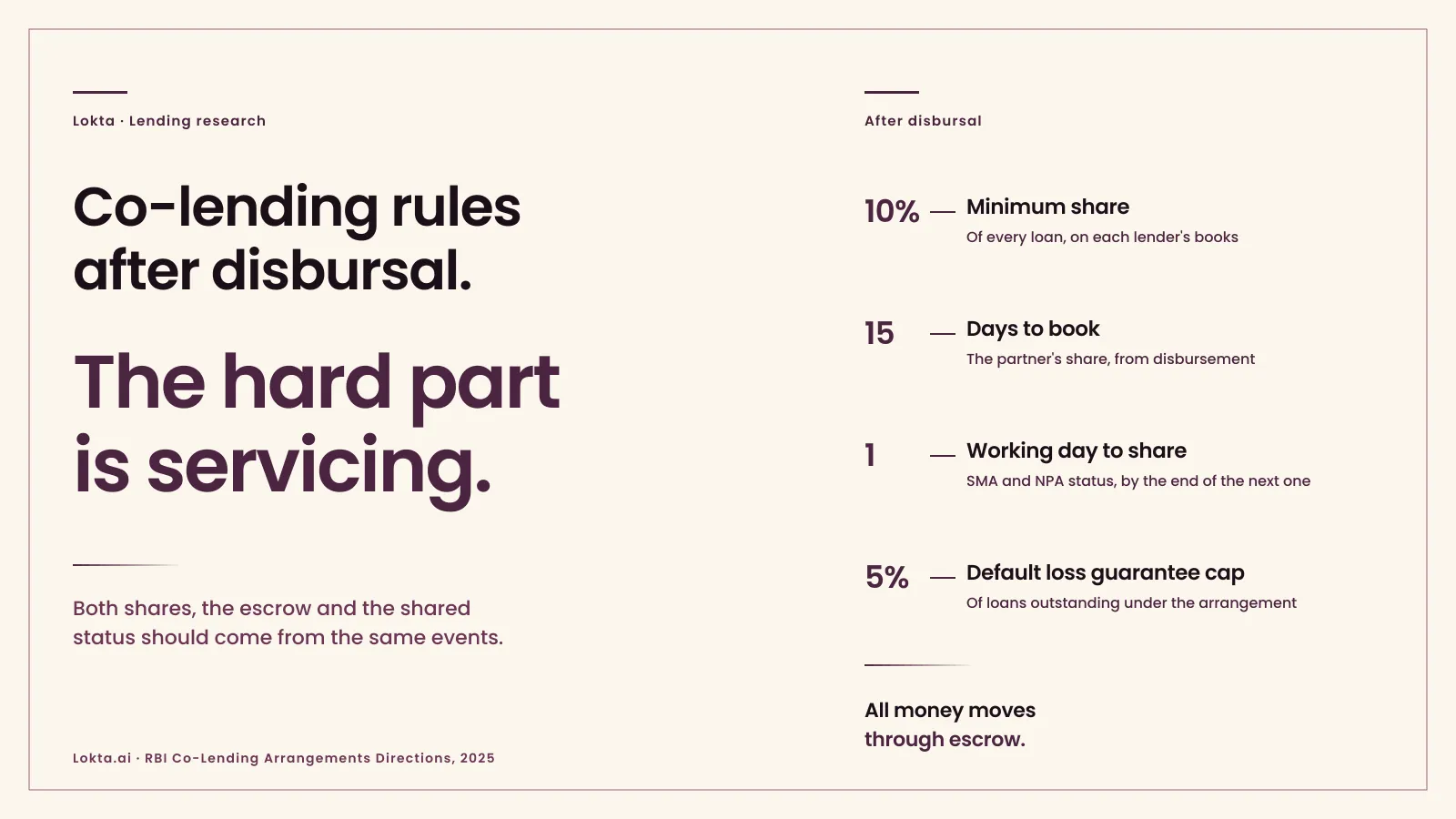
Once a co-lent loan is live, the 2025 Directions require each lender to hold at least 10% of it and to book its share within 15 calendar days. All money moves through an escrow account, and each co-lender reports its part of the loan to the bureaus. When either lender classifies its co-lent exposure SMA or NPA because of a default in it, the other must apply the same status, and the partner has to be told no later than the end of the next working day.
If you run partnerships or co-lending operations at an NBFC, the 2025 Directions put most of their new obligations after disbursal, and they show up in daily operations: whose books the loan sits on, what moved through escrow, and whether both of you called the borrower SMA-1 on the same day.
The 2025 Directions moved the hard part of co-lending from origination to servicing. The rule that bites is the one on shared classification. A partner MIS reconciled at month end cannot tell your bank partner by tomorrow evening that a borrower turned SMA today. That needs both lenders’ positions to come from the same events, every day.
- 10% of every loan. The minimum share applies loan by loan, so every posting carries both lenders’ shares.
- Escrow for all money. Disbursements and repayments between the lenders and the borrower go through one escrow account with a bank.
- 15 days to book. The partner’s share has to be on its books within 15 calendar days of disbursement.
- Next working day for SMA and NPA. A classification for a default in the co-lent exposure has to reach the other lender by the end of the next working day.
- Waivers and write-offs are yours to agree. The Directions leave their allocation to the co-lending agreement, so the agreement has to be precise.
What do the 2025 Directions cover, and when did they apply?
The Reserve Bank of India (Co-Lending Arrangements) Directions, 2025 (RBI/DOR/2025-26/139), often searched as the RBI co-lending guidelines, were issued on 6 August 2025 and took effect on 1 January 2026, or earlier where a lender’s own policy adopted them. They apply to commercial banks other than small finance banks, local area banks and regional rural banks, to all-India financial institutions, and to NBFCs including housing finance companies (paragraph 4). They repeal the 2020 circular on co-lending by banks and NBFCs to the priority sector (paragraph 37).
For NBFCs, RBI has since carried these provisions into its consolidated Transfer and Distribution of Credit Risk Directions, 2025. The paragraph numbers in this post are from the August 2025 Directions, which is where the text was first set out.
Before the first loan, three documents have to be in place. The credit policy has to cover co-lending, including an internal limit on the share of the book under co-lending (paragraph 11). The agreement has to set out the terms, the fees for lending services, the segregation of responsibilities, and the time frame for exchanging critical information (paragraph 12). Each lender also has to list its active co-lending partners prominently on its website (paragraph 35).
What does the 10% minimum share mean for each posting?
Paragraph 10 requires each lender to keep at least 10% of each individual loan on its own books. The test is per loan, so a portfolio that averages 10% but has loans below it breaks the rule.
For the servicing system, this means every account carries two shares from the first day, and every event on the account (an EMI, a charge, a part-prepayment, a reversal) is split between them. Paragraph 25 makes it explicit: each lender maintains the borrower’s account individually for its share.
How must money move between co-lenders?
Through escrow. Paragraph 26 routes every disbursement and repayment, between the lenders and with the borrower, through an escrow account kept with a bank, which can be one of the co-lenders.
That puts a reconciliation at the centre of daily operations. Each receipt into escrow has to be allocated to interest and principal, split by share, and posted to both lenders’ borrower accounts, and the escrow balance has to agree with those postings. How the receipt is allocated in the first place is a product decision, covered in payment appropriation as configuration. The same split has to be modelled when co-lending runs inside an embedded lending platform.
How fast must each lender book its share?
Within 15 calendar days of disbursement. Paragraph 21 makes the partner’s commitment to take its share irrevocable, and paragraph 22 requires both lenders’ shares to be reflected in their books without delay, and no later than 15 calendar days after the originating lender disburses. If the transfer misses that window, the loan stays on the originating lender’s books and can move only under the transfer of loan exposure rules (paragraph 24).
For an NBFC that originates and then passes a share to a bank, the 15-day clock is an operational deadline for every loan. The servicing record has to show the disbursement date, the date the partner booked its share, and every EMI in between, split correctly from the first one.
How quickly must co-lenders share SMA and NPA status?
Paragraph 33 sets two rules. Classification is at borrower level: if either lender classifies its exposure to a borrower under the arrangement as SMA or NPA because of a default in the co-lent exposure, the same classification applies to the other lender’s exposure to that borrower under the arrangement. And the information has to be shared “on a near-real time basis, and in any case latest by end of the next working day.”
Two details matter. The shared classification is triggered by a default in the co-lent exposure, so the text ties it to the arrangement rather than to everything the borrower owes either lender. And the deadline is a working day, not a month, which rules out a month-end MIS as the way the partner finds out.
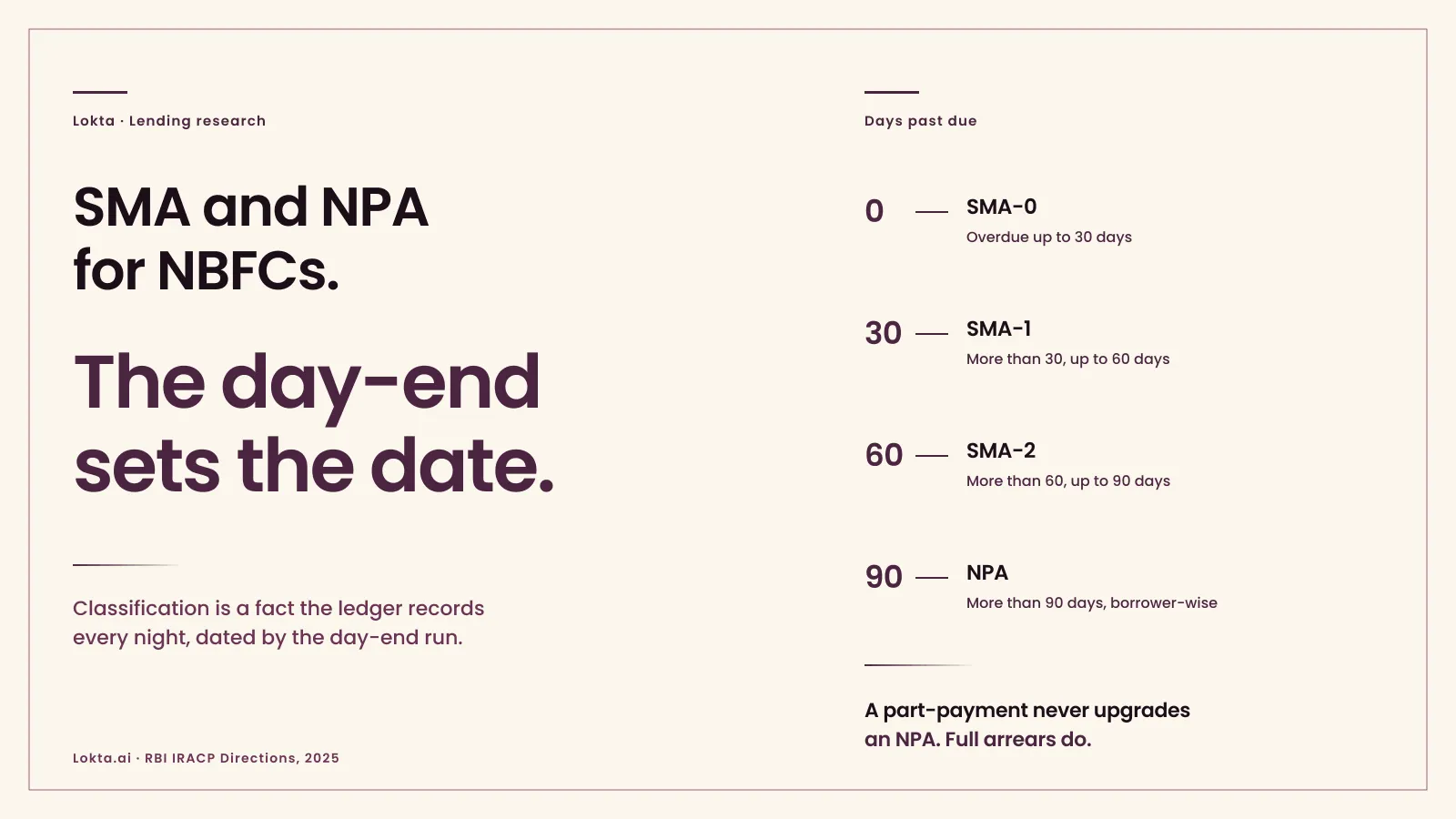
The classification itself follows each lender’s own rules, set out in the SMA and NPA classification rules. The co-lending rule adds the obligation to share it on time.
How is the interest rate set and changed?
The borrower pays a blended rate: the average of the rates each lender charges under its own policy, weighted by its funding share (paragraph 17). When either lender changes its rate, the blended rate has to be updated and communicated to the borrower (paragraph 18).
In practice, a rate reset by one partner reprices one share of the loan and changes what the borrower pays on the whole of it. The schedule, the borrower’s statement and each lender’s interest income all move together, so the reset has to be posted as one event with two effects.
How do co-lenders report to credit bureaus?
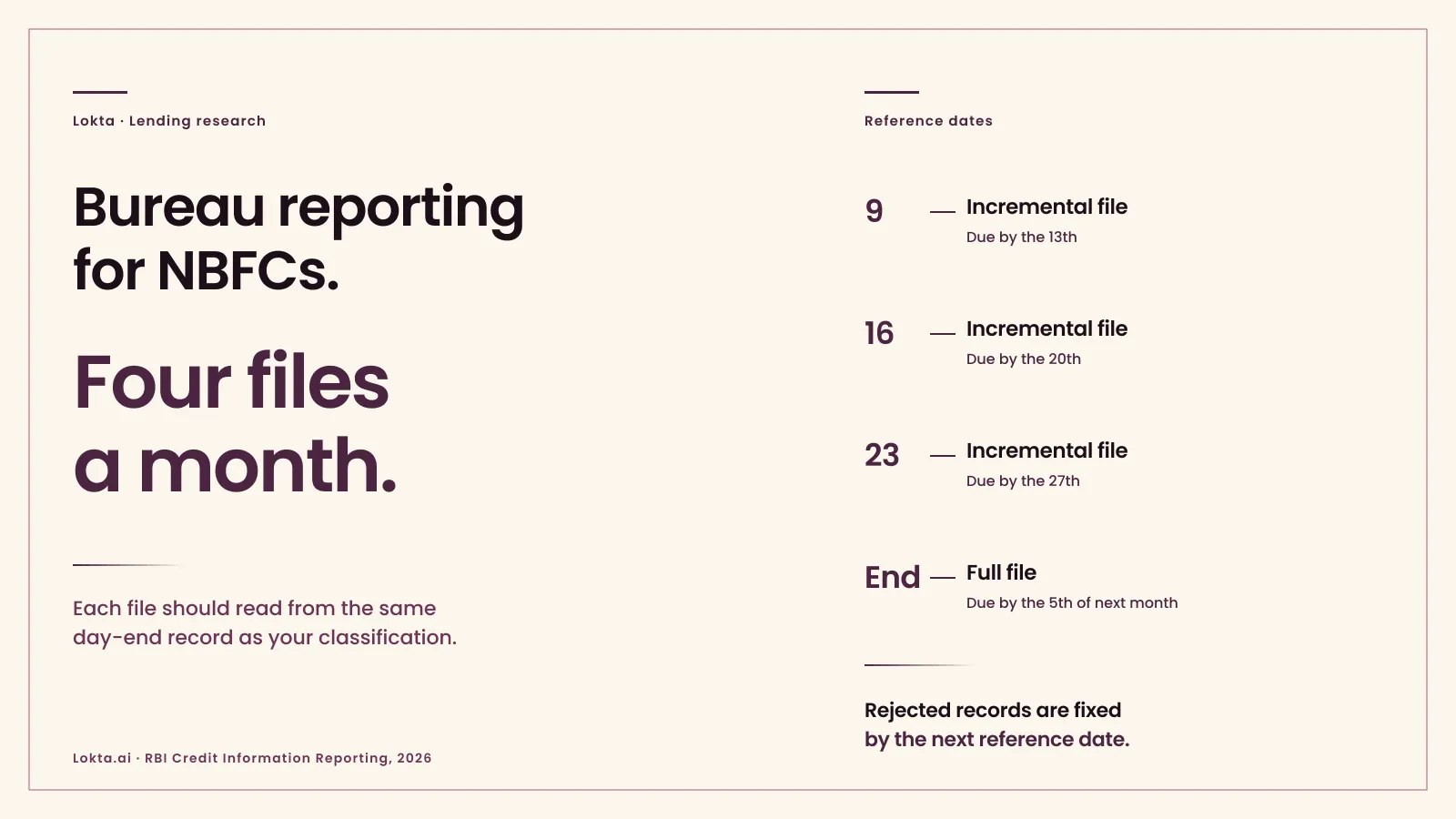
Each lender reports its own share, under the ordinary credit information rules (paragraph 31). One co-lent loan produces two sets of bureau records, one from each lender. Since July 2026 those rules require four reference dates a month, covered in the bureau reporting rules. Both records should show the same days past due, which only happens when both lenders’ positions come from the same repayment events.
Who bears waivers, prepayments and write-offs?
The Directions do not allocate them between the lenders. The agreement has to, as part of the detailed terms and segregation of responsibilities that paragraph 12 requires it to cover. Paragraph 20 requires fees for lending services to follow objective criteria and to involve no element of credit enhancement, direct or indirect. A default loss guarantee from the originating lender is capped at 5% of loans outstanding under the arrangement (paragraph 32).
That makes the agreement the specification for your servicing system. A waiver of a penal charge, a part-prepayment and a write-off each need a written rule for how they split between the lenders, and the servicing system has to apply that rule the same way on every account. Paragraph 27 brings co-lent loans into both lenders’ internal and statutory audit scope, so each split will be read by two sets of auditors.
What does a co-lent loan look like in its first month?
The loan below is invented to show how the rules interact. An NBFC originates a ₹10 lakh loan with a bank partner on a 30:70 split, NBFC to bank, a ratio chosen for the example rather than fixed by any rule.
Day 31 is the deadline only if it is a working day. If it is a holiday, the deadline is the end of the next working day after it.
What should you test in a co-lending demo?
Ask any vendor, including your current one, to run these on a copy of your own co-lent book.
- Post one EMI into escrow and show both lenders’ borrower accounts and the escrow balance agreeing afterwards.
- Flag one account SMA on your side and show when, and how, the partner’s share takes the same status.
- Reset one partner’s rate and show the new blended rate, the borrower’s revised schedule and each lender’s interest income.
- Apply a waiver, a part-prepayment and a write-off, and show each split following the rule in your agreement.
- Produce each lender’s bureau records for one reference date and show that both carry the same days past due.
- Show which loans are near the 15-day booking limit today.
- Rebuild last month’s partner MIS from the postings and show it matches what was sent.
The NBFC LMS RFP guide carries co-lending requirements in RFP form.
Which path fits your co-lending book?
If you want to be the partnerships head whose partner MIS reconciles to both ledgers without a spreadsheet, there are three ways to run it.
- Keep your current system and reconcile with the partner at month end, with a daily list of new SMA accounts sent by email. It needs no change today. Meeting the next-working-day rule then depends on a person sending that list every working day.
- Service both shares from one set of events, so each lender’s borrower account, the escrow reconciliation and the shared classification come from the same postings. The seven demo tests above tell you whether a system does this.
- Let each lender run its own system and exchange files through an API every day. Each side keeps its own tools, and both sides now own an integration and a daily reconciliation between two ledgers.
The second route asks something of your partner. Moving an existing co-lent book onto one servicing record needs the bank to agree the data, the split rules and the reconciliation before cut-over, and that agreement is work of its own on top of the migration.
In Lokta, co-lender shares, partner exposure, settlement and reconciliation sit inside the loan and accounting model rather than beside it, and the structure of each arrangement is set up during implementation. Our team built Apache Fineract, the open-source lending core, before starting Lokta.
Frequently asked questions
What are RBI's Co-Lending Arrangements Directions, 2025?
They are RBI's rules for two regulated lenders funding the same loans, issued on 6 August 2025 and in force from 1 January 2026. They apply to commercial banks other than small finance, local area and regional rural banks, to all-India financial institutions and to NBFCs, and they replace the 2020 priority-sector co-lending framework.
What minimum share must each co-lender keep?
At least 10% of each individual loan, on its own books. The rule is per loan, not per portfolio, so a loan management system has to hold every lender's share on every account. The partner's share has to reach its books within 15 calendar days of disbursement.
How quickly must co-lenders share SMA or NPA status?
On a near-real-time basis, and no later than the end of the next working day. When either lender classifies its co-lent exposure to a borrower as SMA or NPA because of a default in that exposure, the other lender applies the same classification to its own share.
Does Lokta support co-lending?
Yes. Funding partners, originator and co-lender shares, waterfalls, repayment allocation, settlement and reconciliation are part of Lokta's loan and accounting model, and each lender's share stays on one account record. The exact structure of your arrangement is configured during implementation.
Read next:
- SMA and NPA classification for NBFCs: the day-end rules behind the status co-lenders share.
- Credit bureau reporting for NBFCs: the four reference dates each co-lender reports its share on.
- Lokta Loan Management for NBFCs: co-lending shares, settlement and reconciliation on one account record.
Sources:
- Reserve Bank of India (Co-Lending Arrangements) Directions, 2025: RBI/DOR/2025-26/139, 6 August 2025, effective 1 January 2026. Paragraphs 4, 10-12, 17-18, 20-22, 24-27, 31-33, 35 and 37.
- Reserve Bank of India (Non-Banking Financial Companies - Transfer and Distribution of Credit Risk) Directions, 2025: the consolidated directions that now carry the co-lending provisions for NBFCs.
This post covers the servicing work the 2025 Directions create and is not legal advice. Questions about a specific co-lending agreement belong with your counsel.
Chandramouli is a co-founder of Lokta, the agentic loan servicing platform. His two decades span technology, go-to-market and consulting, and he has been an independent director on an NBFC board.