Penal charges, prepayment and rate resets: RBI's servicing rules as LMS configuration
RBI's rules for NBFCs on penal charges, prepayment charges and floating rate resets, set out as the conditions and settings a loan system has to enforce.
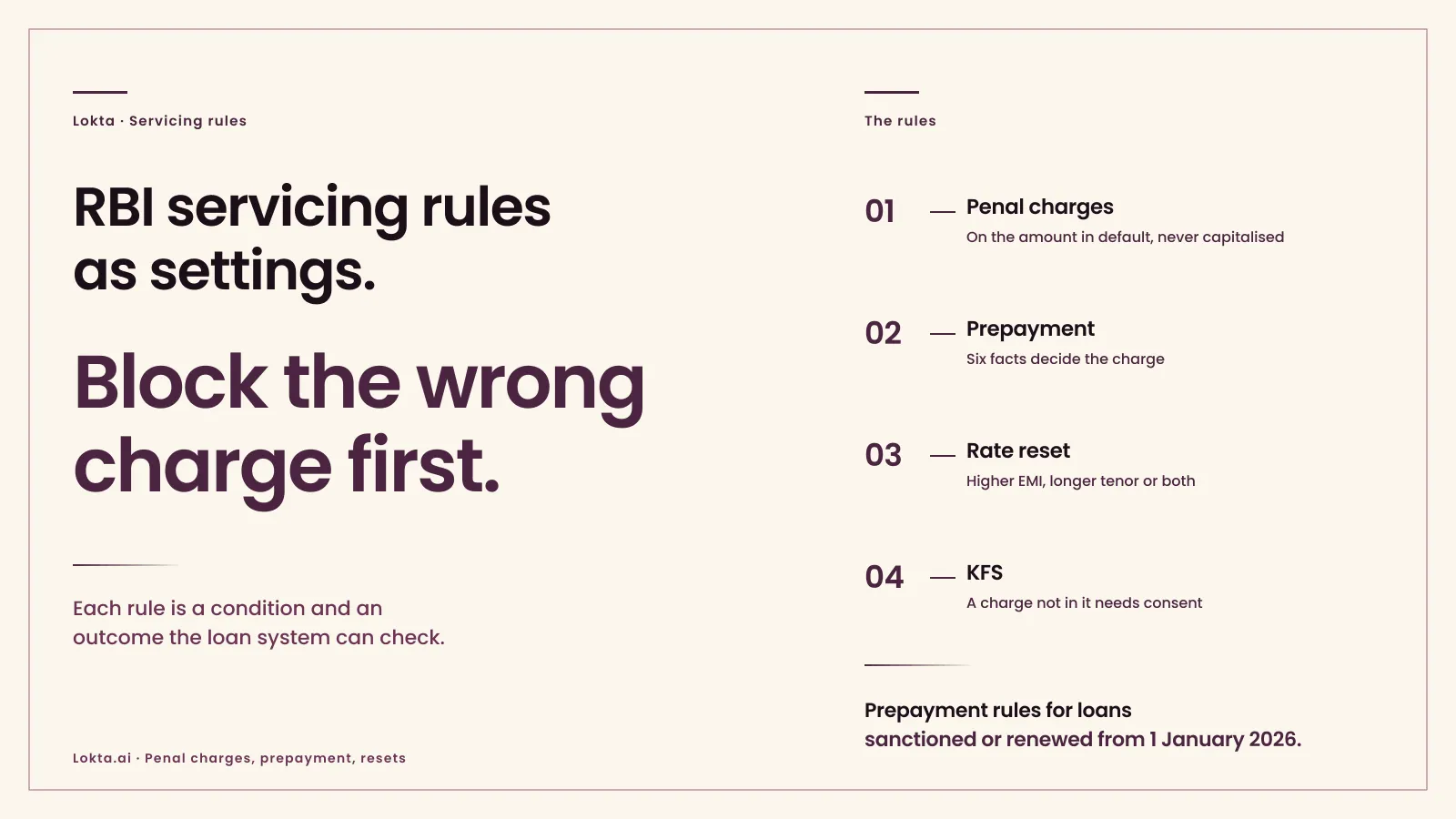
RBI’s rules on penal charges, prepayment charges and floating rate resets for NBFCs were consolidated into the Responsible Business Conduct Directions, 2025, on 28 November 2025. Each rule has conditions (rate type, borrower, purpose, layer, sanctioned amount, sanction or renewal date) and an outcome (charge, no charge, an option the borrower must get). A loan management system should hold those conditions as product settings, so a charge the rules forbid cannot be posted.
If you own loan products at an NBFC, you can stop a wrong penal or prepayment charge before it posts, because the servicing rules RBI has written since 2023 are specific enough to be settings. Whether a charge is allowed turns on facts the loan system already holds, such as the borrower type or the sanction date.
When those conditions live in a policy document and the product team’s memory, the loan system charges whatever it was set up to charge years ago. A prepayment fee lands on a borrower the rules exempt, or a penal charge compounds, and the lender finds out from a complaint. Written as configuration, and tested against the policy, the same rules stop the wrong charge before it posts.
- One set of directions holds the rules. Penal charges, prepayment, resets and the KFS all sit in the NBFC Responsible Business Conduct Directions, 2025.
- Penal charges are charges. No penal interest, no capitalisation, no penal charge on a penal charge.
- Prepayment depends on six facts. Rate type, borrower type, purpose, the NBFC’s layer, the sanctioned amount and the sanction or renewal date.
- A reset comes with options. Higher EMI, longer tenor or both, prepayment at any time, and no negative amortisation.
- The KFS lists what can be charged. A charge it does not mention needs the borrower’s explicit consent.
Why treat these rules as configuration?
Because each rule is a condition and an outcome, which is what a product parameter is. The table sets out the dates that decide which regime a loan falls under.
| Rule | Applies to | Where it sits now |
|---|---|---|
| Penal charges | Fresh loans from 1 April 2024. Existing loans moved over at their next review or renewal, by 30 June 2024 | Paragraph 30 |
| Floating rate reset on EMI loans | EMI-based personal loans. The fixed-rate switch became optional from 1 October 2025 | Paragraphs 31 and 32 |
| Key Facts Statement | Retail and MSME term loans sanctioned from 1 October 2024 | Paragraph 29 |
| Prepayment charges | Loans sanctioned or renewed from 1 January 2026, with an older rule for earlier loans | Paragraphs 33 and 34 |
The original circulars behind these rules were withdrawn when RBI consolidated its NBFC directions on 28 November 2025. Their text carries on in the new directions, with some additions.
What do the penal charges rules require?
A charge, never interest, and only on what is in default. Paragraph 30 covers all credit facilities except credit cards, external commercial borrowings, trade credits, structured obligations and other foreign currency loans. Each rule maps to a setting:
| Rule | What the product has to hold |
|---|---|
| A penal charge, not penal interest, with no extra component on the rate | Penal amounts as a separate charge type, never a rate adjustment |
| Levied only on the amount under default | The base for the charge is the overdue amount, not the outstanding balance |
| No capitalisation, no penal charge on earlier penal charges | Penal charges excluded from the interest base and from the base of later penal charges |
| Interest on an unpaid EMI only at the contracted rate | Overdue interest computed at the loan’s own rate until remediation |
| Uniform within a product whatever the borrower’s constitution. Individuals borrowing for non-business purposes never pay more than non-individuals | One penal schedule per product, tiered by loan amount if the policy chooses but never by the borrower’s constitution, and checked against the non-individual schedule |
| Disclosed upfront in the agreement and the KFS, and on the website. A website reference alone is not enough | The charge schedule printed into the KFS from the same settings the engine uses |
| Applicable charges stated in reminders, and each levy communicated with its reason | Reminder and levy-notice templates that read the charge and its reason from the account |
RBI sets no cap on the amount. It asks for charges that are reasonable and commensurate with the breach, under a board-approved policy, and says they are not meant to enhance revenue.
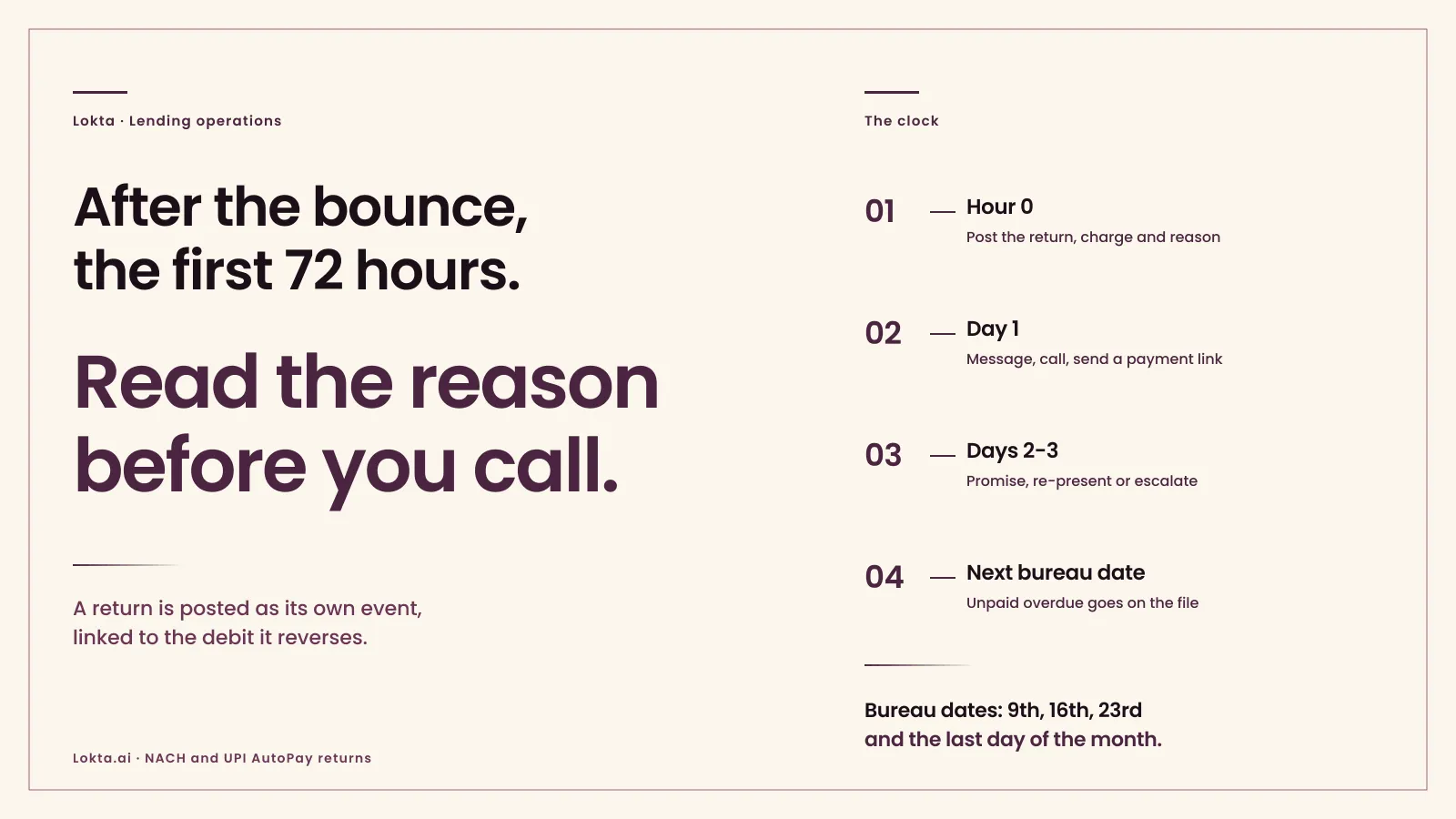
For the charge posted when a NACH or UPI AutoPay debit returns, the bounce post walks through the first three days.
When can an NBFC charge for prepayment?
It depends on six facts about the loan and the lender. RBI’s Pre-payment Charges on Loans Directions of 2 July 2025, now paragraph 34, set the cases for loans sanctioned or renewed on or after 1 January 2026. Foreclosure is a full prepayment, so the same cases decide foreclosure charges:
| Loan | Prepayment charge |
|---|---|
| Floating rate, individual borrower, non-business purpose | None, in every layer |
| Floating rate, business purpose, individual or micro or small enterprise, Upper Layer NBFC | None |
| The same loan at a Middle Layer NBFC, sanctioned up to ₹50 lakh | None |
| Any other loan, fixed rate included | As the NBFC’s policy sets, on the amount prepaid for a term loan |
| Dual or special rate loan | Decided by whether the loan is on a floating rate when it is prepaid |
| Any loan prepaid at the NBFC’s instance | None |
Where no charge is allowed, the exemption holds for part or full prepayment, from any source of funds, with no minimum lock-in. A charge that was not disclosed in the sanction letter, the agreement and, where one is required, the KFS cannot be levied, and a fee waived earlier cannot come back at prepayment. Microfinance loans carry no prepayment charge at all.
For a loan sanctioned or renewed on or before 31 December 2025, paragraph 33 applies: no prepayment charge on floating rate term loans to individuals for purposes other than business. The charge logic therefore has to read the later of the sanction date and the last renewal date.
What happens at a floating rate reset?
The borrower gets options, and the lender owes notice. Paragraph 31 covers floating rate personal loans repaid in EMIs, and paragraph 32 extends it to equated instalments at any other interval, on an external or an internal benchmark:
- at sanction, the NBFC explains how a change in the benchmark could affect the EMI or the tenor
- any rise in EMI or tenor is communicated to the borrower at once
- the borrower can choose a higher EMI, a longer tenor or both, and can prepay in part or in full at any point
- the NBFC may offer a switch to a fixed rate under its board policy, with the charges in the sanction letter and on its website
- a tenor extension must not cause negative amortisation, where the balance grows while the borrower pays
- the borrower receives a statement each quarter with principal and interest recovered, the EMI, the EMIs left and the APR
In configuration terms, a reset is an event with a choice attached. The engine has to recompute the schedule under whichever option the borrower picks, refuse a tenor extension that would leave the instalment below the interest due, and record the notice and the choice.
What does the KFS lock in?
Every charge the loan can carry. Paragraph 29 requires a Key Facts Statement for all retail and MSME term loans, and says fees and charges not mentioned in it cannot be charged at any stage of the loan without the borrower’s explicit consent. The APR in the KFS includes all charges the NBFC levies.
That makes the KFS a test of the configuration. If the charge settings on a product and the KFS generated for it come from the same source, they cannot disagree.
What changes when a loan is disbursed in parts?
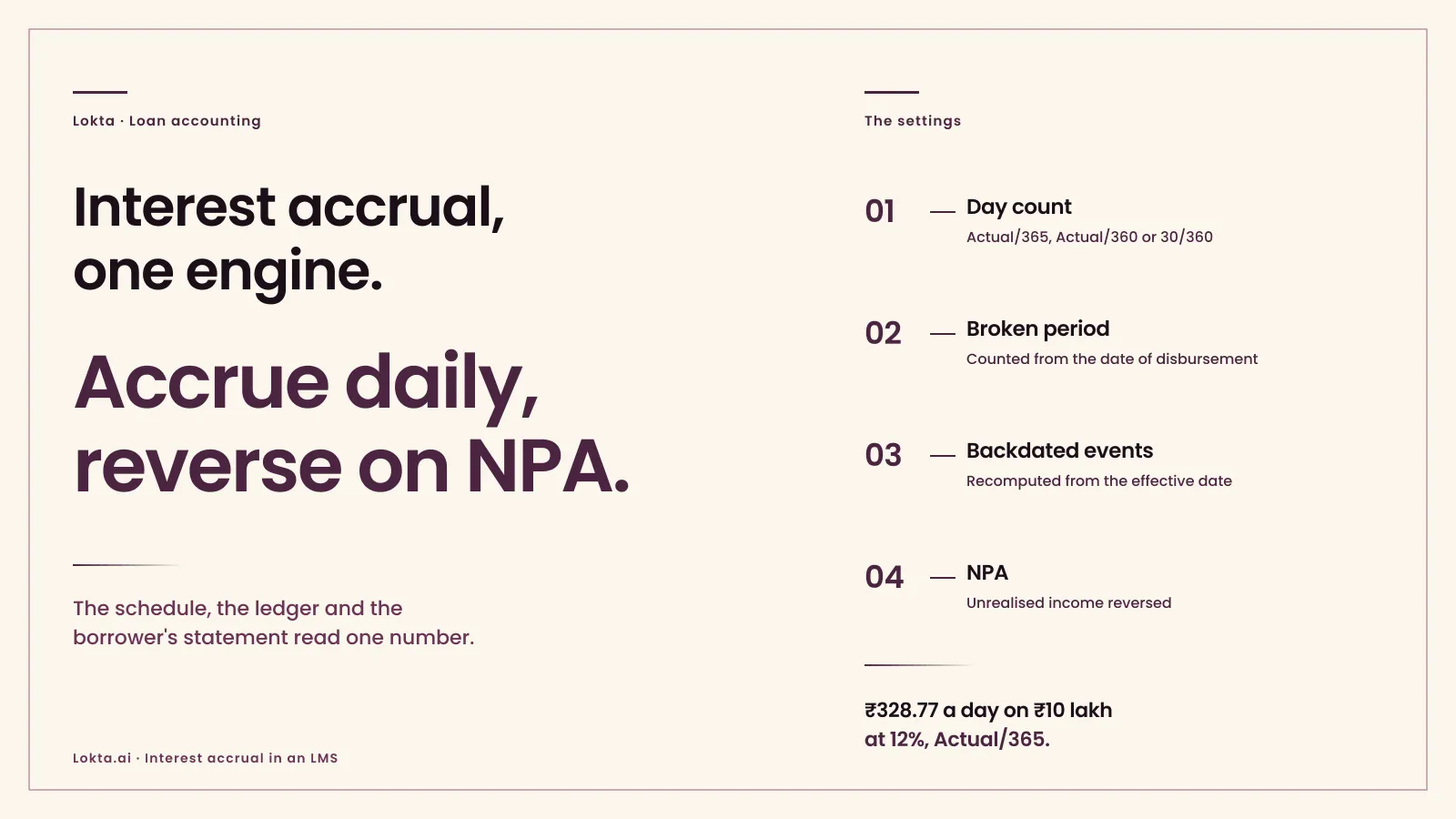
The borrower has to hear about the new schedule. Paragraph 7 of RBI’s Miscellaneous Supervisory Directions for NBFCs, 2026 lists, among unfair practices, changes to the KFS amortisation schedule made with each part-disbursement that are never communicated to the borrower. Paragraph 8 calls such practices matters of serious concern, and paragraph 7 expects corrective action, including system-level changes where needed. For the product, regenerating the schedule after a part-disbursement has to send the borrower a notice as well as recalculate. The same paragraph names four practices about when interest starts and what amount it runs on, and the interest accrual post maps each of them to an accrual setting.
How do you test that the settings match the policy?
With one test case per condition, run before a product goes live and again after any change. A short set covers the prepayment table alone:
- An individual with a floating rate home loan prepays part of it: no charge.
- A micro enterprise with a ₹40 lakh floating rate business loan from a Middle Layer NBFC forecloses: no charge.
- The same loan at ₹60 lakh: the policy charge, on the amount prepaid.
- A fixed rate personal loan prepays in full: the policy charge, on the amount prepaid.
- The NBFC asks the borrower to repay early, and the borrower does: no charge.
- A micro enterprise’s floating rate business loan from an Upper Layer NBFC, sanctioned in November 2025 and not renewed since: the policy charge, because paragraph 33 exempts only individuals’ non-business loans. The same loan renewed in February 2026: no charge.
Penal charges and resets get the same treatment. A penal charge must not accrue interest, must not be charged on an earlier penal charge, and must use the overdue amount as its base. A reset must offer a higher EMI, a longer tenor, both, and prepayment, and it must refuse a tenor extension that fails to cover the interest.
What should the charge record show?
For every charge posted and every charge refused:
- the product setting and the policy version that allowed or blocked it
- the facts it depended on: rate type, borrower type, purpose, sanctioned amount, sanction or renewal date, amount in default
- the KFS the borrower received, the reminder that stated the charge and the levy notice with its reason
- for a reset, the notice sent, the options offered and the borrower’s choice
With that record, a complaint about a charge is answered by reading the account rather than reconstructing it.
How should a product team hold these rules?
If you want to be the product head who can show that no borrower paid a charge the rules exempt, the choice is where the rules live.
- Keep the rules in the policy and train the operations team to apply them by hand. It needs no system work. Every exemption depends on someone noticing it, and an error can surface only when a borrower asks for a refund.
- Hold the rules as product settings, generate the KFS from the same settings, and test each condition before a product goes live. It takes one pass through every product to set up. After that, a charge the rules forbid is blocked before it posts, and the record shows the setting that allowed or blocked each one.
- Rely on the loan system vendor’s standard compliance pack. It arrives ready-made. It may not match your own policy choices, such as your switching charges or your prepayment policy for loans the rules leave to you.
The second path takes the most care at the start. Each product’s conditions have to be mapped once, and the test cases kept up to date when RBI amends a paragraph.
Lokta’s loan management system carries penal charges, prepayment and foreclosure, rate reset, and KFS and APR disclosure as their own configuration domains, and refuses contradictory settings before a product can be tested. Compliance signs the KFS and penal charges before the product moves on. Apache Fineract came from the same team, years before Lokta.
Frequently asked questions
Can an NBFC charge penal interest on a missed EMI?
No. For a breach of a material loan term, an NBFC may levy a penal charge, not penal interest, and it cannot add a component to the interest rate. The charge is levied on the overdue amount alone, earns no interest because it cannot be capitalised, and cannot be levied on earlier penal charges. The unpaid EMI keeps attracting interest at the loan's contracted rate, never a penal rate, until the default is remedied.
When can an NBFC not charge for prepayment or foreclosure?
For loans sanctioned or renewed from 1 January 2026, an NBFC cannot charge on floating rate loans to individuals for non-business purposes, in any layer. On floating rate loans for business purposes to individuals and to micro and small enterprises, an Upper Layer NBFC cannot charge at all and a Middle Layer NBFC cannot charge where the sanctioned amount is up to ₹50 lakh. Earlier loans follow the older rule: no charge on floating rate term loans to individuals for non-business purposes. Microfinance loans, prepayments the NBFC itself asks for, and charges never disclosed carry no charge in any case.
What must an NBFC offer a borrower when a floating rate is reset?
For EMI-based personal loans, the option to raise the EMI, extend the tenor, or combine the two, and to prepay in part or in full at any time. The NBFC may also offer a switch to a fixed rate under its board policy. It must tell the borrower at once when the EMI or tenor goes up, and a tenor extension cannot cause negative amortisation.
Can an NBFC levy a charge that is not in the Key Facts Statement?
Not without the borrower's explicit consent. Fees and charges not mentioned in the KFS cannot be charged at any stage of the loan unless the borrower explicitly agrees. Penal charges and the applicability of prepayment charges both have to be disclosed there, and undisclosed prepayment charges cannot be levied at all.
Sources:
- Reserve Bank of India (Non-Banking Financial Companies - Responsible Business Conduct) Directions, 2025: RBI/DOR/2025-26/362, 28 November 2025, updated as on 1 July 2026. Paragraph 29 (KFS), 30 (penal charges), 31 and 32 (floating rate reset), 33 and 34 (prepayment charges), 81 (microfinance).
- Reserve Bank of India (Non-Banking Financial Companies - Miscellaneous) Supervisory Directions, 2026: RBI/DoS/2026-27/467, 31 July 2026, Chapter III, paragraphs 7 and 8.
- The original circulars, all withdrawn for NBFCs by the consolidation circular of 28 November 2025 and carried into the directions above:
- RBI, Penal Charges in Loan Accounts, 18 August 2023, and extension of timeline, 29 December 2023
- RBI, Reset of Floating Interest Rate on EMI based Personal Loans, 18 August 2023
- RBI, Key Facts Statement for Loans and Advances, 15 April 2024
- RBI, Pre-payment Charges on Loans Directions, 2025, 2 July 2025