The borrower has paid: why is the collections queue still calling?
A posted payment may leave stale collection tasks behind. See how loan management and servicing should refresh assignments, queued messages and agent actions.
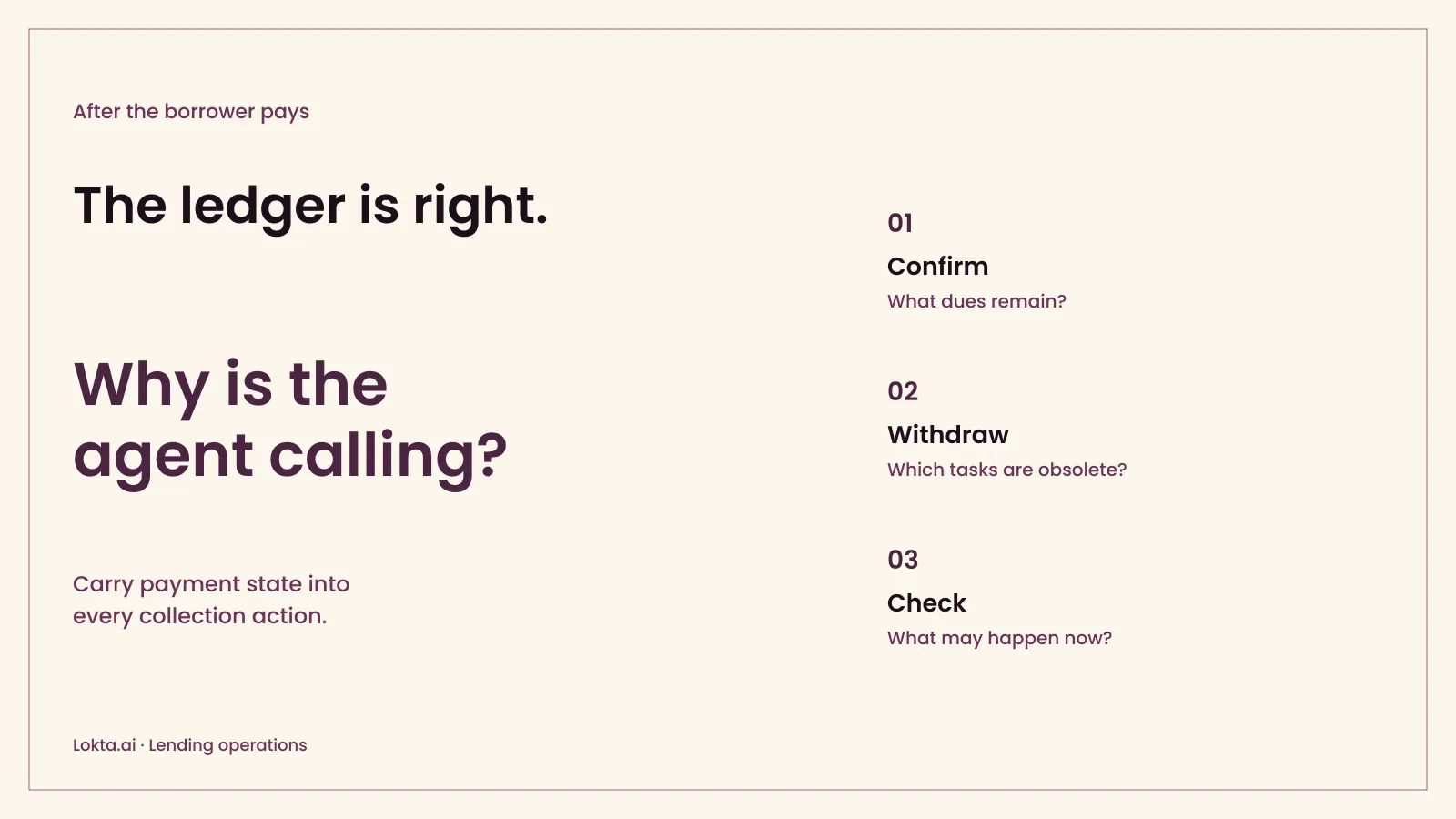
At 09:00 in this illustrative timeline, a collections system prepares a task for an overdue instalment of ₹8,000. At 10:05, the borrower’s full ₹8,000 payment is verified and posted to the loan account. At 10:30, an agent opens the earlier task and asks for ₹8,000.
The Loan Management System (LMS) balance is correct. The collection action is wrong for that balance.
The LMS maintains the account. Servicing must carry its current state into the work being done for the borrower. Here the failure sits after reconciliation. A payment changes what the lender is entitled to ask about the targeted dues. The operating stack must carry that change into assignments, queued messages and the information available at the moment of contact.
Find which clock fell behind
First establish whether the money has reached the loan account correctly. A borrower’s screenshot, a rail notification, a matched receipt and a completed posting are different pieces of evidence. The loan reconciliation guide covers that investigation. When the task began with a failed debit, follow the first 72 hours after a NACH or UPI AutoPay bounce through the subsequent payment before keeping the demand active.
Once posting is verified, trace the action that followed. In the fictional case, assume there are no other overdue amounts or fees and the payment clears the entire targeted instalment. The demand for that ₹8,000 has become obsolete.
| Time | Record | What it establishes |
|---|---|---|
| 09:00 | Task created for ₹8,000 | The amount used when work was assigned |
| 10:05 | Verified payment posted | The targeted dues are now cleared under the example assumptions |
| 10:06 | Update sent to collections | Transmission, not yet proof of application |
| 10:30 | Agent attempts contact from old task | The action must be checked against current eligibility |
An overnight refresh would leave this interval exposed. Faster updates help, but frequency alone does not define correctness. The team needs to know what happens when an update fails, arrives late or reaches the task after a message has already been queued.
Cancel the work that has become obsolete
Define the relationship between an account change and the work it invalidates. A paid instalment may have a reminder, an agency assignment and a scheduled follow-up. Closing one task does not necessarily close the others.
Use the payment event to refresh or withdraw affected work under the lender’s policy. Keep the task references and acknowledgements, so an operator can distinguish “cancellation requested” from “cancelled before dispatch”. Where a message has already been handed to a provider, establish whether recall is supported. Do not report successful cancellation merely because the internal queue entry was removed.
At execution, check the current permitted action and relevant account version again. If reliable state is unavailable, use a defined hold or review path for the affected demand. That check needs a controlled relationship with dispatch so a known account change between selection and sending can invalidate the action. An old export cannot be a standing authority to keep contacting the borrower.
These are evaluation requirements for a connected collections process. Their implementation depends on the lender’s systems and partner interfaces. The lender also retains the conduct obligations described in the recovery-agent rules.
Change the message when only part of the amount is paid
Replace the full-payment scenario with a verified ₹3,000 payment against the same ₹8,000 dues. Under the same simplifying assumptions, ₹5,000 remains. The previous ₹8,000 demand is still obsolete, even though collection work may remain appropriate.
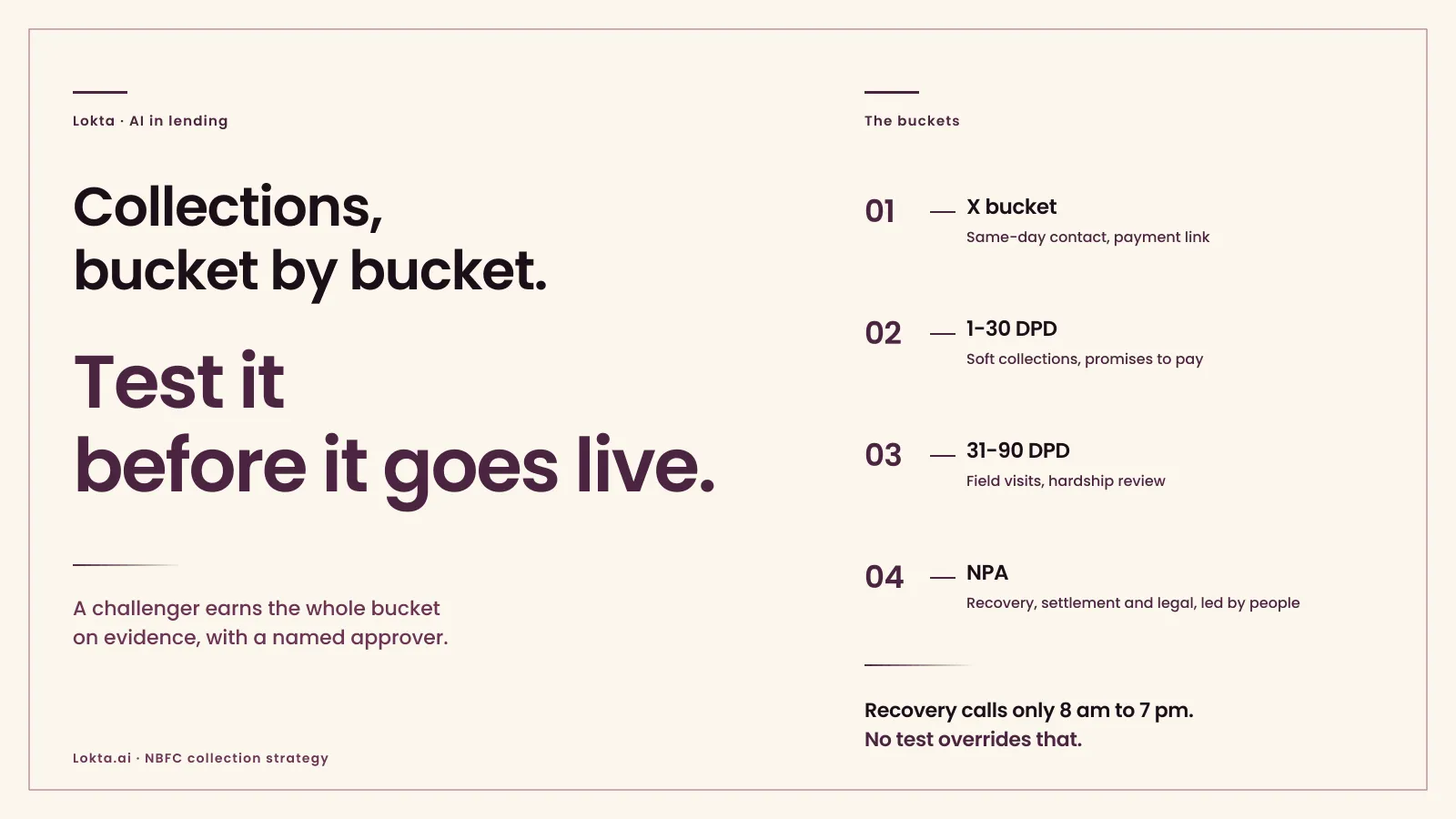
Refresh the amount and context before the next permitted action. A partial payment should not produce a full-clearance confirmation. It also should not be ignored because the account remains in a delinquent bucket. The bucket strategy guide explains treatment selection; this check makes sure the selected treatment uses the current facts.
For an unmatched receipt, keep investigation visible and use the lender’s approved communication and hold rules. Avoid turning a matching failure into an accusation that the borrower did not pay. If a payment is later reversed, assess the new account state and authorise the appropriate treatment. Do not resurrect an old task without checking its amount, dates and context.
Give the agency an explicit change to acknowledge
A lender cannot observe a partner’s behaviour merely by observing its own outbound API. Agree what the partner must do with an account update: withdraw the old assignment, replace its amount, refresh the agent view or return an exception.
The response should identify the affected account or task and the version applied. When an interface fails, assign an owner to the approved fallback process. A controlled manual withdrawal may be necessary in a limited integration. Its completion still needs evidence.
Test the uncomfortable sequence: export an unpaid account, post the payment, make the update unavailable, then ask the partner to execute the original task. The result should demonstrate the agreed control or expose the exact point where the operating contract is incomplete.
Measure the actions that should not have happened
Collection activity and portfolio outcomes do not show this failure by themselves. Add a narrow quality measure: among attempted demands, how many requested dues that had already been verified as cleared before dispatch?
For an illustrative quality check, suppose a reviewed sample contains 200 demand attempts. Eight requested a targeted amount already cleared before dispatch. The observed rate is 8 ÷ 200 = 4%. This is a sample result, not a Lokta outcome or an industry benchmark. Do not include valid confirmations or unrelated remaining dues in the numerator.
Also track elapsed time from verified posting to confirmed task withdrawal, and the age of withdrawals without acknowledgement. Separate dispatch time from delivery time where the channel provides both. A message dispatched before payment but delivered afterwards needs a different diagnosis from one authorised after the payment was known.
Lokta combines Loan Management with AI Loan Servicing. Its servicing agent works from the live loan record, checks contact hours and consent before a message goes out, and records contacts and promises to pay on the account. Those mechanisms put current account evidence into the contact workflow. AI proposes the action; deterministic controls and lender policy govern execution.
A particular agency connection still needs its own withdrawal and acknowledgement tests. Product availability does not prove that an external partner can cancel a task already exported to it.
For the next collections workflow review, measure the interval from payment posting to confirmed withdrawal. Then test a failed update inside that interval. That is where a correct balance can still produce the wrong demand.
Frequently asked questions
Why can collection calls continue after a borrower pays an EMI?
The payment may not yet be matched and posted, or a collections queue may still contain an earlier account snapshot. Those are different failures. Confirm the payment and resulting dues first, then inspect the assignment, queued communication and state checked before contact. A corrected LMS balance does not establish that a partner task was withdrawn. The team needs evidence that the obsolete action was cancelled, refreshed or prevented at execution.
Should every payment immediately stop all collection activity?
Check what the payment cleared. Full payment can make the targeted demand obsolete; partial payment requires a revised amount. An unmatched receipt needs investigation. A repayment confirmation or complaint response is different from a demand for dues that have already been cleared.
How should an LMS and a collection agency stay aligned after payment?
Define how an account update changes agency assignments, queued contacts and displayed amounts. Require an acknowledgement of the affected task or account version, and a fallback process when the agency interface is unavailable. Test an exported task that becomes obsolete before execution. The lender should know whether the old task was withdrawn, replaced or remains unresolved, rather than treating delivery of an update message as proof that the agency acted on it.
What should happen when a payment is later reversed?
Re-evaluate the account and permitted treatment using the verified reversal. Preserve the payment and cancellation history. Create or approve the current action with its current amount; do not replay the old demand automatically.
Read next
- Collection strategy by bucket: choose an appropriate treatment for the current account
- Collections performance measures: separate contact activity from portfolio outcomes
Sources
- Lokta: loan reconciliation in an LMS: the separate receipt-to-posting workflow. The timeline, monitoring example and action controls in this article are original illustrations
Lokta editorial analysis by Chandramouli, co-founder and CEO.