Which loan management and servicing workflow should an NBFC automate first?
Choose an LMS and loan servicing automation pilot using eligible volume, retained human work, exception cost and consequence. Includes a worked comparison.
The busiest queue is an obvious place to look for an automation pilot. It is not enough to choose one.
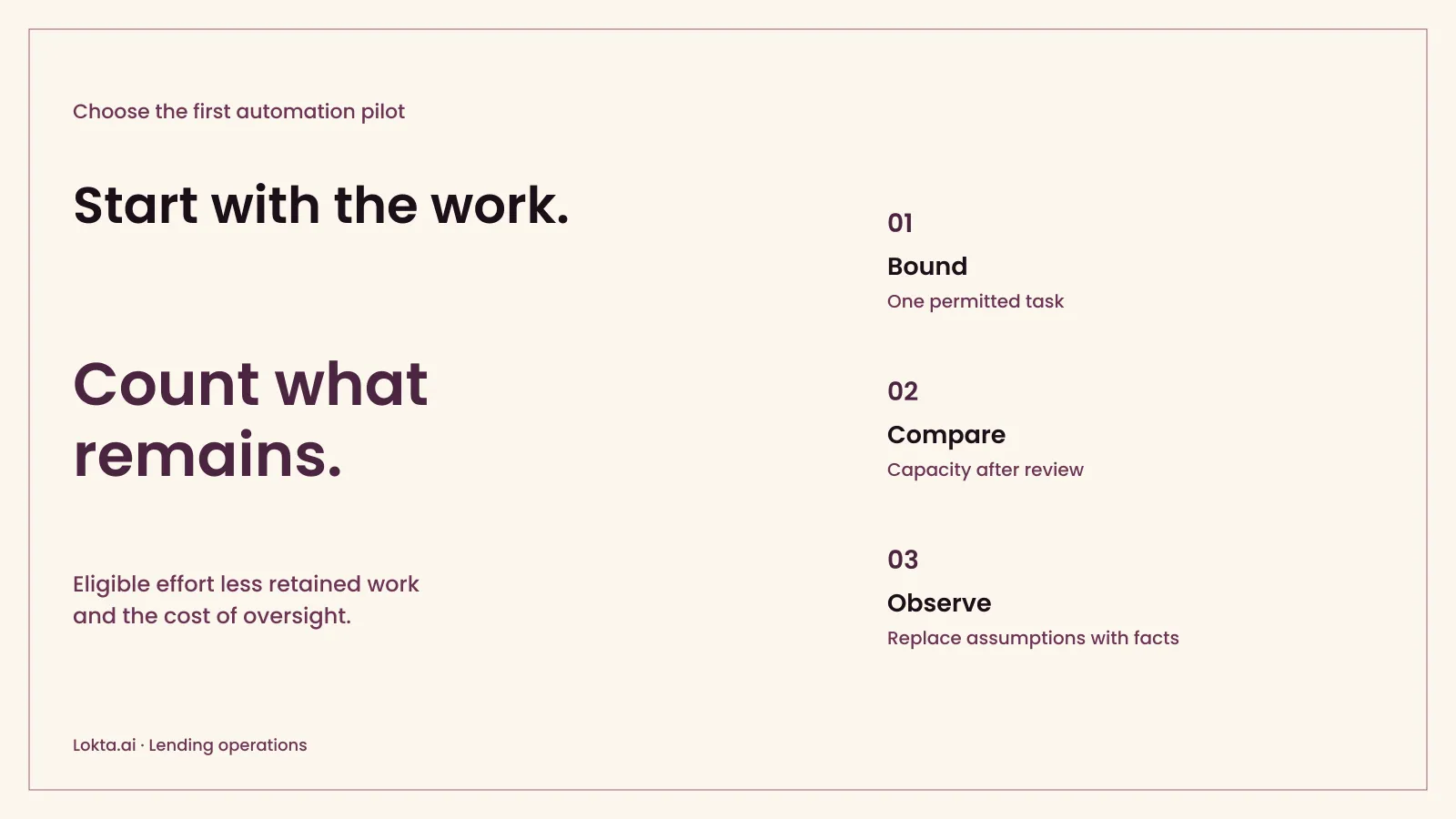
A large queue may contain many cases that need missing evidence or an authorised judgement. A smaller queue may have repeatable work, reliable records and a result the team can verify. For an NBFC investing in loan management and servicing, the useful comparison is the work that can be removed safely after the new review work is counted.
Start with a Loan Management System (LMS) workflow the operations owner can describe from trigger to verified completion. The LMS maintains the account; servicing is the work across its life. Define the task being automated before estimating its benefit. Use where servicing time actually goes to check that the chosen queue represents meaningful operating effort.
Separate a task from the decision around it
“Automate settlements” is too broad to price or test. Gathering the account history, preparing a proposal, authorising terms and executing an approved change are different tasks. They have different evidence requirements and consequences.
Tracking a promise to pay is narrower than deciding how to treat a broken promise. A closure letter needs a verified closure state and an authorised recipient before preparation and delivery can be automated. The point of narrowing the task is to make its authority and result testable.
Use the servicing workflow map to find candidates. For each, write the trigger, authoritative records, allowed action, completion evidence and person who handles an exception. If the team cannot name those five things, preparation is the next investment.
Apply readiness gates before comparing hours
Three questions can exclude a candidate from autonomous execution without excluding it from useful assistance.
First, are the required records available and trustworthy enough for the proposed action? Second, is the action governed by a clear rule and authority boundary? Third, can the team detect failure, stop affected work and restore a controlled operating path?
Treat these as conditions, not small penalties in a weighted score. A missing authorisation control cannot be compensated for by a large queue. Where judgement is central, narrow the candidate to evidence preparation or a reviewed recommendation.
Then estimate eligible volume. Exclude cases outside the agreed products, channels, data conditions or permitted actions. Keep them visible as retained work. A pilot that handles only clean cases may still be valuable, but its results cannot be presented as coverage of the whole queue.
Compare four queues on a 50,000-account book
Assume a mid-size NBFC with 50,000 live accounts. The following monthly volumes and handling times are synthetic planning inputs, not measured lender results. “After” means the human work retained for each eligible case. Separate oversight covers monitoring and exception review outside those case minutes; do not count it twice. Ineligible cases remain with the existing process.
Bounce follow-up: 160 hours after oversight
Of 5,000 monthly cases, assume 60% qualify for a permitted follow-up after the payment state is verified. Human effort falls from six to two minutes per eligible case. The calculation is 5,000 × 60% × 4 ÷ 60 = 200 hours, less 40 hours of oversight, leaving 160 hours. The dependency is reliable payment state before contact.
Promise-to-pay tracking: 130 hours after oversight
Of 3,000 promises due for review, assume 80% have complete amount, date and account references. Human effort falls from five to one minute. That is 3,000 × 80% × 4 ÷ 60 = 160 hours, less 30 hours of oversight, leaving 130 hours. The scope is matching verified receipts to promises, updating status and preparing an exception queue. It does not authorise new repayment terms or autonomous escalation.
Closure letters: about 19 hours after oversight
Of 500 cases, assume 70% have an accepted closure state and verified delivery details. Reducing effort from eight to three minutes gives 500 × 70% × 5 ÷ 60 = 29.17 hours, less ten hours of oversight, leaving 19.17 hours. If the LMS already generates the letter, measure only the remaining work; do not credit a new agent with an existing feature.
KYC-refresh outreach: about 47 hours after oversight
Of 2,000 cases, assume 50% meet the lender’s refresh and contact rules. Reducing human effort from six to two minutes gives 2,000 × 50% × 4 ÷ 60 = 66.67 hours, less 20 hours of oversight, leaving 46.67 hours. The scope is permitted outreach and routing responses. KYC verification and approval remain outside this automation boundary.
Do not add the four figures into a programme benefit without checking overlapping staff time and shared oversight. Each is a separate candidate estimate.
Choose the first pilot by its unresolved dependency
For this example, choose promise-to-pay tracking, despite bounce follow-up having the larger time estimate. Assume receipts are reconciled reliably each morning, while real-time payment updates to the contact gateway are not yet proven. A morning review can be bounded by that verified cut-off. Autonomous bounce contact needs the more demanding dispatch-time control to avoid calling a borrower who has just paid.
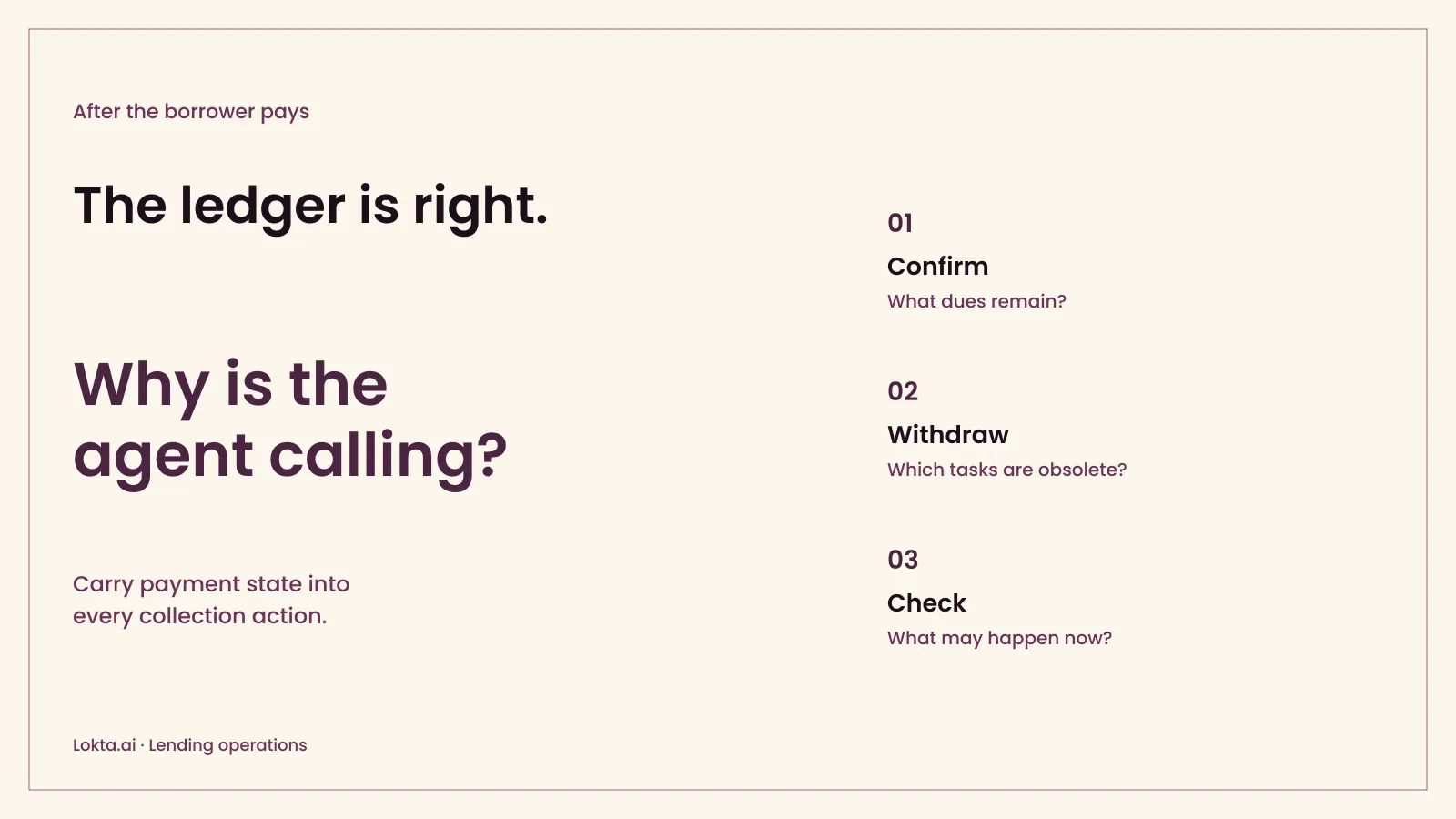
That is a reason to sequence the work, not a permanent preference for one queue. Record the excluded dependency and the evidence needed to revisit it. The paid-borrower collections case supplies the failure test for the next stage.
Price the pilot and test the fragile assumption
At an illustrative loaded staff cost of ₹600 an hour, 130 hours has ₹78,000 of monthly capacity value. Suppose the pilot requires ₹30,000 per month in incremental recurring expense and ₹90,000 of setup cost. Spread setup over a three-month evaluation solely for this decision: the comparison is ₹78,000 against ₹60,000 per month, leaving ₹18,000 of capacity value above the monthly pilot cost. This is a planning allocation, not an accounting amortisation policy.
Over three months, the model values released capacity at ₹2.34 lakh against ₹1.80 lakh of pilot cost. It produces a business case only if that capacity avoids expense or is redeployed to valuable work. It does not establish cash savings or justify removing staff.
Eligibility is the fragile assumption. If only 50% of promises qualify, the estimate becomes 3,000 × 50% × 4 ÷ 60 − 30 = 70 hours, worth ₹42,000 monthly at the same rate. The pilot then falls ₹18,000 short of its monthly comparison cost. With the other inputs fixed, break-even requires 100 hours, or 65% eligibility. Observe eligibility and retained effort before extending the commitment. Use the LMS cost guide for the wider implementation and change budget.
Design the pilot to find the counterexample
For the selected workflow, define the expected result and the case that must stop it. A promise-tracking pilot should encounter a payment posted after the review cut-off, a partial payment, two promises against one account and an ambiguous receipt. A missing match should enter review; it must not automatically become a broken-promise finding. Success includes correct escalation.
Use the AI loan servicing pilot scorecard after selection to record scope, controls, evidence and stop criteria. Compare baseline and pilot observations on the same task definition. Track errors, reopens and ageing alongside handling time so work has not merely moved into another queue.
A deterministic rule may be sufficient for part of the workflow. AI can help where interpreting a request or assembling evidence adds value. The choice of technique follows the task. It should not force a lender to add a model to a calculation or permission check that already has a precise rule.
Lokta’s Loan Management and AI Loan Servicing address that combination: authoritative account operations with AI proposals governed by the lender’s controls. Use a pilot selection discussion to agree the observed baseline, the cost ceiling and the condition that would stop expansion. The first pilot has earned a second phase when those records support the decision, including the cases it could not complete.
Frequently asked questions
Which loan servicing workflow should an NBFC automate first?
Choose meaningful eligible work whose inputs and completion can be verified. In this example, promise-to-pay tracking comes before bounce contact because reconciled daily receipts are available while dispatch-time payment checks remain unproven. The largest projected time saving is not automatically the best first pilot.
How do you estimate capacity released by loan servicing automation?
Multiply eligible case volume by the reduction in human minutes, divide by 60, then subtract additional oversight hours. The promise-tracking example gives 130 hours monthly. That is capacity, not cash savings; count financial benefit only when redeployment or avoided expense is evidenced.
Should an NBFC automate a high-exception workflow first?
It may be a useful candidate for assistance, but a high exception rate can make full execution a poor first scope. Separate evidence gathering, triage and drafting from decisions that change the account or bind the lender. Measure how much work each component can remove and what review it adds. If source records or decision rules are unreliable, fixing those dependencies may be more valuable than automating the current process.
How should an automation pilot be evaluated before expansion?
Compare handling time, eligibility, errors, reopens and borrower outcomes with the baseline. In the example, the pilot needs 65% eligibility to cover its assumed cost in capacity value. Expansion also requires acceptable controls and useful redeployment of the released time.
Read next
- Where AI agents fit in servicing: map candidate tasks and their authority boundaries
- LMS total cost of ownership: include implementation and continuing change costs
Sources
- Lokta: AI loan servicing pilot scorecard: defines acceptance after a workflow is selected. The comparison and capacity calculation in this article are synthetic planning examples
Lokta editorial analysis by Chandramouli, co-founder and CEO.