The Five Integrations Every LMS Needs, and What Slows Them Down
The API is rarely the hard part of an LMS integration. Bureau certification, mandate registration, CKYC onboarding and DLT approval all run on someone else's clock, not the vendor's.
Ask an engineer how long a bureau integration takes and you get an honest, short answer: the API call is a few days of work. Ask when the lender can actually start reporting to that bureau, and the honest answer is a different number entirely, because the API was never the part that took time.
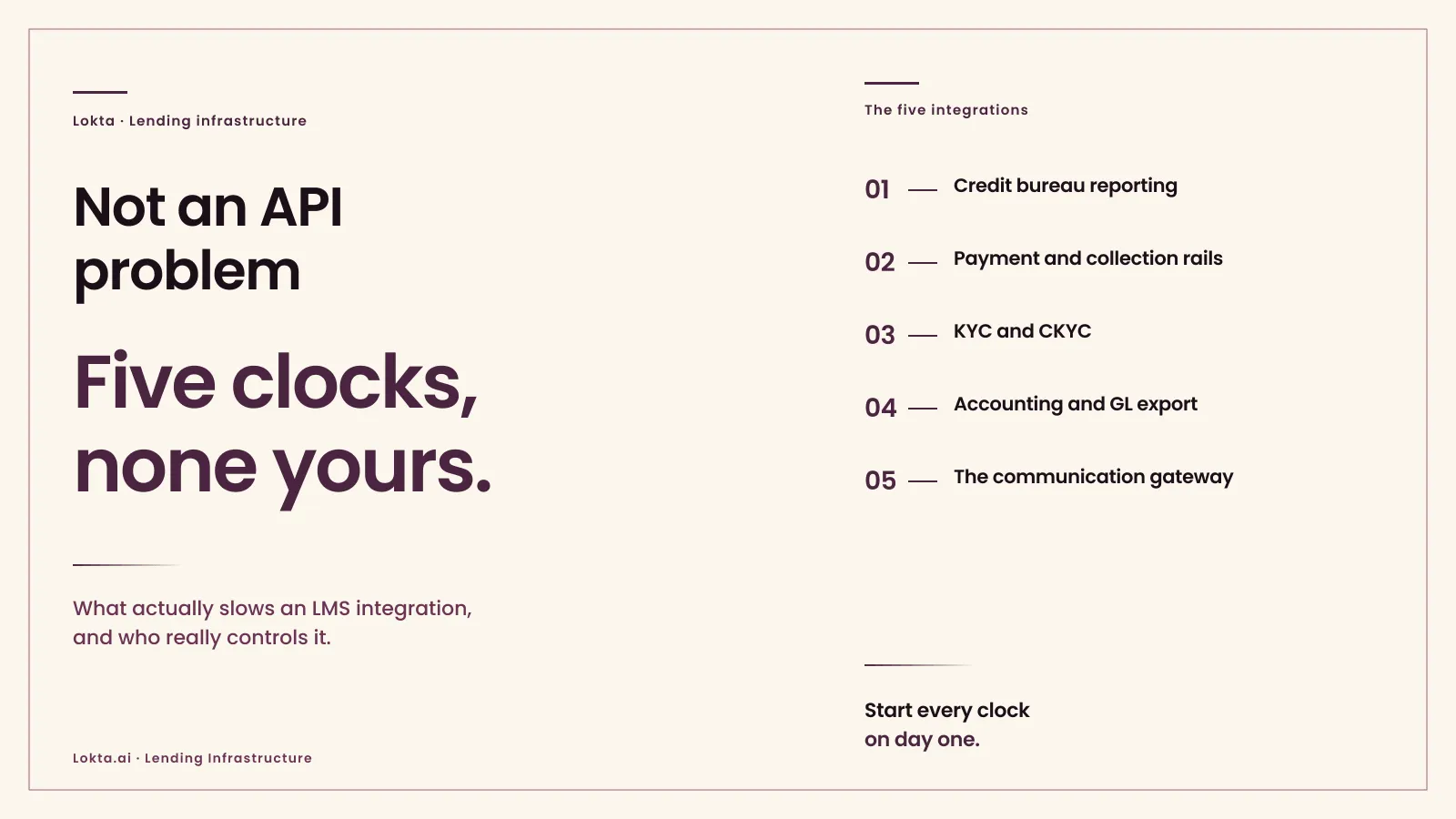
An LMS needs five integrations at minimum: credit bureau reporting, payment and collection rails, KYC and CKYC verification, an accounting or GL export, and a communication gateway. Each one has its own external certification or registration process, run by a bureau, a bank, CERSAI or a telecom regulator, not by the LMS vendor. The API is rarely the bottleneck. The queue in front of it is.
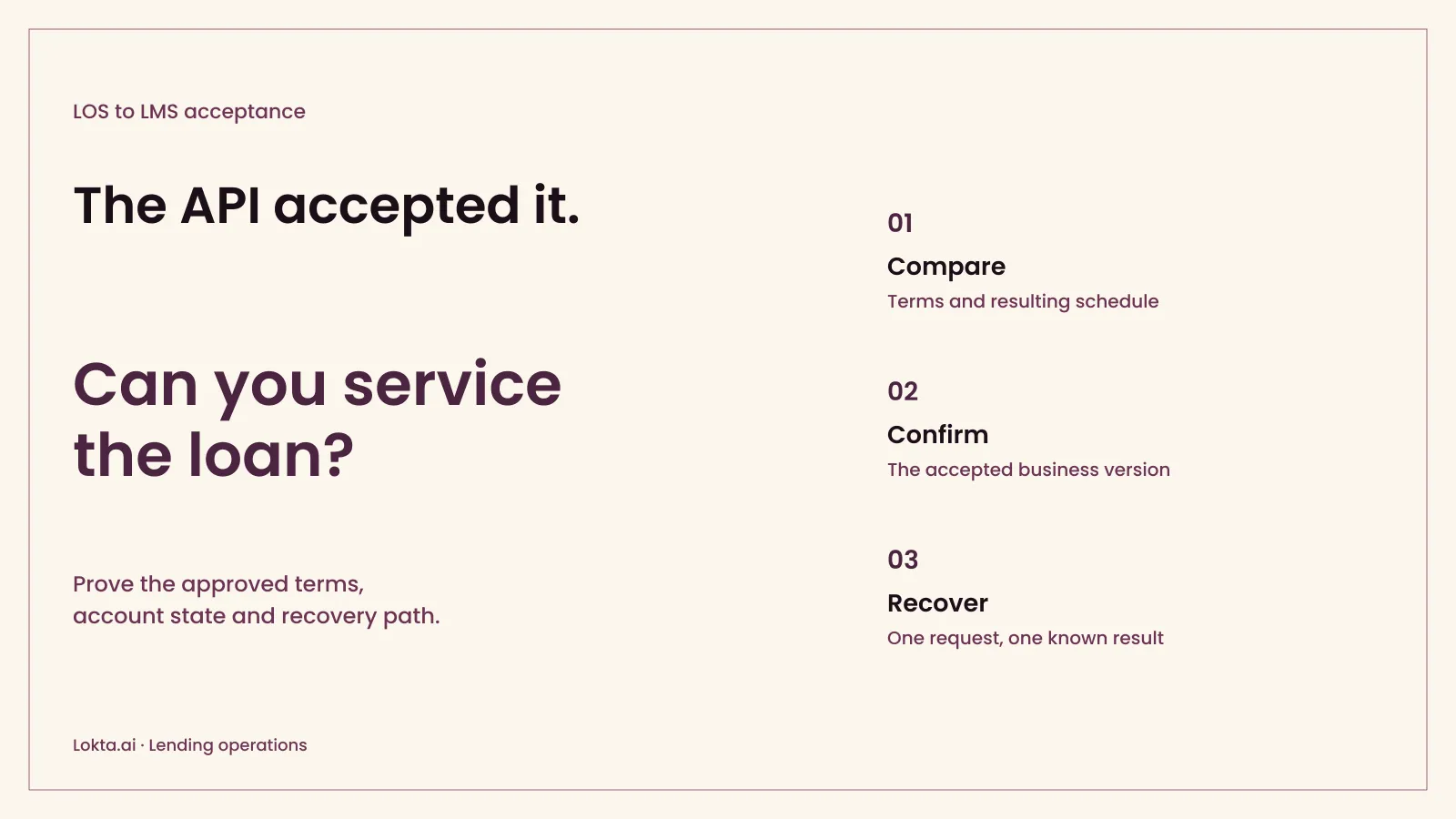
That distinction changes how an integration should be planned. A project plan that treats integrations as engineering tasks, sized in developer-days, is sizing the wrong variable. The five below are sized correctly when the calendar dependency is named alongside the API work, not after it. At the origination boundary, LOS-to-LMS acceptance adds a different test: whether the resulting account and schedule match the approved terms, including when a response is lost.
Credit bureau reporting
Reporting to a credit information company is not a single integration. It is membership, a data-format certification against the bureau’s own specification, and then a recurring reporting cadence the lender has to hold every cycle. The certification step, proving the file format is correct before the bureau accepts live data, is the queue most project plans underestimate, because it depends on the bureau’s own review calendar, not the lender’s.
How credit bureau reporting actually works for an NBFC covers the ongoing cadence and the CKYC-linkage requirement in the file itself. This integration’s setup risk is getting the certification queue started before configuration finishes, not the reporting logic itself.
Payment and collection rails
NACH mandate registration runs through the borrower’s sponsor bank, and UPI AutoPay mandates run through the UPI ecosystem’s own approval flow. Neither is a direct API contract between the lender and a single counterparty the LMS vendor controls, which means neither can be certified and turned on purely by the LMS team working faster.
The operational failure mode that follows a rushed setup here is well understood: a mandate that was registered but never tested against a real bounce shows up as a broken collections flow on day one. The first 72 hours after a NACH or UPI AutoPay bounce only works if the bounce-handling path was tested before go-live, not discovered during it.
KYC and CKYC
Verifying a borrower’s identity against the Central KYC Registry is a search-and-download integration against CERSAI’s own system, and getting certified to call it is a separate approval step from writing the integration code. A lender that treats this as “just an API key” finds out otherwise when the certification request sits in a queue the LMS vendor has no ability to expedite.
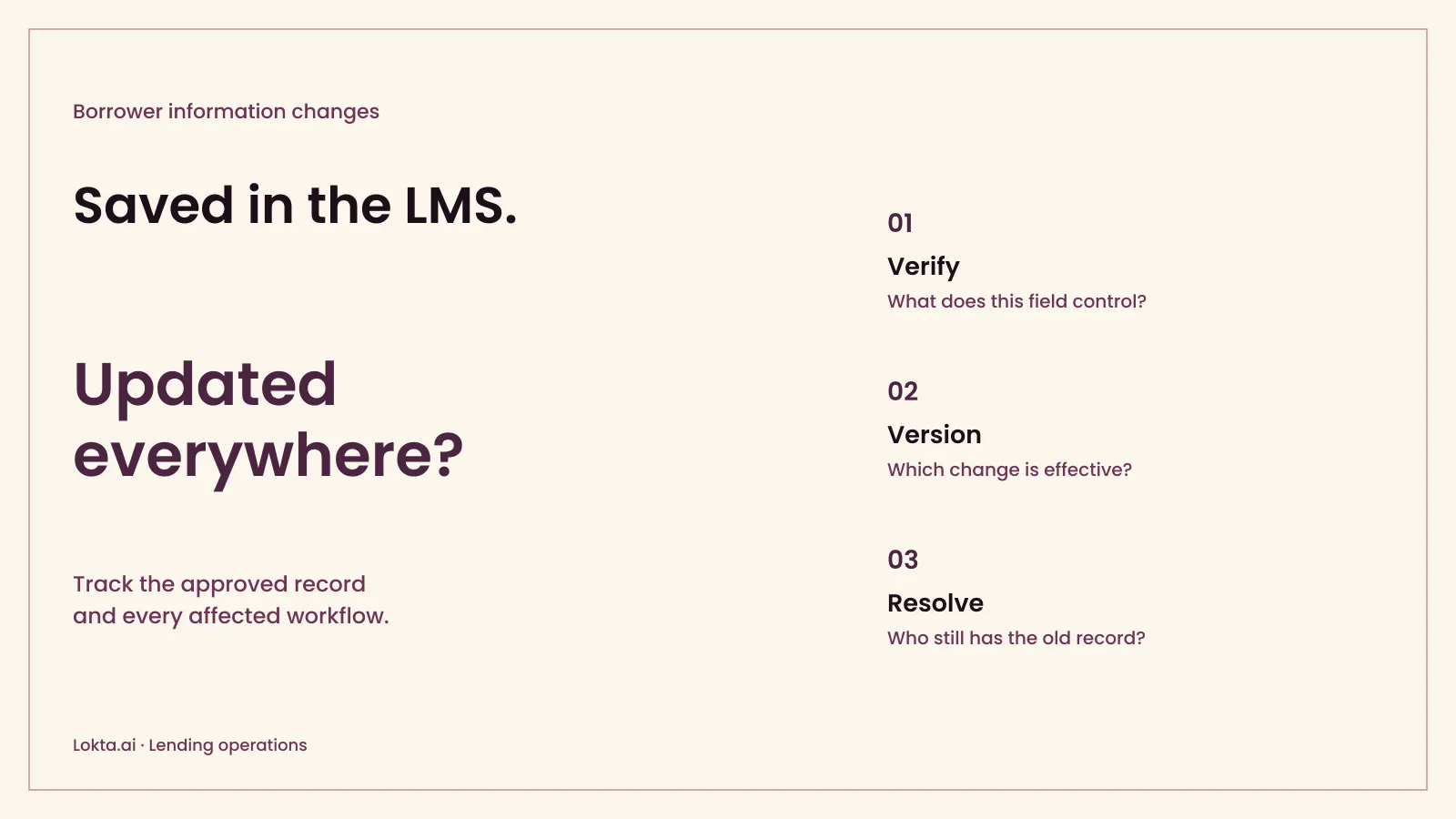
This integration is also where a migration and a fresh implementation diverge: a lender replacing an existing system already has CKYC linkage on its borrower records and has to carry it across intact, which is a sequencing problem covered separately. A greenfield lender is setting this integration up for the first time, with the full certification queue ahead of it. After go-live, the borrower-detail change workflow must also carry updated KYC information to CKYCR within the applicable clock and process incoming change notifications.
Accounting and GL export
Every loan event, disbursal, repayment, write-off, has to land somewhere in the lender’s own books, and the LMS side of this integration is usually the easiest of the five: mapping the platform’s chart of accounts to the lender’s existing ERP or accounting system. The delay here rarely comes from an external queue. It comes from the lender’s own finance team needing time to agree on the mapping, which is internal work the project plan should schedule explicitly rather than assume happens automatically alongside configuration.
The communication gateway everyone forgets
A payment reminder, a collections message, an OTP: all of it depends on an SMS or communication gateway, and in India that gateway will not send a single message until the sender has completed DLT registration with the telecom regulator, covering the sending entity, the sender ID and every message template in use. This step has nothing to do with the LMS and everything to do with how Indian telecom carriers filter commercial messages, and it is the integration most likely to be discovered missing in the final week before go-live, when someone tries to send the first reminder and nothing goes out.
The fix is not technical. It is starting the registration the same week the project starts, regardless of how far along configuration is, because the telecom operators’ own review queue does not move faster because the LMS is ready.
Start every clock on day one
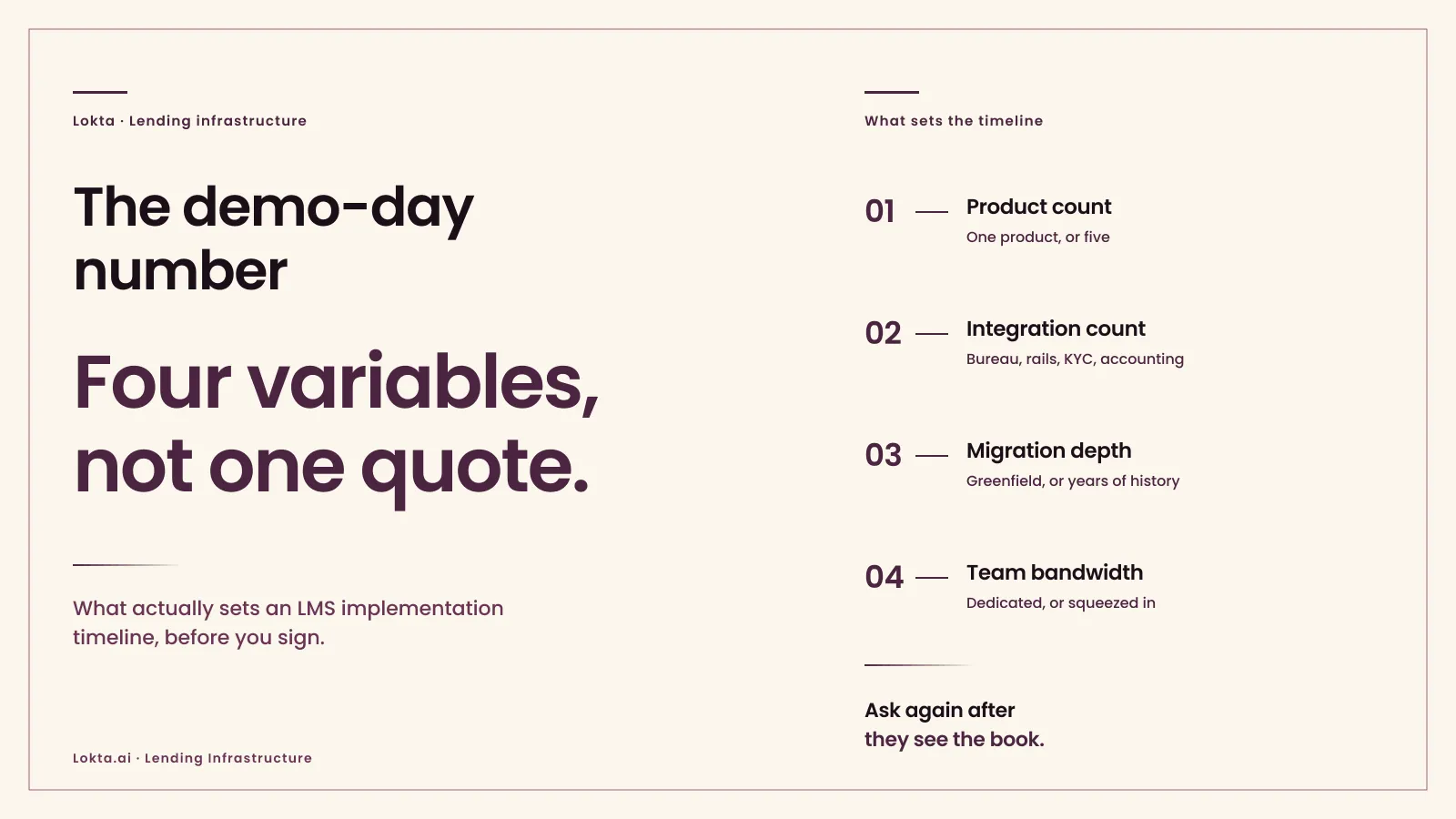
The pattern across all five integrations is the same: each one has an external dependency that runs on its own calendar, and none of those calendars care how fast the LMS configuration finishes. A project plan that starts bureau certification, mandate registration, CKYC approval and DLT registration in parallel with configuration, on day one, finishes when the slowest of the five clocks runs out. A plan that starts them one after another, waiting for configuration to finish first, adds every queue’s full duration on top of the configuration timeline instead of overlapping it.
There are three honest ways to run this. Start every integration’s registration process on day one regardless of configuration status, and accept that some approvals will sit waiting before the platform is ready to use them. Sequence integrations after configuration, which is simpler to manage but adds every external queue’s duration to the total timeline. Or assign one owner per integration whose only job is chasing the external party’s queue, which costs a person’s time but is usually the fastest of the three paths.
None of this shortens a bureau’s own certification calendar or a telecom regulator’s review queue. What it does is make sure the LMS is never the reason those clocks started late.
Frequently asked questions
What integrations does a loan management system actually need?
Five, at minimum: credit bureau reporting (to report and pull borrower history), payment and collection rails (NACH mandates and UPI AutoPay), KYC and CKYC verification, an accounting or GL export to the lender's books, and a communication gateway for reminders and alerts. Each has its own external certification process the LMS vendor does not control, which is why integrations are usually a scheduling problem rather than a coding one.
Why do LMS integrations take longer than the API work suggests?
Because most of the time is spent in a certification or onboarding queue run by someone other than the LMS vendor: a bureau's own data-format certification, a sponsor bank's mandate-registration process, CERSAI's CKYC search-and-download approval, or the telecom regulator's SMS template registration. The API integration itself is often the fastest part. The queue in front of it is not something the vendor's engineering team can speed up.
What is DLT registration, and why does it matter for a loan management system?
DLT registration is India's telecom-regulator requirement that any business sending commercial SMS, including payment reminders and OTPs, register its sending entity, sender ID and message templates before a single message goes out. Lenders that leave this until go-live week discover that reminders and collection messages cannot send, because the registration runs on the telecom operators' own clock, not the LMS vendor's.
In what order should LMS integrations be started?
All of them, on day one, in parallel with product configuration, not sequenced one after another. Each integration's external certification queue moves at its own pace regardless of how fast the LMS side is ready, so starting a bureau certification or a mandate-registration process only after configuration is done adds the queue's full duration to the project timeline instead of overlapping it.
Read next:
- How Long an LMS Implementation Actually Takes: where integration risk fits inside the whole-project timeline.
- How credit bureau reporting actually works for an NBFC: the ongoing reporting cadence once this integration is live.
- NACH or UPI AutoPay bounce: the lender’s first 72 hours: the operational path this integration has to support from day one.
Chandramouli is the co-founder and CEO of Lokta, the agentic loan servicing platform. He has spent two decades building AI for decisions that change people’s lives, and has served as an independent director on an NBFC board. He writes here about the clocks a project plan forgets are not the vendor’s to control.