The LMS Selection Mistakes That Have Nothing to Do With Features
The feature grid is rarely why an LMS selection goes wrong. It is who ran the evaluation, what the reference call would have shown, and what the signed contract actually says.
Ask a lender what went wrong with their last loan management system and the answer is almost never “it was missing a feature.” Features get checked. What gets missed is who ran the evaluation, whether anyone called a lender actually running the platform, and what the signed contract says next to what the sales deck promised.
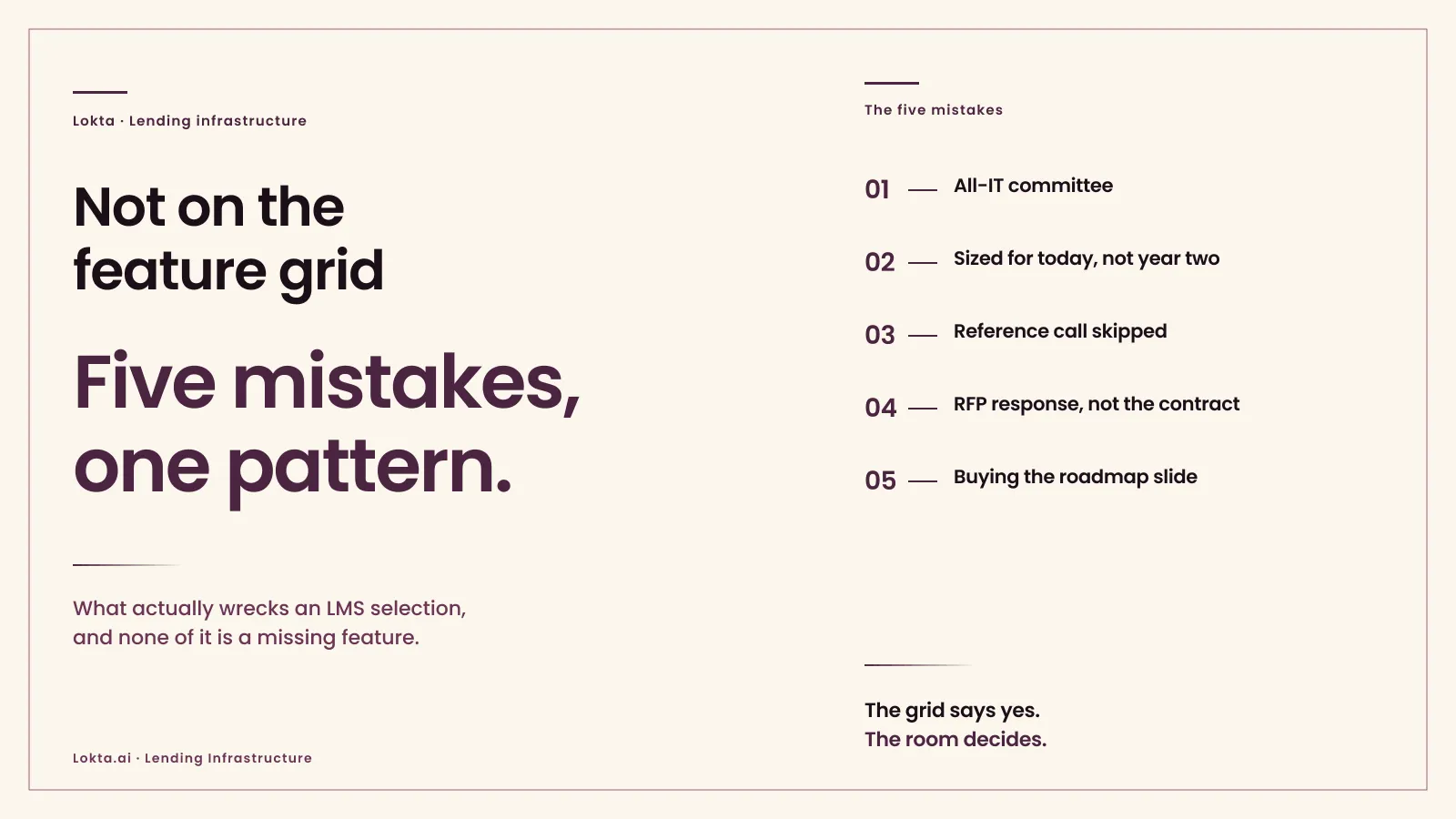
The mistakes that wreck an LMS selection are procedural, not technical: an all-IT buying committee with no collections or compliance voice, a contract sized for today’s book instead of the next two years, a reference call skipped in favor of a polished demo, an RFP response trusted more than the signed contract, and a roadmap slide bought as if it were a shipped feature.
None of this shows up on a feature comparison grid, which is exactly why it is so easy to miss. A grid rewards the vendor who answers “yes” the most times. It has no row for who was in the room, what a reference lender actually said, or what the contract’s exit clause reads like at 2am eighteen months from now.
Mistake one: the buying committee is all IT
IT can assess architecture, security posture and integration effort better than anyone else in the building. It cannot tell you whether the platform’s part-payment logic matches how your collections team actually negotiates a settlement, or whether your compliance team can pull the export a regulator will ask for on day one. Those are different questions, answered by different people, and a committee that skips them finds out the hard way after go-live.
The fix is not complicated: put collections, servicing and compliance in the room before the shortlist is final, not after the contract is signed. Each of them tests a different failure mode a purely technical evaluation will not surface, because what predicts fit is how a platform governs a change to a loan before it posts, not its architecture diagram.
Mistake two: sizing for today’s book, not the next two years
A contract negotiated against this year’s loan count, product count and transaction volume looks like a good deal until the book grows the way every successful lender’s book grows. Per-seat pricing that felt generous at launch becomes the single biggest line item in the budget two renewal cycles later, and a product catalog that fit at signing needs a change request for every new product the business wants to launch.
The question to ask before signing is not “what does this cost today” but “what does this cost at twice the book, and does adding a fourth product require a new commercial conversation or a configuration change.” A vendor who cannot answer the second half of that question in specifics is telling you the contract was priced for the demo, not for growth.
Mistake three: skipping the reference call
A demo shows exactly what the vendor chose to show, in an environment the vendor controls completely. A reference call, arranged directly with a lender running a similar product mix and a similar book size, is the one part of the evaluation the vendor does not get to stage.
The questions worth asking on that call are specific: what actually broke in the first ninety days after go-live, how long support actually took to resolve it against what the contract promised, and whether the implementation timeline the vendor quoted matched the timeline the reference lender actually lived through. A vendor confident enough in its own delivery will offer this call before you ask for it. One that resists, or offers only a reference from a very different kind of book, is telling you something too.
Mistake four: trusting the RFP response instead of the contract
An RFP response is a sales document, written to win the deal. The signed contract is the only document that is enforceable, and selection mistakes made here do not surface until eighteen months later, when a lender discovers that the SLA the RFP promised and the SLA the contract actually specifies were never the same commitment.
Every specific promise made during evaluation, a support response time, an audit right, an exit timeline, a data-export format, needs to appear in the contract with a number and a remedy attached, not just in the deck the sales team presented. What RBI’s outsourcing rules actually require you to prove about audit rights and exit strategy is a useful checklist for exactly which promises need to survive the trip from RFP response to signature.
Mistake five: buying the roadmap slide
Every vendor demo has a slide with a feature on it that is “coming soon,” and every evaluation has at least one buyer who scores that slide as if the feature already shipped. It rarely does on the timeline promised, and a selection decision anchored on a roadmap item is a selection decision made on a capability that does not exist yet.
The honest evaluation question is narrow: is this shipped, in production, on a live tenant today, or is it a roadmap item with no committed date. A vendor being honest about that distinction, rather than blurring it, is itself a signal worth weighing. Ours is one of them: Lokta lists Loan Origination as a roadmap capability, not available now, precisely so a buyer scoring today’s platform is not scoring tomorrow’s slide.
Run the evaluation you would defend to your own board
There are three honest ways to run this evaluation. Run it fast with the committee you already have, and accept the risk that a voice missing from the room becomes a problem discovered after go-live. Build the full cross-functional committee and add the reference calls and contract-language review, which costs weeks the procurement timeline may not have budgeted for. Or run a structured discovery phase with your top two vendors before the final decision, trading a longer evaluation for a contract that was actually tested against your book rather than a template.
None of these guarantees a perfect selection. What they guarantee is that if it goes wrong, it goes wrong for a reason you can point to, not a mistake nobody in the room was positioned to catch.
Frequently asked questions
What are the most common mistakes NBFCs make when selecting a loan management system?
The costliest mistakes are rarely about a missing feature. They are procedural: letting IT run the evaluation without collections, servicing and compliance in the room, sizing the contract for today's book instead of the next two years, skipping a candid reference call with a lender running a similar book, trusting the RFP response deck instead of what the signed contract actually commits to, and buying a roadmap slide as if it were a shipped capability.
Should IT alone run an LMS vendor evaluation?
No. IT can assess architecture, security and integration fit, but cannot answer whether a platform's appropriation logic matches how collections actually works, or whether compliance can produce the exports a regulator will ask for. An evaluation committee without collections, servicing and compliance in the room buys a platform that works in a demo and fights the operations team for the next five years.
Why does a reference call matter more than a vendor demo?
A demo shows what the vendor chose to show. A reference call with a lender running a similar product mix and book size answers the question the vendor cannot: what actually broke after go-live, how support responded, and what the vendor's own timeline estimate turned out to be worth. Vendors control a demo completely. They do not control what a reference lender says on a call the lender arranged directly.
What is the difference between an RFP response and the signed contract?
The RFP response is a sales document, and the signed contract is the only one that is enforceable. A vendor's written answer that they support a given SLA, a given exit timeline, or a given audit right means nothing if that specific commitment, with a number and a remedy attached, is not in the contract itself. Selection mistakes made here surface eighteen months later, when the lender discovers the RFP promise and the contract clause were never the same document.
Read next:
- How Long an LMS Implementation Actually Takes: the timeline questions to ask before you sign, not after.
- On-Prem, VPC or Shared Cloud: the audit, exit and disaster-recovery test that belongs in the contract itself.
- Loan management system cost: pricing models and TCO: the five-year cost sheet that catches mistake two before you sign.
Chandramouli is the co-founder and CEO of Lokta, the agentic loan servicing platform. He has spent two decades building AI for decisions that change people’s lives, and has served as an independent director on an NBFC board. He writes here about the evaluation questions a feature grid never asks.