Best loan servicing software for fintechs in India: five tests to run on every vendor
Five tests a fintech lender in India should run on every loan servicing software vendor, including a replayable audit trail and RBI rules as configuration.
You answer to RBI for a book that no vendor demo has seen. The decks on your shortlist will all say governed, compliant and audit-ready, and the feature grid will get each of them to yes within a few rows. What the grid never asks is what the platform does the moment a payment, a waiver or a write-off tries to change money on your ledger. That question decides whether the platform holds on your book after go-live, and this guide gives you a script for it.
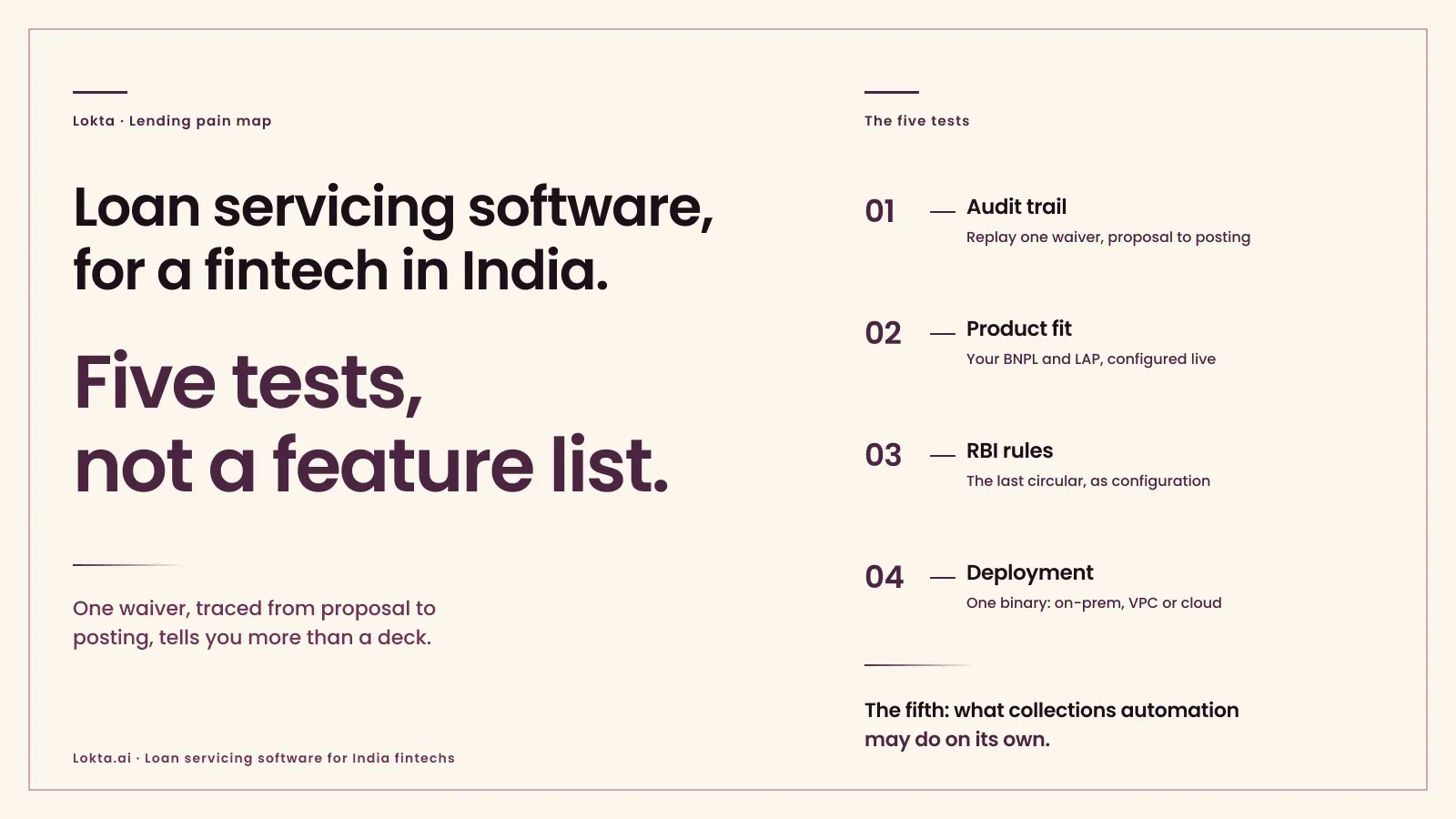
By the end you have five tests to run on every vendor, Lokta included: one transaction traced through to the ledger, your own products configured in front of you, the last RBI circular as a timed change, deployment and exit terms settled alongside functional fit, and a stated boundary for what collections automation may do alone. Each test comes with the question to ask and what a good answer sounds like.
There is no single best loan servicing software for a fintech lender in India, because fit depends on the book. What predicts fit is how a platform governs a change to a loan before it posts, not its feature count. Run five tests on every vendor: a replayable audit trail, your products configured live, RBI rules as configuration, one codebase across deployments, and a stated boundary for collections automation. The vendor that passes all five is your shortlist.
1. Ask for one waiver, traced from proposal to posting
Pick one real action, a fee waiver on an overdue account, and have the vendor walk it from the moment it is proposed to the entry on the ledger. Not a report of waivers. One waiver, with the policy it was checked against, who or what proposed it, who approved it, and the entry it produced.
A good answer shows that chain on the account itself, and can show it again on a later date without a support ticket. A weak answer shows a dashboard of totals, or a log that records that something changed without the policy version and the approver beside it. An examiner asks why one loan’s balance is what it is, and a log of totals cannot answer that.
Ask the same question with an AI-proposed action, because the distinction is going away. A servicing agent that drafts a borrower reply is low stakes. One that proposes a waiver or a write-off is not, and the trail has to read the same whichever one it was. On Lokta the ledger is double-entry and event-sourced, and any book can be replayed from its own history. The servicing agent proposes rather than posts: the core checks each proposal against policy and the required approvals, and the account record keeps the proposal, the approval and the outcome. That is what audit by design means in practice, and what an audit trail in a loan management system has to hold sets out the statutory side.
2. Put your own products in front of the vendor
Name the products you run and ask to see each one configured in a live tenant, not on a roadmap slide. Consumer and BNPL loans sit at one end of a fintech book, home loans and loan against property at the other, and a platform tuned for one end has to prove it on the other.
- Subvention and the merchant fee as fields on the product, not an adjustment your team makes after disbursal.
- Short tenors at high volume, with the month-end close running at the same speed as the tenth of the month.
- A part payment or foreclosure the borrower triggers without a call, posted in the same event stream as everything else.
- A floating-rate reset where the borrower’s election is recorded and the reset never grows the principal.
- A part-prepayment that redraws the schedule on the actual date, with the charge set by rate type.
- Collateral held on the loan and released on closure, not in a spreadsheet someone reconciles each quarter.
Ask for the day-count convention, the appropriation order and the foreclosure logic for each product by name, and ask which of them a live lender is running today. Lokta’s loan product engine exposes one ledger as 190 configuration parameters across 19 domains, with 20 retail product types and 200 launch-ready templates. The consumer durable and BNPL, home loan and loan against property pages set out how each is configured. A mixed book stays on one ledger rather than on two systems a team reconciles by hand.
3. Ask which RBI circular shipped last, and how long it took
“Compliant” is not a feature a vendor ships once. RBI changes the rules on its own calendar, and the platform’s job is to take each change once, as configuration, rather than as a build per product. For a fintech lender the working list is asset classification under the IRAC norms and the SMA buckets, the Key Facts Statement and APR disclosure, the 2024 penal-charge rules, and the Prepayment Directions 2025.
Ask which of these the vendor shipped last, when the circular landed, and when the change reached production for every affected product. A good answer names a circular and a number of weeks. A weak answer says the platform is compliant.
Days past due and the SMA stage should come from the ledger’s own events, not from a nightly report someone reconciles before the return goes out.
Each should be a parameter on the product, so a new circular changes a setting once and every product inherits it.
The model risk guidance RBI put out in draft in June 2026, still not final, asks for a model inventory with owners and validation evidence. A separate control from servicing, and worth asking about in the same meeting.
Lokta ships IRAC and SMA classification automated, KFS and APR disclosure, and the 2024 penal-charge rules and the Prepayment Directions 2025 as configuration. How SMA and NPA dates are set and how penal charges, prepayment and rate resets become configuration go through the rules themselves. Model risk is a separate product, RBI Model Risk Management, which organises the evidence a board needs and does not validate your models.
4. Settle deployment and exit terms with functional fit
Deployment gets negotiated late in an evaluation, after the functional fit is settled, and that order is backwards. Data residency and exit terms are the two things that are hard to change once a lender has gone live, so settle them in the same round as the product tests.
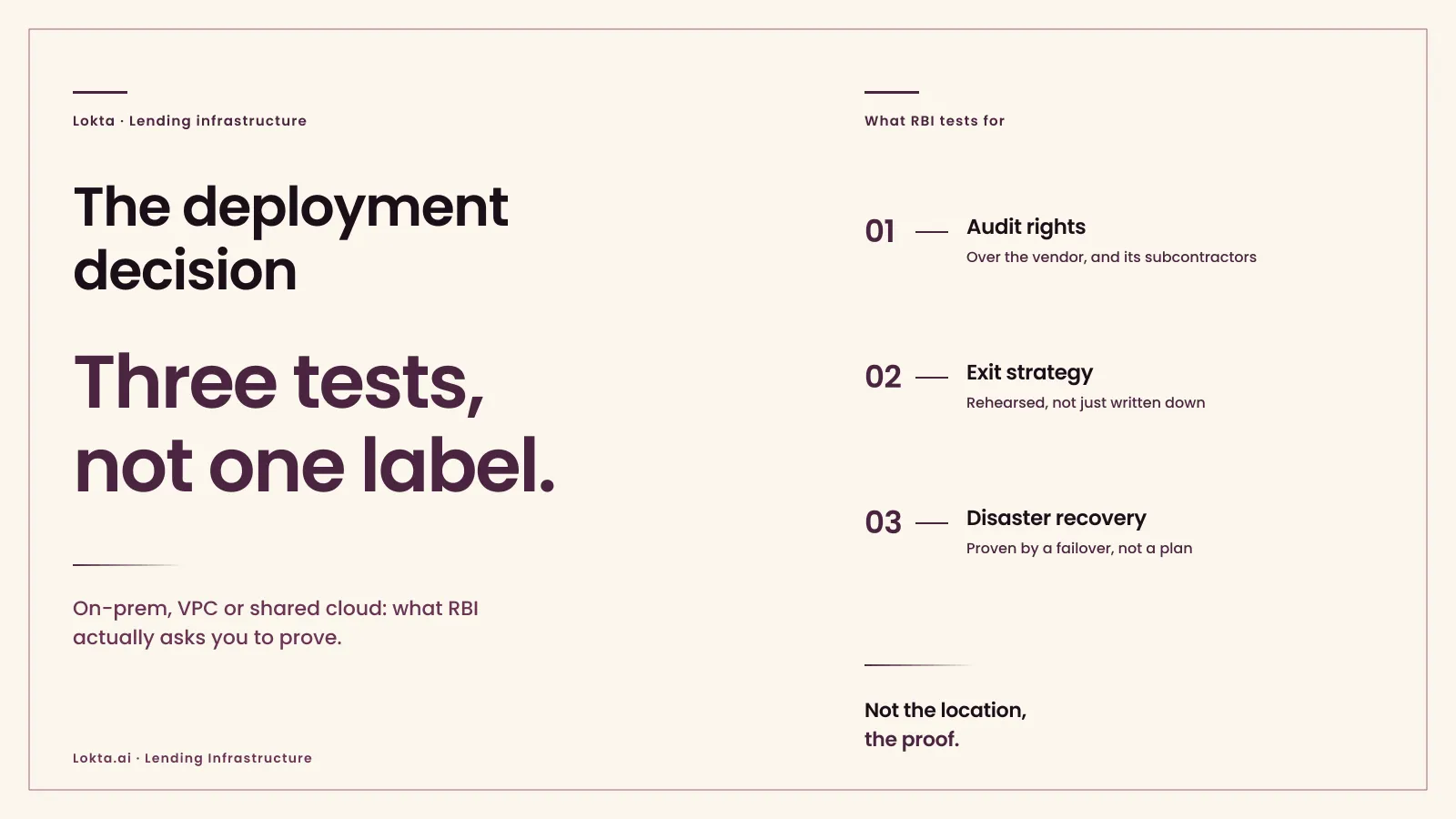
The question that matters more than which shape you pick is whether all three are one codebase. Three codebases mean three release cadences, and the lender ends up on whichever version it deployed first. Ask for it in writing: same binary or not, where the data sits, and what leaving costs in year five. Lokta ships as one Spring Boot binary on Linux with PostgreSQL, and that same binary runs on-prem, in a single-tenant cloud or inside your VPC, with schema-per-tenant isolation and an OpenAPI 3.1 contract generated from the code. Put the exit cost on the five-year cost sheet before you sign. Which shape actually satisfies RBI’s outsourcing rules is a separate question from vendor fit; see on-prem, VPC or shared cloud: what RBI actually requires you to prove for the audit, exit and disaster-recovery test the regulator applies regardless of which one you pick.
5. Ask what collections automation may do on its own
Automated collections is where a servicing platform meets RBI’s conduct rules, and where a vendor’s AI claims deserve the hardest look. RBI’s 2022 circular on recovery agents, now carried into its conduct directions for NBFCs, keeps recovery calls between 8 am and 7 pm for loans other than microfinance, bars harassment, and applies to whatever is doing the calling.
Ask what the automation may do on its own, what needs a person, and how the platform stops a message that would break the window. A good answer is a boundary held in configuration: contact windows and consent checked before a message goes out, every contact and every promise to pay logged on the account, and settlements and write-offs with a named approver. A weak answer is a model that has been told the rules.
Rank the overdue queue, draft the reminder, send it inside the window, record the reply and the promise to pay, and route a hardship or a dispute to a person.
Settlement terms, write-offs, legal escalation, and anything the borrower disputes. The automation proposes them, and a named person approves or declines on the record.
Lokta’s servicing agent works inside that boundary. It proposes the next action, logs each promise to pay and each contact on the account, and posts nothing to the ledger itself. What RBI’s rules let an AI agent do in collections and the evidence a collection contact should leave cover the rules in detail.
The five tests on one page
| Test | Ask the vendor | A good answer |
|---|---|---|
| Audit trail | Trace one waiver from proposal to posted entry, with the policy version and the approver. | The chain sits on the account and replays on a later date. |
| Product fit | Show our products configured in a live tenant, with the day count, appropriation order and foreclosure logic for each. | A live lender runs them today. |
| RBI rules | Which circular did you ship last, and how long from circular to production? | A named circular and a number of weeks. |
| Deployment | Are on-prem, VPC and cloud one binary, and what does leaving cost in year five? | Same binary, in writing, with the exit cost on a sheet. |
| Collections | What may the automation do alone, and how does it stop a message outside the window? | A boundary in configuration, with a named approver for the rest. |
Apply the tests to Lokta as hard as to anyone else. The wider loan servicing software comparison sets six platforms against the same servicing and control criteria, and the best LMS for NBFC shortlist asks the system-of-record question for an NBFC book.
Three ways to run the evaluation
From here there are three ways to go. Keep the servicing setup you have and carry the exception work by hand, which is the cheapest path this quarter and the one whose cost grows with the book. Build the servicing and collections layer on the core you already run, which keeps control in-house and puts your engineers on plumbing for a year. Or run the book after approval on a platform built for it, which is Lokta’s case, with one limit stated plainly: the first weeks go on wiring your products and policy into the core, and the agent proposes nothing until that is done.
Whichever path you take, the five tests are the same, and a vendor that fails one on your products fails it on your book. Lokta comes from the team behind Apache Fineract, the open-source lending core, and it answers the five tests from the record and from configuration rather than from a custom build. An NBFC-licensed fintech at or under the AUM cap can also put its book on the Next 100 programme. The lender who can show an examiner one waiver from proposal to posted entry is the one who ran the script.
Frequently asked questions
What is the best loan servicing software for fintech in India?
There is no single best platform, because fit depends on the book. What predicts fit is how a platform governs a change to a loan before it posts, not its feature count. Run five tests on every vendor: trace one waiver from proposal to posted entry, see your own products configured in a live tenant, ask which RBI circular the vendor shipped last and how long it took, get deployment and exit terms in writing, and get a stated boundary for collections automation. Lokta answers those tests with a double-entry, event-sourced ledger, RBI rules as configuration, one binary across deployments, and a servicing agent that proposes rather than posts. Loan origination is on the roadmap.
How do you choose loan servicing software for BNPL and consumer loan portfolios?
Ask to see the product configured, not described. Consumer and BNPL books run on subvention, short tenors and high volume, and a platform built around a personal-loan template can end up handling subvention as a manual adjustment after disbursal. Ask for the day-count convention, the appropriation order and the foreclosure logic for the product by name, and ask whether a part payment posts at once or waits for a batch. Lokta configures consumer durable, BNPL and personal-loan variants as parameters on one event-sourced ledger, with 190 configuration parameters across 19 domains, so servicing and collections read one account record whichever product created the loan.
How do you choose regulatory compliance-friendly loan servicing software for a fintech in India?
Start from the rules your book is classified and charged under: asset classification under the IRAC norms and the SMA buckets, the Key Facts Statement and APR disclosure, the 2024 penal-charge rules and the Prepayment Directions 2025. A platform that holds these as configuration takes the next circular as a settings change, not a project. Ask the vendor to name the last RBI change it shipped and the weeks it took to reach production. On Lokta, IRAC and SMA classification runs automatically, the KFS and APR disclosure is generated, and the penal-charge and prepayment rules sit in product configuration. Model risk is a separate Lokta product, which organises the evidence a board needs and does not validate the lender's models.
How do you choose loan servicing software that supports cloud or VPC deployment?
Decide data residency and exit terms before you decide the topology, because the topology is easy to change later and the residency commitment is not. Then ask whether on-prem, VPC and single-tenant cloud are one binary with different settings or separate codebases. Separate codebases drift apart after the first year, and the lender ends up on whichever version it deployed first. Lokta is one Spring Boot binary on Linux and PostgreSQL, deployed on-prem, in a single-tenant cloud or inside the lender's VPC with no separate build for any of the three, and each tenant sits in its own database schema, so the choice of residency does not fork the platform.
How do you choose loan servicing software for home loan and loan-against-property portfolios?
These books sit at the opposite end from BNPL: long tenors, floating-rate resets, part-prepayment, and for loan against property a collateral position that has to be tracked and released as the loan runs down. Ask how the platform redraws a schedule when a floating rate resets, whether a part-prepayment cuts the tenor or the EMI by the borrower's election, and whether the collateral record lives on the loan or in a separate system someone reconciles. On Lokta a floating-rate reset follows the lender's policy with the election recorded and the reset never grows the principal, a part-prepayment redraws the schedule on the actual date, and collateral is held on the loan.
Read next:
- Best loan servicing software 2026, six platforms compared: the wider vendor shortlist on the same servicing-depth and control criteria.
- Ten things your LMS needs to do in 2026: the operational requirements the audit and compliance tests here are drawn from.
- How to use AI agents in loan servicing: where the proposal boundary sits inside a servicing workflow.
Sources:
- RBI, Outsourcing of Financial Services: Responsibilities of regulated entities employing Recovery Agents, RBI/2022-23/108, 12 August 2022.
- Lokta, the loan management RFP toolkit, for the deployment and architecture facts quoted above.
- Two vendor-published comparison listicles that rank servicing software by feature set, one and another, for the feature-grid framing this guide argues against.
Chandramouli is the co-founder and CEO of Lokta, the agentic loan servicing platform. He has spent two decades building AI for decisions that change people’s lives, and has served as an independent director on an NBFC board. He writes here about what a lender should ask before it signs.