Interest accrual in a loan management system: daily accrual, day count and reversal
How a loan system should accrue interest daily, which day-count convention to set, how to handle broken periods and backdated events, and when to reverse it.
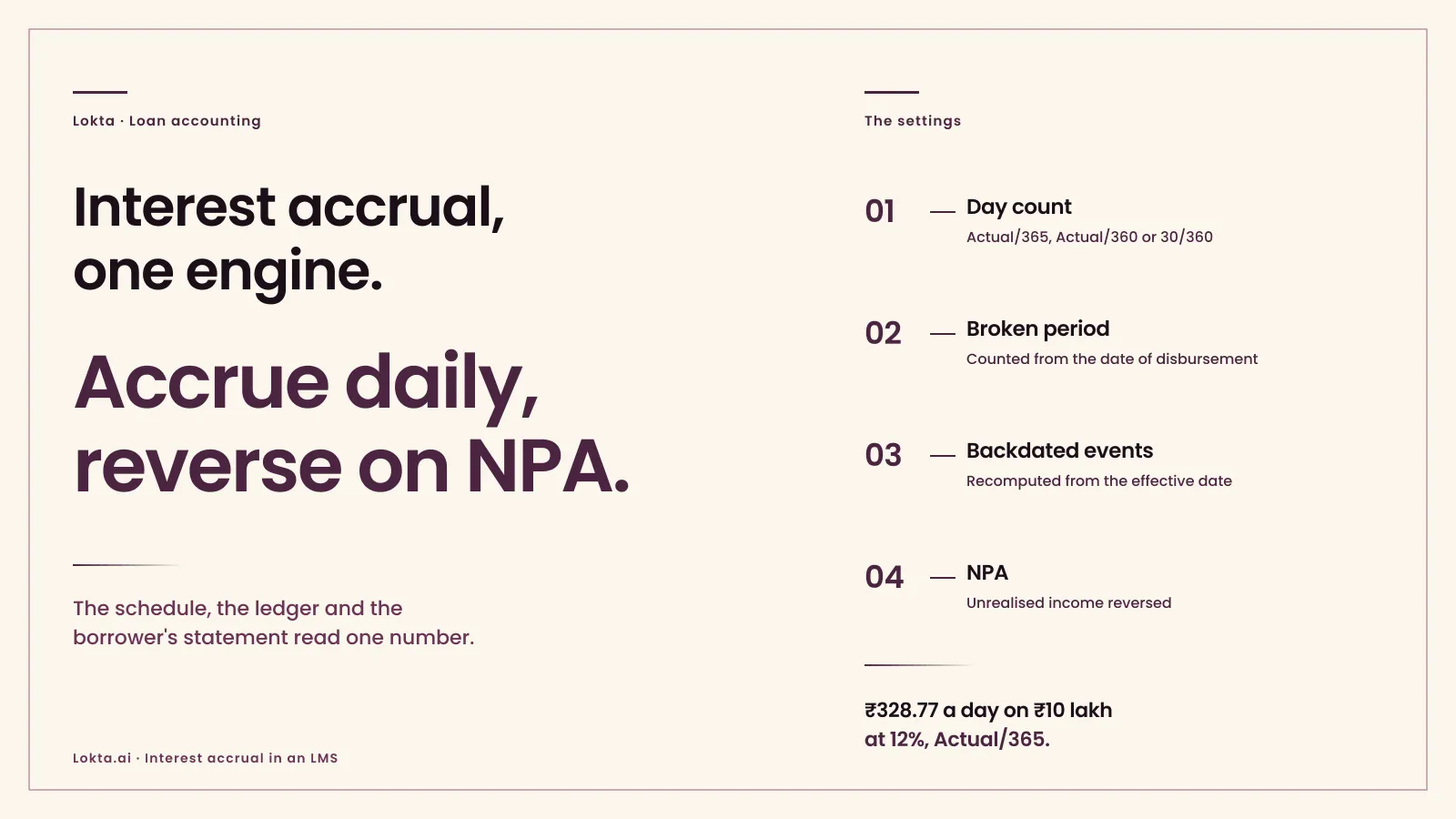
A loan management system should accrue interest every day on the outstanding principal, at the loan’s rate, under the day-count convention in the product terms. It should compute broken periods from the actual disbursement date, recompute from the effective date when an event is backdated, and, for NBFCs under RBI’s income recognition rules, stop recognising income and reverse unrealised interest when an account turns NPA.
If you run finance or product at an NBFC, the interest your loan system accrues is a number your auditors, your borrowers and RBI’s supervisors can each check a different way. It has to come out the same for all three.
Accrual goes wrong in small, repeated ways: a day-count convention that differs between the schedule and the ledger, a broken period charged from the sanction date, a backdated receipt that fixes the balance but not the interest, an NPA whose accrued income was never reversed. Each one is small on a single loan and repeats on every loan built on the same product. The fix is one deterministic accrual engine, driven by the product’s settings, that the schedule and the ledger both read.
- Accrue daily. Interest earned each day moves from accrued to due to received, and the ledger should show each stage.
- The day count is a product choice. RBI sets no convention, and in a 31-day month the same ₹10 lakh at 12% accrues anywhere from ₹10,000 to ₹10,333.33 depending on it.
- Count from disbursement. RBI objects to interest from the sanction date or for a whole month when the loan was out for part of it.
- Backdated means recomputed. A late-posted receipt or rate change has to rerun accrual from its effective date.
- NPA means reversal. Unrealised income is reversed, and new income waits until it is received.
What is interest accrual on a loan?
Interest the lender has earned on the loan but not yet billed to the borrower. Each day, the loan system computes that day’s interest on the outstanding principal and adds it to interest accrued. When the instalment falls due, the accrued amount becomes interest due. When the borrower pays, it becomes interest received.
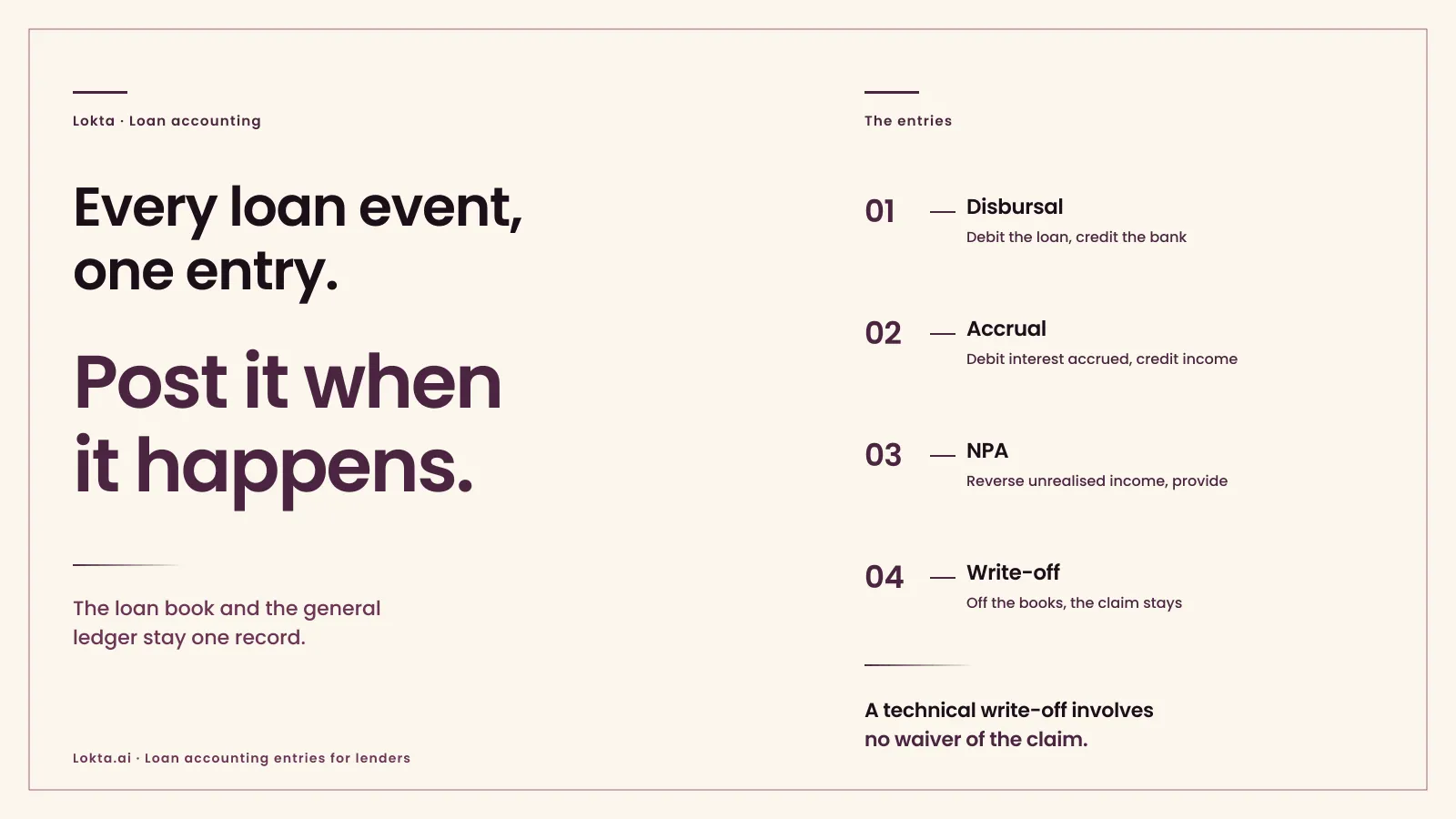
The three stages matter because each has its own ledger account and its own meaning. Accrued interest is income earned and not yet billed. Interest due is a receivable the borrower is late on if unpaid. Received interest is cash. A report that mixes them cannot tell a finance team how much income is at risk. The debit and credit for each stage, and for the other main loan events through write-off and recovery, are laid out in loan accounting entries for lenders.
Which day-count convention should a lender use?
The one written into the product terms, applied the same way everywhere. RBI’s directions for NBFCs set no convention. They require interest only for the period the loan was outstanding, and the illustrative repayment schedule that accompanies the Key Facts Statement charges one-twelfth of the annual rate each month. The convention is the lender’s choice, and it has visible effects. On ₹10 lakh at 12% a year:
| Convention | Interest per day | 31-day month | 28-day month |
|---|---|---|---|
| Actual/365 | ₹328.77 | ₹10,191.78 | ₹9,205.48 |
| Actual/360 | ₹333.33 | ₹10,333.33 | ₹9,333.33 |
| 30/360 | ₹333.33 (every month counts as 30 days) | ₹10,000.00 | ₹10,000.00 |
These are illustrative figures for one month on one loan. Over a full year on a constant ₹10 lakh balance, Actual/360 charges ₹1,21,666.67 where Actual/365 charges ₹1,20,000, because it divides the annual rate by 360 and applies it to 365 days.
Whichever convention the product uses, the schedule the borrower sees, the accrual the ledger posts and the APR in the KFS have to use the same one. A schedule built on 30/360 and an accrual run on Actual/365 will disagree every month, because one counts every month as 30 days and the other counts the days actually in it.
How is broken period interest calculated?
For the actual days between disbursement and the start of the first full instalment period, at the loan’s rate, under its convention. On the same ₹10 lakh at 12% under Actual/365, a 17-day broken period is ₹5,589.04.
RBI’s Miscellaneous Supervisory Directions for NBFCs, 2026, name unfair interest practices, among them: interest from the date of sanction or agreement instead of actual disbursement, interest from a cheque’s date when the cheque is handed over days later, EMIs on the sanctioned amount instead of the disbursed amount without the borrower’s knowledge or consent, interest for the entire month when a loan is disbursed or repaid mid-month, and interest on the full loan amount when instalments were collected in advance. Each of those is an accrual setting: the start date, the base and the period counted.
What happens when an event is backdated?
The interest has to be recomputed from the event’s effective date. A receipt posted on the 20th with a value date of the 12th can change the principal outstanding from the 12th, depending on what the product applies it to, so every day’s accrual from the 12th onward is wrong until it is rerun. The same holds for a backdated rate change, a reversal of an earlier receipt, or a correction to the disbursement date.
A system that only adjusts the balance leaves the interest showing the old principal. The difference is small on one loan, which is why it survives until an auditor samples accounts with backdated entries. The reliable design recomputes the affected days and posts the difference as its own event, dated and linked to the backdated one, so the original postings stay on the record.
When is accrued interest reversed?
When an account becomes a non-performing asset. Under RBI’s income recognition, asset classification and provisioning directions for NBFCs, income from an NPA, including interest and other charges, is recognised only when it is actually realised. Income recognised before the account turned NPA and still unpaid is reversed.
For the loan system, that means three things on the day of classification: stop recognising new interest on the account as income, post a reversal of the unrealised income already recognised, and keep computing the interest the borrower owes under the contract, because the claim does not go away. When the borrower pays, the part of the receipt applied to interest and charges is recognised as income when realised. Which part that is depends on the product’s appropriation order. For when an account crosses that line, and how the day-end run dates it, see the SMA and NPA classification post.
NBFCs that report under Ind AS follow the accounting standard for their financial statements where it conflicts with these directions, as paragraph 8 of the same directions provides. Ind AS 109 has its own test for a credit-impaired asset. For one that became credit-impaired after origination, it calculates interest revenue by applying the effective interest rate to amortised cost, which is net of the loss allowance (paragraph 5.4.1(b)). Whichever system produces that figure starts from the contractual interest, receipts and classification dates the loan record holds.
How do fees and the effective interest rate fit?
Under Ind AS 109, fees that are an integral part of the effective interest rate, such as origination fees, are included in that rate along with transaction costs, and recognised over the loan’s expected life. Fees for servicing the loan are not, and fall under the revenue standard instead. The effective interest rate excludes expected credit losses.
So the rate the borrower sees and the rate used to recognise income can differ. The effective rate is estimated from expected cash flows over the loan’s expected life, so it also moves with prepayment assumptions. It starts from the contractual schedule and the fee records, which is why both have to be complete before anyone calculates it.
How should accrued interest be rounded?
Compute to the paise, round when the amount is charged. RBI’s directions for NBFCs require transactions, including interest charged on advances, to be rounded to the nearest rupee: 50 paise and above up, anything less ignored. Rounding each day’s accrual instead of the posted charge builds up errors that differ from loan to loan.
What should the accrual record keep?
For each account and each day, the record should show:
- the principal the interest was computed on, the rate and the day-count convention
- the amount accrued, and when it moved to due and to received
- any recomputation, the event that caused it and its effective date
- the date the account turned NPA, the income reversed and the interest still owed
- the rounding applied when the charge was posted
With that record, a finance head can answer a borrower’s interest query, an auditor’s sample and a supervisor’s review from the same numbers.
Where should interest accrual run?
- Accrue monthly in the ledger from a schedule the loan system produces. It is simple to run. Broken periods, backdated events and mid-month NPAs are adjusted by hand, and the schedule and the ledger drift apart.
- Accrue daily in the loan system from the product’s settings, recompute on backdated events, and post accruals, reversals and recomputations to the ledger as events. It needs the day count, rounding and NPA rules set once per product. After that the schedule, the ledger and the borrower’s statement agree.
- Let the finance team compute accruals in a spreadsheet from a loan extract. It gives finance full control. It depends on the extract being complete, and every month the spreadsheet has to be rebuilt and reconciled.
The second path asks for exact settings up front. The day-count convention, the broken-period rule and the rounding point have to be decided for every product, and the product terms have to say the same thing.
Lokta’s loan management system has interest and accrual, day-count conventions and broken-period interest among its configuration domains. It computes schedules to the paise and regenerates them deterministically after a prepayment, rate reset or backdated correction. Each event it books lands in the general ledger as a double entry, under heads the lender maps. The team that built it wrote Apache Fineract first.
Frequently asked questions
How is daily interest accrual calculated on a loan?
Multiply the outstanding principal by the annual rate and divide by the number of days in the year that the day-count convention sets. On ₹10 lakh at 12% under Actual/365, that is about ₹328.77 a day. The loan system adds each day's amount to interest accrued but not yet due, and moves it to interest due when the instalment falls due.
Does RBI prescribe a day-count convention for NBFC loans?
No. RBI's directions for NBFCs do not set a day-count convention. They require interest to be charged only for the period a loan was outstanding and from the date of actual disbursement, and they require the APR in the Key Facts Statement to include all charges. The lender picks the convention in its product terms, and the loan system has to apply it consistently.
What is interest accrual reversal?
Under RBI's income recognition directions, once an NBFC account becomes a non-performing asset, income on it is recognised only when realised, and income recognised earlier but still unpaid is reversed. The loan system stops recognising new interest as income on that account, posts a reversal of the unrealised amount, and keeps tracking the interest the borrower owes under the contract. NBFCs reporting under Ind AS follow the standard in their financial statements where the two conflict.
What is broken period interest?
It is interest for the days between disbursement and the start of the first full instalment period. RBI's supervisory directions object to charging interest from the sanction or agreement date instead of the disbursement date, and to charging a whole month for part of one. The broken period is computed for the actual days, at the loan's rate, under its day-count convention.
Sources:
- Reserve Bank of India (Non-Banking Financial Companies - Income Recognition, Asset Classification and Provisioning) Directions, 2025: paragraph 8 (Ind AS NBFCs) and paragraph 38 (income on NPAs and reversal of unrealised income).
- Reserve Bank of India (Non-Banking Financial Companies - Miscellaneous) Supervisory Directions, 2026: Chapter III, paragraph 7 (interest-charging practices).
- Reserve Bank of India (Non-Banking Financial Companies - Responsible Business Conduct) Directions, 2025: paragraph 29 (KFS and APR) and paragraph 103 (rounding to the nearest rupee).
- ICAI, Ind AS 109, Financial Instruments, Compendium of Indian Accounting Standards 2025-26: Appendix A (effective interest rate), paragraphs 5.4.1 and B5.4.1 to B5.4.3.