Loan tape: what a buyer, investor or rating agency asks for, and the loan history behind it
What a loan tape is, who asks an Indian NBFC for one, the fields RBI's rules and rating agencies look at, and the loan history a loan system has to keep.
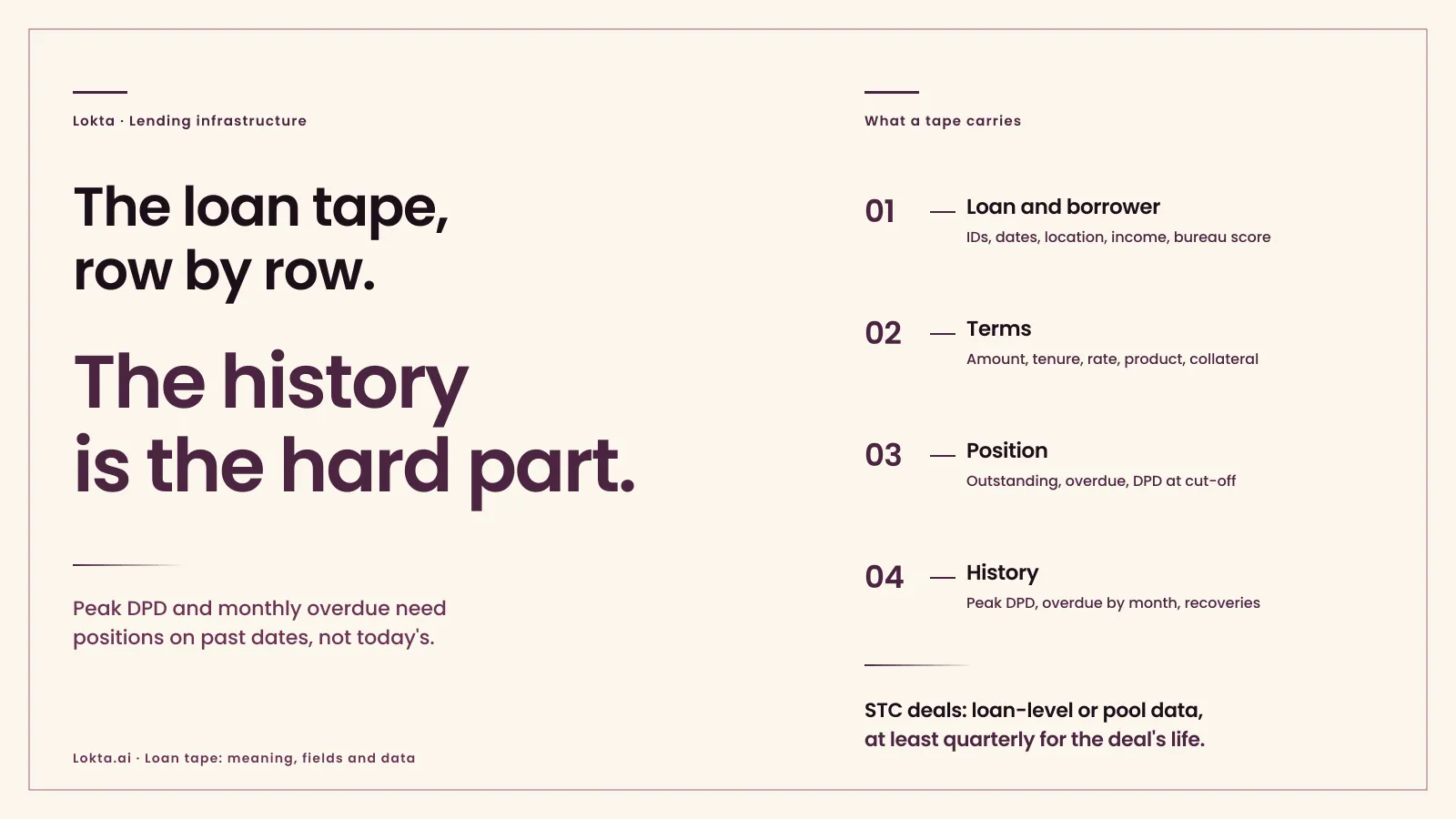
A loan tape is a file with one row per loan and the columns a buyer, investor, rating agency or funder needs to judge a portfolio: identifiers, terms, balances, status and history. No regulator defines the term. RBI’s securitisation rules ask for loan-level data, and Indian rating agencies look at seasoning, overdue status and peak days past due. The hard columns are the historical ones, which the loan system has to keep rather than overwrite.
If you run treasury or finance at an NBFC, the loan tape is the file a buyer, investor or rating agency reads to judge a securitisation, a direct assignment or a new funding line. Every gap in it comes back as a question, and each question adds time to the deal.
The present-day columns are straightforward. Loan identifiers, amounts, rates and today’s balances come straight from the loan system. The columns that slow a deal down are about the past: how many instalments each borrower has actually paid, the worst delinquency each loan has reached, and how the pool behaved month by month. Those can only come from history the loan system kept.
- A market term, not a legal one. RBI asks for loan-level data. Europe’s templates call it underlying exposures.
- Buyers check each loan. Under RBI’s transfer rules, due diligence on acquired loans is done loan by loan, by the buyer’s own staff.
- Agencies read history. Peak DPD, monthly overdue status and static pool curves all need past positions.
- Holding periods are per loan. The minimum holding period applies to each loan in a pool, so dates have to be exact.
- Keep the past. Positions stored for past dates, rather than overwritten, turn the history columns into a query.
What is a loan tape?
A file with one row for each loan in a portfolio. The columns describe the loan and its behaviour well enough for someone outside the lender to judge the pool without seeing the loan files.
The term is market usage. RBI’s securitisation directions speak of loan-level data. The European Securities and Markets Authority’s disclosure templates call the rows underlying exposures, and its consumer loan template runs to 69 fields covering identifiers and dates, the borrower, loan terms, prepayments, and arrears and default. In the United States, bank supervisors use a standard Interagency Loan Data Request, whose required fields rose from 5 to 30 of 82 in 2013.
We found no standard template that Indian buyers and rating agencies share. The agencies’ published methodologies each list their own parameters, so the same NBFC can end up building a different tape for each deal.
Who asks an NBFC for a loan tape?
Anyone taking on the credit risk of the loans, or rating it:
- Investors in a securitisation. For deals meeting RBI’s simple, transparent and comparable (STC) criteria, loan-level data, or stratification data for granular pools, should be available before pricing and at least quarterly afterwards (paragraphs 51 and 52 of the securitisation directions).
- Buyers of loans by direct assignment. RBI’s transfer directions require the buyer’s own staff to carry out due diligence at the level of each loan. Where a buyer checks at least one-third of a portfolio, by value and by number of loans, loan by loan, the rest can be checked at portfolio level, and the seller keeps at least 10% of the economic interest in the transferred loans (paragraphs 39 and 40).
- Rating agencies rating the securitised notes or the pool.
- Co-lending partners and lenders to the NBFC, who may ask for the same data to monitor a shared or hypothecated book.
After the deal, the tape keeps coming. A buyer has to monitor the loans it acquired on an ongoing basis (paragraph 41 of the transfer directions), and an NBFC investing in securitised notes should track, where relevant, the share of loans more than 30, 60 and 90 days past due, default rates and prepayment rates (paragraph 107 of the securitisation directions).
What fields does a loan tape carry?
Five groups, whatever the template:
| Group | Typical fields |
|---|---|
| Identifiers and dates | Loan ID, borrower ID, disbursal date, first repayment date, maturity date, cut-off date |
| Borrower | State and city, customer type, income, instalment to income, bureau score at origination |
| Loan terms | Product, purpose, sanctioned and disbursed amount, tenure, interest rate and type, repayment frequency, collateral and loan to value |
| Current position | Principal outstanding, overdue amount, days past due at cut-off, asset classification, instalments paid |
| History | Peak days past due, overdue status by month, prepayments, modification dates, default date, recoveries |
The first four groups describe the loan today. The fifth describes how it got there, and it is the group buyers and agencies lean on to judge a pool’s behaviour.
Borrower fields are personal data. Share the minimum each recipient needs, under the contract and consent that cover it.
What do rating agencies look for in a pool?
History, loan by loan. From the published methodologies:
- ICRA compares a pool with the lender’s wider portfolio on seasoning or amortisation before securitisation, overdue status at the cut-off date, peak days past due, loan to value, geography, tenure, instalment to income and bureau scores, and factors in the past payment record of the pool contracts.
- CRISIL Ratings looks at asset class, loan to value, original tenure, geography, borrower profile, diversification, seasoning, loan cycle, interest rate, loan amount and overdue profile. It treats net seasoning, the number of instalments the borrower has actually paid, as an important driver of performance.
- CARE Ratings uses static pool data to build overdue and DPD curves and recovery rates, and reviews each deal’s pool selection criteria, which typically set limits on seasoning, loan to value, tenor and months overdue.
- India Ratings, in an FAQ from September 2017, listed the loan-level data it requests, including loan ID, loan to value, tenure, rate, amount, fixed obligation to income ratio, state, city, loan type and origination date, and, for the pool, the overdue mix across 1-30, 31-60, 61-90 and 90+ days over the last 12 months.
Peak DPD is the clearest history field. Today’s position cannot show it. Net seasoning also differs from months since disbursal: CRISIL defines it as total seasoning minus overdue status minus any moratorium, so the system has to record every moratorium.
What do RBI’s rules say about loan-level data?
Four things, across the securitisation and transfer directions for NBFCs, both updated as on 1 July 2026:
- The minimum holding period applies to each loan. Under the transfer directions, a loan can be sold only after three months for tenors up to two years and six months for longer tenors, counted from registration of security with CERSAI or, where there is no security or it cannot be registered, from the first repayment (paragraph 43). For securitisation, the holding period applies to each loan in the pool (paragraph 8).
- Investors get loan-level data. Originators should give prospective investors access to all materially relevant data on the credit quality and performance of the individual underlying exposures (paragraph 111 of the securitisation directions).
- Performance history is checked. For simple, transparent and comparable securitisations, investors must check that the originator’s performance history on similar retail exposures runs at least five years, and seven for non-retail (paragraph 40).
- Data systems are a board matter. The board-approved policy on transfer and acquisition of loans has to cover the IT systems for capturing, storing and managing the data (paragraph 13 of the transfer directions), and buyers of a pool, and sellers that retain an economic interest, keep borrower-wise accounts (paragraph 46).
Where a third party services the loans, the originator has to get the servicer’s data certified by the servicer’s own auditors, preferably at least once a year (paragraph 109 of the securitisation directions).
Why is a loan tape hard to produce?
Because the history columns ask about dates the loan system may no longer describe. Four common gaps:
- Overwritten status. If the system stores only today’s days past due, peak DPD and the monthly overdue mix have to be rebuilt from old reports or backups.
- Instalments paid versus months elapsed. Net seasoning counts instalments actually paid, net of overdues and any moratorium, not months since disbursal.
- Changes to terms. A rescheduled or modified loan needs its original terms, the change date and the new terms, or its history reads wrongly.
- Loans already sold. Where the seller keeps servicing sold loans, its system has to record which loans left, when, to whom and the share retained. For stressed loans, bureau reporting passes to the buyer if the buyer is a credit institution (paragraph 68 of the transfer directions), and an account whose ownership changed has to appear in the incremental bureau file.
India Ratings noted in 2017 that static pool data from different originators was not standardised. Every tape built by hand, for one deal at a time, adds to that problem inside a single lender.
What should the loan system keep?
Enough to answer any tape’s history columns as of any past date:
- each instalment’s due date, amount, and the date and receipt that cleared it
- days past due and asset classification for every account on every day, or at least at every month end
- every change to a loan’s terms, with the date and the reason
- receipts split into principal, interest and charges, and prepayments marked as such
- write-offs, recoveries after write-off, and the date of each
- for sold or securitised loans, the pool, the transfer date, the buyer or trust, and the share retained
With those kept, a tape is a query run against a fixed list of field definitions. The collections KPIs post uses the same history for roll and cure rates, and the SMA and NPA classification post explains why classification on past dates has to be re-derivable.
How should an NBFC produce its loan tapes?
If you want to be the treasury head whose tape answers a buyer’s questions before they are asked, compare three ways of producing it. They differ mostly in where the history columns come from.
- Build each tape in spreadsheets from system reports when a deal needs it. It needs no system change. Each deal repeats the work, history fields are rebuilt from old reports, and two tapes for the same pool can disagree.
- Keep dated history in the loan system and generate each tape as a query against one maintained field dictionary, mapped to each recipient’s format. It needs agreed field definitions and a loan system that keeps history rather than overwriting it. After that, a new tape is a mapping exercise, not a reconstruction.
- Hand the raw data to an arranger, trustee or data platform and let it build the tape. It is quick for one deal. The definitions become someone else’s, and the NBFC has to reconcile their figures back to its own books.
The second path does not help with history the system never kept. Tapes for older vintages may still need a one-time rebuild from archives.
Lokta’s loan management system is built on a double-entry, event-sourced ledger, and any book can be replayed in full from its history. The team behind it first built Apache Fineract.
Frequently asked questions
What is a loan tape?
A loan tape is a file with one row for each loan in a portfolio and columns for what a buyer, investor, rating agency or funder needs to judge it: identifiers and dates, borrower attributes, loan terms, current balances and status, and payment and delinquency history. The term is market usage, not a regulatory one. RBI's securitisation rules speak of loan-level data, and Europe's disclosure templates of underlying exposures.
What data does a rating agency ask for in a securitisation pool?
Loan-level attributes and history. ICRA's securitisation methodology compares a pool on seasoning, overdue status at the cut-off date, peak days past due, loan to value, geography, tenure, instalment to income and bureau scores. CRISIL Ratings looks at net seasoning, the number of instalments actually paid, among other parameters. CARE Ratings builds static pool overdue and DPD curves. Each of these needs the history of every loan, not only its position today.
What is peak DPD in a loan tape?
It is the highest number of days past due a loan has reached over its life or over a stated window, as opposed to its days past due on the cut-off date. A loan that is current today may have been 75 days overdue a year ago. Rating agencies use peak DPD to judge how a pool has behaved, so the loan system has to keep days past due for past dates rather than overwrite it each day.
Do RBI rules require loan-level data for securitisation?
For a securitisation to meet RBI's criteria for simple, transparent and comparable deals, sufficient loan-level data, or summary stratification data for granular pools, should be available to potential investors before pricing, and loan-level or pool data at least quarterly for the life of the deal. More generally, originators should give investors access to all materially relevant data on the credit quality and performance of the individual underlying exposures.
Sources:
- RBI, Reserve Bank of India (Non-Banking Financial Companies - Securitisation Transactions) Directions, 2025, updated as on 1 July 2026: paragraphs 8, 40, 51, 52, 107, 109 and 111.
- RBI, Reserve Bank of India (Non-Banking Financial Companies - Transfer and Distribution of Credit Risk) Directions, 2025, updated as on 1 July 2026: paragraphs 13, 39 to 41, 43, 46 and 68.
- RBI, Reserve Bank of India (Non-Banking Financial Companies - Credit Information Reporting) Directions, 2025, updated as on 1 July 2026: paragraph 10(2)(iii).
- ICRA, Securitisation Transactions rating methodology, June 2025. CRISIL Ratings, criteria for securitisation transactions, June 2026. CARE Ratings, criteria for asset and mortgage-backed securitisation, March 2025. India Ratings, ABS FAQ, September 2017.
- European Securities and Markets Authority, securitisation disclosure templates, Annex 6 (consumer). FDIC, FIL-12-2013.