RBI recovery-agent rules for NBFCs: the evidence every collection contact should leave
Which RBI recovery-agent rules apply to which NBFC loans, from calling hours to agent notices, and the record that shows each collection contact was lawful.
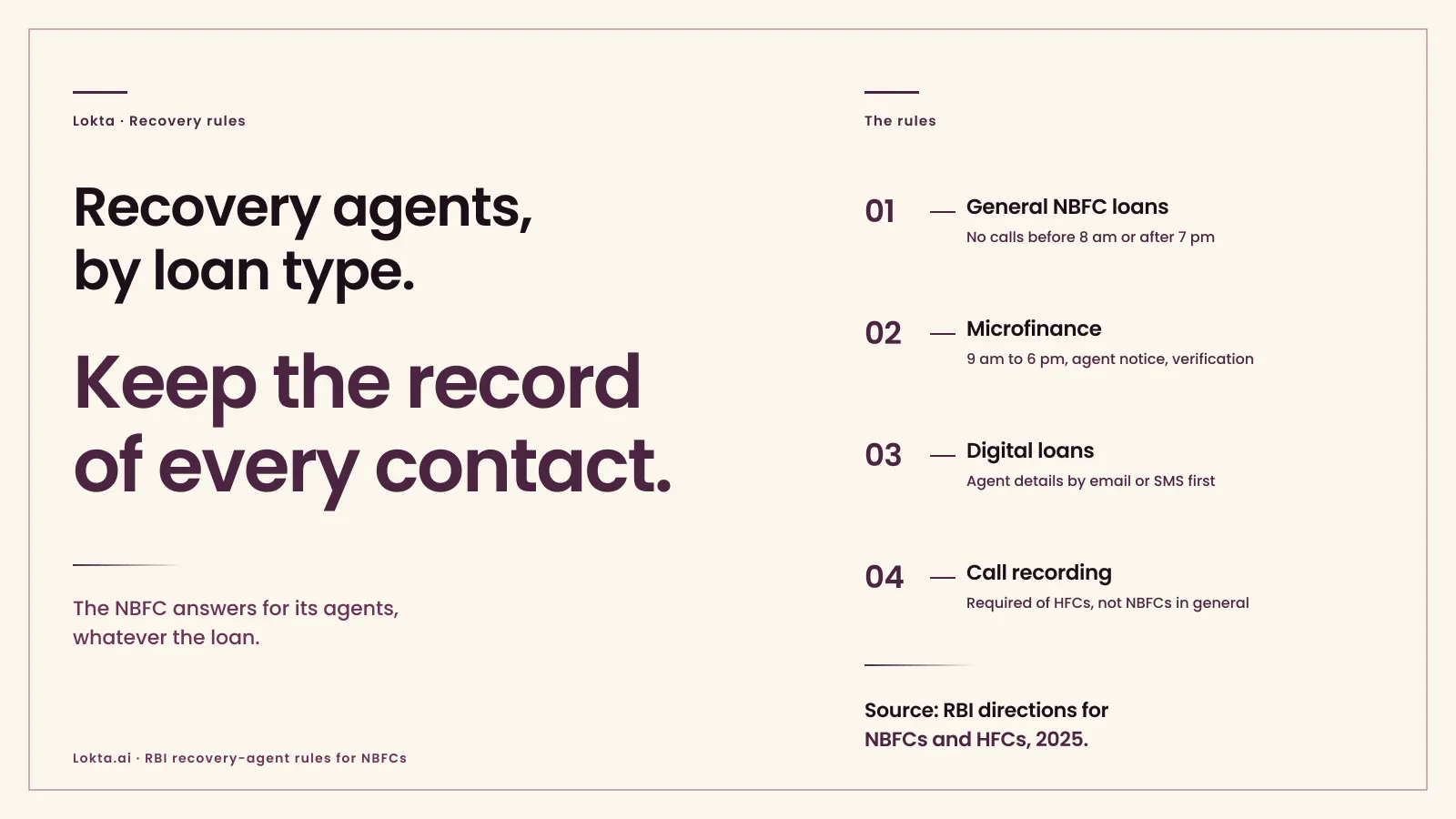
RBI’s recovery rules for NBFCs sit in three sets of directions. The general conduct list in paragraph 100 (no calls before 8 am or after 7 pm, no harassment) covers every NBFC loan except microfinance, which has its own stricter window of 9 am to 6 pm plus agent notices and police verification. Digital loans add an email or SMS naming the agent before contact. The NBFC answers for its agents in every case.
If you head collections or compliance at an NBFC, the question after a complaint is simple: what did your agent do, and can you show it? RBI’s rules decide what the agent may do. Your records decide whether you can prove it.
Lists of RBI’s recovery rules that circulate online can merge rules written for different loans and different lenders. Some of what circulates, such as mandatory call recording and certified agents, applies to banks and housing finance companies, not to NBFCs in general. Other rules apply only to microfinance or digital loans. A collections team that knows which rules bind which loans can build one contact record that satisfies all of them.
- Three directions, one obligation. Conduct, outsourcing and digital lending rules each cover part of recovery.
- Hours depend on the loan. 8 am to 7 pm for NBFC loans other than microfinance, 9 am to 6 pm for microfinance.
- Agent notices depend on the loan too. Required for microfinance and digital loans, not by the general NBFC rules.
- No general recording mandate. Call recording is required of housing finance companies and banks, not NBFCs in general.
- The NBFC answers for its agents. That is why each contact should leave evidence, whatever the rule.
Which RBI rules govern recovery agents at an NBFC?
Three sets of directions, each issued on 28 November 2025 when RBI consolidated its rules for NBFCs. The August 2022 circular on recovery agents was withdrawn at the same time, and its conduct list carried forward.
| Directions | What they cover on recovery |
|---|---|
| Responsible Business Conduct Directions, 2025 | Conduct and calling hours for NBFC loans in general, a separate microfinance section with agent notices and verification, and board policies on recovery agents |
| Managing Risks in Outsourcing Directions, 2025 | The NBFC’s responsibility for its service providers, including recovery agents, access to their records and grievance handling |
| Credit Facilities Directions, 2025, Chapter III | Digital lending: notice of the agent before contact, lending service providers acting as recovery agents |
What applies to NBFC loans in general?
Five rules from the Responsible Business Conduct Directions:
- the board approves a policy on engaging recovery agents and a code of conduct for them, alongside the fair practices code (paragraph 7)
- the NBFC must not resort to undue harassment, such as persistently bothering borrowers at odd hours or using muscle power (paragraph 20)
- recovery agents are trained to handle their work with care and sensitivity, including hours of calling and customer privacy (paragraph 98)
- the NBFC obtains each agent’s undertaking to follow the code of conduct, and agents keep customer information confidential (paragraph 99)
- neither the NBFC nor its agents may intimidate or harass anyone, publicly humiliate the borrower, intrude on the privacy of family, referees or friends, send inappropriate messages, make threatening or anonymous calls, call persistently or before 8 am or after 7 pm, or make false or misleading representations (paragraph 100)
Paragraph 100 does not apply to microfinance loans, which follow their own rules.
What changes for microfinance loans?
More, and stricter. The microfinance section of the same directions adds:
- a list of harsh recovery methods the NBFC and its agents must not use, including threatening or abusive language, persistent calling or calling before 9 am or after 6 pm, harassing relatives or colleagues, publishing borrowers’ names, and misleading the borrower about the debt (paragraph 91)
- recovery at a place agreed with the borrower, with visits to home or work only after the borrower fails to appear at the agreed place on two or more successive occasions (paragraph 90)
- a mechanism to identify borrowers in difficulty and guide them on the options available (paragraph 89)
- a recovery grievance mechanism, disclosed at disbursal (paragraph 92)
- due diligence on recovery agencies, including police verification of the people involved (paragraph 94)
- the agent’s details given to the borrower when recovery starts, and a notice, an authorisation letter and an identity card carried by the agent, naming the agency and the NBFC (paragraphs 95 and 96)
- the recovery agencies engaged listed on the NBFC’s website (paragraph 97)
Carrying a physical identity card is a rule about the agent. Whether a field app can show which credential was presented, and issue a receipt the moment cash changes hands, is a rule about the technology behind the agent. What a mobile field-collections app actually needs to work covers that side of it.
What changes for digital loans?
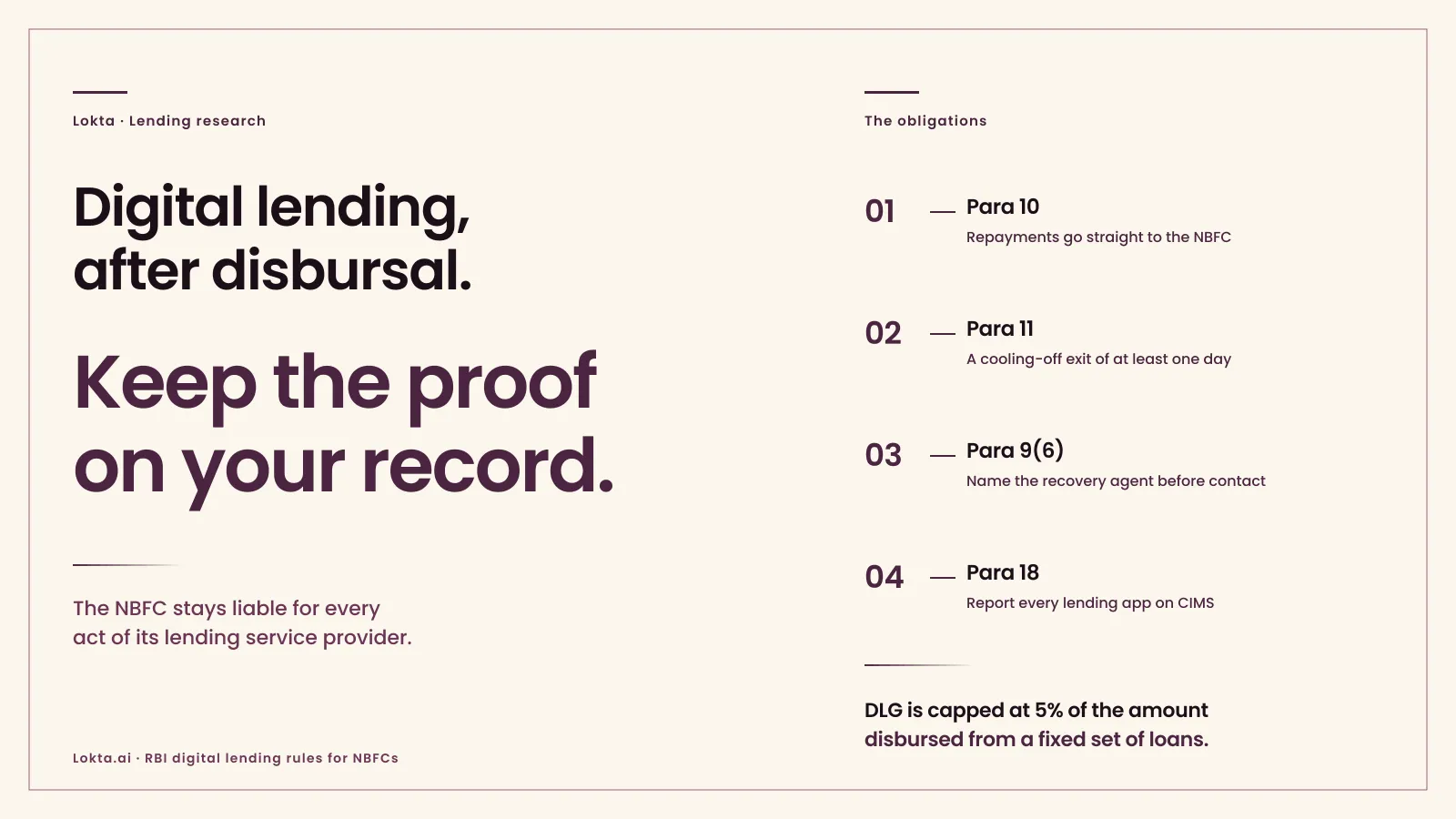
Notice before contact. Chapter III of the Credit Facilities Directions, which now holds RBI’s digital lending rules for NBFCs, says that once a recovery agent is assigned, the NBFC has to tell the borrower who the agent is, by email or SMS, ahead of any contact from the agent. A lending service provider acting as a recovery agent must be guided to act responsibly and to follow the conduct directions, and the NBFC stays fully liable for what it does. The wider set of obligations once a digital loan is live is covered in RBI’s digital lending rules after disbursal. Cash recovered must show in the borrower’s account the same day.
The directions define digital lending broadly, as a remote and automated lending process, so a book sourced through an app or a partner’s platform may be covered even if the lender does not think of itself as a digital lender.
Does RBI require NBFCs to record recovery calls?
Not NBFCs in general. RBI’s directions for housing finance companies require recovery calls to be recorded with the customer’s knowledge, the time, number and content of calls to be documented, and agents to complete a prescribed training course. Banks have similar rules. The general NBFC directions contain none of these.
What they do contain is responsibility. The NBFC answers for its agents, and where recovery is a material outsourcing arrangement, the agreement must give it access to all records relevant to the outsourced work. When a borrower complains that an agent called at 9 pm or threatened a relative, the NBFC has to answer from whatever record it kept.
Who answers for what an agent does?
The NBFC. The Managing Risks in Outsourcing Directions say the NBFC is responsible for the actions of its service providers, including recovery agents, and that outsourcing does not diminish the obligations of its board and senior management. Grievances about outsourced services remain the NBFC’s to resolve, and its grievance officer handles those about the agency too.
For material outsourcing arrangements, the same directions require the agreement to give the NBFC access to the agent’s books, records and information about the work, and require the service provider to preserve documents as the NBFC’s legal and regulatory obligations demand.
What evidence should each contact leave?
Enough to show the contact followed the rule for that loan, without asking the agent to remember. For every attempt:
- the loan, and the rule set that applies to it: general, microfinance or digital
- the time of the attempt, checked against the permitted window for that loan
- the channel, the number or address used, and who was reached
- the agent or agency, and for microfinance and digital loans, the notice sent before contact
- what was said or sent, and any promise to pay or dispute raised
- the count of attempts over the period, so persistent calling can be seen
A lender that records calls, even where RBI does not require it, gets the strongest version of that evidence. A recording is personal data, so the decision to record belongs with the compliance team.
Where do agents and automation fit?
In checking the rule before each contact. Software can hold each loan’s rule set, refuse a contact outside the permitted window, count attempts, send the digital-lending notice once an agent is assigned and before the agent’s first contact, and log every attempt. The NACH and UPI AutoPay bounce post shows where that first contact happens, and the collections-by-bucket post shows why no strategy test may move the window.
The same log feeds the collections KPIs that depend on contact outcomes, such as right-party contact and promises kept.
Settlements, legal notices and repossession stay with named people at the lender.
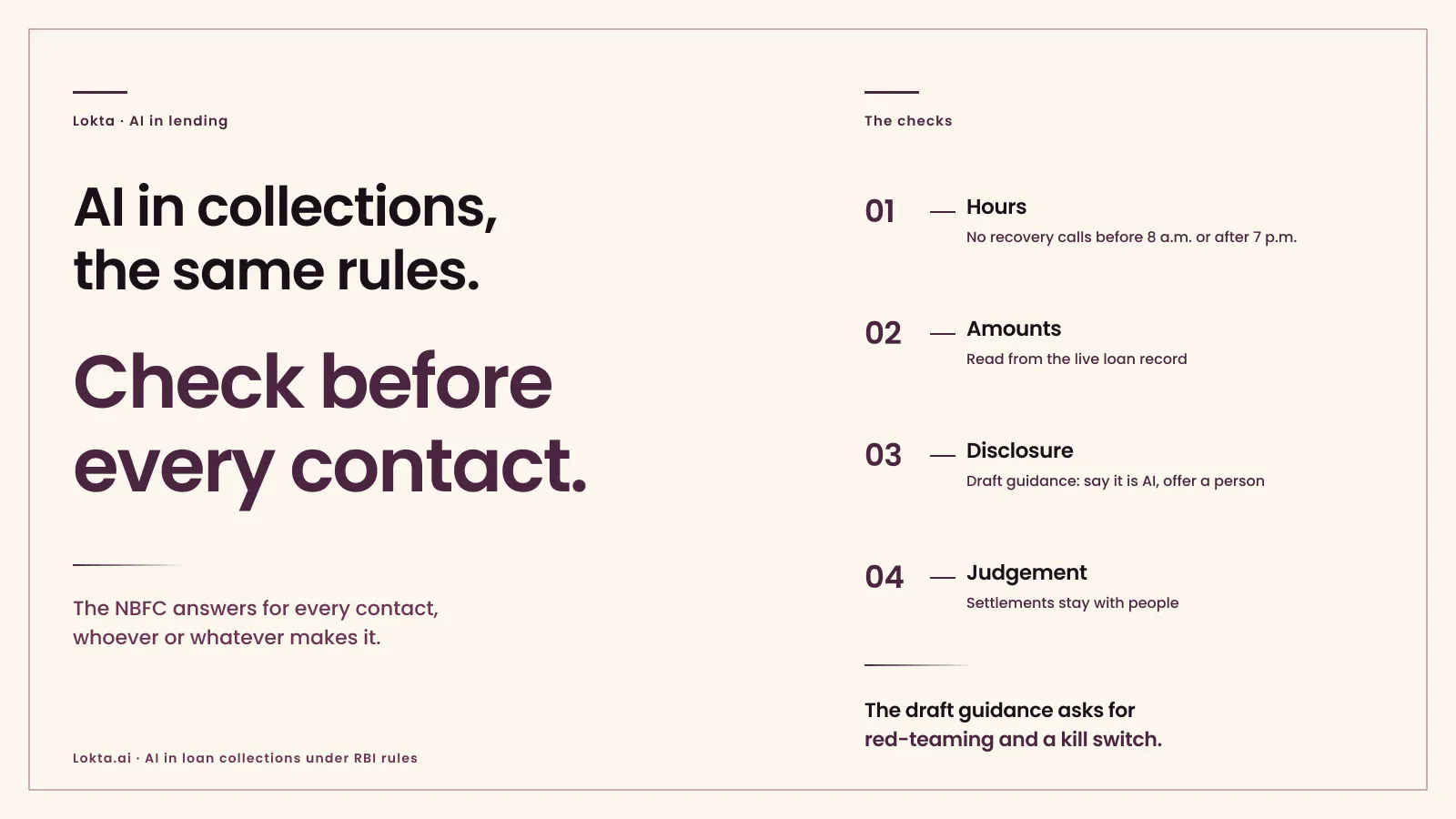
When the software is an AI agent talking to borrowers, RBI’s draft model risk guidance adds disclosure and human-handoff expectations, set out in the post on AI in loan collections.
Where should the contact record live?
If you want to be the compliance head who answers every agent complaint from the lender’s own file, the choice is where that file lives.
- Brief agencies on the rules and rely on their own call logs. It needs little build. When a complaint arrives, the evidence sits with the agency, in its format, and the NBFC answers for it anyway.
- Keep one contact record in the lender’s own system, with each loan’s rule set applied before every contact and every attempt logged. It needs the rule sets mapped once and agencies working through the lender’s system or feeding it. After that, a complaint is answered from the lender’s own record.
- Record every call and keep the audio. It gives the fullest evidence of what was said. It covers calls only, not visits or messages, and each recording is personal data the lender must hold and protect.
The second path depends on agencies using the lender’s system or sending contact data in a set format. Agencies that cannot will need a transition period.
Lokta’s AI Loan Servicing works from the live loan record, checks each message against the permitted calling hours before it is sent, and logs each contact and promise to pay against the account. Legal escalation stays with people. The team behind it wrote Apache Fineract.
Frequently asked questions
What are RBI's calling hours for loan recovery?
For NBFC loans other than microfinance, RBI bars recovery calls before 8 am and after 7 pm, under paragraph 100 of the Responsible Business Conduct Directions, 2025. For microfinance loans the directions treat calls before 9 am or after 6 pm as a harsh recovery method. Persistent calling is barred in both cases, as are threats, abuse and intruding on the privacy of family, referees and friends.
Must an NBFC tell the borrower which recovery agent will call?
It depends on the loan. For microfinance loans the NBFC must give the borrower the agent's details when recovery starts, and the agent carries a notice, an authorisation letter and an identity card. For digital loans the NBFC must email or text the borrower the agent's particulars before the agent's first contact. The general NBFC rules carry no such requirement, though other RBI directions, such as those for housing finance companies, have their own.
Does RBI require NBFCs to record recovery calls?
Not for NBFCs in general. RBI's directions require housing finance companies to record recovery calls with the customer's knowledge, and banks have a similar rule, but the general NBFC directions do not. They do make the NBFC responsible for its recovery agents' actions and, for material outsourcing, require access to the agent's records, which makes a contact record the practical way to show what happened.
Is an NBFC responsible for what its recovery agent does?
Yes. RBI's outsourcing directions for NBFCs say the NBFC is responsible for the actions of its service providers, including recovery agents, and that outsourcing does not reduce the obligations of its board and senior management. The conduct rules bind the NBFC and its agents alike, and grievances about an agent remain the NBFC's to resolve.
Sources:
- Reserve Bank of India (Non-Banking Financial Companies - Responsible Business Conduct) Directions, 2025: RBI/DOR/2025-26/362, 28 November 2025, updated as on 1 July 2026. Paragraphs 7, 20 and 98 to 100 (paragraph 100 excludes microfinance), 89 to 97 (microfinance).
- Reserve Bank of India (Non-Banking Financial Companies - Managing Risks in Outsourcing) Directions, 2025: RBI/DOR/2025-26/363, 28 November 2025. Paragraphs 9 and 17 (responsibility), 34 (access to records and preservation), 56 and 57 (grievances).
- Reserve Bank of India (Non-Banking Financial Companies - Credit Facilities) Directions, 2025: RBI/DOR/2025-26/347, updated as on 15 July 2026. Chapter III, paragraphs 6(5), 6(7), 9(6) and 10(5).
- Reserve Bank of India (Housing Finance Companies) Directions, 2025: paragraph 170 (recovery agents at HFCs, including call recording).
- RBI, Reserve Bank of India (Commercial Banks - Responsible Business Conduct) Directions, 2025: paragraphs 442(4) and 448 (recovery agents at banks).