Loan pricing and RAROC: servicing costs change the return
See how servicing costs change risk-adjusted loan returns. Work through a RAROC example and trace the operating evidence an NBFC needs after loan approval.
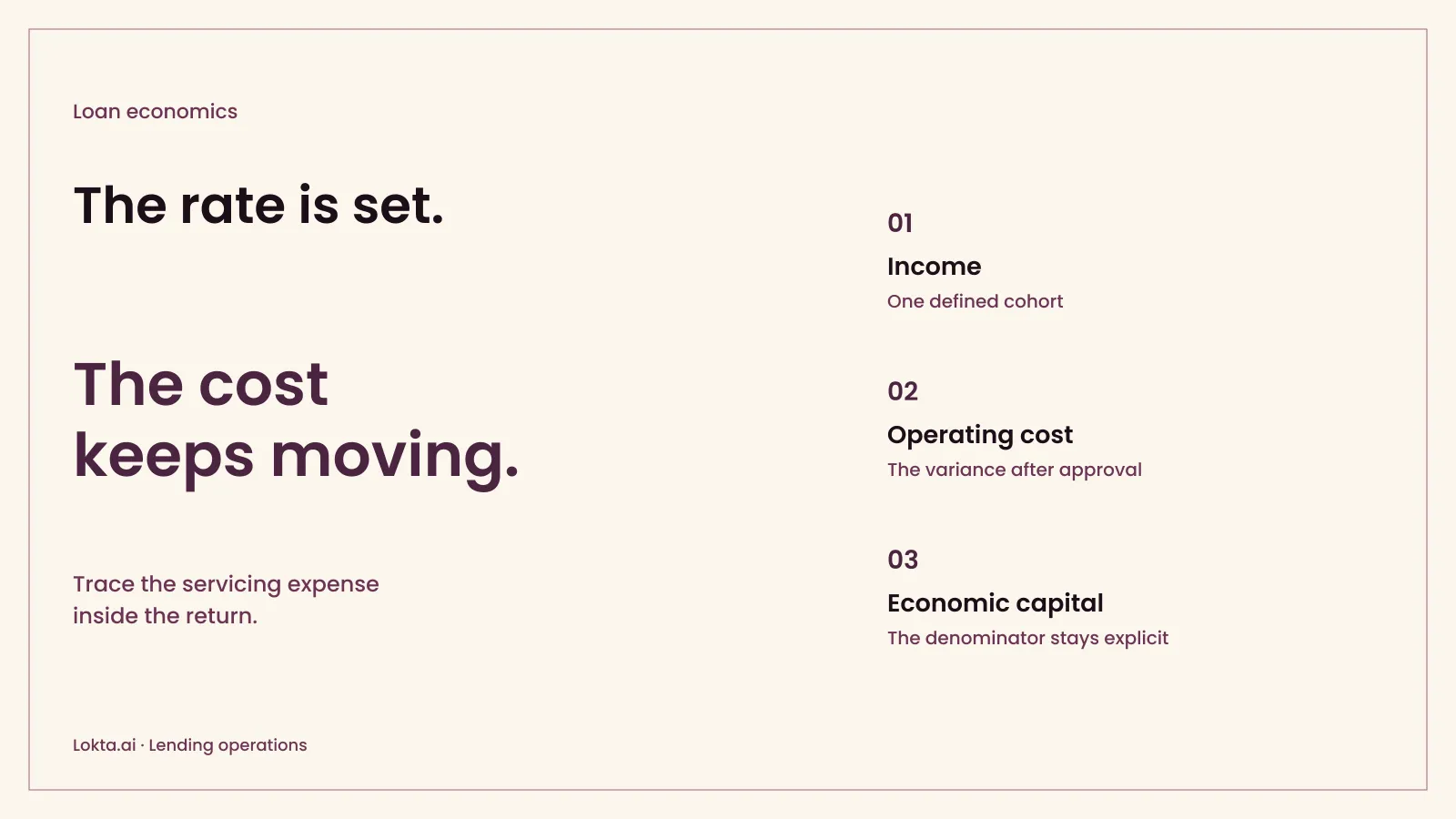
For an NBFC finance team, a loan that met the pricing hurdle at approval can still miss its return target because of the work needed to service it. The approved rate stays visible. The cost of repeated payment matching, borrower queries and exception handling is easier to lose inside a monthly expense line.
Loan pricing therefore needs a feedback loop from the live book. RAROC, or risk-adjusted return on capital, is one way to examine that loop. It compares income after defined risk and cost adjustments with the economic capital allocated to the exposure. The useful question is whether the operating assumptions behind the price survived contact with the borrower’s actual account. The Loan Management System (LMS) maintains the account and its transactions. Loan servicing is the work around that account, including investigations and borrower requests whose cost belongs in the pricing review.
The case below follows an invented cohort through one annual review. Every amount is illustrative. It is a management-accounting exercise, not a customer result or a recommended lending rate.
At approval: write down what the price assumes
Suppose your finance team forecasts ₹22 lakh of interest and fee income for a defined cohort over one year. Funding costs are ₹9 lakh, operating costs ₹4 lakh and the expected credit-loss allowance used for this economic calculation ₹3 lakh. Average allocated economic capital is ₹20 lakh.
For this example only:
Pre-tax RAROC = (income - funding costs - operating costs - expected credit loss) / average allocated economic capital.
The numerator is ₹6 lakh. Dividing by ₹20 lakh gives 30%. A hypothetical internal pre-tax hurdle of 20% would leave room for the proposal. Both the hurdle and the capital allocation are assumptions, not market benchmarks.
The Basel Committee’s discussion of economic capital treats risk-adjusted performance measures as management tools with methodological choices. Economic capital is not automatically the same as a regulatory capital requirement. Your finance and risk teams must agree the basis before a percentage becomes a decision.
Expected loss belongs in pricing and the loss allowance. Economic capital covers unexpected loss, as the Federal Reserve Bank of San Francisco explains. Keep that distinction when reconciling this management measure to accounting provisions. Charging the same expected loss twice understates the return.
During servicing: record the work against the account
A receipt arrives without a usable loan reference. An operator investigates it, another person checks the match, and the borrower calls because the statement still shows an overdue amount. Those are separate pieces of work caused by one unresolved event.
Capture the activity against the account and the workflow that caused it. The minimum useful record contains an event identifier, task type, owner, handling time and disposition. Aggregate this into the same cohort used in the original pricing assessment. The cost-to-service guide explains the cost numerator in more detail.
Avoid allocating every rupee equally just because each row is a loan. A secured account with document custody and a small unsecured account may demand different work. Use a documented allocation method for shared overhead, and show sensitivity where that method changes the conclusion. An estimate can be useful if its uncertainty remains visible.
At the annual review: isolate the servicing variance
Hold income, funding costs, expected credit loss and capital constant. Replace the ₹4 lakh operating forecast with ₹7 lakh of measured and allocated operating cost.
| Annual cohort measure | At approval | Cost-only review |
|---|---|---|
| Interest and fee income | ₹22 lakh | ₹22 lakh |
| Funding costs | ₹9 lakh | ₹9 lakh |
| Operating costs | ₹4 lakh | ₹7 lakh |
| Expected credit-loss allowance | ₹3 lakh | ₹3 lakh |
| Risk-adjusted income, pre-tax | ₹6 lakh | ₹3 lakh |
| Average economic capital | ₹20 lakh | ₹20 lakh |
| Illustrative pre-tax RAROC | 30% | 15% |
The extra ₹3 lakh takes RAROC to 15%, below the assumed 20% hurdle. Restoring that hurdle requires ₹4 lakh of risk-adjusted income: 20% × ₹20 lakh of capital. The shortfall is ₹1 lakh.
To translate that into price, add one explicit assumption: the cohort has ₹1 crore of average performing principal over the full year. With volumes, losses, funding, fees and capital unchanged, another ₹1 lakh of annual interest requires 100 basis points of additional realised yield. The numerator becomes ₹4 lakh and RAROC returns to 20%. Recovering the original 30% would require ₹3 lakh, or 300 basis points.
This is a sensitivity for the next pricing decision, not permission to reprice existing contracts. A higher quoted rate may change demand or credit risk, and a declining balance changes the exposure over which interest is earned. The alternative worth testing is whether the recurring servicing expense can be reduced without removing necessary controls.
A real review will also find changes in income, losses, funding and capital. Build a variance bridge that separates those changes. Do not subtract an expected-loss allowance and then subtract the same loss again through an accounting provision. Reconcile the management calculation to the accounting view and explain the adjustments.
Before changing a policy: test the cause of the cost
The most expensive workflow is a candidate for investigation, not automatic removal. Some work protects the borrower or satisfies a control. A low handling-time number can also conceal unresolved complaints or inaccurate statements.
Take one workflow, such as unmatched receipts. Measure exception volume, repeat handling, time to a verified posting and subsequent corrections. If a proposed change removes a check, identify the control replacing it. If it merely moves work to another team, include that team’s cost.
An AI agent can propose an action or summarise a case. Financial state should change only through the authorised system of record after deterministic checks and any required approval. Reducing the effort needed to prepare a decision is different from granting authority to change a balance.
At the next pricing review: carry evidence forward
Compare cohorts at equivalent ages. A new cohort with few repayment cycles cannot establish its lifetime servicing cost. Keep forecast cost, observed cost to date and estimated remaining cost in separate columns. Preserve the original assumptions so later information does not rewrite what the committee knew at approval.
Profit per loan disbursed belongs alongside this review, with a stated profit definition and cohort denominator. It gives the business a per-loan view. RAROC supplies a capital-relative view. Neither metric should become a claim of improvement until the measurement supports it.
The practical output is a dated pack: original assumptions, current variance, the source events behind it, the control change proposed and the person who approved the next step.
Choose how to build the evidence
You can keep a spreadsheet review if the book is small and reconciliation is dependable. You can connect servicing records to a governed operating platform such as Lokta’s Loan Management when fragmented work is the obstacle. Or you can build and maintain the full measurement and control layer internally if that is a capability you intend to own.
The platform route still requires clean records, cost-allocation decisions and a lender-owned capital model. Lokta operates after approval, and Loan Origination is roadmap. For a new institution, put those requirements into the stack’s profit and cost model.
A pricing committee should see the ₹1 lakh hurdle shortfall and the operating work behind it on the same page. That is the handoff finance needs from servicing. Talk to us about making that account history available for the review.
Frequently asked questions
What is RAROC in loan pricing?
RAROC compares risk-adjusted income with the economic capital assigned to support the risk. A lender must specify its income adjustments, measurement period, tax treatment and capital methodology before comparing results. It can inform a pricing decision, but the same calculation also exposes what happened after approval. Our example keeps those assumptions fixed to isolate servicing cost. It is an educational pre-tax calculation, not a prescribed regulatory formula.
How do servicing costs affect RAROC?
In this example, an extra ₹3 lakh of annual servicing expense lowers pre-tax RAROC from 30% to 15%, below the assumed 20% hurdle. With ₹20 lakh of economic capital, restoring the hurdle requires ₹1 lakh more annual income or ₹1 lakh less expense, holding the other inputs fixed.
Is RAROC the same as profit per loan disbursed?
They answer different questions. RAROC puts risk-adjusted income over allocated economic capital. Profit per loan disbursed puts a clearly defined profit measure over a count of originated loans in a specified cohort and period. Neither should silently switch to active accounts as its denominator. Use the two together only after documenting which costs and loss measures each includes, and keep accounting profit distinct from an economic management measure.
How much extra yield restores the RAROC hurdle?
The illustrative ₹1 lakh income gap over ₹1 crore of average performing principal for one year requires 100 basis points of additional realised yield. This is a sensitivity for future pricing. It assumes unchanged risk, funding and volumes, and gives no authority to change an existing borrower’s rate.
Read next
- Cost to service a loan: build the operating-cost input before calculating returns
- The price of money and lending outcomes: connect funding economics to the work of running a book
Sources
- Basel Committee: economic capital frameworks: March 2009, section II.A on risk-adjusted performance measurement. The scenario above is our illustration, not Basel data.
Lokta editorial analysis by Chandramouli, co-founder and CEO.