Loan Against Property (LAP) lenders in India: the five challenges that start after disbursal
Five things drain a loan against property book after the money goes out: frontline attrition, field collections, balance transfer, the top-ups nobody writes, and the statutory clocks that cost referrals when they slip. With a published signal behind each one.
Contents 9 sections
A loan against property is underwritten in a day and lived with for a decade. The industry has spent years perfecting the day. The decade after it is barely instrumented.
Five things drain the book in that decade. Here they are in order, with a published signal behind each one.
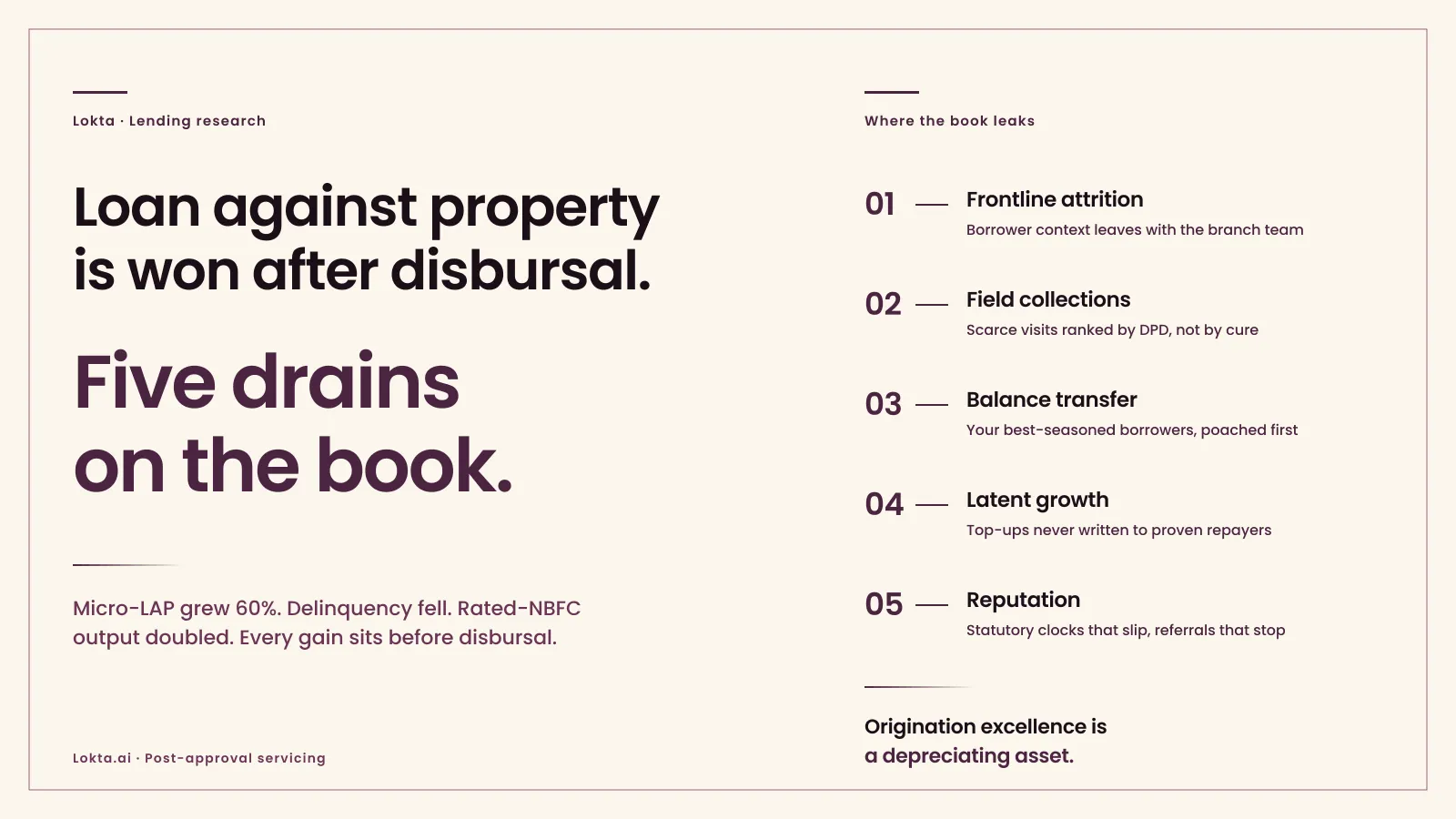
- Frontline attrition runs 24%, the highest of any Indian sector. Worst in the relationship-manager and sales roles that hold borrower context.
- Field collections face a 5.6% versus 3.7% PAR90+ gap by ticket. Micro-LAP delinquency runs higher, and recovery visits are ranked by days past due rather than likelihood of cure.
- Balance transfer costs ₹0 to leave, for specified new loans. No prepayment charge or lock-in on floating-rate LAP sanctioned or renewed from January 2026: every individual non-business loan, and business loans by lender category and ticket. Exits come from the top of the book.
- Latent growth sits in a ₹1.6 lakh crore micro-LAP book, now seasoning. Top-ups to proven repayers are among the lowest-risk assets a lender can add, and mostly go unwritten.
- Reputation carries a ₹5,000-a-day statutory meter on part of the book. A referral cost runs on all of it, and the RBI deed-release clock covers only the personal-purpose slice.
Is any of this a credit-quality problem?
Not primarily, and it is worth separating the two before the five. Indian secured MSME lending has become measurably better at everything measured before the money goes out.
Over the same window the MSME LAP market grew from ₹7.5 to ₹11.3 lakh crore, and micro-LAP below a ₹10 lakh ticket grew about 60%, from ₹1.0 to ₹1.6 lakh crore. Across the market delinquency fell as the book grew; at the CareEdge-rated micro-LAP NBFCs specifically, disbursement per branch doubled. Different samples, same direction, and a well-drilled operating model on the evidence available.
The rating agency attributes part of the remaining micro-LAP delinquency gap to new-to-credit borrowers, assessed-income underwriting, and cash-flow mismatches. All are real, and all are set at or before sanction. None of them explains what happens to a loan in the years after it is booked. That is where the five drains sit.
01 · Frontline attrition: what walks out when a relationship manager leaves?
Financial services recorded the highest attrition of any Indian sector at 24%, concentrated across sales, relationship-management, and digital roles. TeamLease-managed loan-sales teams specifically report 9-13% attrition a month, a narrower cohort than the sector figure. Sources: EY Future of Pay 2026. TeamLease, as reported.
In a branch-run secured book, attrition is not a staffing statistic. It is a data-loss event.
What leaves is the part of the credit file nobody writes down: which borrower’s business is seasonal and always catches up by October, who pays late but has never actually defaulted, which promise was made across a branch counter, which property has a boundary dispute the valuation missed. The successor inherits an account number and a repayment schedule, and starts from zero on a loan that may be six years old.
- Judgement resets to zero. The successor cannot tell a seasonal dip from early distress, so real warning signs read as noise and noise gets escalated.
- Retention goes blind. The person who would have noticed a good borrower shopping around is the person who left.
- The cost lands twice. Once in the hiring and ramp cycle, again in the accounts that deteriorate while the replacement learns the patch.
02 · Field collections: why can’t micro-LAP be collected from a dialer?
Micro-LAP carries a higher reported PAR90+ rate than larger-ticket LAP. CareEdge attributes the gap to factors set at or before sanction, including new-to-credit borrowers, assessed-income underwriting, and cash-flow mismatches; field prioritisation is a response once an account slips, not the proven cause of the gap. Both bands improved over the two years to September 2024. Source: CareEdge Ratings.
Because the borrower is a self-employed trader with irregular cash flows and no meaningful digital servicing habit, on a loan whose ticket sits in the low lakhs. Collection here is a conversation held in person, often more than once, and the person holding it needs to know what they are walking into.
That makes field capacity the binding constraint on recovery once an account slips, and it is easy to spend on the wrong visits.
A DPD queue ranks accounts by how bad they already are. It says nothing about which will cure if visited this week. Scarce visits land on accounts that were going to roll regardless, while recoverable ones drift into a worse bucket and get expensive.
A visit with no context is a request for money. A visit that knows the borrower’s receipts dipped for two months and recovered, or that a bureau enquiry just appeared elsewhere, is a negotiation. The difference is not effort. It is what the officer was handed before leaving the branch.
03 · Balance transfer: why do your best borrowers leave first?
Floating-rate LAP sanctioned or renewed from 1 January 2026 carries no prepayment charge and no lock-in for individual non-business borrowers at any amount, and for business borrowers depending on the lender’s regulatory layer and the sanctioned amount. One large listed housing financier’s balance-transfer-out ratio improved to 5.3% in Q1 FY26 from 5.9% in Q1 FY25, roughly 60 basis points, per analyst coverage of its results. Sources: RBI Pre-payment Charges Directions, 2025. ICICI Direct research note, Q1 FY26.
Refinancing is a credit decision, and the easiest borrower for a competitor to approve is the one who has already proven themselves on someone else’s book. Two to three years of clean repayment against appreciated property is close to a free lunch for the lender doing the poaching: demonstrated behaviour, a lower loan-to-value, no acquisition risk.
The gap they attack with is real, and it is wide: aggregated loan-against-property rate cards run roughly 8.5% to 18% across banks and NBFCs, so a competitor rarely needs to be a cheaper institution type, just a sharper quote.
The seasoned borrower was priced as an unknown when the loan was booked. They are no longer unknown, and given a spread this wide, someone in that range has noticed. Exits are not random. A book losing 3% of balances a year is not losing 3% of its average quality, it is losing from the top and replacing from the middle.
What changed in January is that the last contractual brake came off, for the part of the book written under the new rule. The Directions apply across commercial banks other than payments banks, co-operative banks, NBFCs including housing finance companies, and all-India financial institutions, but which bucket a lender falls into still depends on its own regulatory layer.
Floating-rate loans to individuals for non-business purposes, with or without co-obligants. No prepayment charge at any amount, from any regulated entity.
Most commercial banks (excluding small finance, regional rural, and local area banks) plus upper-layer NBFCs are barred at any amount. Small finance banks, regional rural banks, and middle-layer NBFCs are barred up to a ₹50 lakh sanctioned limit. Base-layer NBFCs follow board-approved policy.
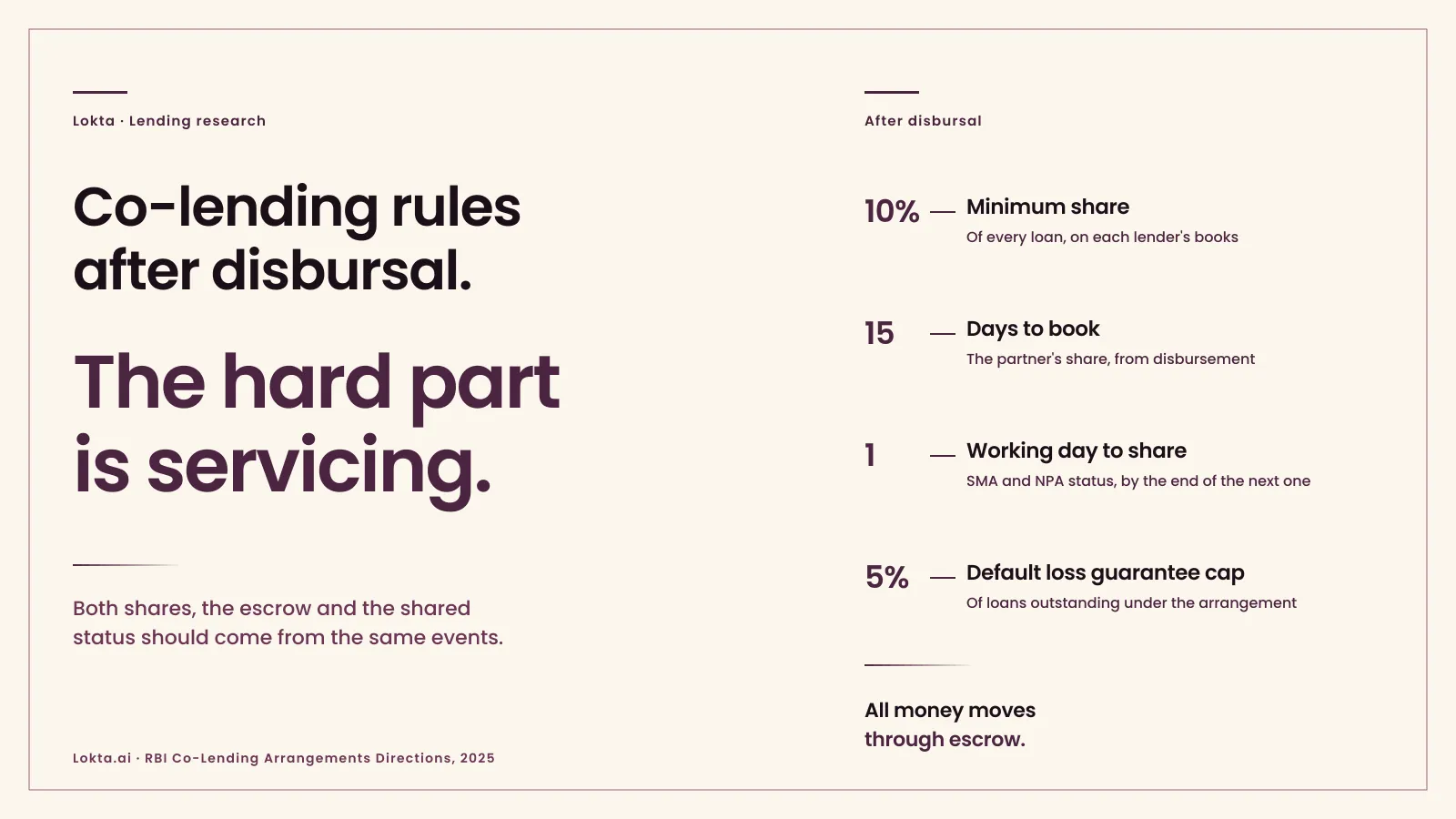
The bar covers partial prepayment and full closure equally, applies irrespective of the source of funds, and removes minimum lock-in periods on covered loans.
The rule is prospective. It binds loans sanctioned or renewed on or after 1 January 2026, so the back book keeps its lock-ins. That sounds like relief and is closer to the opposite. A retroactive rule would strip the whole book at once and force a response inside a quarter. A prospective one swaps exposed loans for protected ones without ever producing the moment of alarm that funds a retention programme, and the exposure grows exactly as fast as the book does.
04 · Latent growth: what is the cheapest loan you are not writing?
Micro-LAP below a ₹10 lakh ticket grew about 60% over the two years to September 2024, with NBFCs holding over 45% share against just over 25% for private banks. That cohort is now reaching the seasoning at which a top-up becomes underwritable. Source: CareEdge Ratings.
This is the flip side of drain 03. If two to three years of clean repayment makes your borrower attractive to a competitor, it makes them attractive to you, and you hold information nobody else has: the repayment history, the collateral, and the valuation headroom built up as the property appreciated and the principal amortised.
Little of that headroom gets lent against. Branch teams carry origination targets, so effort goes to sourcing strangers. The borrower who has paid on time for two or three years often generates no alert at all, because good behaviour is invisible in many servicing systems. The customers who trigger a workflow are usually the ones who miss.
- Acquisition cost on an unproven borrower, plus the underwriting effort to form a view from bureau and documents alone.
- A first-vintage risk profile on a customer with no repayment record on your book.
- A de-risked borrower with headroom, amortised principal, appreciated collateral, two to three years of demonstrated behaviour.
- Zero acquisition cost, and a top-up that doubles as the strongest retention move available.
A top-up to a proven repayer does two jobs at once. It is among the highest-quality assets the lender can add, and it is the reason that borrower does not take a competitor’s call.
05 · Reputation: what does a missed statutory clock cost?
Regulated entities must release all original movable and immovable property documents within 30 days of full repayment or settlement, and where the delay is attributable to the lender, compensate the borrower ₹5,000 for each day of delay. The rule is titled and scoped to personal loans: consumer credit, education, and loans for creating or enhancing immovable or financial assets. Source: RBI/2023-24/60, Responsible Lending Conduct, Release of Movable/Immovable Property Documents on Repayment/Settlement of Personal Loans, applying where release falls due on or after 1 December 2023.
This rule is not universal. A large share of LAP is written for business purposes, such as working capital, expansion, or a second shop, and that is not what the rule’s own title covers. On the personal-purpose slice of the book, the compensation is the smaller cost anyway. In a segment that runs substantially on referral, a borrower who has repaid a ten-year loan and then spends six weeks chasing their own title deed is not a contained incident. They are the person the next few applicants were going to ask. On the business-purpose slice, this RBI direction does not impose its 30-day and ₹5,000-per-day framework, so nothing but the lender’s own process and whatever the loan contract requires stands between a repaid loan and a released deed, in exactly the segment where the referral damage is worst.
| Post-disbursal obligation | The clock | What a slip actually costs |
|---|---|---|
| Release of title deeds, personal-purpose LAP | 30 days from full repayment or settlement. | ₹5,000 per day, plus the referral chain from a decade-long customer. |
| Release of title deeds, business-purpose LAP | Outside this RBI direction. Process and contract only. | No RBI compensation meter, but the same borrower and the same referral chain. |
| Collection conduct | Every contact, for the life of the loan. | In a small trading community, one bad recovery call prices your next ten leads. |
What should a lender instrument first?
None of this has to start with replacing the loan management system. The servicing layer can read a book it did not originate. What it cannot do is run on a book nobody is watching. Mapped against the five drains, the sequence is fairly obvious.
Core means the deterministic system of record does it. Agent means the AI proposes and the lender’s own policy disposes, with the reasoning kept. Mixed means both.
Each of those is a decision made under policy the lender sets, on evidence the lender can inspect afterwards. That constraint is not decoration. A retention offer is a pricing action, and a collections priority is a customer-treatment action. Both belong on the record with the reasoning attached.
The takeaway
The Indian LAP industry became very good at the day the loan is written. Origination excellence is a depreciating asset: that skill is worth less every year it isn’t matched downstream. The book is drained by five things that all happen afterwards. Four of them have been true for a decade. The fifth just lost its last contractual defence on every new loan the rule covers. Whoever runs the decade after disbursal keeps the margin.
Frequently asked questions
What are the main challenges in servicing a loan against property book?
Five recur, and all of them sit after disbursal. Frontline attrition, which walks borrower context out of the branch. Field collections, which cannot be run from a central dialer on small-ticket self-employed loans. Balance transfer, which takes the best-seasoned borrowers first. Latent growth, meaning the top-up lending never written to proven repayers. And reputation, where a missed statutory clock costs referrals in a segment that runs on them. Origination is not on the list.
What changed for loan against property under the RBI prepayment charges rules from January 2026?
Regulated entities can no longer levy prepayment charges on floating-rate loans to individuals for non-business purposes, at any amount, from any lender. On floating-rate business loans to individuals and micro and small enterprises, most commercial banks and upper-layer NBFCs are barred at any amount, while small finance banks, regional rural banks, and middle-layer NBFCs are barred up to a fifty lakh rupee sanctioned limit. The bar covers part prepayment and full closure alike, applies irrespective of the source of funds, and removes lock-in periods on covered loans. It binds loans sanctioned or renewed on or after 1 January 2026, so it is prospective rather than retroactive.
Is asset quality in Indian micro-LAP getting better or worse?
Better, on the published data. Over the two years to September 2024, PAR90+ in micro-LAP below a ten lakh rupee ticket improved from 6.7% to 5.6%, and LAP above ten lakh improved from 6.0% to 3.7%, per CareEdge Ratings citing CRIF High Mark. That happened while the MSME LAP market grew from roughly 7.5 to 11.3 lakh crore rupees and disbursement per branch at CareEdge-rated micro-LAP NBFCs doubled from about 5.2 to 10.3 crore rupees. Underwriting and branch execution are working. What is not measured is what happens to a loan after it is booked.
How does a LAP lender reduce balance-transfer outflow?
By treating outflow as an operational metric rather than as weather. Competitors target borrowers with two to three years of clean repayment, and aggregated loan-against-property rate cards show a wide spread, roughly 8.5% to 18% across banks and NBFCs, so a seasoned borrower rarely needs to change lender category to find a cheaper quote. The lenders that move the number watch on-time payers for flight signals before a foreclosure letter is requested, and arrive with a pre-approved, policy-bounded response. One large housing financier's balance-transfer-out ratio improved by roughly 60 basis points year on year, per analyst coverage of its results.
Read next:
- A loan’s profit is decided after approval, not at underwriting: the economics underneath this post, and why the two levers a lender controls both sit after disbursal.
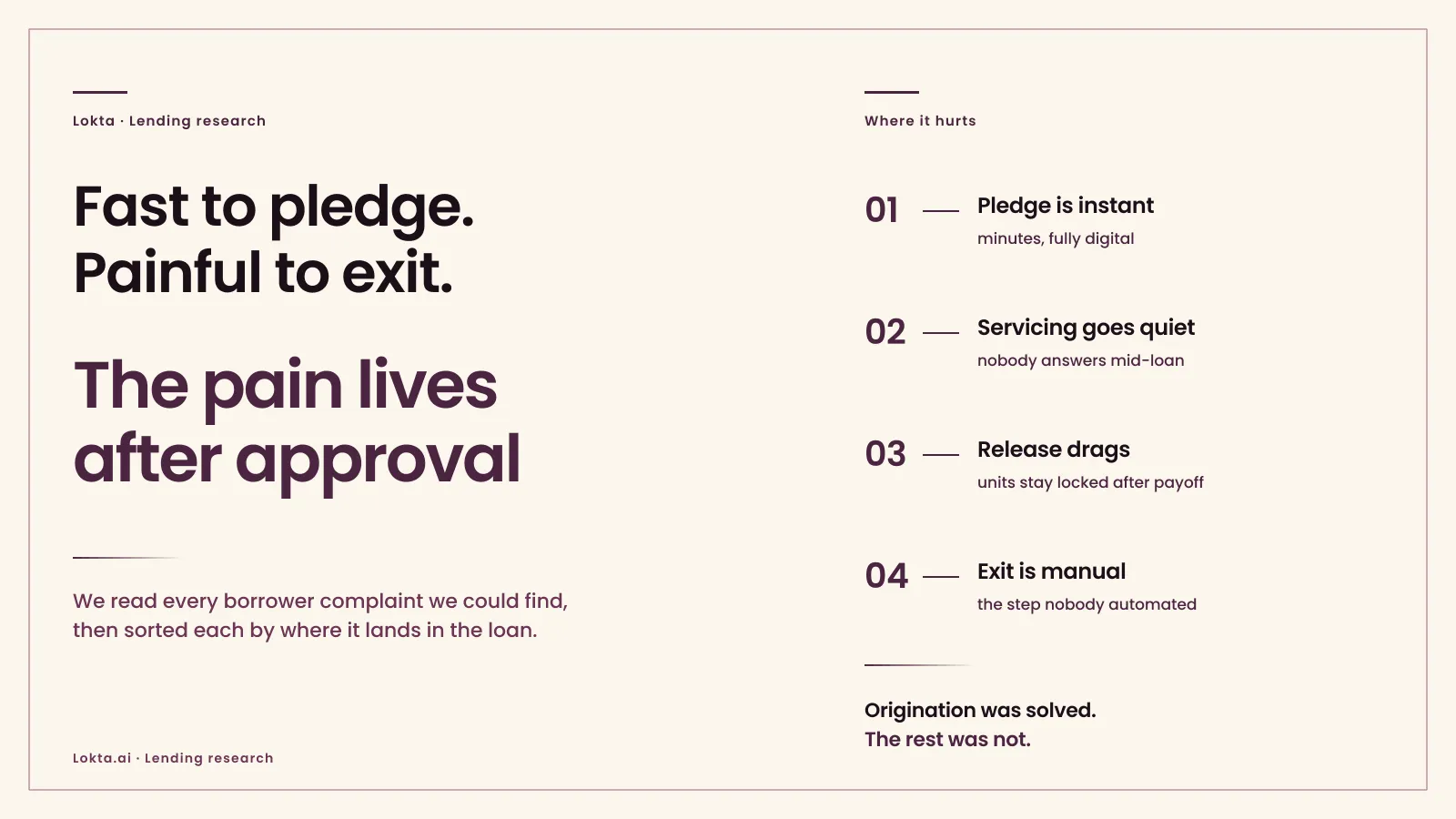
- Loans against mutual funds: fast to pledge, painful to exit: the same pattern in a different secured product, read from borrower complaints instead of regulation.
- How to use AI agents in loan servicing: what it looks like to actually run the post-approval work this post argues is now the whole game.
- Vehicle and EV loan servicing: the book page for two-wheeler, auto, CV and EV lending, another secured product where the decade after disbursal decides the outcome.
Sources:
- MSME AUM for NBFCs to cross Rs 5.3 lakh crore by FY26, CareEdge Ratings: LAP and micro-LAP market size, PAR90+ by ticket band (citing CRIF High Mark), branch productivity, and market share.
- Reserve Bank of India (Pre-payment Charges on Loans) Directions, 2025: RBI/2025-26/64, issued 2 July 2025. Scope, lender-layer thresholds (including the small finance bank / regional rural bank / local area bank carve-out), and applicability to loans sanctioned or renewed on or after 1 January 2026.
- FAQs on pre-payment charges, Vinod Kothari Consultants: the lender-classification thresholds read against the Directions, and the sanctioned-or-renewed applicability test.
- Responsible Lending Conduct: Release of Movable/Immovable Property Documents on Repayment/Settlement of Personal Loans: RBI/2023-24/60, issued 13 September 2023. The 30-day release requirement, ₹5,000 per day compensation, and the personal-loans scope named in its own title.
- EY India, Future of Pay 2026 newsroom release: financial services at 24% attrition, the highest of any Indian sector.
- Coverage of loan-sales-team attrition, TeamLease, as reported: 9-13% monthly attrition in loan-sales teams.
- ICICI Direct research note on a large listed housing financier, Q1 FY26: balance-transfer-out ratio at 5.3% in Q1 FY26 versus 5.9% in Q1 FY25.
- Published loan-against-property rate cards, Indian banks and NBFCs: the prevailing spread between bank and NBFC LAP pricing.
Individual lender names are masked in the write-up because the pattern is structural rather than specific to any one brand. Research houses and regulators are named. Source URLs resolve to the original disclosures.
Chandramouli is a co-founder of Lokta, the agentic loan servicing platform for the live book. He has spent over two decades in technology, go-to-market, and consulting, the last several years building machine learning and GenAI, and has served as an independent director on an NBFC board.