Multi-lender servicing: trace the repayment before fixing the DPD gap
When your repayment record and a partner lender's DPD disagree, start with the loan, dated rules and payment evidence. Keep borrower dues and partner obligations distinct.
Contents 8 sections
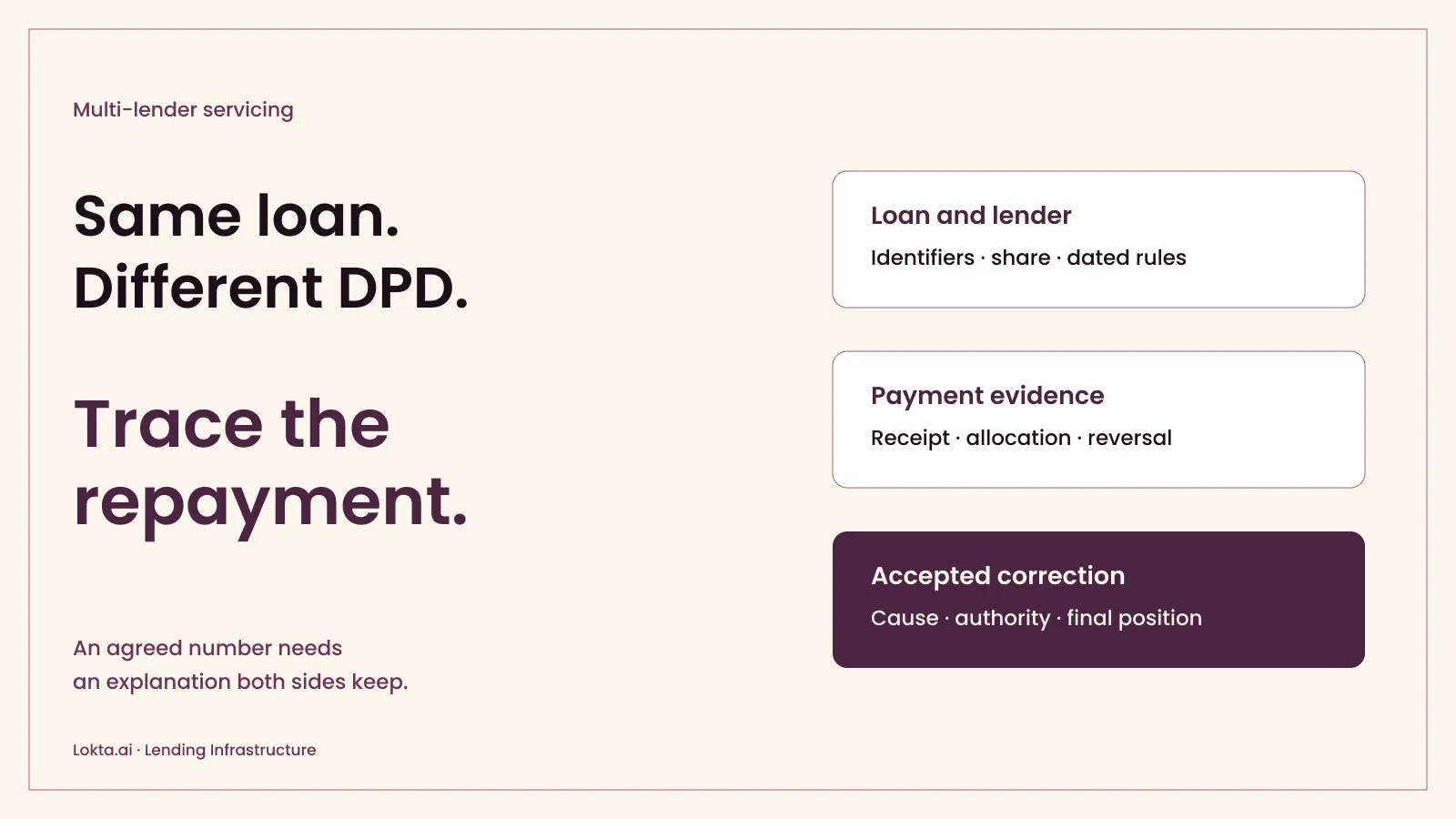
For an LSP operations lead, this guide produces one useful record: a repayment exception that explains why your days past due (DPD) differed from the partner lender’s, what changed and who accepted the correction.
Multi-lender servicing depends on how the loan is recorded before a mismatch appears. The loan needs its lender, applicable share and dated rules. Month-end reconciliation can uncover missing information, but it cannot substitute for recording the terms that governed an earlier payment.
Lokta’s multi-lender servicing page covers the available product scope. This guide supplies an operating check for the disagreement itself. An LSP servicing separate lenders’ loans and two regulated lenders in a co-lending arrangement have different obligations. Establish the arrangement before choosing its rules.
1. Establish which loan and lender the repayment belongs to
Start the exception record with the lender’s loan identifier and the identifier used in your servicing record. Include the borrower mapping and the account or statement from which the receipt came. A name or a matching amount can help an investigation, but should not by itself settle an ambiguous match.
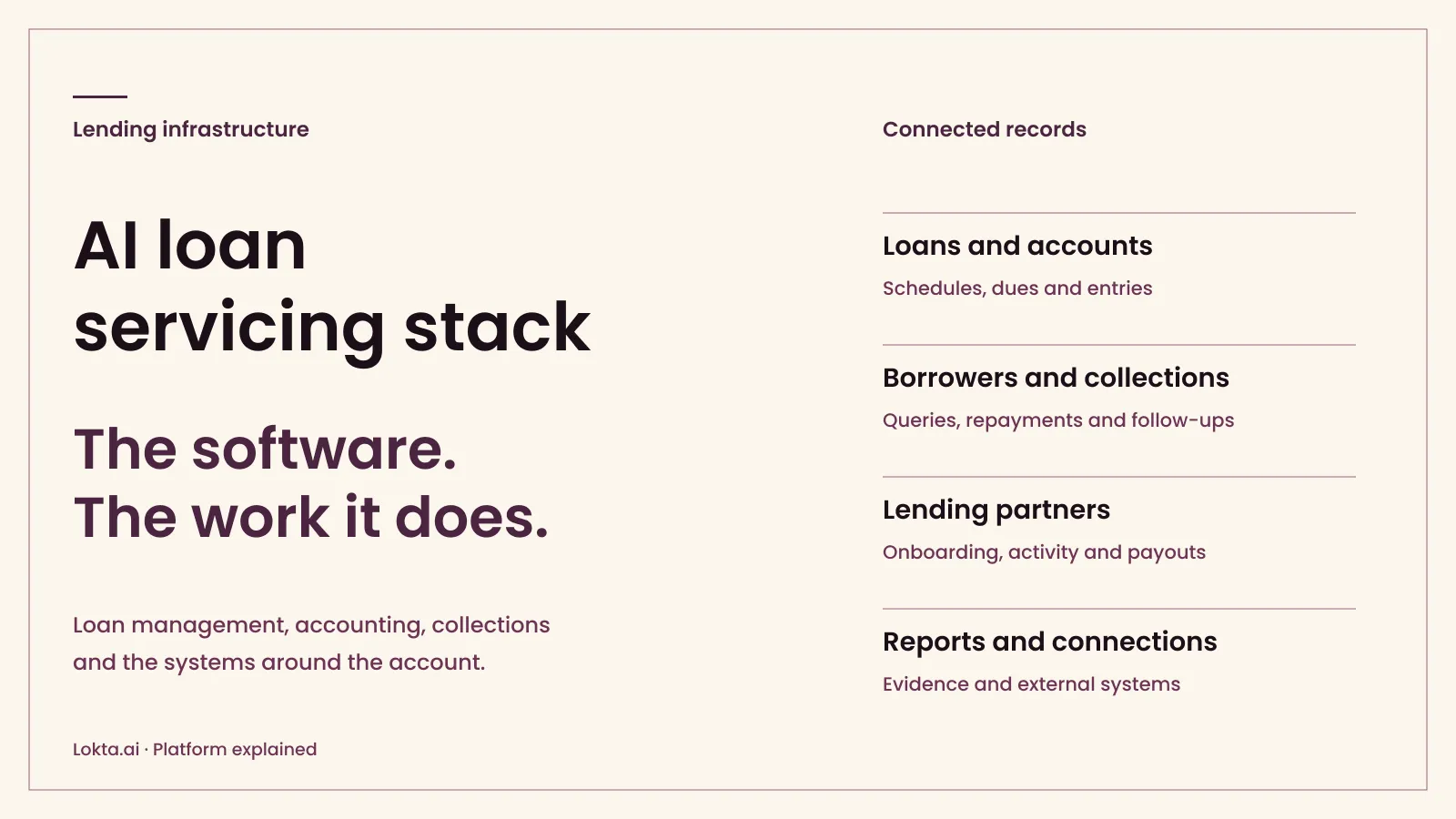
Each loan in Lokta carries the lender it belongs to. Where a partner offers no API, bank-statement upload can post repayments against the loan. Those capabilities were confirmed by the product team in October. Agree the statement layout, mapping and exceptions during implementation.
For a co-lent loan, preserve each lender’s share and the agreement governing allocation. Paragraphs 116 and 117 of the RBI’s current NBFC Transfer and Distribution of Credit Risk Directions require a separate borrower account for each lender’s share and an escrow route with agreed appropriation. A servicing tag therefore has to connect to the financial arrangement, not just a reporting label.
If the match is unresolved, keep the receipt in the exception process agreed with the lender. The receipt reconciliation resource explains matching and control totals without assuming that every file row is ready to post.
2. Reconcile the same events at the same cut-off
Compare a dated position with a dated position. A lender’s morning extract and a servicer’s later extract can differ even when both have processed the information available to them.
Use the confirmed statement-upload path as a concrete test: retain the source file, identify its coverage period and check the posted loan events against that period. For an API flow, retain the corresponding source references and processing evidence. Agree who follows up when a source arrives late.
Useful diagnostic possibilities include a partial repayment, a receipt posted after the extract, a reversed payment, a changed schedule or an allocation made under a different rule version. These are examples to test, not findings about a particular lender. Record the effective date separately from the date your team learned about or entered the event.
A deterministic core applies explicit rules to those inputs. If two records disagree, compare the inputs and rules before deciding which output to correct. Never make the totals agree by silently changing the source evidence.
3. Explain the DPD gap before changing the report
The DPD investigation should identify the oldest unpaid due under the accepted schedule and allocation rules at the agreed cut-off. It should also check classification separately, because an asset-classification decision can carry information beyond the DPD number in one extract.
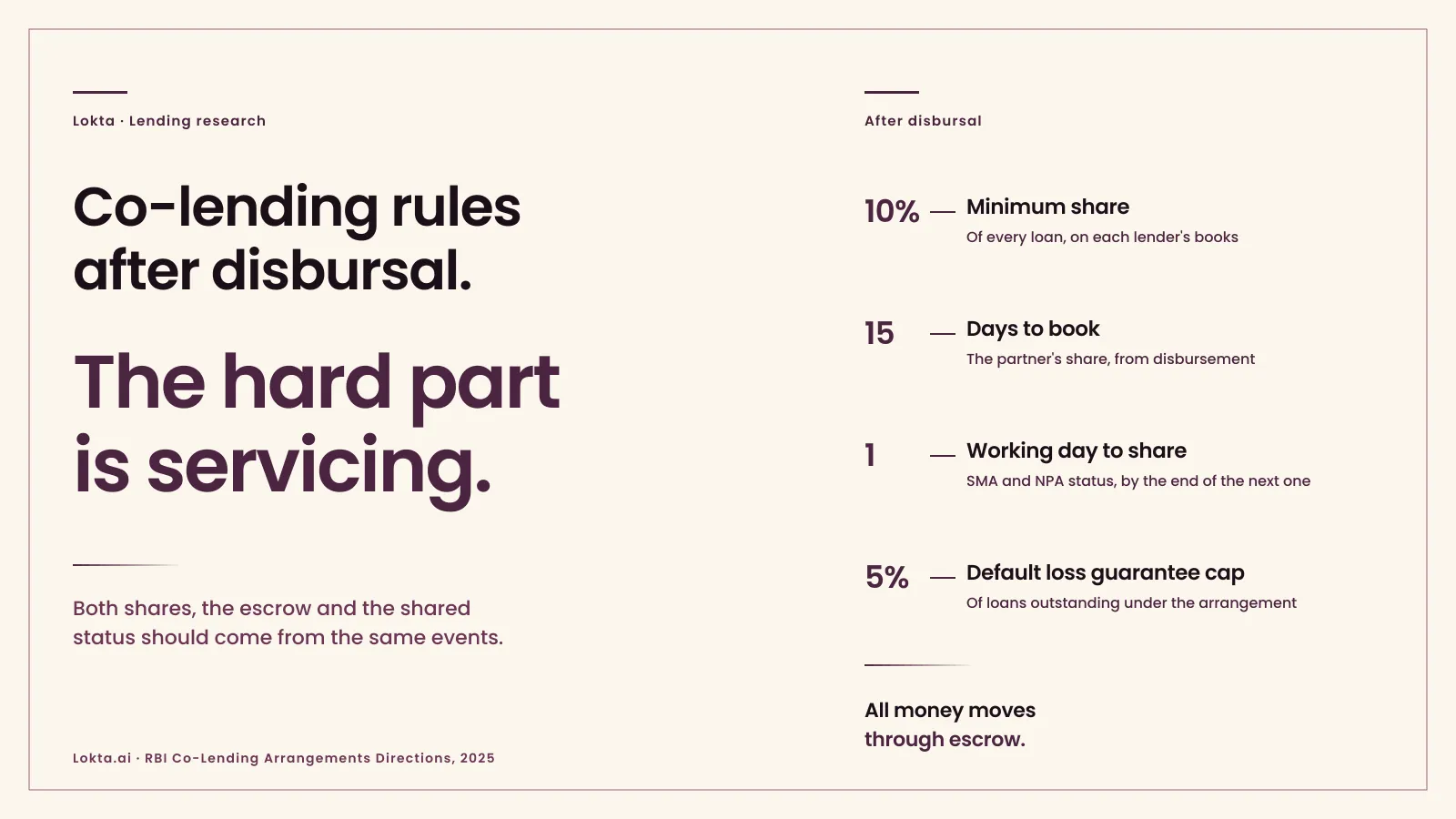
For covered co-lending exposures, paragraph 124 of the NBFC Transfer and Distribution of Credit Risk Directions applies shared borrower-level SMA/NPA classification when either lender classifies its CLA exposure because of default in that exposure. Relevant information must be shared near real time, and by the end of the next working day at the latest. A quarterly audit is too late to operate that requirement.
The co-lending Directions guide explains the broader framework. In the exception record, keep the partner notice, the affected exposure and the effective classification date. A late notice needs an explanation of its downstream effect, not merely a new value pasted into the next report.
For example, if a receipt was reversed in one record but remained applied in the other, the investigation should show the receipt, reversal authority and resulting dues on both sides. That example tests the trail. It does not prescribe a universal interest reversal for every late partner payment.
4. Separate DLG money from borrower repayments
A default loss guarantee (DLG, often called FLDG in conversation) creates a partner obligation that needs its own record. Do not treat money received under the guarantee as evidence that the borrower paid an instalment.
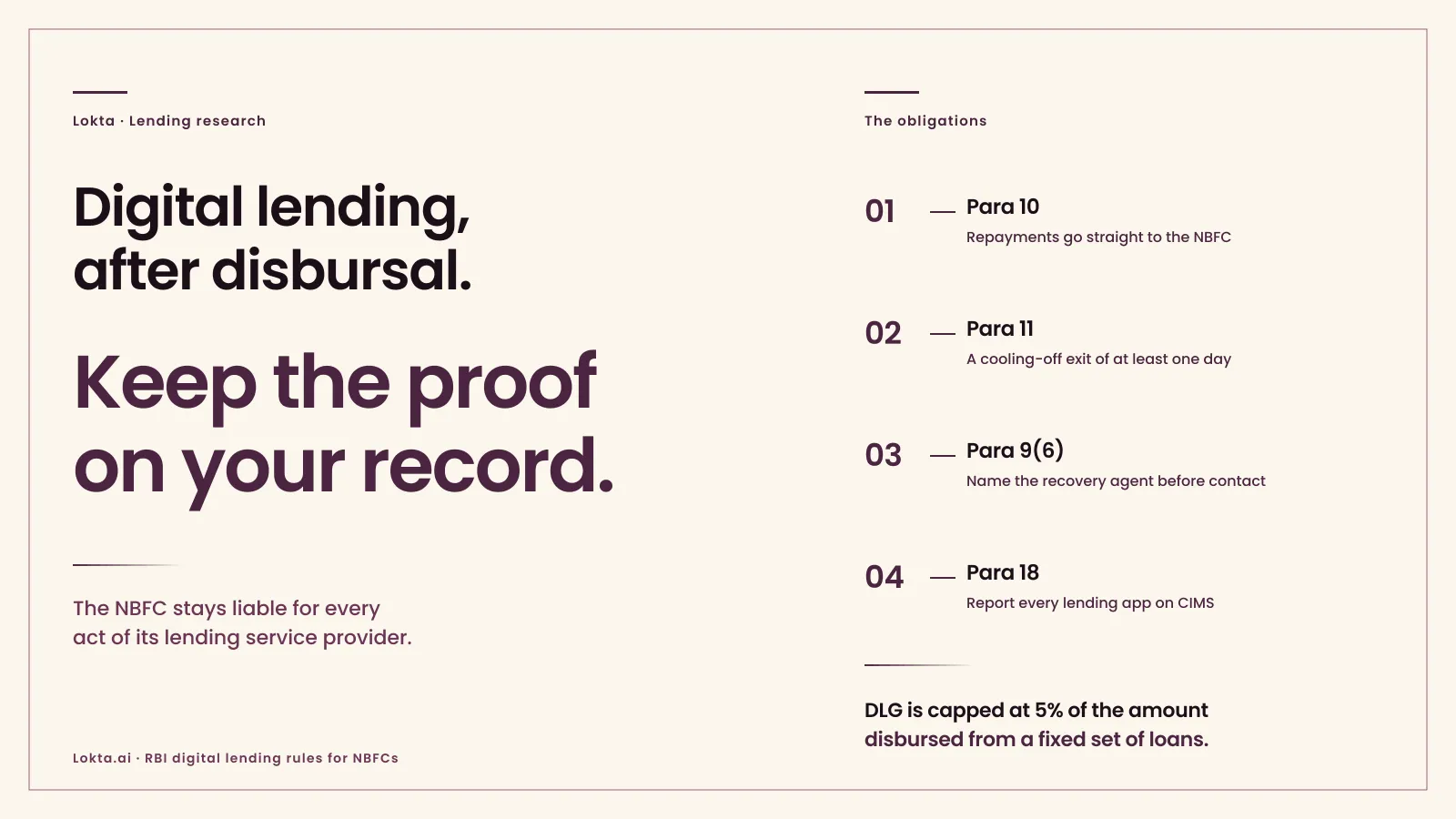
The NBFC Credit Facilities Directions, paragraphs 24-27, cap digital-lending DLG cover at 5% of the amount disbursed from the specified portfolio and require invocation within a maximum 120-day overdue period unless the borrower makes good the dues first. Invocation leaves the borrower’s liability unchanged. Co-lending has a distinct cap based on loans outstanding under the arrangement in paragraph 123 of the Transfer Directions.
Keep the covered set, invocation, guarantee receipt and later borrower recovery distinguishable. A contractual settlement date also needs its own field and evidence. Check the agreement’s trigger and settlement date; a DLG does not automatically require payment on every EMI due date. The digital-lending guide owns the detailed DLG explanation.
The same discipline separates a lender settlement from a servicing fee: the amount due to the lender, your commercial entitlement and the borrower’s outstanding answer different questions.
5. Close the exception with evidence
Close a discrepancy when the authorised correction and its consequences are recorded. The current co-lending Directions put the loans within each lender’s internal and statutory audit scope (paragraph 118). The retained explanation should survive the original investigator moving to another task.
- Identify the account. Loan, borrower, lender and applicable share, with both parties’ references.
- Freeze the comparison. Source evidence, cut-off, schedule version and each original position.
- Name the cause. Missing receipt, reversal, date, allocation, mapping or classification notice, supported by evidence.
- Record the authority. Proposed correction, approver and completed posting reference.
- Verify the result. Loan dues, lender share, classification and affected downstream reports, with each unresolved dependency still visible.
You can keep separate systems with a disciplined reconciliation process, use a shared servicing record, or build the coordination layer in-house. Choose against the exceptions your partners actually produce. A shared record still requires source mapping, agreement on rules and a named owner for disputed inputs.
Talk to us with one partner statement and the loan behind a DPD gap. The useful demonstration ends with an explanation both parties can reproduce.
Frequently asked questions
How do you investigate a DPD mismatch with a partner lender?
Match the borrower and loan identifiers, then compare both positions at the same cut-off. Check the schedule version, effective dates of receipts, allocation, reversals and any classification information shared by the partner. Keep the original extracts and explain each correction. A matching final DPD number is insufficient if the underlying events still differ. The objective is a reproducible account history and an authorised resolution that both parties can trace, rather than an unexplained adjustment to the report.
Can an LSP service a partner's loans if the partner has no API?
Yes, a missing API does not rule out statement-based servicing. Lokta supports bank-statement upload to post repayments against loans, with the lender recorded on each loan. The implementation still needs agreed identifiers, file mapping, delivery timing and a process for unmatched or disputed entries. Test those conditions with a partner statement before relying on the flow. Uploading a file provides an input path; it does not remove the need to reconcile the resulting record with the partner.
Does matching DPD mean both co-lenders have the right asset classification?
Matching days past due is only part of the check. Asset classification also depends on the applicable borrower-level rules and information shared between co-lenders. Compare the classification, its effective date and the event or partner notice behind it alongside DPD. Use the current RBI co-lending provisions for the relevant entities and arrangement. An LSP servicing loans for unrelated lenders should not assume that the co-lending rules apply to every partner loan simply because it appears in the same operating system.
What should an LSP retain when a repayment exception is closed?
Retain the source statement or API record, the mapped loan and lender, the relevant schedule and rule versions, both original positions, the cause found, and evidence of the authorised correction. Record who accepted the resolution and which downstream balances or reports were checked. The lender and servicer should agree the retention and access requirements for their arrangement. A closed ticket should let another reviewer explain the discrepancy without asking the person who originally fixed it.
Read next
- RBI co-lending servicing rules: the arrangement’s wider obligations
- RBI digital lending rules for NBFCs: the DLG and LSP framework
Sources
- RBI: NBFC Transfer and Distribution of Credit Risk Directions, 2025, issued 28 November 2025, updated 1 July 2026. Paragraphs 116-118 and 123-124
- RBI: NBFC Credit Facilities Directions, 2025, issued 28 November 2025, updated 15 July 2026. Paragraphs 24-27
Lokta editorial analysis by Chandramouli, co-founder and CEO.