For repayment operations and finance teams
Loan repayments, accounted for.
Record the receipt, apply the loan’s repayment rules and follow the accounting entry. Lokta keeps repayment management on the loan record, with reconciliation scoped around the bank or provider evidence your team can verify.
Available now within Loan Management. Payment-provider connections, statement formats and exception rules are agreed and tested for your deployment.
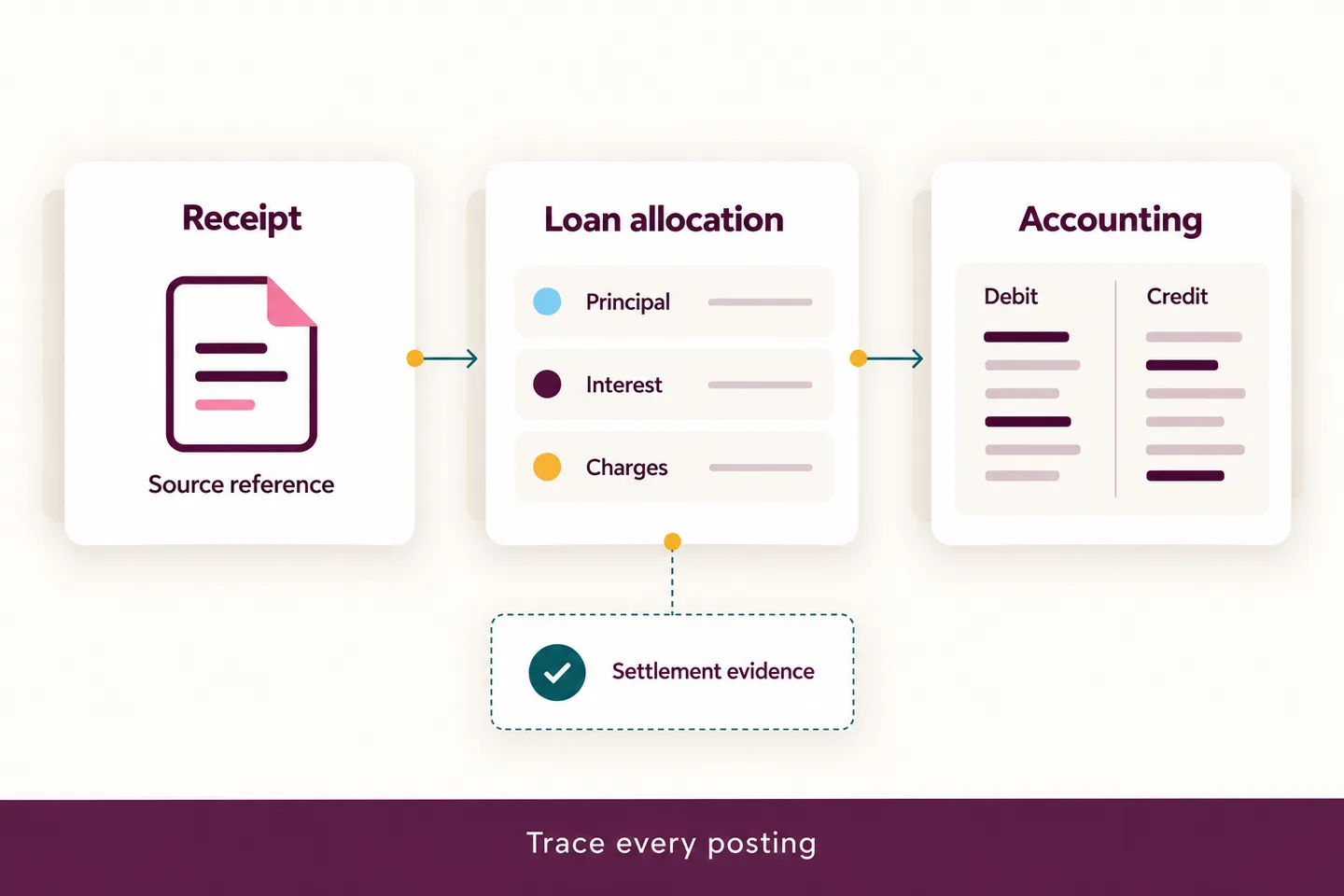
Follow the received money through the book.
Establish the receipt
Start with the provider event or bank statement. Check the source reference, amount, value date and settlement status before deciding which loan it belongs to.
Apply the loan rules
Record the repayment on the account and apply the product’s appropriation order. Keep the transaction reference behind the resulting principal, interest and charge balances.
Reconcile the posting
Compare the loan transaction and mapped accounting entries with the source evidence. Investigate a missing receipt, a repeated reference or an amount difference before closing the exception.
For the buyer’s control checklist and worked example, use the loan reconciliation guide. See integrations for provider and system handoffs.
Keep the evidence when something does not match.
- A borrower says they have paid
- Compare the claimed payment with verified receipt and settlement evidence. A screenshot can start an investigation; it cannot establish that money reached the lender.
- The same reference arrives twice
- Test repeated provider events and statement re-uploads. Agree the duplicate key and rejection or review behaviour so a retry cannot count the money twice.
- The amount or account is unclear
- Retain the unmatched evidence and proposed treatment for review. A model suggestion must pass the configured rules and required approvals before changing the loan.
- A posted receipt is reversed
- Keep the original transaction and correction traceable. Review the effect on the schedule, loan balance and accounting entries using the actual transaction dates.
The payment-dispute workflow shows the servicing response. If more than one lender shares the loan, use the partner allocation and settlement example.
Prove the full path with one synthetic receipt.
- Agree the expected result.
Choose a synthetic loan, its dues and appropriation order. Specify the source reference and the expected account and GL movements before posting.
- Match the records.
Trace the verified receipt to one loan transaction and its accounting entries. Reconcile amounts using the same value date and cut-off.
- Try the failure cases.
Replay the reference, remove the account mapping and reverse a posted receipt. Inspect the exception or correction and confirm that no unapproved adjustment or duplicate repayment reached the book.
Bank settlement, loan posting and reconciliation completion are separate observations. Agree who resolves differences and who approves an adjustment. The reporting and analytics page covers how to inspect the resulting portfolio measures.
Repayment and reconciliation questions
Receipt evidence, payment providers, unmatched records and reversals.
What does loan repayment management cover in Lokta?
Loan Management records repayments against the loan, applies the configured appropriation rules and retains the accounting entries. Reconciliation compares those records with the agreed payment-provider or bank evidence. Formats, matching rules and exception handling are tested for the deployment.
Is Lokta a payment gateway or bank account?
Lokta manages the loan and servicing record. The lender uses its bank accounts and payment providers to receive money. Provider connections and the evidence used to confirm a payment are agreed during implementation; a loan posting does not itself prove bank settlement.
What happens when a receipt cannot be matched?
Agree the exception process before go-live. The reviewer needs the source reference, amount, date and proposed account match. A missing or ambiguous reference should remain unresolved until supported by evidence and any required approval. Include that case in the acceptance test.
How do reversals affect the loan and accounting records?
Review the reversal against the original transaction and the lender’s rules. The account history and resulting accounting entries must explain the correction. Test the effect on dues, balances and any downstream report before accepting the workflow.
Start with the exception your team handles by hand.
Describe the payment source, the mismatch and the decision that needs approval. Keep borrower details out of the first message; we can agree suitable demonstration material for the next conversation.