Lokta launches collateral management that prices the security daily, and names Vamshi Krishna Putta Head of Engineering
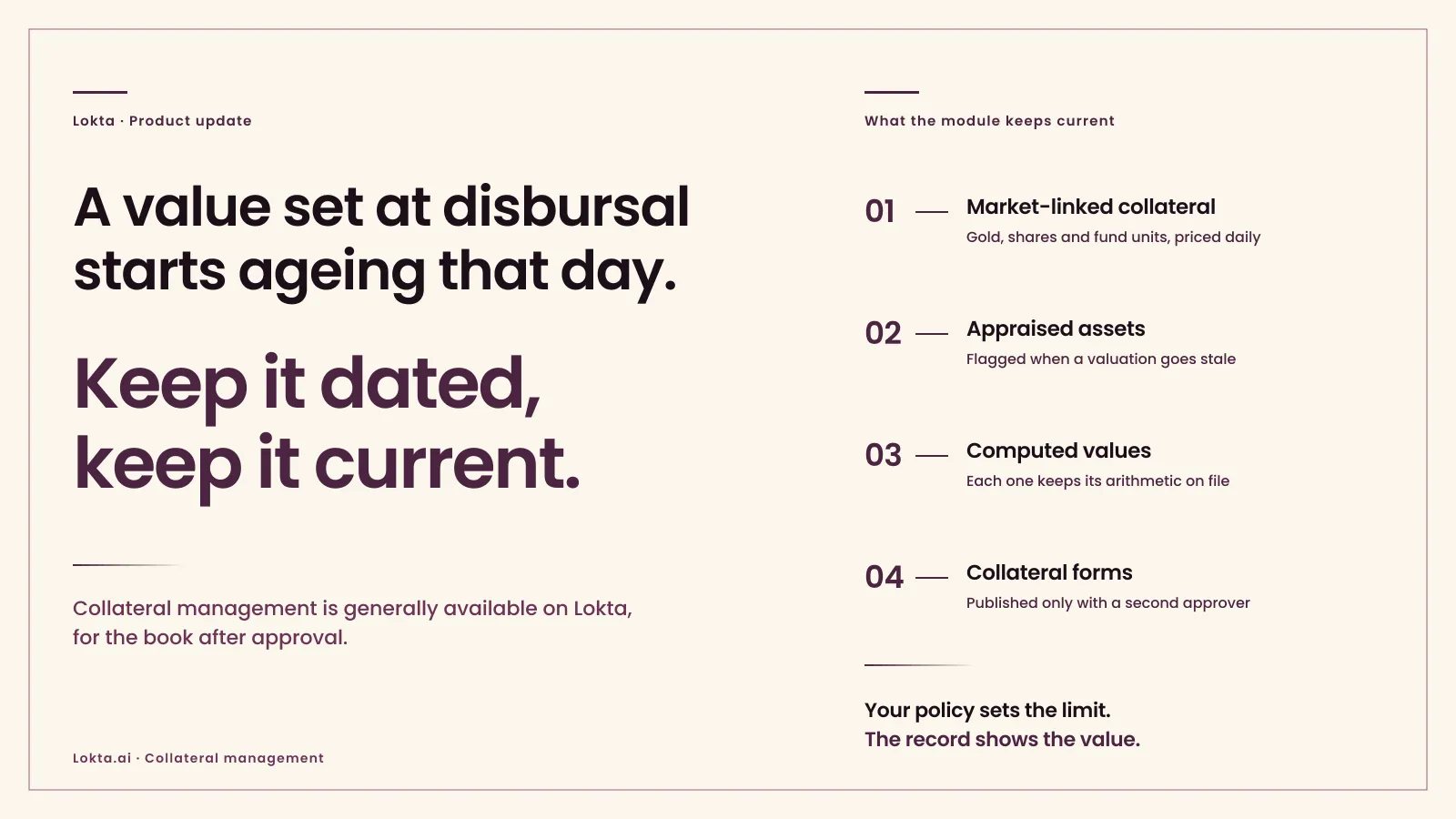
A collateral value set at disbursal starts ageing that day. Lokta's module gives gold, shares and fund units dated daily prices and flags stale appraisals.
Contents 9 sections
Lokta’s collateral management module is generally available from 7 October 2026. It records ten kinds of collateral, from property and gold to shares, mutual fund units and deposits, and keeps the value behind each secured loan dated after disbursal. Gold, shares and fund units get daily prices from sources the lender configures. Appraised assets keep their valuer’s report and are flagged when it goes stale. Eligibility and loan-to-value limits stay with the lender’s policy.
A collateral value captured at disbursal and then left alone is paperwork, not risk management. The loan stays secured on paper while the gold price, the share price or the property market moves under it, and the gap can stay unseen until a renewal, a top-up or a default forces a fresh look. Until then, the lender may be carrying less cover than its policy requires.
Lokta today made its collateral management module generally available and named Vamshi Krishna Putta Head of Engineering. The module is part of Lokta, the agentic loan servicing platform, and keeps the value behind each secured loan dated after approval, inside the lender’s policy. Vamshi helped shape it alongside the engineering team, and he now leads the engineering behind it. Lender implementations are underway.
01 · The gap: a collateral value starts ageing on the day the loan is disbursed
For gold, and for larger NBFCs lending against listed shares, Indian rules already treat the loan-to-value ratio as a daily number, so a value fixed at disbursal is out of date by the next morning.
The Reserve Bank of India’s credit facilities directions for NBFCs define the ratio for a gold loan “on a day” as the outstanding loan against the value of the collateral on that day, and require the prescribed ratio to be maintained “on an ongoing basis throughout the tenor of the loan”. The same directions fix the price: the lower of the 30-day average closing price and the previous day’s closing price, as published by the India Bullion and Jewellers Association or a SEBI-regulated commodity exchange. For bullet repayment loans, the calculation counts the total amount repayable at maturity, not just the principal.
Larger NBFCs lending against listed shares must hold a 50% loan-to-value ratio “at all times”, and make good any shortfall caused by share price movement within seven working days. A lender cannot cure a shortfall it has not seen. Mutual fund units move on the same rhythm: SEBI requires schemes, other than those investing largely overseas, to disclose their NAV by 11 pm on every business day.
The Basel framework for banks makes the same assumption from the other side. Its haircuts on financial collateral in secured lending assume daily revaluation, and they must be scaled up when a bank revalues less often.
A value typed into the loan file at sanction does none of this. It records what the collateral was worth on one day, and every rule above asks about the days after it.
Collateral that is captured at disbursal and then left to go dumb is paperwork, not risk management. A system should tell the lender when a price has changed, when an appraisal has gone stale and what needs review.
02 · The module: how each kind of collateral gets its value
The module values each kind of collateral the way its market does. A valuer appraises a house, a gold rate prices an ornament, an exchange quotes a share, and a deposit’s value follows its contract. Every kind carries the same core underneath: who owns it and in what share, what it is worth, and the date that value was set.
| Collateral | How the value is set | How it stays current |
|---|---|---|
| Gold | Net weight and purity of each ornament, multiplied by a reference rate. | Daily rate from a source the lender configures. Default basis for gold: the lower of the previous close and the 30-day average. |
| Shares and mutual fund units | Units held, multiplied by the market price or NAV. | Daily price or NAV, with the as-of date recorded against the value. |
| Deposits | Contract terms: principal, rate, start and maturity dates. | Value to date computed from the contract. |
| Property, land, vehicles, machinery, artwork and other collateral | A valuer’s appraisal, with market value and, where the policy uses it, distress value. | The lender’s own review cycle. A valuation is flagged when it ages past that cycle or a configured event occurs. |
Four capabilities keep those values usable after disbursal. The collateral management page shows the module with demonstration data.
Agents retrieve prices from sources the lender configures, within what local rules allow, for daily updates to gold, mutual fund units and shares. Appraised assets follow their own valuation and review process.
The module supports multiple currencies and can integrate with country-specific pricing and valuation sources to track loan-to-value ratios.
Computed fields keep their expressions, so an auditor reads the arithmetic instead of trusting the number. Valuations that go stale, by age or by a configured event, are flagged for review.
Lenders can extend collateral forms while the fields used for valuation and exposure stay protected. Publishing a form needs a second approver, and existing records keep the form version they were captured on.
03 · The objection: daily repricing is noise for a property book
For appraised assets the objection is right, and the module does not reprice them daily.
Nobody quotes a house, a tractor or a painting every morning. The Basel framework asks banks to monitor real estate collateral “at a minimum once every year”, more often where the market is subject to significant changes in conditions, and to have a qualified professional revalue the property when information suggests its value may have declined materially or when a credit event such as default occurs. For vehicles and equipment, it asks the revaluation process to account for model-year obsolescence and to include physical inspection.
Capital rules can also hold a property at its value at origination: the Basel standardised approach does this for the loan-to-value ratio behind its risk weights. That number answers a capital question. It does not tell a risk head what the collateral behind today’s overdue book is worth.
The risk in an appraised asset is a valuation nobody knows is old. The module records each appraisal with its valuer and its date, and flags it when it ages past the lender’s review cycle or when a configured event occurs. Lokta does not appraise property. A valuer does. The module keeps the report and raises the flag when the lender’s policy says a fresh one is due.
04 · The controls: the lender’s policy decides, the record shows how
Collateral eligibility and loan-to-value limits remain the lender’s policy. Lokta records appraisals and computes values from inputs the lender configures; valuation judgement and the appointment of valuers remain with the lender. Lokta does not originate, underwrite or approve loans.
The division of work follows the rule the platform is built on: AI proposes, the core decides, the record proves it. Agents retrieve the day’s prices. The deterministic core, the rule-based part that applies the lender’s own policy, computes the value and checks it against the limit. The record keeps the input, the date and the arithmetic, so a risk head can show an auditor where a number came from without rebuilding it in a spreadsheet.
05 · The person accountable: Vamshi Krishna Putta leads engineering
Vamshi Krishna Putta came to Lokta from both ends of lending technology: the vendor that builds it and the business that runs on it. At Finflux, he helped build and later led development of its lending stack, built on Apache Fineract, and stayed on after M2P Fintech acquired the company in 2022. He then worked on technology inside a lending business whose collateral prices changed daily, and saw what it takes to keep those records current.
His work before Lokta includes migrating nine million accounts with full reconciliation and implementing a regulatory moratorium across one million accounts. Both figures belong to his earlier roles; neither describes a Lokta deployment.
“Vamshi has worked with lending software from both sides of the table,” said Chandramouli C S, co-founder and CEO of Lokta. “That changes the questions you ask. Where did this collateral value come from? How old is it? What happens when it changes? He brought those questions into the design of this module. That is the judgement we want leading engineering at Lokta.”
Vamshi will lead platform development, build the engineering team and oversee how product and policy changes reach a live loan book.
06 · Where to start: the market-linked part of the book
Our recommendation is to start where the price moves every day: gold, shares and fund units. A stale value turns into an unnoticed shortfall fastest there, and for gold, and for larger NBFCs lending against shares, the rules already assume the lender knows the current price. Appraised assets can follow on the lender’s existing review cycle, with the age of every valuation visible from the first day.
The trade-off: values are only as current as the sources the lender connects. Configuring a country-specific price or valuation source is implementation work that comes first, and the module computes nothing from a feed it has not been given. A lender can keep revaluing at month-end in a spreadsheet and carry values up to a month old, wire price feeds into a core that was not built to hold them and maintain that integration itself, or hold the collateral alongside the loan on Lokta, which means migrating the book onto Lokta’s ledgers first.
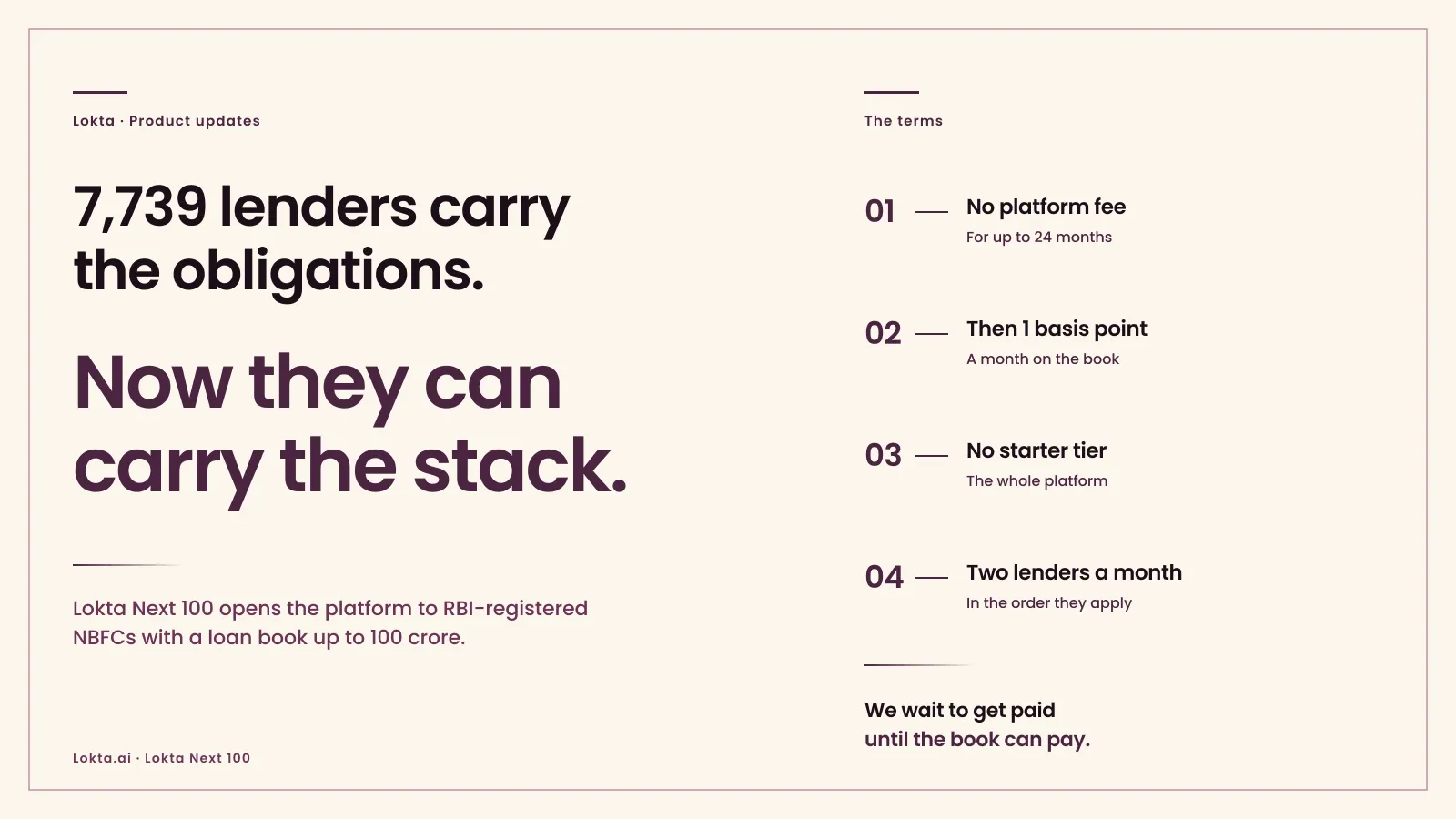
Smaller Indian NBFCs can take the module through Lokta Next 100, opened on 3 September 2026, which offers eligible lenders no platform fee for up to two years, subject to programme terms. To walk through your own collateral with demonstration data, talk to us.
Frequently asked questions
What collateral can Lokta's collateral management module record?
Ten kinds: property, land and plots, vehicles, machinery, artwork, gold, mutual fund units, shares, deposits, and a category for other collateral. Each kind carries the same core of owners, value and valuation date, plus the fields its valuation needs, such as ornament weights and purity for gold or units and NAV for fund units. Lenders add fields from a standard library or their own. Which collateral is eligible, and at what loan-to-value limit, is set by the lender's policy, not by the module.
How does the module value gold collateral?
From the recorded weight and purity of each ornament, multiplied by a daily reference rate that agents retrieve from a source the lender configures. The default basis is the lower of the previous day's closing price and the 30-day average closing price, which is the basis the Reserve Bank of India's gold and silver lending directions require of regulated lenders in India, with the price taken from the India Bullion and Jewellers Association or a SEBI-regulated commodity exchange. Lenders elsewhere can configure the basis their own rules require.
Does the collateral module approve loans or set LTV limits?
No. Collateral eligibility and loan-to-value limits are the lender's policy. Lokta records appraisals and computes values from inputs the lender configures; valuation judgement and the appointment of valuers stay with the lender. Agents retrieve prices, the deterministic core applies the lender's rules, and publishing a change to a collateral form needs a second approver. Lokta does not originate, underwrite or approve loans.
Can lenders outside India use the collateral module?
Yes, with one condition. The module supports multiple currencies and can integrate with country-specific pricing and valuation sources to track loan-to-value ratios, and currency follows the lender's configuration. What it does not promise is a ready-made connection to every source in every market. Whether a particular exchange, bullion association or valuation feed is connected depends on the source and the implementation scope agreed with the lender.
Read next
- Loan against property lenders in India: the five challenges that start after disbursal: what drains a LAP book once the money goes out, including the statutory clocks.
- Early warning signals for NBFCs: credit EWS and fraud EWS are different things: where a falling collateral value fits among the signals RBI expects a lender to catch early.
- Lokta Next 100: no platform fee for up to two years: who qualifies for the programme, and the terms after the free period.
Sources
- Reserve Bank of India, Credit Facilities Directions for Non-Banking Financial Companies, 2025, RBI/DOR/2025-26/347, 28 November 2025, updated 15 July 2026, paragraphs 40, 43, 44 and 106: https://www.rbi.org.in/Scripts/BS_ViewMasDirections.aspx?id=12957
- Reserve Bank of India, Lending Against Gold and Silver Collateral Directions, 2025, RBI/2025-26/47, 6 June 2025: https://www.rbi.org.in/Scripts/NotificationUser.aspx?Id=12859
- Securities and Exchange Board of India, circular SEBI/HO/IMD/IMD-I POD2/P/CIR/2023/48, Review of time limit for disclosure of NAV of mutual fund schemes investing overseas, 29 March 2023: https://www.sebi.gov.in/legal/circulars/mar-2023/review-of-time-limit-for-disclosure-of-nav-of-mutual-fund-schemes-investing-overseas_69519.html
- Basel Committee on Banking Supervision, Basel Framework, CRE22 (financial collateral, paragraphs 22.57 and 22.59): https://www.bis.org/committees/bcbs/basel-framework/81416/chapter-no-footnotes.pdf
- Basel Committee on Banking Supervision, Basel Framework, CRE36 (IRB minimum requirements, paragraphs 36.131 and 36.144): https://www.bis.org/committees/bcbs/basel-framework/81423/chapter.pdf
- Basel Committee on Banking Supervision, Basel Framework, CRE20 (standardised approach, paragraph 20.74): https://www.bis.org/committees/bcbs/basel-framework/81429/chapter-no-footnotes.pdf
- Inc42, M2P Fintech acquires cloud lending startup Finflux, 6 July 2022: https://inc42.com/?p=319893
Lokta editorial analysis by Chandramouli, co-founder and CEO.