Charges waived at settlement: what changed, and who approved it?
A charge waiver belongs in a decision record finance can reconcile. Separate concessions, corrections and unpaid dues before judging a branch's collections.
Contents 8 sections
For an NBFC CFO explaining the last settlements of the month, a charge waiver belongs in a decision record finance can reconcile. The record should show what the lender gave up, why it did so and who had authority to approve it.
A lower charge balance alone does not answer those questions. The borrower might have paid, the lender might have granted relief, or the team might have corrected an invalid levy. Collections and finance need to tell those movements apart before deciding whether money was lost or a policy worked as intended.
This is an operating model for evaluating a loan management system and the process around it. Lokta’s role in this discussion is to make the requirement testable. No dedicated waiver approval workflow or waiver report is being claimed.
Establish what happened to the charge
Classify the movement before attaching a performance label. A charge that remains unpaid, a concession and an error correction need different explanations.
| Movement | What finance needs to establish | Evidence to retain |
|---|---|---|
| Borrower payment | Cash received and allocated to the charge | Receipt, allocation and accounting reference |
| Approved waiver | A valid claim was reduced under permitted authority | Reason, approval, amount and resulting posting |
| Correction | The original levy or posting was wrong | Original event, error reason and corrective entry |
| Uncollected charge | The amount remains due or unresolved | Outstanding balance and follow-up or review status |
A technical write-off is another distinct event. Paragraph 91 of the RBI’s NBFC Resolution of Stressed Assets Directions preserves the claim against the borrower after a technical write-off. Do not label that accounting treatment as a waiver.
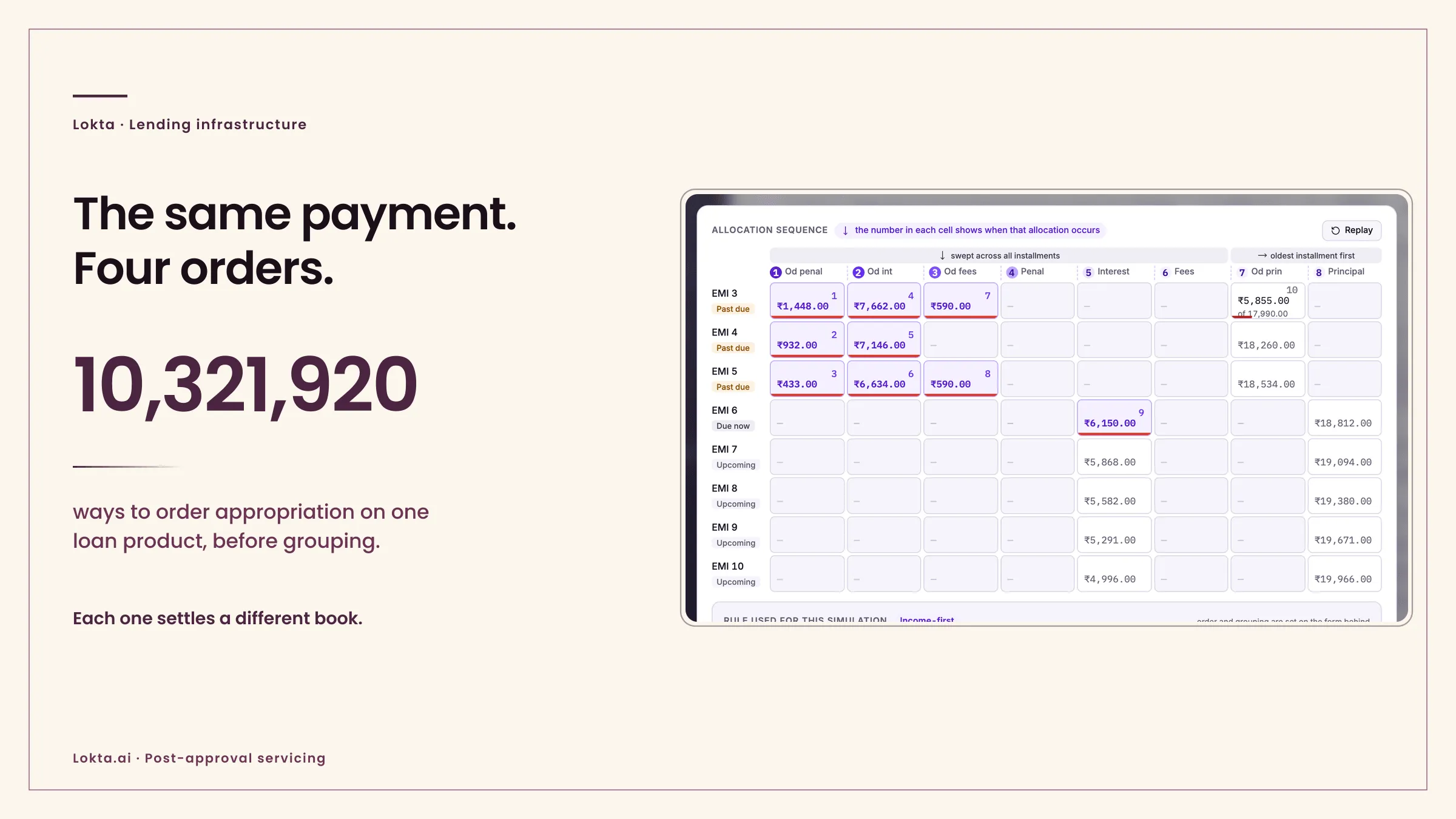
The payment appropriation guide explains how a receipt is allocated across dues. Changing that order and waiving a charge are separate decisions, even when both change what remains unpaid.
A valid waiver can be the right decision
A lender can have a sound reason to accept less than the full contractual amount. The RBI’s compromise-settlement provisions recognise the lender’s commercial judgement and the objective of maximising possible recovery at minimum expense (paragraphs 86-87 of the Resolution Directions). An unexplained waiver is a control gap. The existence of a waiver is not, by itself, evidence of poor collection work.
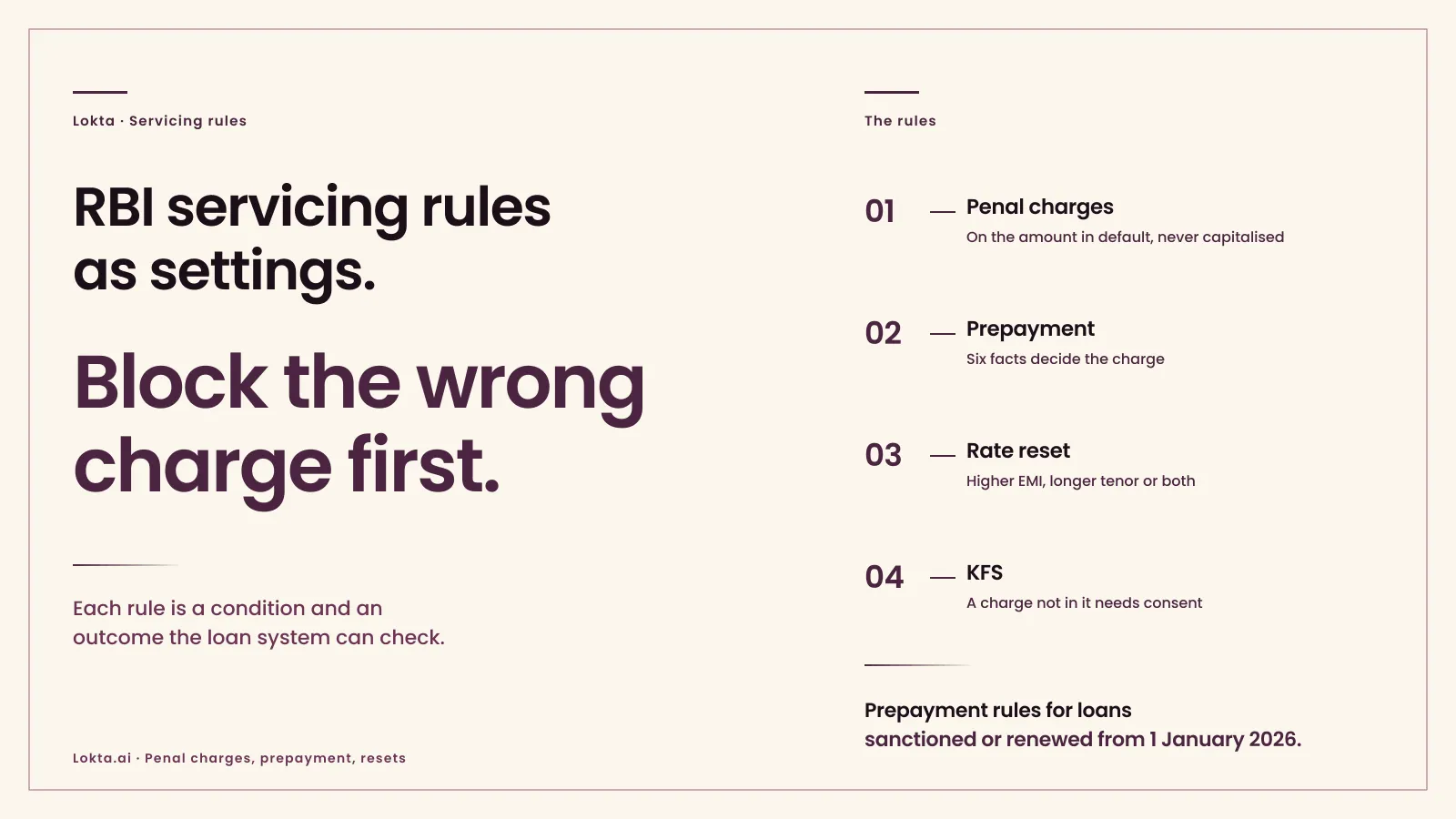
There is also a limit to the revenue framing. RBI’s 18 August 2023 penal-charges circular, paragraph 2, says the purpose is credit discipline rather than revenue enhancement. The current NBFC Responsible Business Conduct Directions, paragraph 30, retain the penal-charge controls, including reasonable amounts under a board-approved policy and no capitalisation.
A branch should not be rewarded for collecting a charge that should never have been levied. The charge configuration guide covers that upstream question. This article starts with what happens when a posted charge is paid, corrected, waived or left outstanding.
Keep the authority with the decision
The waiver record should connect the proposal to the authority that accepted it. An email attachment can support the record, but somebody must be able to establish that the approval covers this loan, this charge and this amount.
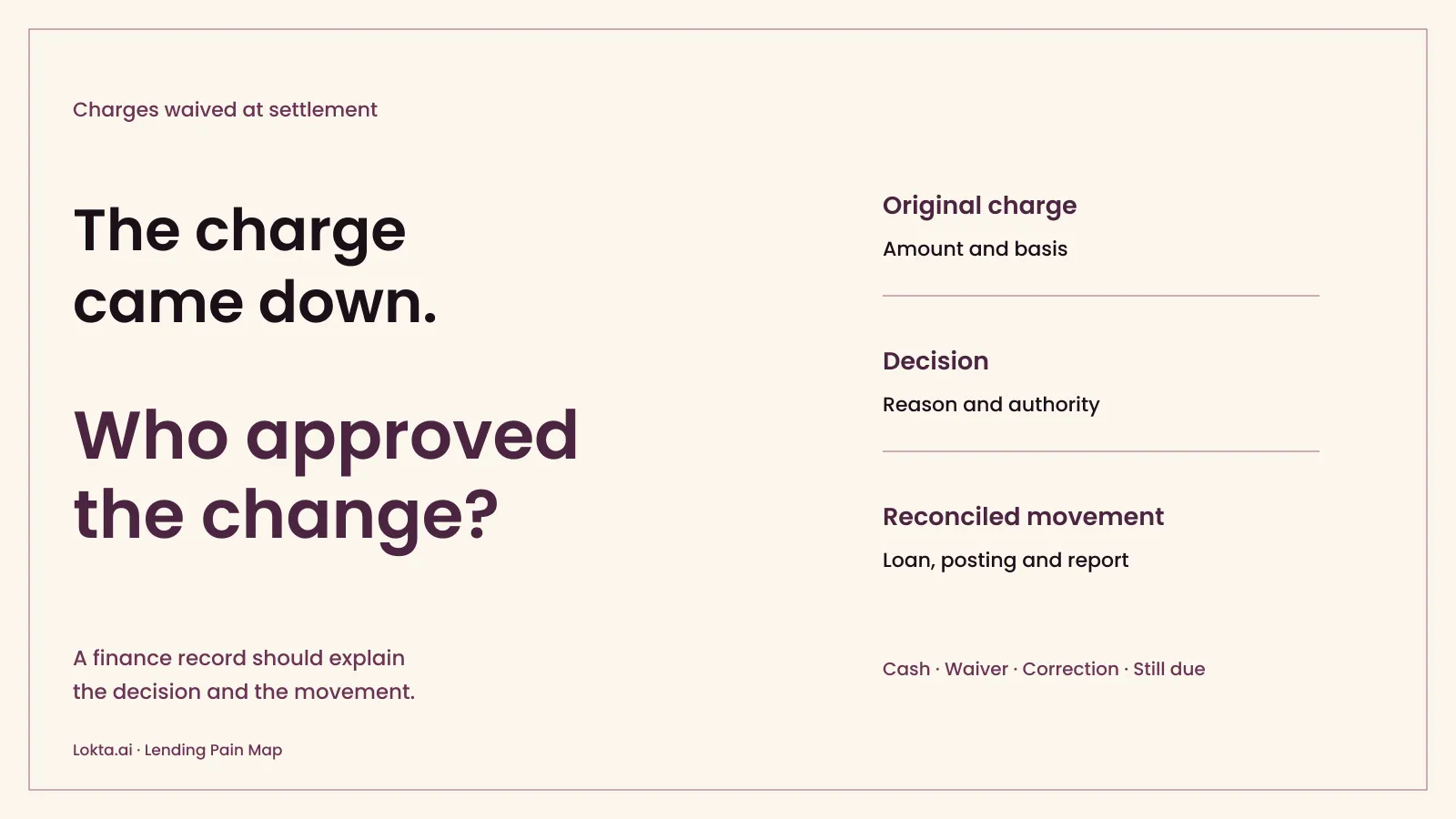
Record the amount before the decision, the proposed concession and the amount remaining. Add the reason, policy version, delegated limit, proposer, approver and effective date. Keep any conditions on the concession visible. If approval depends on the borrower paying an agreed sum by a specified date, the record needs to show whether that condition was fulfilled before the waiver was applied.
These are recommended operating controls. Formal compromise settlements have their own regulatory treatment: paragraph 93 of the Resolution Directions requires reporting to the next higher authority at least quarterly, with specified senior approvals reported to the board. Paragraph 94 sets minimum reporting coverage. Do not assume that calling every adjustment a “charge waiver” resolves which framework applies.
General maker-checker and audit features are useful only when they cover the action being tested. In a demonstration, ask to see the original charge, the proposed waiver, the authority check, the completed entry and the evidence retained. A screen with an approval button is only one part of that test.
Reconcile the waiver to the books
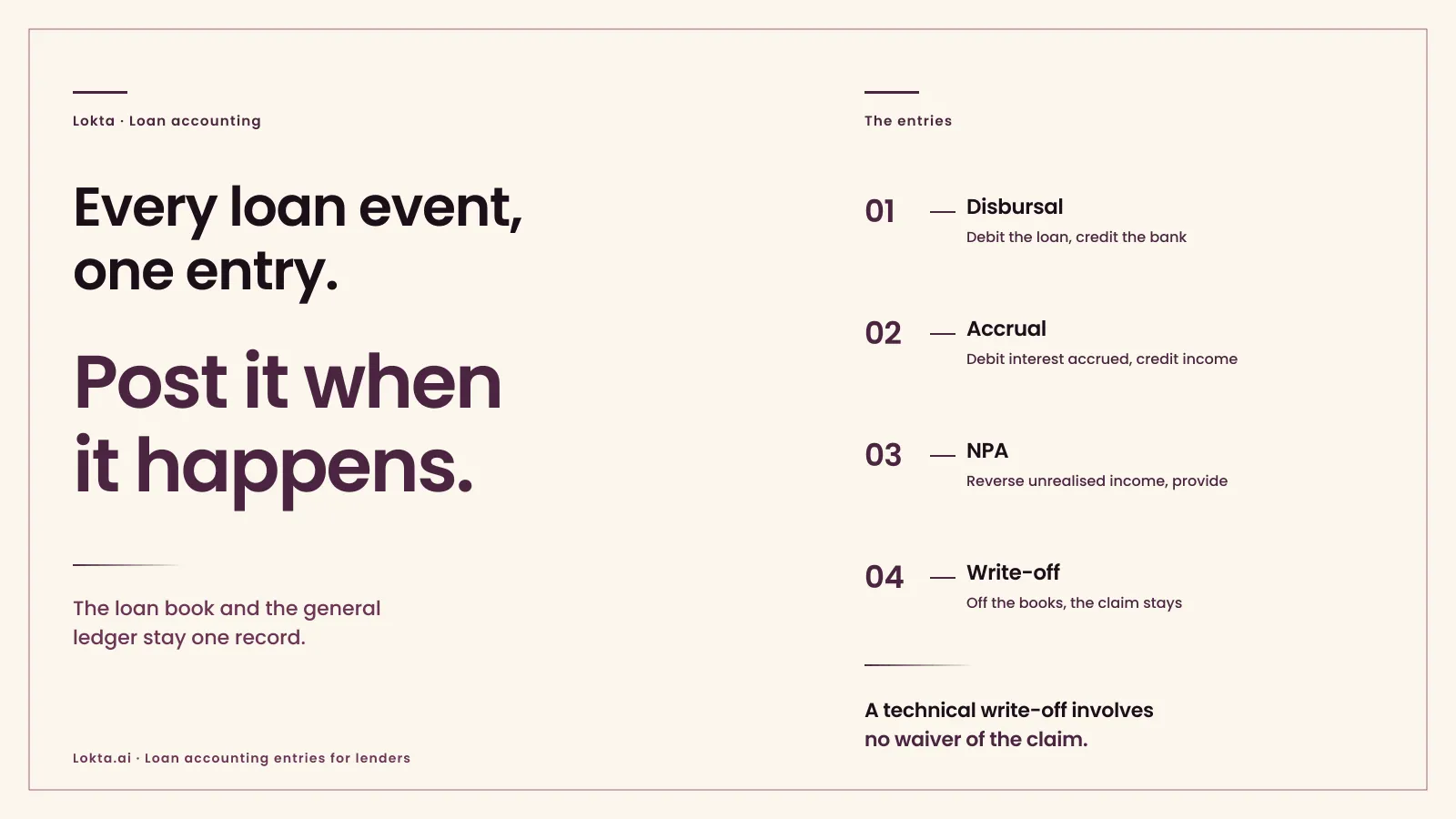
Finance should be able to move from the approval to the loan balance and the accounting entry. The loan accounting guide starts a recognised charge with a debit to charges receivable and a credit to charge income. That provides the starting point for checking what a later concession reverses.
Consider a simplified bookkeeping illustration: a valid ₹500 charge was already recognised as income and remains receivable. An approved ₹200 waiver reduces that receivable to ₹300. In this limited example, the reversing entry debits charge income by ₹200 and credits charges receivable by ₹200. No cash was collected by that entry.
The illustration excludes tax and assumes the charge remains recognised. Finance must choose the applicable accounts and treatment if income was previously reversed, the account is NPA, or the settlement has a different accounting effect. Reversing income twice would be another error. The approval and posting need to describe the same movement.
The lender can preserve this trail in a controlled register beside its current system, in a system that demonstrates the required workflow, or in a custom control with maintained interfaces. The choice should follow the evidence available for that exact operation.
Show branch movements before month-end
A branch review should explain the change in charge dues over a stated period. Use a reconciliation bridge: opening dues, valid new charges, cash allocated, approved waivers, corrections and closing dues. Give corrections their signed effect rather than hiding them inside a single “waived” amount.
The ₹500 illustration makes the distinction visible: ₹200 waived and ₹300 remaining are not ₹200 collected. Apply the same separation when interpreting collection efficiency. Preserve gross demand, show concessions and explain any adjusted denominator. Compare branches only after allowing for charge type and portfolio mix.
Review the bridge by branch, reason, approving authority and effective date, with loan-level drill-down evidence. Daily review and a specific view of the last days of the month are operating recommendations here. They do not replace any applicable settlement reporting obligation.
A report can reveal a concentration of concessions. Someone still has to read the decisions and judge whether policy was applied consistently. Talk to us about the evidence your finance team needs to explain a charge movement. Start with one settled account and its approval record.
Frequently asked questions
What should an NBFC record when a loan charge is waived?
Keep the original charge, the amount waived, the remaining amount, the reason, the applicable policy or delegated authority, the approving person and the posting evidence together. Include the effective date and borrower communication where relevant. This article recommends a decision record that finance can reconcile to the loan and accounting entries. A general audit log or a settlement total alone may not explain the authority for the concession. The lender must define the controls for its own policy and arrangement.
Is a charge waiver the same as correcting an incorrect charge?
No. A correction removes or adjusts a charge that should not have been posted in that form. A waiver is a decision to give up an otherwise valid claim, subject to the applicable policy and terms. Keep the reasons distinct so a branch is not penalised for correcting an error or credited with a collection it never received. A charge left unpaid is a further category: it remains unresolved unless an authorised action changes the claim.
How should waived charges appear in a collections review?
Show cash collected, approved waivers, corrections and remaining charge dues separately, using a consistent period and cut-off. Preserve the original demand and explain any change to a collection-efficiency denominator. Review the amounts with account counts, charge types, branch, reason and approving authority. A higher waiver total is a reason to inspect the decisions and portfolio mix, not proof of misconduct. The purpose of the review is to explain the movement and detect missing authority or inconsistent treatment.
Does this article describe a Lokta waiver workflow or waiver report?
No. The approval record and reporting views described here are operating requirements for a lender to evaluate. This article does not establish that Lokta offers a dedicated waiver approval workflow, waiver report or waiver-specific audit action. Ask any provider to demonstrate the exact charge, proposed concession, authority check, completed posting and report before treating that requirement as covered. General maker-checker and audit features should be assessed against the particular operation the lender needs.
Read next
- Penal charges and prepayment rules: establish whether the original charge was allowed
- Loan accounting entries: connect loan events to finance’s books
Sources
- RBI: Fair Lending Practice, Penal Charges in Loan Accounts, 18 August 2023, paragraph 2. Historical policy origin
- RBI: NBFC Responsible Business Conduct Directions, 2025, paragraph 30. Current penal-charge controls
- RBI: NBFC Resolution of Stressed Assets Directions, 2025, paragraphs 86-87 and 91-94. Compromise settlements, technical write-offs and reporting
Lokta editorial analysis by Chandramouli, co-founder and CEO.