Account Aggregator data in loan servicing: turn signals into reviewed action
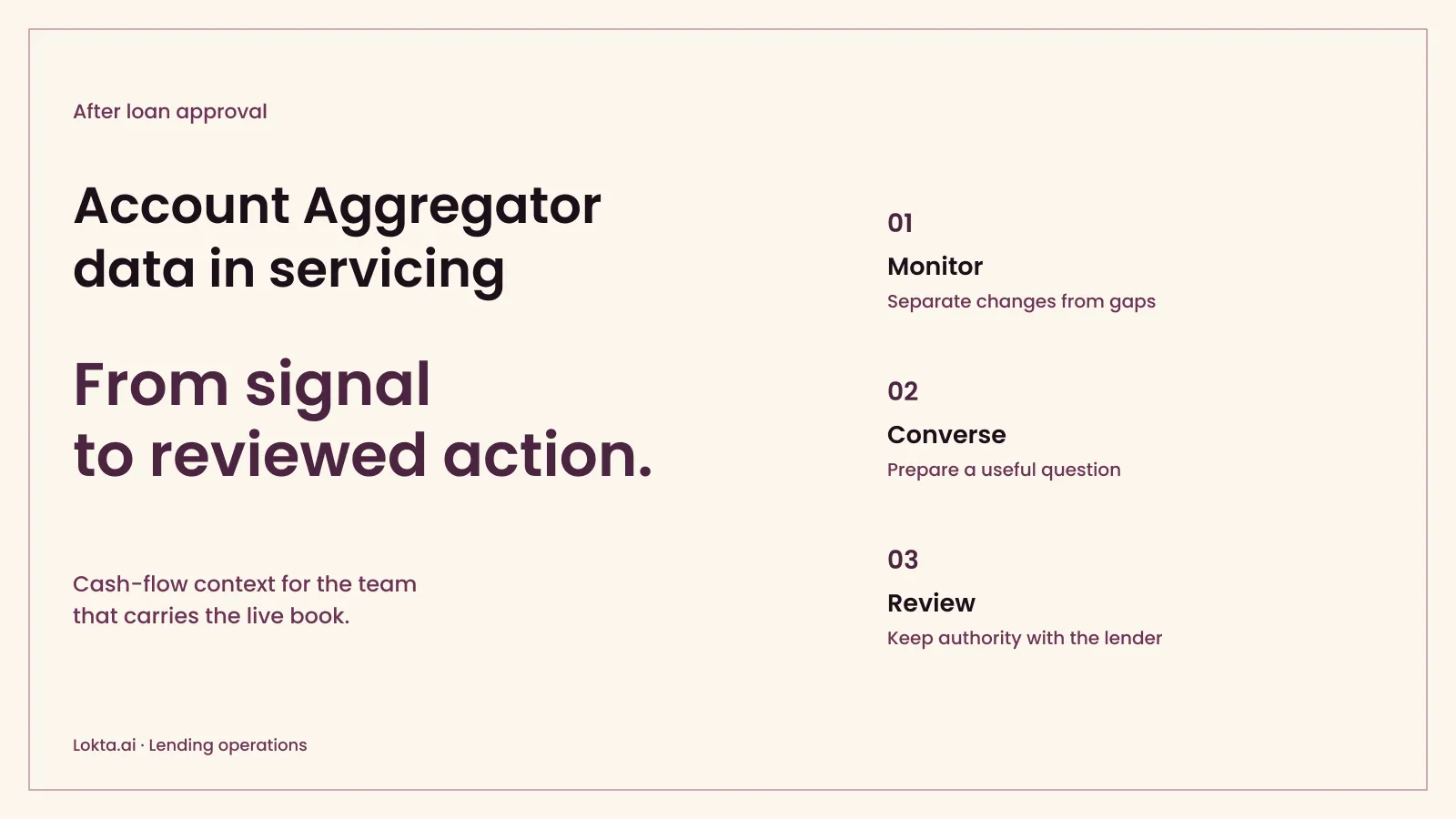
Use Account Aggregator data to inform loan servicing: cash-flow monitoring, borrower conversations and repayment-support reviews, with lender-owned controls.
Contents 10 sections
Account Aggregator data earns its place in an NBFC’s loan servicing stack when it changes a specific review or conversation. A missing salary credit can justify checking the evidence. It cannot, by itself, turn a current loan overdue.
The Loan Management System (LMS) records contractual dues, payments and account state. Servicing teams use that record to act across the loan’s life. AA adds permitted financial context to those actions. The integration needs to preserve that division of authority.
Match the consent to the job
Sahamati’s CT003 v1.1 template separates monitoring consent from underwriting. Its purpose code is 104. Periodic fetching is capped at five times monthly, with a six-month maximum data range, incremental subsequent pulls and one-month data life. Fetches require an active loan. General validity is the shorter of five years and loan tenure. For loans under one year, the published clarification permits validity extending up to three months beyond tenure. These are industry fair-use ceilings, not a requirement to fetch at the maximum or a substitute for applicable law.
CT035 separately addresses collections after an amount has remained overdue for more than a day. It permits deposit-account summary data with a maximum daily fetch. That eligibility condition is distinct from the lender’s SMA and NPA classification rules.
For implementation, keep consent eligibility and loan status in the same fetch decision. Test a current loan, an overdue loan, a repaid loan and revoked consent. The scheduler should be able to explain why each request ran or stopped.
1. Start with the servicing decision
Pick a task whose owner can explain how additional financial context would change their work. “Collect more data” is too broad. “Prepare a borrower-support review after a reported income disruption” gives the operations lead something to evaluate.
There are three useful starting points:
| Servicing task | Possible AA context | Action to evaluate |
|---|---|---|
| Cash-flow monitoring | A change in recurring credits or observed balances | Place a dated signal in a review queue |
| Borrower conversation | Timing of inflows alongside upcoming instalments | Prepare a relevant question or permitted reminder |
| Repayment-support review | Recent inflows and outflows within the permitted scope | Assemble evidence for the lender’s authorised reviewer |
Choose the smallest data scope that supports the task, then test the action against the lender’s conduct policy.
2. Read the signal alongside the loan account
Consider a fictional salaried borrower with an instalment approaching. The most recent permitted statement does not show the salary credit usually seen by that point in the month. The loan is still current.
The first task is to establish what the observation means. Perhaps payroll moved, the employer changed the payment account, or the fetched period ends before the relevant credit. The absence of a transaction in one data set is not proof of lost income.
Join the observation to the account using verified identifiers. Show the statement period, last successful fetch, covered accounts and the comparison period. Keep the signal’s date separate from the loan’s due date and days past due. Use the early-warning workflow to give that observation an owner, review window and recorded disposition.
The servicing screen should let a reviewer answer one plain question: what changed in the evidence, and what remains unknown?
3. Use the context to improve the conversation
In the example, a permitted service contact could confirm whether the expected repayment arrangement still suits the borrower. The operator needs the upcoming instalment, recent repayment history and the specific reason for review. They do not need to recite unrelated purchases or expose unnecessary transaction details.
Prepare a question rather than a conclusion. “Has the timing of your income changed?” is different from asserting that the borrower cannot pay. An agent could draft the case summary and suggest the next permitted step, with the underlying records available to the reviewer.
A low observed balance must not automatically trigger a debit, extra charge or an adverse account classification. Payment authority belongs to its own mandate and controls. Collection activity remains subject to the lender’s applicable policy and borrower-protection obligations.
Measure whether the added context made the contact more useful: fewer repeated information requests, fewer unsupported escalations and a clearer recorded outcome. Those are pilot measures to establish, not improvements to assume.
4. Support a repayment review without rewriting the contract
Suppose the borrower reports a temporary disruption and asks for help. Permitted AA information may help the reviewer understand recent cash flow. Combine it with the borrower’s explanation, existing obligations and the account record available under the lender’s procedures.
A cash-flow summary is evidence for a decision. It is not authority to change an EMI, offer a settlement or grant a moratorium. A contractual variation needs the lender’s eligibility rules, approval, documentation and financial-state controls. An AI-generated recommendation must stop at those boundaries.
Record the data used, its limitations, the proposal, the approving person and the resulting action. Preserve a rejected proposal too, with its reason. The aim is for the next operator to understand why the account took that path without interviewing everyone who handled it.
5. Keep consent and data quality inside the workflow
RBI’s NBFC-AA Directions assign consent-handling duties to the aggregator in paragraphs 14, 17, 20 and 21. Paragraph 28 also binds the financial information user, including a participating lender: use and disclosure must stay within the consent artefact. The lender cannot treat the aggregator’s consent screen as a substitute for its own controls.
Plan for the phased DPDP Rules, 2025: Rule 4 on consent managers starts one year after Gazette publication, while Rules 3, 5-16, 22 and 23 start after eighteen months. As of 2 October 2026, those phases are still ahead. An AA consent flow should not be described as automatically satisfying every DPDP requirement.
Keep consent state connected to scheduled work. ReBIT’s guidance describes notifications for consent-status changes. A queued fetch should not proceed solely because yesterday’s local flag said access was active. Information already held needs a separately governed retention and use policy.
Treat stale, incomplete and unavailable data as distinct states. A provider outage should create a data exception, not a deterioration alert against the borrower. When visibility stops, the team should continue the permitted servicing process using the evidence it actually has.
6. Prove one use case before widening access
Choose a defined cohort and one servicing task. Establish a baseline for handling effort, contact quality, unsupported alerts and complaints. Then test whether the AA-informed workflow changes those measures without weakening the controls. Document the observation window and what would cause the pilot to stop.
- A signal tied to a source period, consent reference and loan account.
- A reviewer who can distinguish a borrower change from missing data.
- A servicing action with its policy check and approval recorded.
- A revoked-access test that stops the next unauthorised fetch.
- An outcome comparison that includes borrower complaints and rework.
For an occasional review, a controlled manual process may be enough. For recurring servicing work, evaluate an operating layer such as Lokta’s AI Loan Servicing against the complete signal-to-action record. An internal build is another path when your team can own the data access, monitoring and ongoing control maintenance.
Confirm the proposed AA provider connection and production permissions separately. Lokta’s available Loan Management and AI Loan Servicing capabilities do not establish a particular AA integration.
The useful pilot output is one completed borrower review, including the source period, consent decision, reviewer’s conclusion and resulting action. Talk to us about how that review should connect to the live account.
Frequently asked questions
How can Account Aggregator data help with loan servicing?
With appropriate authority and usable data, a lender can compare cash-flow patterns with the loan schedule, prepare a more informed borrower conversation, and assemble evidence for a repayment-support review. The information adds context to the servicing record. It does not establish that a payment will fail or that a borrower is unwilling to pay. Every signal still needs coverage checks, interpretation and a lender-owned action policy.
Can origination consent be reused for ongoing loan monitoring?
Sahamati treats underwriting and monitoring as separate purposes requiring distinct consents. For ongoing servicing, check monitoring eligibility, permitted information and validity before each fetch. An active loan does not override a revoked or expired consent.
Should a low balance automatically trigger collections?
A balance observation is a limited piece of evidence. Its timestamp, account coverage, expected inflows and the repayment due date affect its meaning. Use it to support a review or a permitted service reminder when the lender’s policy allows. Do not label the borrower delinquent before an amount is actually overdue, and do not let an external signal independently change contractual terms, charges, payment instructions or the loan ledger.
What should happen when AA data is unavailable?
Mark the observation as unavailable, with its last successful coverage period. Do not turn a missing feed into a borrower-risk event. Route the data problem to its owner and continue permitted servicing using the loan record and other verified evidence.
Read next
- Loan portfolio analysis: connect borrower signals to the account and cohort record
- LMS integration planning: plan the access and implementation dependencies
Sources
- Sahamati CT003 and CT035: published v1.1 parameters and short-term-loan clarification, checked 2 October 2026
- RBI: NBFC Account Aggregator Directions, 2025: Chapter III: aggregator consent duties in paragraphs 14, 17, 20-21; purpose-limited use by the aggregator and FIU in paragraph 28, checked 2 October 2026
- ReBIT: consent-notification guidance: technical handling of consent-status changes
Lokta editorial analysis by Chandramouli, co-founder and CEO.